
Key Takeaways
- The world splits into nine zones. Every country's dialing prefix starts with one of nine digits, +1 to +9. The ITU assigned each digit to a broad world region, so a code's first number tells you roughly where on the planet you are calling.
- Only two codes are a single digit. +1 (North America) and +7 (Russia and Kazakhstan) are the only one-digit codes. Everyone else uses two or three digits, and no code is the start of another, which is why they vary in length.
- +1 is shared by about 25 countries. The North American Numbering Plan puts the US, Canada and around 23 Caribbean nations under one +1, each split only by its own three-digit area code.
- Big economies got the short codes. The two-digit codes went to the countries with the earliest, busiest networks, from +44 Britain to +81 Japan. Smaller and newer states were left the three-digit prefixes.
- The newest codes are barely a decade old. South Sudan received +211 in 2011, and Kosovo was assigned +383 in 2016, the most recent country code the ITU has issued.
Dial any international number and the first thing you enter is a country code: +1 for the United States, +44 for the United Kingdom, +81 for Japan. There are about 240 of them, and they are not random. They follow a system the world agreed on more than half a century ago, and it is written into the map below.
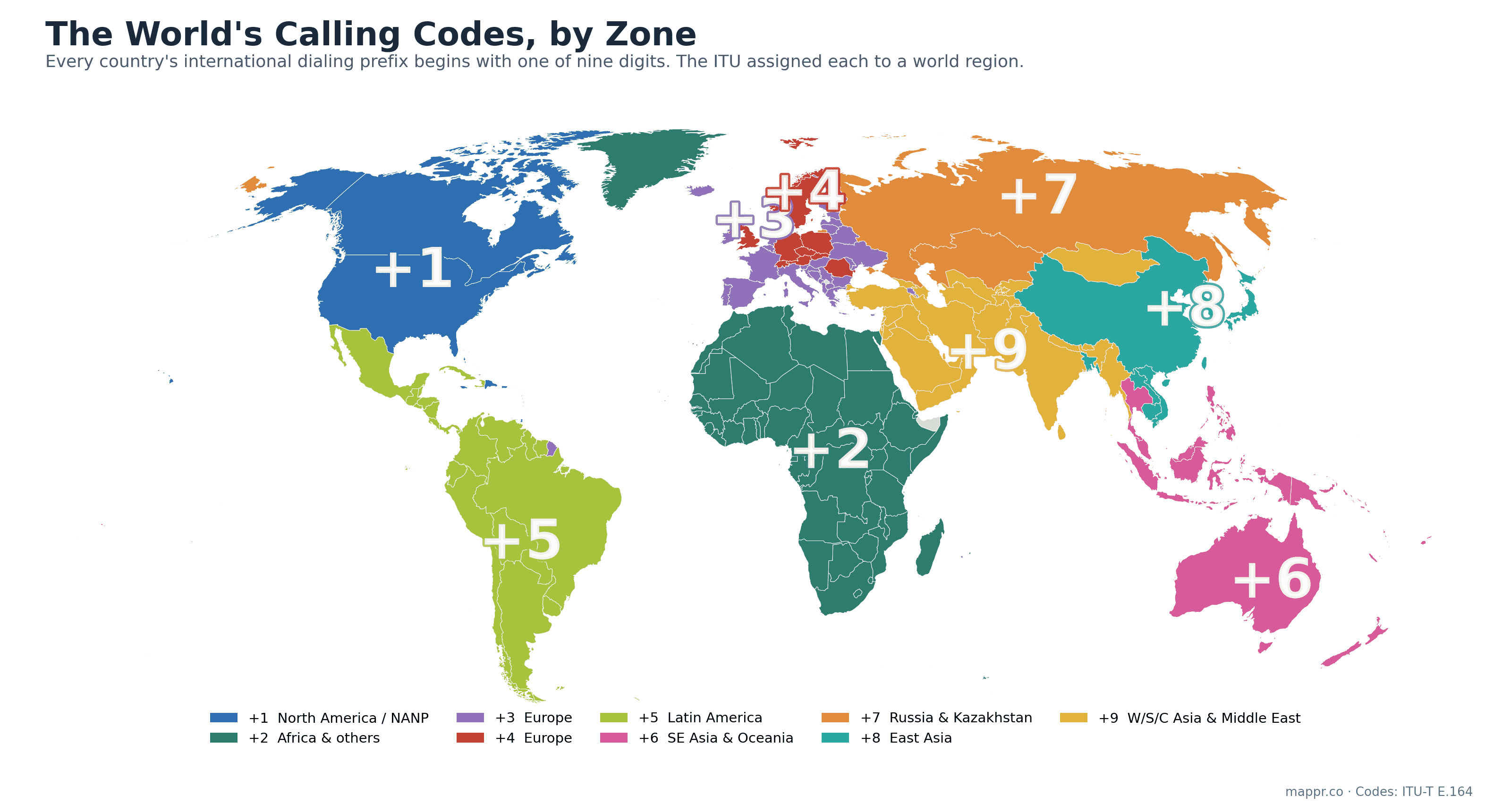
The colors show the nine world zones. The number you dial first, +1 to +9, tells you which region you are reaching. Below, we break down how the system works and then map every continent up close so you can read each country’s code.
How the +1 to +9 system works
The framework comes from the International Telecommunication Union, the UN agency that coordinates global telecoms. Its E.164 numbering plan carves the planet into nine zones, one for each leading digit, and every country code begins with its zone’s number.
So a code that starts with a 2 is almost always in Africa. A 5 points to Latin America. A 9 covers the Middle East and southern Asia. The first digit is a rough postal district for the phone network.
Zones 3 and 4 both cover Europe, which ran out of two-digit space first. Source: ITU-T Recommendation E.164.
Look closely and the codes come in three lengths: one digit, two digits or three. That is deliberate. The codes are prefix-free, meaning no country code is the start of another. Because nothing else begins with 1 or 7, those two can stand alone. The shortest codes went to the regions that joined earliest and carried the most traffic; smaller and later nations got the three-digit codes.
The calling codes of each continent
The world map is colored by zone, but at that scale the individual codes get crowded. Here is every region up close, each country labeled with its own dialing code.
Europe
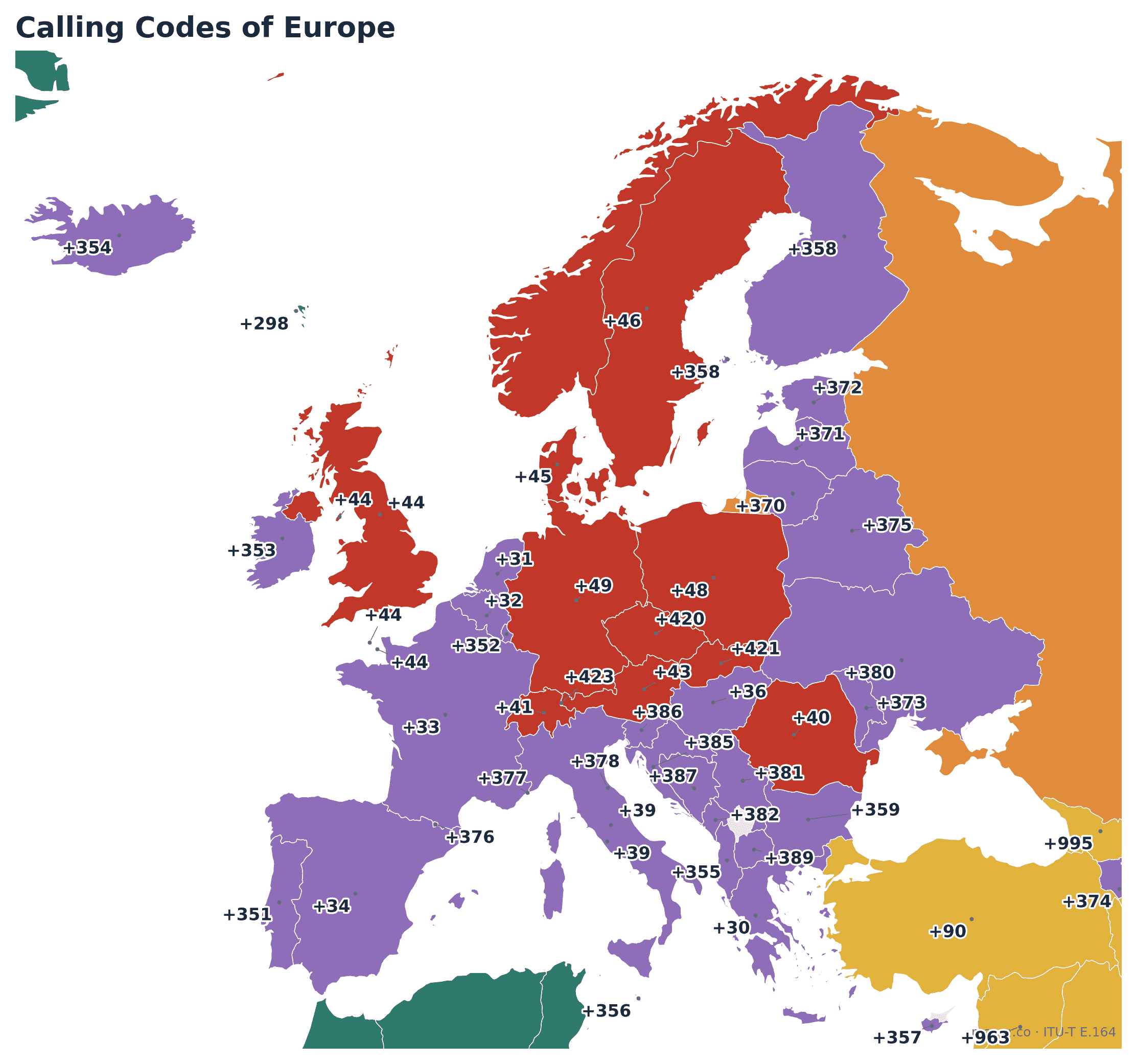
Europe is the only region to fill two whole zones, +3 and +4. The early, high-traffic networks took the two-digit codes, +33 France, +44 the UK, +39 Italy, +49 Germany. Smaller and later states got three digits, from +353 Ireland and +351 Portugal to +383 Kosovo, the newest country code in the world.
Africa
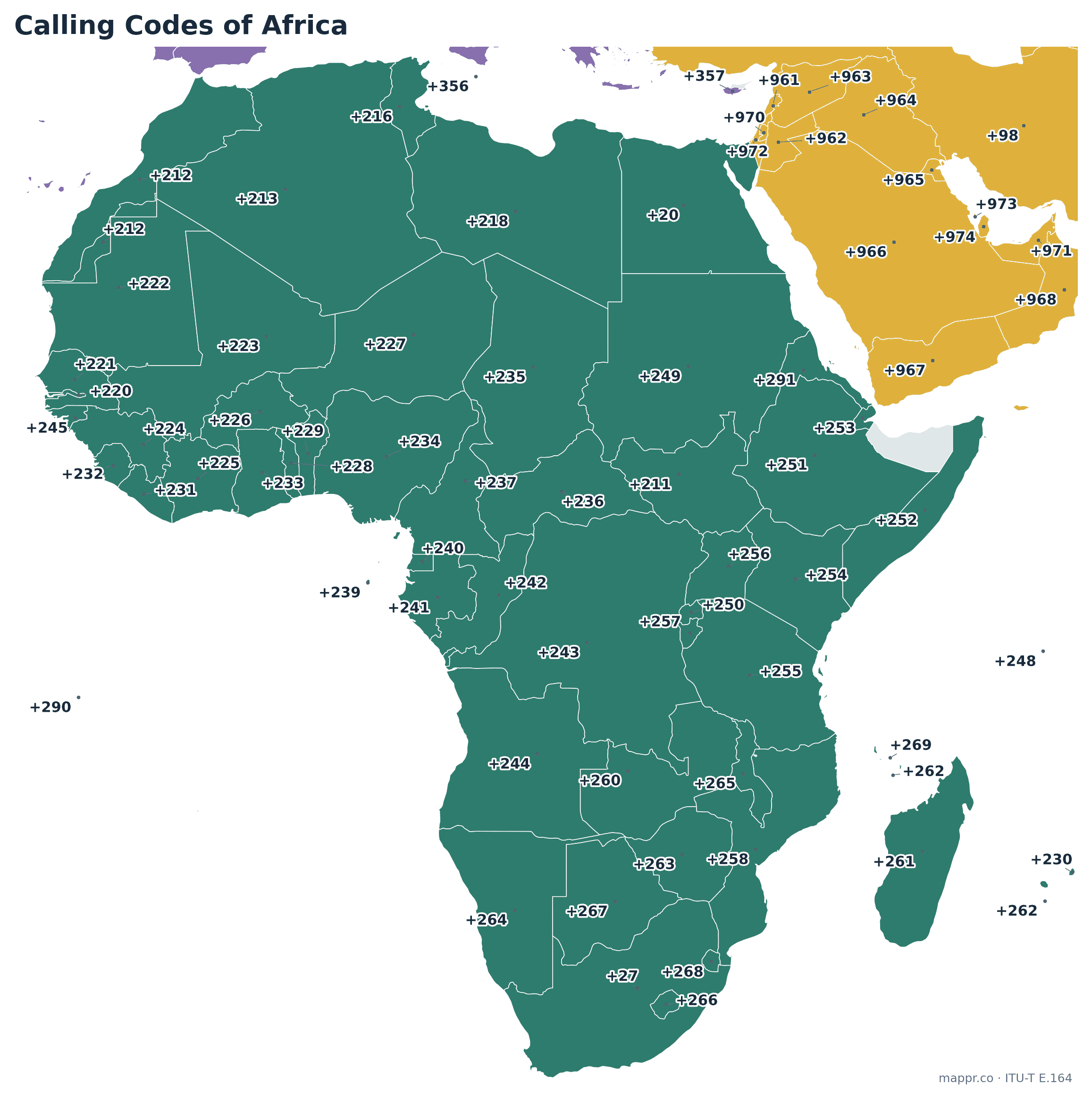
Almost all of Africa sits in zone 2. Only two countries kept a two-digit code: +20 Egypt and +27 South Africa. Everywhere else dials +2xx, a near-complete sweep of the range from +211 South Sudan to +291 Eritrea.
Asia & the Middle East
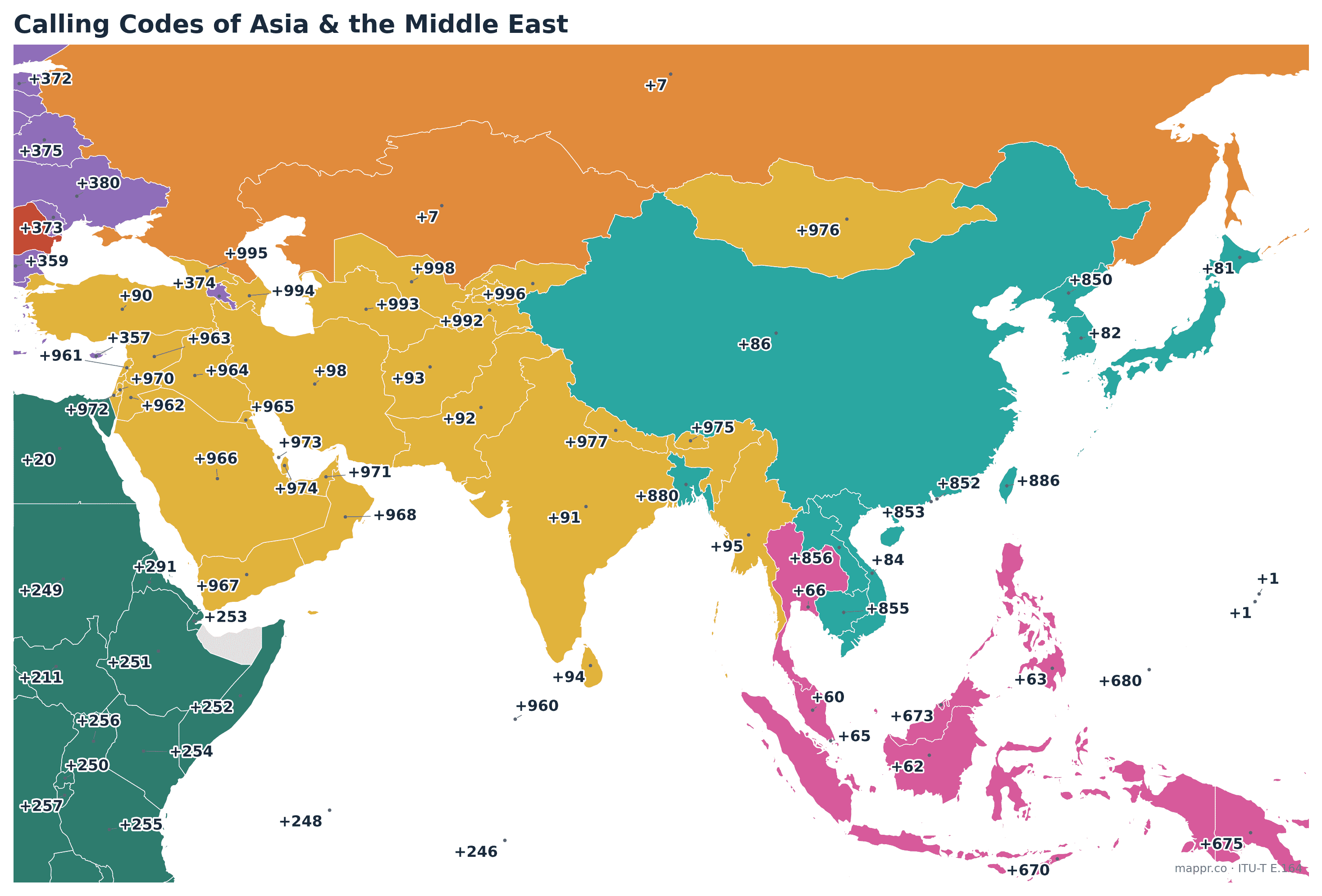
Asia is split across four zones. +7 covers Russia and Kazakhstan; +8x is East Asia (+81 Japan, +82 South Korea, +86 China); +9x runs through the Middle East and South Asia (+90 Turkey, +91 India, +98 Iran); and +6x picks up mainland Southeast Asia (+66 Thailand, +84 Vietnam). Again, the biggest economies hold the shortest codes.
North America
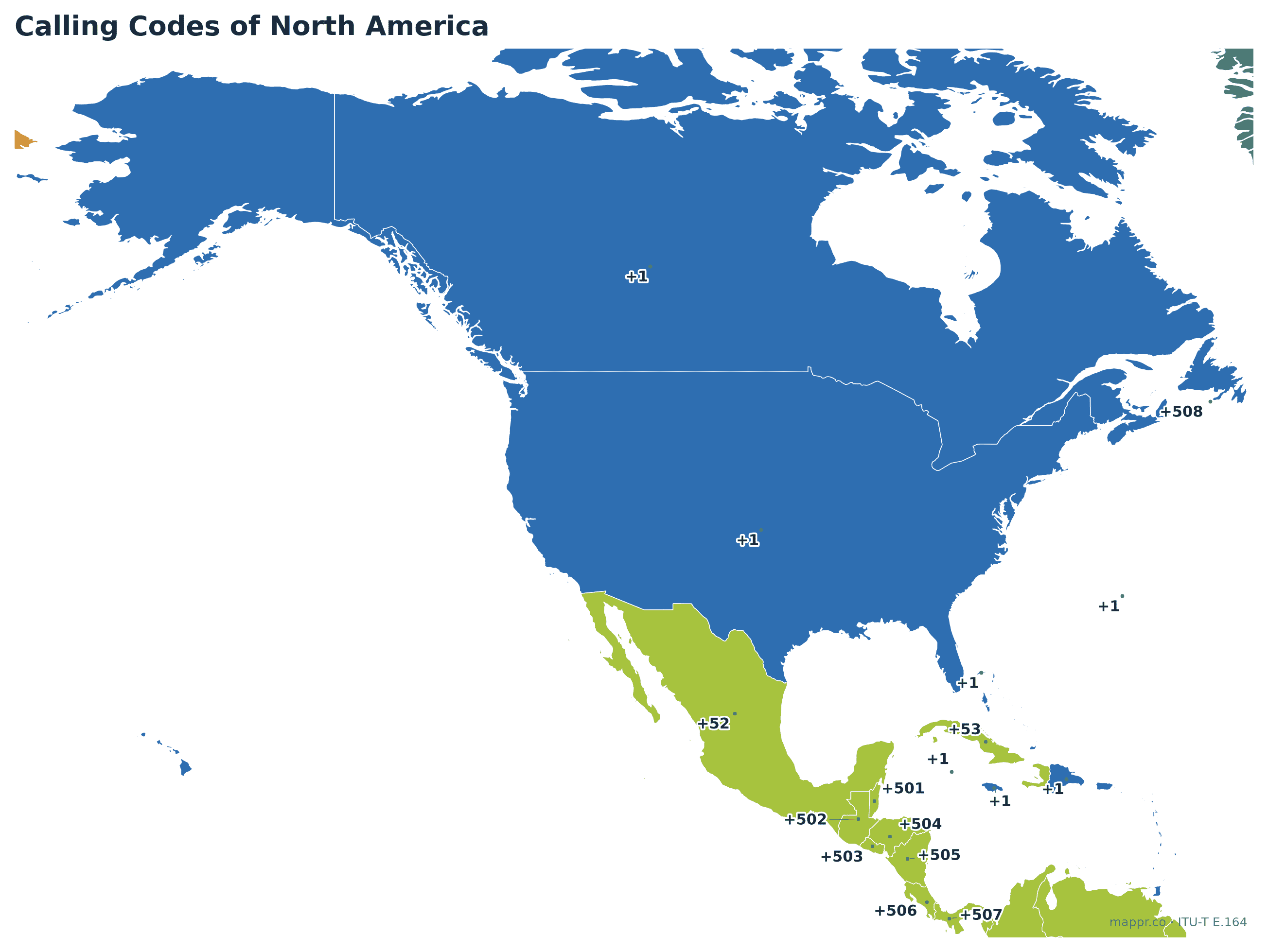
The United States and Canada share +1. Cross into Mexico and the code jumps to zone 5 (+52), and the Central American isthmus runs through +501 Belize down to +507 Panama. The Caribbean is a story of its own, below.
The Caribbean
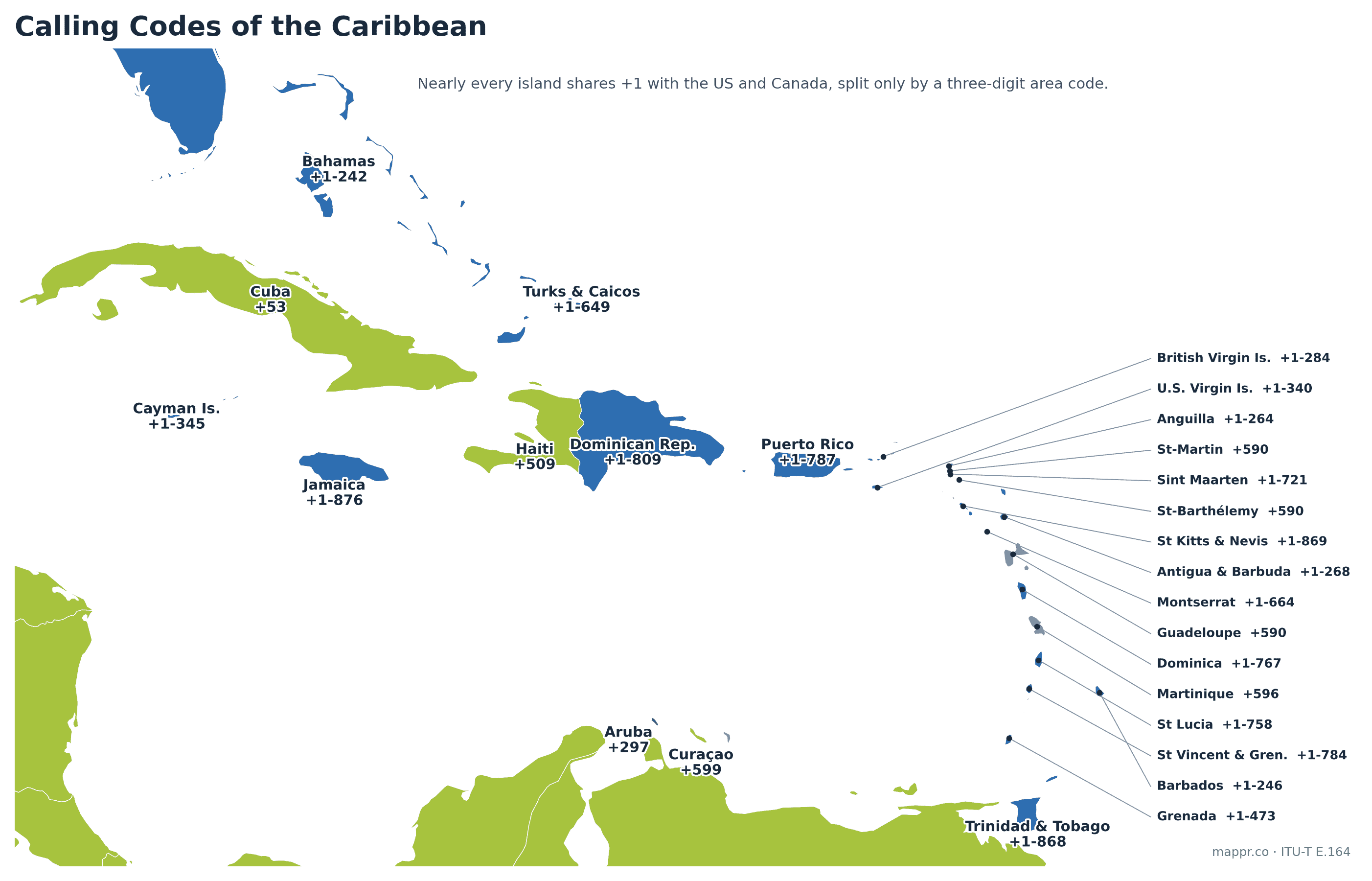
This is where +1 gets crowded. Nearly every Caribbean island belongs to the North American Numbering Plan and shares +1 with the US and Canada, separated only by a three-digit area code: +1-876 Jamaica, +1-246 Barbados, +1-868 Trinidad. The exceptions are the ones that never joined: +53 Cuba, +509 Haiti and the Dutch and French islands (+599, +590).
South America
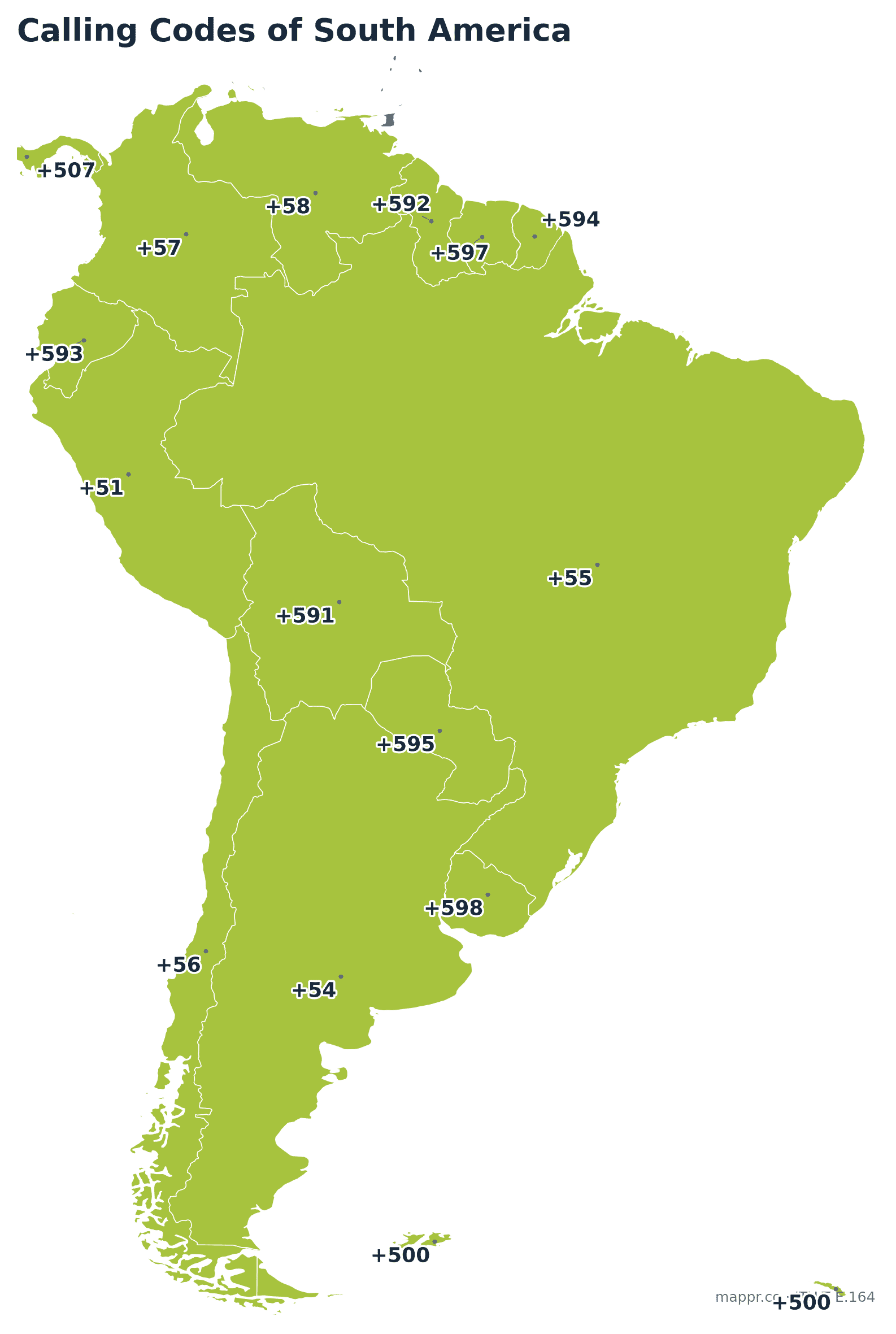
The whole continent sits in zone 5. The larger nations took the two-digit codes, +54 Argentina, +55 Brazil, +56 Chile, +57 Colombia, +58 Venezuela, while the rest run through +59x, from +591 Bolivia to +598 Uruguay.
Oceania & the Pacific
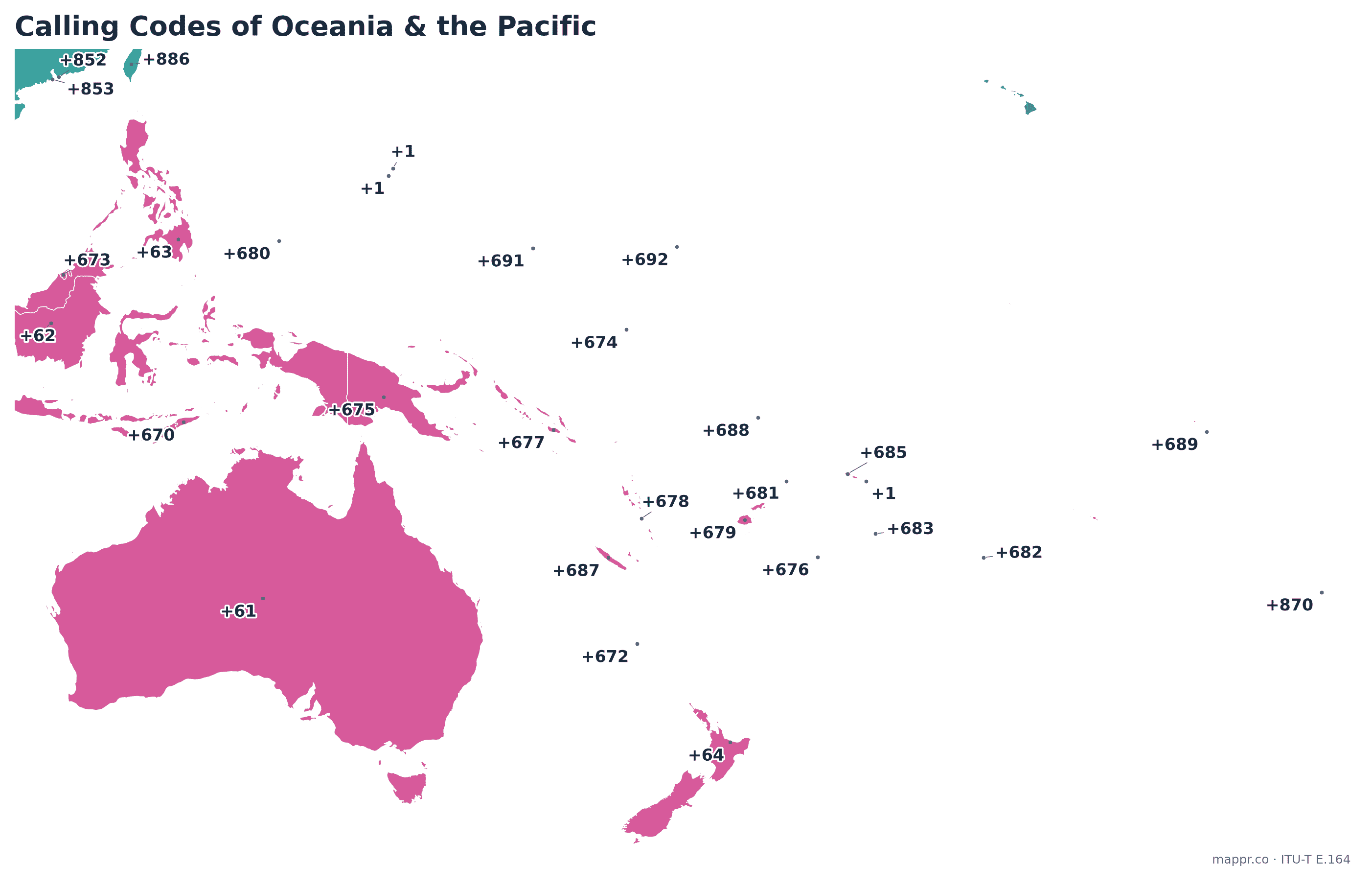
Australia (+61) and New Zealand (+64) anchor the region with two-digit codes. The scattered island nations of the Pacific fill out the +6xx range, from +675 Papua New Guinea and +679 Fiji to +685 Samoa and +688 Tuvalu.
The codes that break the pattern
A few codes tell a story the zones alone cannot.
+7: a Soviet leftover
Russia and Kazakhstan are the only two sovereign states to share a single-digit code. Kazakhstan kept +7 after the Soviet Union dissolved and never moved to its own number, so the two countries still split the zone by area code today.
The codes with no country
Not every code belongs to a place. A cluster of them are non-geographic: +800 is the Universal International Freephone Number, +888 is reserved for disaster-relief operations, and +870 reaches satellite phones on the high seas through Inmarsat. Dial those and you are not calling a country at all.
Every country’s calling code
Here is the full list, searchable and sortable. Start typing a country or a code to filter the table, and click any country to open its Mappr profile.
Test yourself
Think you can match the country to its code? We built a quiz for exactly that. Try the Country Calling Codes Quiz and see how many of the world’s dialing prefixes you actually know.


