
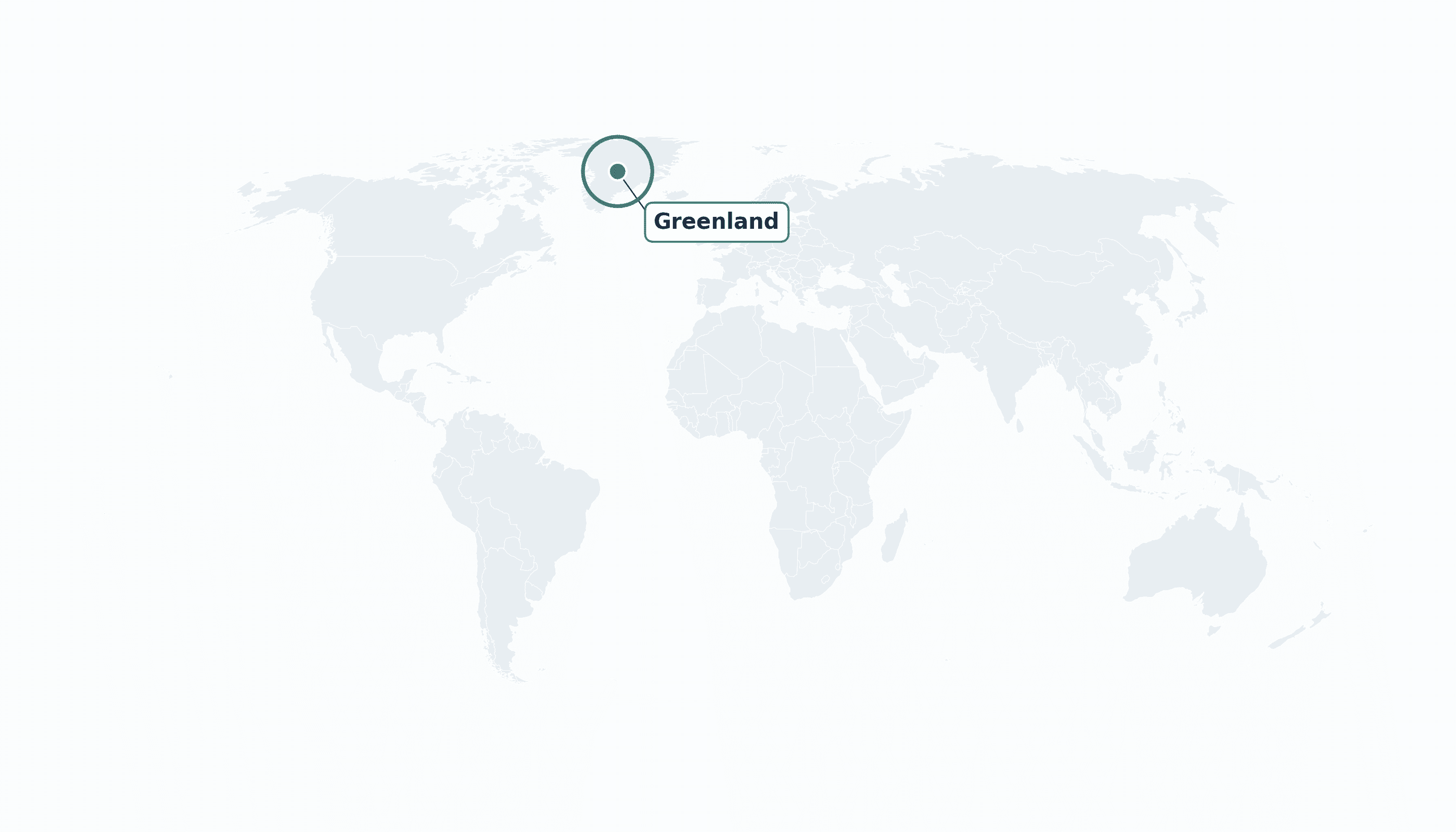
Greenland is located in the North America region at latitude 71.7069 and longitude -42.6043 and is part of the North American continent.
The DMS coordinates for the center of the country are:
- 71° 42' 25'' N
- 42° 36' 15'' W
You can see the location of Greenland on the world map below:
Maritime Borders
Greenland has no land borders; it is surrounded by the Arctic and Atlantic Oceans, with Baffin Bay separating it from Canada.
Greenland Key Facts
| Country | Greenland |
| Coordinates | Latitude: 71.7069 Longitude: -42.6043 |
| Country Codes | Alpha 2: GL Alpha 3: GRL |
| Country Flag Emoji | 🇬🇱 |
| Int. Phone Prefix | +299 |
| Capital city | Nuuk |
| Continent Subcontinent | North America North America |
| Country Area | 2166086 sq km |
| Population 2025 | 56,831 World Rank: 201 |
| Median Age | 34 |
| Life expectancy | 70.3 |
| Major languages | Greenlandic (Kalaallisut, official), Danish |
| UTC/GMT Time | Number of time zones: 4
|
| Internet TLD | .gl |
| Biggest Airport | Nuuk International Airport (GOH) |
| Average temperature | -7 °C 19 °F |
| Administrative Divisions | 5 municipalities |
| Political system | Self-governing autonomous territory within the Kingdom of Denmark |
Greenland Economy Facts
| World Bank Income Group | High income |
| World Bank Region | Europe & Central Asia |
| Currency | Danish krone (DKK) |
| GDP in 2023 | $3.33 (billions of USD) World Rank: 179 |
| GDP per capita in 2023 | $58,499 World Rank: 26 |
| Major Industries / Economic Sectors | Fishing and seafood processing, public administration, tourism, hunting, mining (emerging), hydropower |
| Top 5 Import Countries | Denmark, Sweden, Netherlands, Germany, Norway |
| Top 5 Export Countries | Denmark, China, Japan, Latvia, Germany |
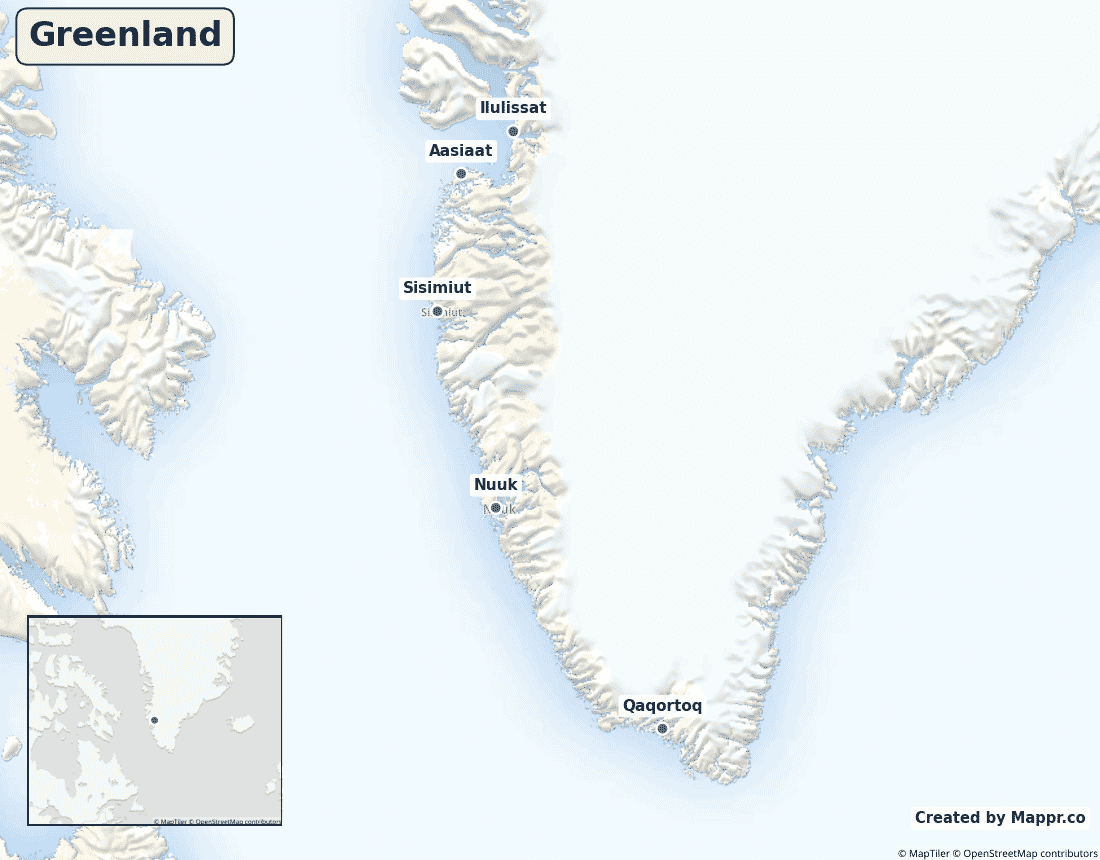
Biggest Cities in Greenland
Here are the largest cities in Greenland based on 2024 data:
| City | Population |
|---|
| Nuuk | 14,798 |
Map of Greenland with the Largest Cities
Other Countries in the North America Region
Geography
Greenland is the world’s largest island, lying between the Arctic and Atlantic Oceans, northeast of mainland Canada and northwest of Iceland. Although it is geographically part of the North American continent, it has been politically tied to Europe for centuries through the Kingdom of Denmark.
Roughly 80% of Greenland is covered by a permanent ice sheet — the second largest body of ice on Earth after Antarctica — which confines almost all of its small population to ice-free pockets along the coast. The capital, Nuuk, sits on the milder southwestern shore.
Spanning more than 2.1 million square kilometres but home to only around 56,000 people, Greenland is the least densely populated territory in the world.
Is Greenland a country?
Greenland is an autonomous territory within the Kingdom of Denmark. Since adopting self-government in 2009, it has controlled most of its own domestic affairs — including natural resources, justice and policing — while Denmark handles defence and foreign policy and provides an annual block grant. Greenlanders are Danish (and EU-area) citizens, though Greenland itself left the European Communities in 1985 and is not part of the EU. The territory has a clear constitutional path to full independence should its people vote for it.
| Status | Autonomous territory within the Kingdom of Denmark |
| Sovereign state | Denmark 🇩🇰 |
| Capital | Nuuk |
| Population | ≈ 56,000 (2023) |
| Area | 2,166,086 km² (836,330 sq mi) — world’s largest island |
| Currency | Danish krone (DKK) |
| Official language | Greenlandic (Kalaallisut); Danish widely used |
| ISO 3166 code | GL / GRL |
| Calling code | +299 |
| Internet TLD | .gl |
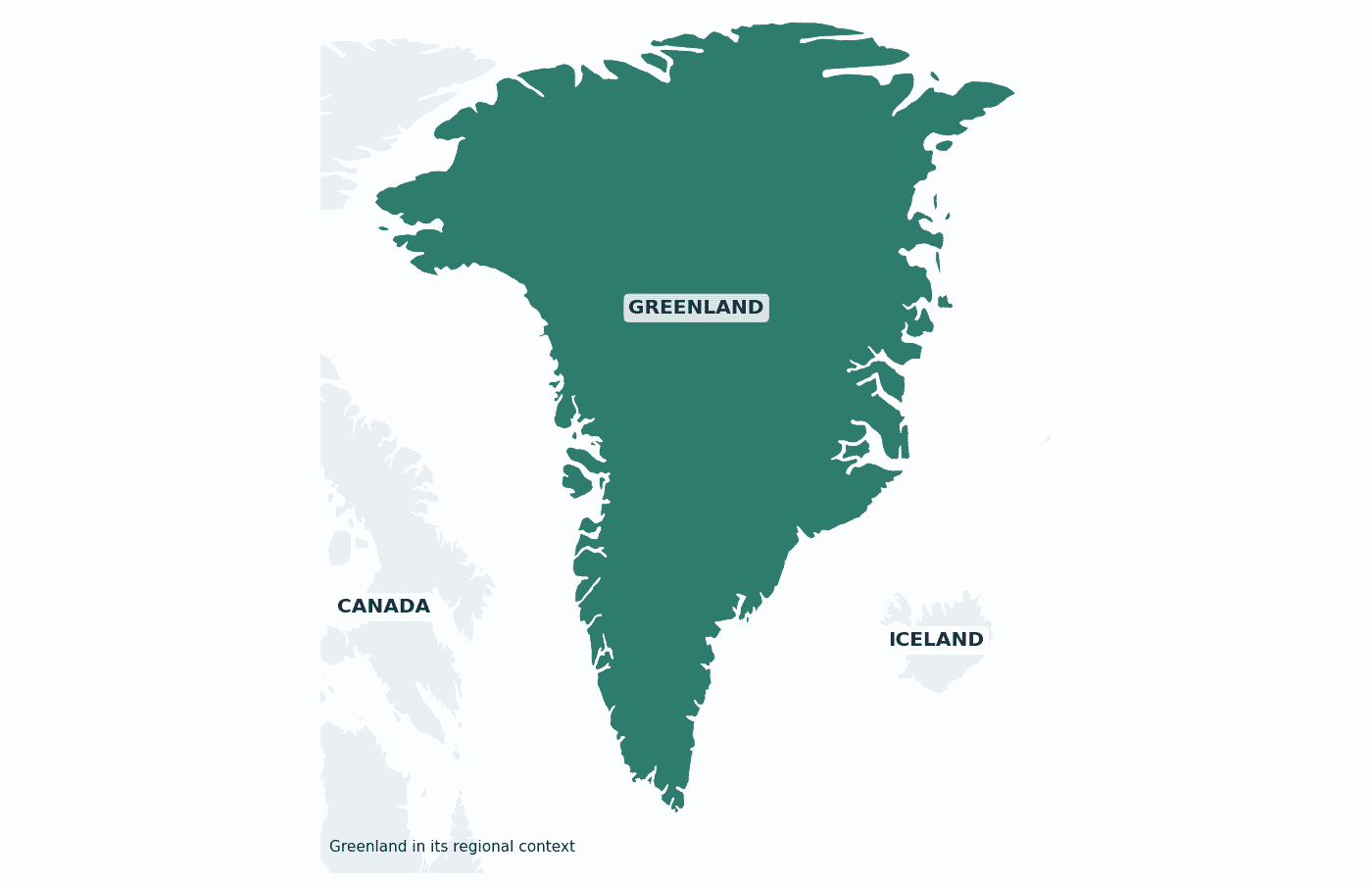
Greenland in the North Atlantic and Arctic
Greenland’s nearest neighbours are Canada to the west, across the narrow Nares Strait and Baffin Bay, and Iceland to the southeast across the Denmark Strait. Its northern tip is among the closest land masses to the North Pole.
Climate
Greenland has an Arctic to subarctic climate. Coastal towns like Nuuk average a few degrees below freezing over the year, while the interior ice cap is among the coldest places on Earth. Summers are short and cool along the southwest coast.
Economy
Greenland’s high-income economy is overwhelmingly dependent on fishing and seafood, which dominate its exports, supplemented by public spending and a large annual block grant from Denmark. Tourism and mining are seen as future growth areas.
Administrative divisions
Greenland is divided into five municipalities — Sermersooq (which contains Nuuk), Kujalleq, Qeqqata, Avannaata and Qeqertalik — plus the vast, largely uninhabited Northeast Greenland National Park. Most towns are coastal and connected by sea and air rather than roads.


