Key Takeaways
- Two high-speed trains collided in central Spain on Wednesday morning. At 08:54 local time, a Renfe AVE running Madrid–Seville rear-ended a stopped Iryo train on the Madrid–Andalusia high-speed line between Los Yébenes and Urda, in Toledo province.
- The toll has climbed all morning. Early reports said 10 dead; by midday Spanish media reported at least 46 killed and more than 170 injured. Figures are still provisional.
- The crash hit Spain's original high-speed line. The Madrid–Seville LAV, opened in 1992, was Spain's first high-speed railway. Adif suspended all Madrid–Ciudad Real–Andalusia high-speed traffic.
- It is Spain's second mass-casualty rail disaster this year. A January 2026 derailment in southern Spain killed 45. If current figures hold, Urda becomes Spain's deadliest rail crash since Santiago de Compostela in 2013 (80 dead).
Developing story. Casualty figures and official findings are provisional and may change; this post reflects reporting as of Wednesday afternoon (CET), 28 October 2026.
Spain woke up on Wednesday to its second mass-casualty rail disaster of 2026. At 08:54 local time, a Renfe AVE high-speed train slammed into the back of an Iryo train that was stopped on the track of the Madrid–Andalusia high-speed line, between the towns of Los Yébenes and Urda in Toledo province.
Both trains were running the same route, Madrid to Seville. The AVE, train 2080, had left Madrid at 07:54. An hour later it struck the stationary Iryo 6076 near Urda’s high-speed station, knocking carriages off the track.
By midday, Spanish media citing emergency services put the toll at at least 46 dead and more than 170 injured, up from 10 confirmed at mid-morning. Officials have warned the figures may still rise.
Where It Happened
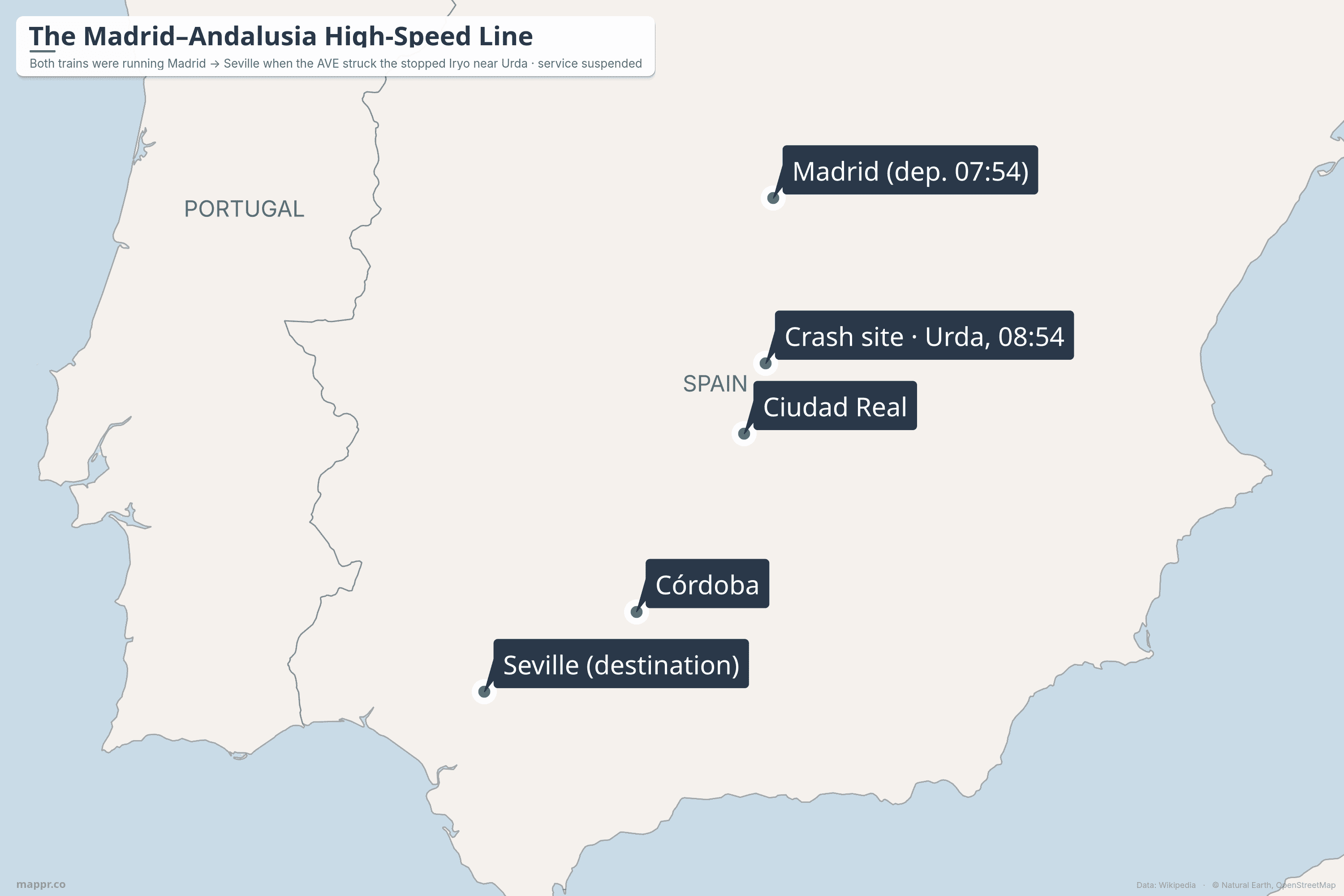
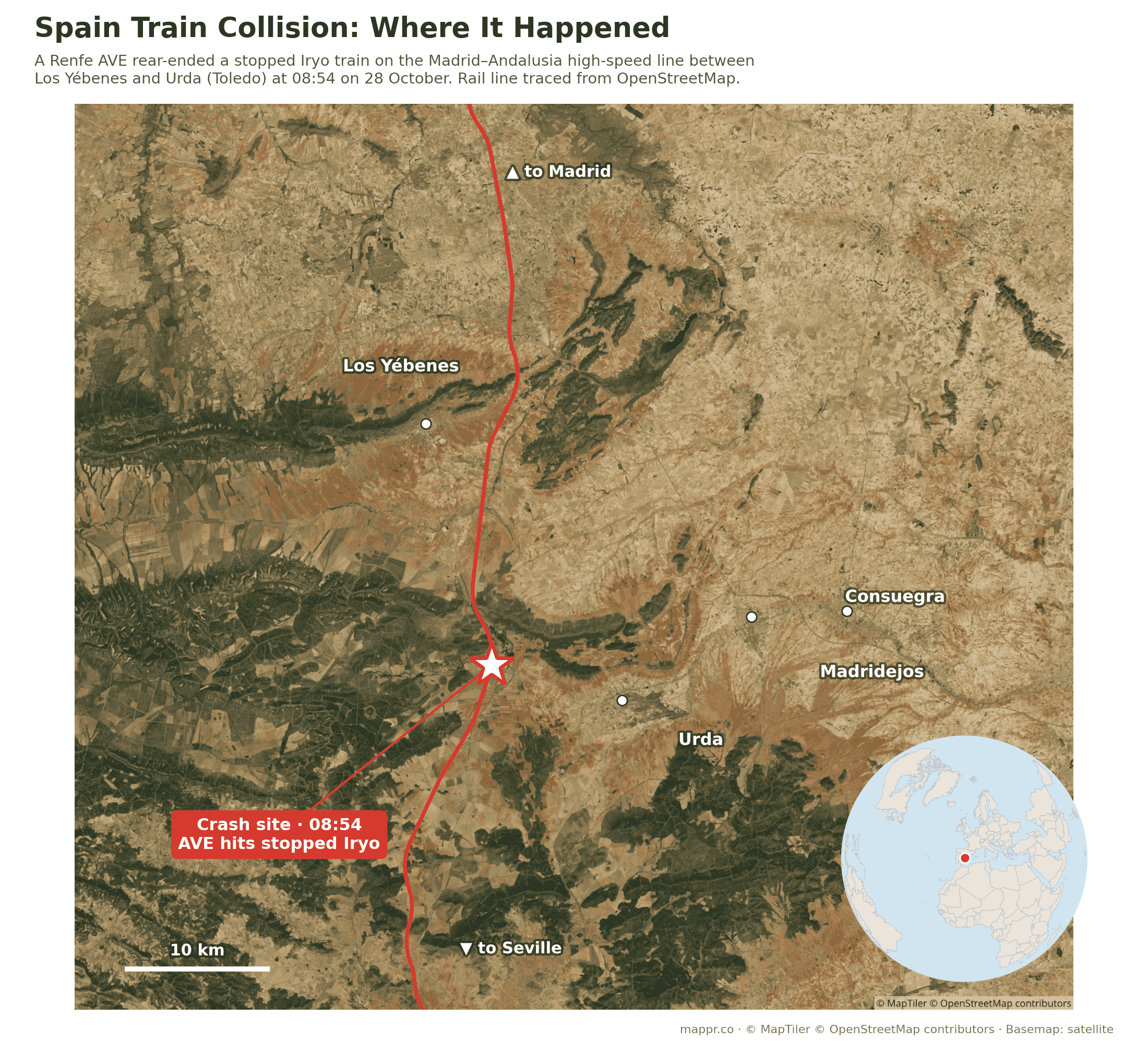
The collision happened roughly 120 km south of Madrid, where the high-speed line threads between the Montes de Toledo foothills and the plain of La Mancha. The nearest towns, Urda (pop. ~2,500) and Los Yébenes, are small rural municipalities; Urda’s town hall opened its sports pavilion to treat and shelter passengers.
What We Know So Far
07:54: Renfe AVE 2080 departs Madrid Puerta de Atocha for Seville. Ahead of it on the same track runs Iryo 6076, also bound for Seville.
08:54: the Iryo is stopped on the line between Los Yébenes and Urda when the AVE strikes it from behind at speed. Spanish state broadcaster TVE reports two carriages were thrown off the track.
Mid-morning: Adif, the state rail-infrastructure operator, suspends all high-speed traffic between Madrid, Ciudad Real and Andalusia. Emergency services, field hospitals and helicopters converge on the site; the regional president of Castilla-La Mancha, Emiliano García-Page, travels to the scene.
Midday: the confirmed toll passes 39 and then 46 as rescue crews work through the wreckage. Why the Iryo was stopped, and why the AVE was allowed to run into an occupied section, are the two questions investigators now have to answer. Spain’s rail-accident investigation commission (CIAIAF) has opened an inquiry; no official cause has been given.
The Line: Spain’s Original High-Speed Railway
The Madrid–Seville LAV is where Spanish high-speed rail began: opened for Expo ’92, it was the country’s first AVE line and remains one of its busiest corridors. Since open-access competition arrived, Renfe’s AVE shares the track with private operators, including the Italian-backed Iryo, whose train was struck on Wednesday.
Spain runs the longest high-speed network in Europe (nearly 4,000 km) and has long had one of the continent’s best rail-safety records, which makes two catastrophic crashes in one year all the more jarring: 45 died in January when a derailing train hit an oncoming service in southern Spain, the country’s worst accident since the 2013 Santiago de Compostela derailment killed 80.
If Wednesday’s provisional toll of 46 holds, Urda surpasses January’s crash to become Spain’s deadliest rail disaster in 13 years.
What Happens Next
Attention now turns to the signalling system. The Madrid–Seville line is equipped with train-protection systems designed to stop a train before it enters an occupied block; investigators will examine whether the system failed, was overridden, or was degraded in the section where the Iryo had stopped.
We will update this post as the investigation establishes an official cause and the casualty figures are consolidated.