Key Takeaways
- Ten countries are in the protest wave. France, Italy, Spain, Portugal, Greece, Albania, Belgium, Germany, Austria and Ireland have all seen major demonstrations since September, the broadest European unrest in years.
- France is the epicentre. An estimated 410,000 people marched last week with 1,300 arrests and the worst rioting in decades in some cities. 70,000 police are deployed for this weekend, and demonstrations are banned from several city centres.
- The common thread is affordability. Student anger over education costs lit the fuse in France and Albania; housing drives Spain and Portugal; wages and precarious work drive Italy. Behind it all sit strained budgets, with France and Belgium running deficits above 5% of GDP.
- This page tracks the wave as it evolves. The latest-developments box and the map are updated as the situation changes. Last update: 31 October 2026.
Latest developments (updated 31 October 2026)
- France braces for a Halloween-weekend showdown: 70,000 police deployed nationwide, protests banned in several city centres, and the interior minister warning of a “very high risk” of unrest after last week’s 410,000-strong marches and 1,300 arrests.
- Germany joins at scale today: more than 160,000 expected at “Gen Z regelt” marches in 34 cities, including Berlin and Frankfurt.
- Continent-wide Saturday pattern: the 24 October wave brought nearly 1,000 arrests in France and violent clashes in Spain, Italy and Belgium; a repeat is expected this weekend.
- The US Embassy in Paris has advised travellers to avoid demonstration areas.
A wave of protest is rolling across Europe. What began with French students angry about the state of their schools and an Albanian backlash against a luxury resort has grown into the continent’s broadest unrest in years: ten countries, hundreds of thousands in the streets, and a shared grievance underneath it all, the feeling that ordinary life has become unaffordable.
We mapped where the wave has reached and how hard it is hitting, country by country.
The Map: Where Europe Is Protesting
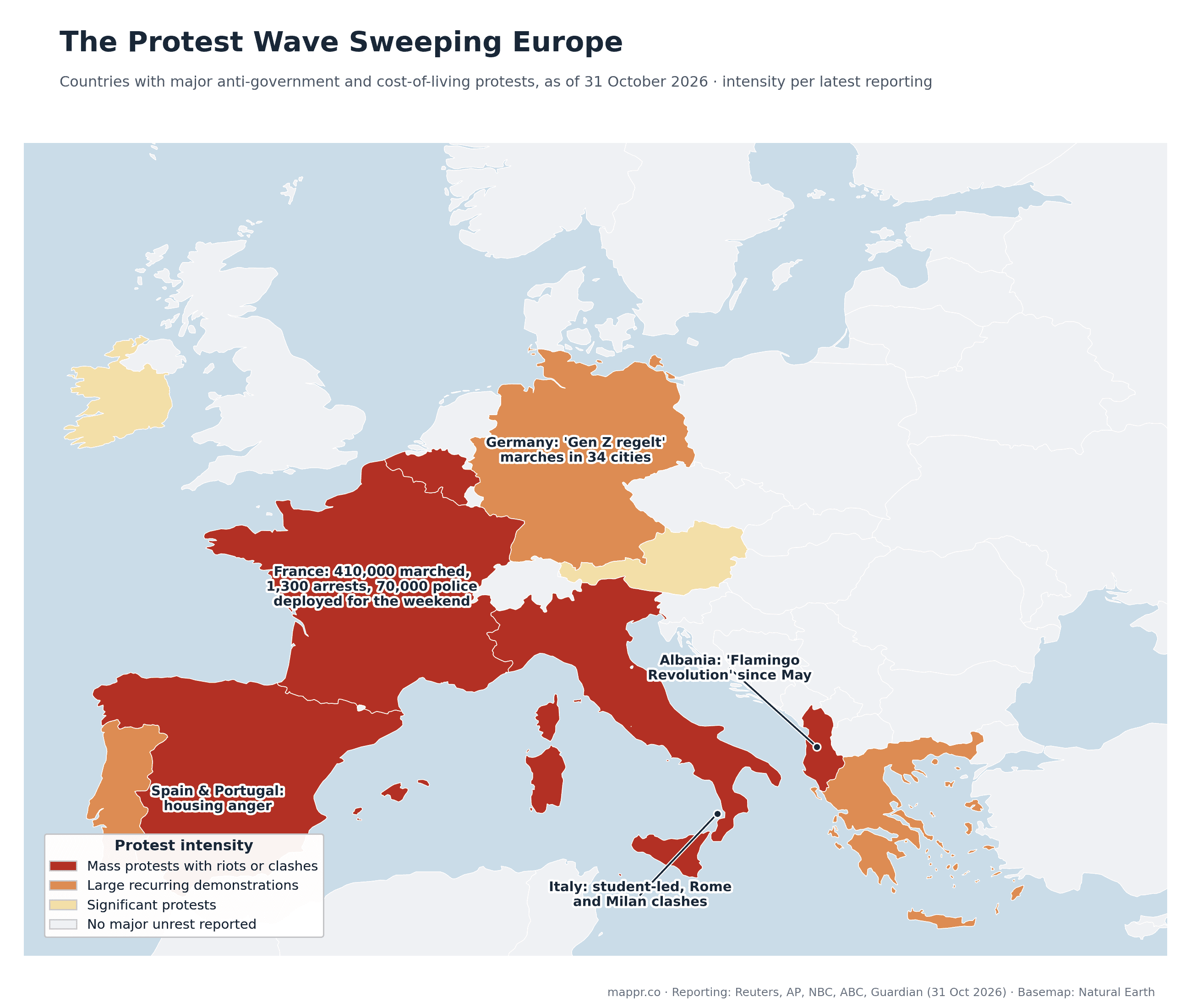
The deepest tier, mass protests with riots or clashes, covers France, Italy, Spain, Belgium and Albania. Germany, Portugal and Greece are seeing large recurring demonstrations, while Austria and Ireland have joined with significant but so far calmer protests.
Country by Country
🇫🇷 France
The epicentre. Protests began in September when students marched over a declining education system, then widened to the cost of living once the government opened its 2027 budget talks. Unions and the Yellow Vests movement joined, and last week an estimated 410,000 people took to the streets nationwide, with 1,300 arrests and rioting that damaged shops and public buildings in several cities.
🇦🇱 Albania
Europe’s longest-running thread. The ‘Flamingo Revolution’ began in late May against a luxury resort development on ecologically protected Sazan Island, then widened into calls for Prime Minister Edi Rama’s resignation over corruption allegations after thirteen years in power. A fresh student wave over university costs and conditions erupted on 13 October, with clashes against riot police.
🇮🇹 Italy
Student-led protests over the cost of living, fuel prices, low wages and precarious employment have filled streets in Rome, Milan and other cities, including a mass rally at the Colosseum, with violent clashes during the 24 October wave.
🇪🇸 Spain and 🇵🇹 Portugal
Iberia’s wave is about housing. Spain’s long-running affordability crisis boiled over into mass demonstrations that turned violent in late October, and Portugal’s protests carry the same demand: rents and homes that people under 35 can actually pay for.
🇧🇪 Belgium
The French unrest spilled north on 17 October with demonstrations in Brussels and Liège, which escalated into clashes a week later. Belgium shares France’s underlying fiscal squeeze, with a deficit above 5% of GDP.
🇩🇪 Germany and 🇦🇹 Austria
Germany’s movement is the newest and possibly the largest organised one: the ‘Gen Z regelt’ campaign expected more than 160,000 people at marches in 34 cities on 31 October, including Berlin and Frankfurt. Austria, running a deficit above 4% of GDP, has seen significant protests over budget cuts.
🇬🇷 Greece and 🇮🇪 Ireland
Greek demonstrations tap a familiar vein of austerity-era anger over costs and wages. In Ireland, protests have centred on the housing shortage, so far the calmest corner of the wave.
Why It’s Happening Now
The sparks differ, schools in France, an island resort in Albania, rents in Madrid, but the fuel is common. Analysts point to the gap between what people expect from democratic governments and what they feel those governments deliver, especially for the young: expensive housing, squeezed education systems, precarious work and an uncertain future.
The fiscal backdrop makes it combustible. Several governments face pressure to cut deficits just as borrowing costs rise: France and Belgium are running deficits above 5% of GDP, Austria above 4%. Budget consolidation and street-level affordability anger are pulling in opposite directions, and the protests live exactly in that gap.
What to Watch
Three things will shape where this goes: whether the Halloween-weekend mobilisations stay peaceful or harden the confrontation, whether any government makes a concrete concession (France’s budget talks are the most likely venue), and whether the wave spreads further east and north. We will keep the map and the developments box above updated as events unfold.
Sources: