
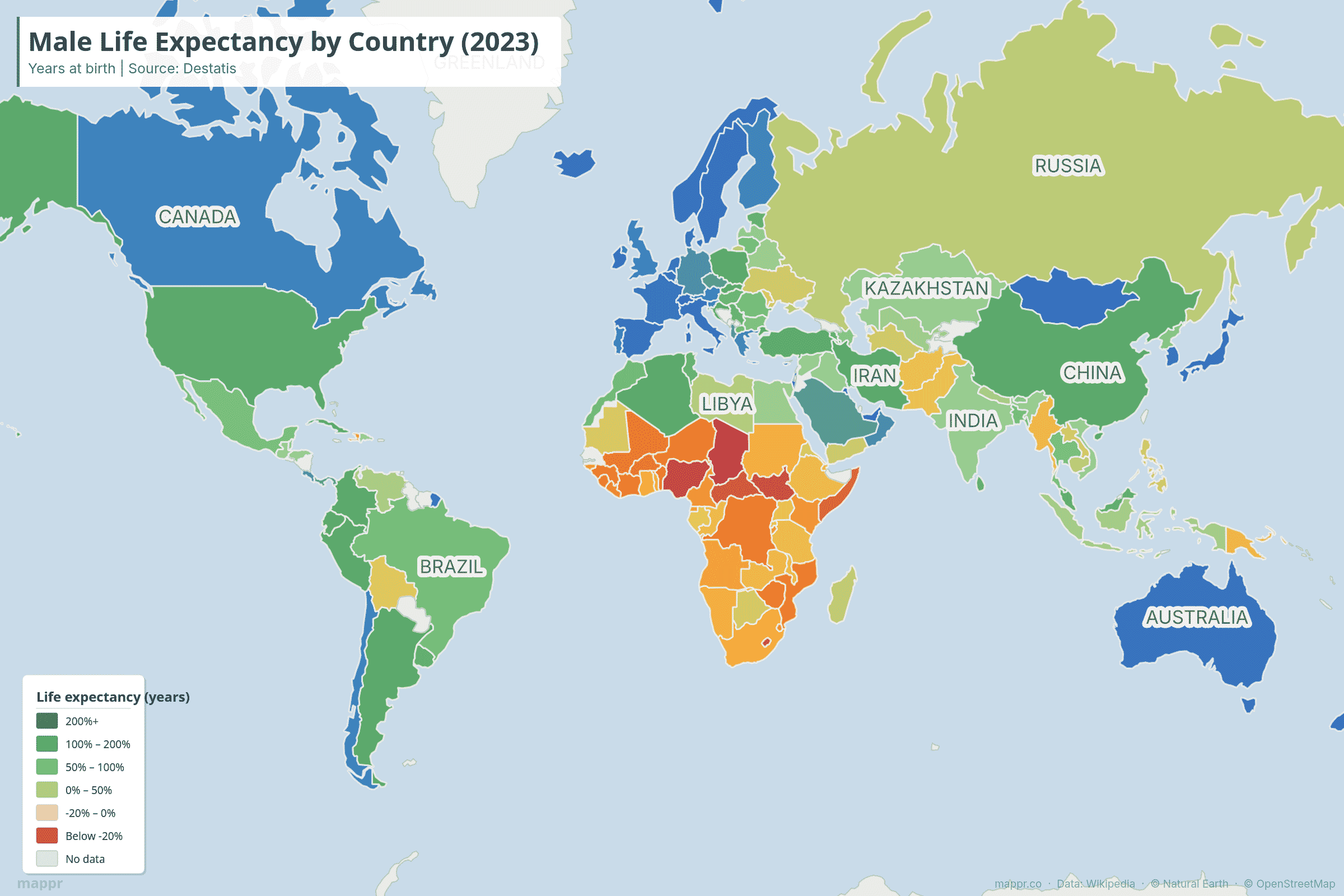
A boy born in Monaco in 2023 can expect to live to 84.4 years. A boy born the same year in Chad can expect just 53.2. That is a gap of more than three decades — a chasm shaped not by genetics, but by wealth, healthcare, conflict, and the everyday conditions of life. Male life expectancy at birth, one of the most revealing single-number indicators in global development, paints a stark portrait of inequality when mapped across all nations.
Drawing on 2023 data from the German Federal Statistical Office (Destatis), this article examines where men live longest, where they die youngest, and — most importantly — why. The answers involve everything from the Mediterranean diet and universal healthcare to civil war, HIV/AIDS, and the lingering economic damage of colonialism and Soviet collapse. Across 200+ countries, the patterns are unmistakable: geography, policy, and prosperity determine how long men live far more than any biological factor.
The Top 15: Where Men Live Longest
The fifteen countries where men live longest form a striking group: small, wealthy, and disproportionately European. Monaco (84.4) and San Marino (84.2) sit atop the list — two European microstates with populations under 40,000. Liechtenstein (82.5) and Andorra (82.1) complete the microstate quartet. These tiny nations benefit from enormous per-capita wealth, world-class medical systems, and populations that skew affluent and well-educated. Some researchers caution that their small size creates statistical noise: a few hundred centenarians can shift national averages significantly.
More revealing are the larger nations in the top 15. Switzerland (82.3) spends more of its GDP on healthcare than almost any other European nation, and its population embraces an active outdoor culture — hiking, skiing, and cycling are embedded in daily life. Swiss men also benefit from one of the lowest smoking rates in Western Europe and a diet rich in dairy, dark chocolate, and fresh produce. Japan (81.1) and Australia (81.1) round out the non-European high performers. Japan’s longevity is famously linked to the traditional diet — heavy on fish, soy, fermented vegetables, and green tea — alongside universal healthcare that has been in place since 1961.
Two Gulf states make a surprising appearance: Kuwait (82.7) and the UAE (82.0). Both have invested oil wealth into advanced healthcare infrastructure and attract large populations of young, healthy expatriate workers, which pulls the national average upward. Israel (81.0) also ranks among the top 15, bolstered by a strong public health system, a Mediterranean diet, and one of the world’s most robust cultures of preventive care. The remaining spots belong to European nations — Malta (81.8), Italy (81.7), Luxembourg (81.7), Sweden (81.7), and Norway (81.6) — all of which combine universal healthcare, high incomes, and cultures that promote work-life balance.
Europe Dominates — But With a Sharp East-West Divide
Europe contributes more countries to the top tier of male life expectancy than any other continent. From Switzerland at 82.3 down to Portugal and Denmark in the high 79s, Western Europe is a bastion of male longevity. Universal healthcare, strong social safety nets, regulated working hours, and diets rich in olive oil, fresh vegetables, and moderate wine consumption all play a role. The Mediterranean diet, in particular, has been identified by researchers as a key factor behind the impressive numbers in Italy, Spain, and France.
But cross into Eastern Europe, and the picture darkens dramatically. Russia‘s male life expectancy sits at just 68.0 years — nearly 15 years below Switzerland. Ukraine (66.9) and Moldova (66.6) fare even worse. The causes are well-documented: catastrophic levels of alcohol consumption (particularly spirits), high rates of smoking, cardiovascular disease, and a healthcare system that never fully recovered from the collapse of the Soviet Union. During the 1990s, Russian male life expectancy actually fell below 58 years — a peacetime demographic disaster without modern precedent.
The east-west gradient is not a clean line but a gradient that follows the old Iron Curtain with remarkable precision. Germany (78.2) — which reunified only in 1990 — still shows a measurable gap between its eastern and western states. Poland (74.8) and Hungary (73.5) have made significant gains since joining the European Union, but remain several years behind their western neighbors. The data makes a powerful case that political systems, institutional quality, and public health investment matter as much as individual behavior in determining how long men live.
The Asia-Pacific Split
The Asia-Pacific region contains some of the world’s best and worst outcomes for male longevity, often separated by just a few thousand kilometers. Japan (81.1) and Australia (81.1) sit at the very top, joined closely by South Korea (80.6) and Singapore. Japan’s Okinawa prefecture is one of the original Blue Zones identified by longevity researcher Dan Buettner — a place where centenarians are ten times more common than in the United States. The factors include a plant-forward diet rich in sweet potatoes, tofu, and seaweed; strong community bonds (known as moai); a cultural sense of purpose (ikigai); and daily, low-intensity physical activity woven into ordinary life rather than confined to a gym.
Australia’s success stems from different roots: a well-funded public healthcare system (Medicare), strict tobacco control laws, high rates of outdoor physical activity, and immigration policies that attract younger, healthier populations. South Korea’s rapid climb — gaining more than 20 years of male life expectancy since 1960 — is arguably the greatest public health success story in modern history, driven by economic growth, universal healthcare coverage, and dramatic improvements in sanitation and nutrition.
At the other end of the spectrum, Afghanistan (64.5) and Myanmar (63.8) illustrate how conflict and institutional failure can erase decades of progress. Afghanistan’s numbers reflect four decades of near-continuous war, collapsed healthcare infrastructure, and widespread malnutrition. India (70.5) falls in the middle — a vast country where male life expectancy ranges from the mid-60s in some northern states to the mid-70s in Kerala, underscoring how subnational inequality can be as large as the gap between countries.
The Americas: From Canada to Haiti
Canada (79.5) leads the Americas in male life expectancy, followed closely by Chile (79.2) — a remarkable achievement for a middle-income Latin American nation. Chile’s success is attributed to steady investments in primary healthcare, falling poverty rates, and a diet that, while shifting toward processed foods, still features substantial amounts of fish, legumes, and fresh produce. Costa Rica is another standout, with its Nicoya Peninsula recognized as a Blue Zone where men routinely live past 90.
The United States (75.8) presents one of the most puzzling cases in global health. Despite spending more on healthcare per capita than any other nation — roughly $13,000 per person annually — American men live shorter lives than their counterparts in nearly every other wealthy democracy. The causes are multifaceted: the opioid epidemic, gun violence, lack of universal healthcare coverage, high rates of obesity, deep racial and socioeconomic disparities, and a car-dependent built environment that discourages physical activity. COVID-19 widened the US gap further, with American male life expectancy dropping to 73.2 in 2021 before partially recovering.
Further south, the picture fragments. Brazil (72.8) and Mexico (72.6) cluster in the low 70s, pulled down by violence, uneven healthcare access, and rising rates of diabetes and heart disease. Haiti (61.7) sits at the bottom of the hemisphere, its numbers shaped by extreme poverty, political instability, and a healthcare system that has struggled to function for decades. The Americas, in miniature, mirror the global pattern: wealth, stability, and public health investment are the strongest predictors of how long men will live.
Sub-Saharan Africa: The Life Expectancy Crisis
Every country in the bottom ten of global male life expectancy is in Sub-Saharan Africa. Chad (53.2), Lesotho (54.6), South Sudan (54.6), the Central African Republic (55.3), and Somalia (56.4) are countries where the average man does not reach 57. The causes compound relentlessly: infectious diseases — HIV/AIDS, malaria, tuberculosis — still account for 40-50% of premature deaths in the region, according to the World Health Organization. Armed conflict in South Sudan, the Central African Republic, and Somalia destroys healthcare facilities and displaces millions. Extreme poverty limits access to clean water, adequate nutrition, and basic medical care.
Lesotho’s case is particularly instructive. A small, mountainous nation encircled by South Africa, it has one of the world’s highest HIV prevalence rates — roughly one in four adults is living with the virus. The epidemic, which peaked in the early 2000s, slashed life expectancy by more than a decade. Burkina Faso (58.9), Mali (59.0), and Benin (59.3) face a different but equally devastating mix: high child mortality from malaria and diarrheal diseases, limited healthcare infrastructure (often fewer than one doctor per 10,000 people), and chronic food insecurity.
Yet the narrative is not uniformly bleak. Sub-Saharan Africa has achieved the fastest gains in life expectancy of any world region since 2000. The scale-up of antiretroviral therapy for HIV, insecticide-treated bed nets for malaria, and oral rehydration therapy for childhood diarrhea have saved millions of lives. Rwanda, Ethiopia, and Senegal have all gained more than ten years of life expectancy since the turn of the millennium. Cabo Verde (72.9) now matches many Latin American countries. The progress proves that even in the most challenging settings, targeted public health interventions can dramatically shift outcomes — though the distance still to travel remains vast.
Why Do Some Countries’ Men Live So Much Longer?
Researchers studying longevity have identified several factors that consistently distinguish the countries where men live longest. The first is universal healthcare access. Every top-15 country provides comprehensive medical coverage to its citizens, ensuring that preventable and treatable conditions do not become death sentences. This stands in sharp contrast to the United States, where gaps in insurance coverage contribute to worse outcomes despite enormous spending.
Diet is a second critical factor. The Blue Zones research — studying communities in Okinawa (Japan), Sardinia (Italy), Nicoya (Costa Rica), Ikaria (Greece), and Loma Linda (California) — has found that populations with the longest lifespans share several dietary characteristics: predominantly plant-based eating, moderate caloric intake (the Okinawan principle of eating until 80% full), minimal processed food, and small amounts of alcohol, usually red wine consumed socially rather than in isolation. The Mediterranean diet, in particular, is rich in polyphenols, omega-3 fatty acids, and fiber — all linked to reduced inflammation and cardiovascular disease, the leading killer of men worldwide.
Beyond healthcare and diet, a constellation of social and economic factors shapes male longevity. Income inequality, as measured by the Gini coefficient, correlates strongly with lower life expectancy — even in wealthy countries, high inequality predicts worse health outcomes for men across the income spectrum. Political stability matters: every country in the bottom ten has experienced significant armed conflict in recent decades. Education, particularly women’s education, drives better child survival and family health outcomes. And cultural factors — including attitudes toward alcohol, tobacco, risk-taking, and seeking medical help — help explain why men in Sweden (81.7) outlive men in Russia (68.0) by nearly 14 years despite comparable climates.
Behavioral differences between men and women also matter. Globally, men are more likely to smoke, drink excessively, engage in physically dangerous work, and delay seeking medical attention. These behavioral gaps are widest in the countries with the largest gender life-expectancy gaps — particularly in Eastern Europe and parts of Central Asia — and narrowest in the countries where men live longest.
The 31-Year Gap: Monaco vs Chad
The distance between Monaco‘s 84.4 years and Chad‘s 53.2 is not just a statistical abstraction. It is 31.2 years of lived experience — three additional decades of watching grandchildren grow up, of afternoon walks, of ordinary days. In Monaco, a boy born today will likely see the 2100s. In Chad, he will, on average, not reach retirement age by the standards of most nations.
That gap is not inevitable. It reflects choices — choices about how societies invest in healthcare, how they distribute wealth, whether they build clinics or buy weapons, whether they fund childhood vaccination programs or let preventable diseases run unchecked. The countries that have narrowed the gap most rapidly in recent decades — South Korea, Rwanda, Ethiopia, Chile — prove that progress is possible, sometimes at astonishing speed. But the gap also reflects deep structural inequalities in the global order: the legacy of colonialism, the resource curse that afflicts mineral-rich but institutionally weak nations, and a global health architecture that still spends more treating diseases of affluence than preventing the diseases of poverty.
The map of male life expectancy is, ultimately, a map of human priorities. Where societies have chosen to invest in their people — in healthcare, education, nutrition, and stability — men live long, productive lives. Where those investments have been absent, insufficient, or destroyed by conflict, the cost is measured not in dollars but in decades.
Sources and data used in this article:
Primary Data
- Destatis – Life Expectancy Male – German Federal Statistical Office, international comparison data
- World Bank – Life Expectancy at Birth, Male – World Bank development indicators
Research u0026 Analysis
- Blue Zones – Research on regions with highest longevity
- WHO – Global Health Observatory – World Health Organization health statistics