Key Takeaways
- Finland wins for the 9th year — 7.764. Finland has topped the World Happiness Report every year since 2018. Its 2026 life-evaluation score is more than five points above Afghanistan's.
- Costa Rica cracks the Top 5. Costa Rica climbs to 4th — the highest ever for a Latin American country, displacing two Nordic nations and beating Sweden, Norway, and the Netherlands.
- US #23, UK #29 — no English-speaking country in the Top 10. For the second year running, no anglophone nation makes the Top 10. Australia (15), Ireland (13), and New Zealand (11) come closest.
- Afghanistan last at 1.446 — a decade-long collapse. Afghanistan's score has fallen from 3.8 in 2016 to 1.45 in 2026. Afghan women report the lowest life satisfaction of any group globally.
- Young-adult wellbeing in anglophone countries has fallen off a cliff. Under-25 life evaluation in the US, Canada, UK, Australia, and New Zealand has dropped 0.81 points since 2006–2011 — the WHR's editors call it the biggest wellbeing finding of 2026.
The World Happiness Report 2026, published on 20 March 2026, ranks 147 countries by a simple question: when you imagine a ladder with the best possible life for you at the top (rung 10) and the worst at the bottom (rung 0), where do you stand today? Three years of Gallup World Poll answers are averaged into a single life-evaluation score. The result, released every year on the International Day of Happiness, is the closest thing the world has to a common yardstick for subjective wellbeing.
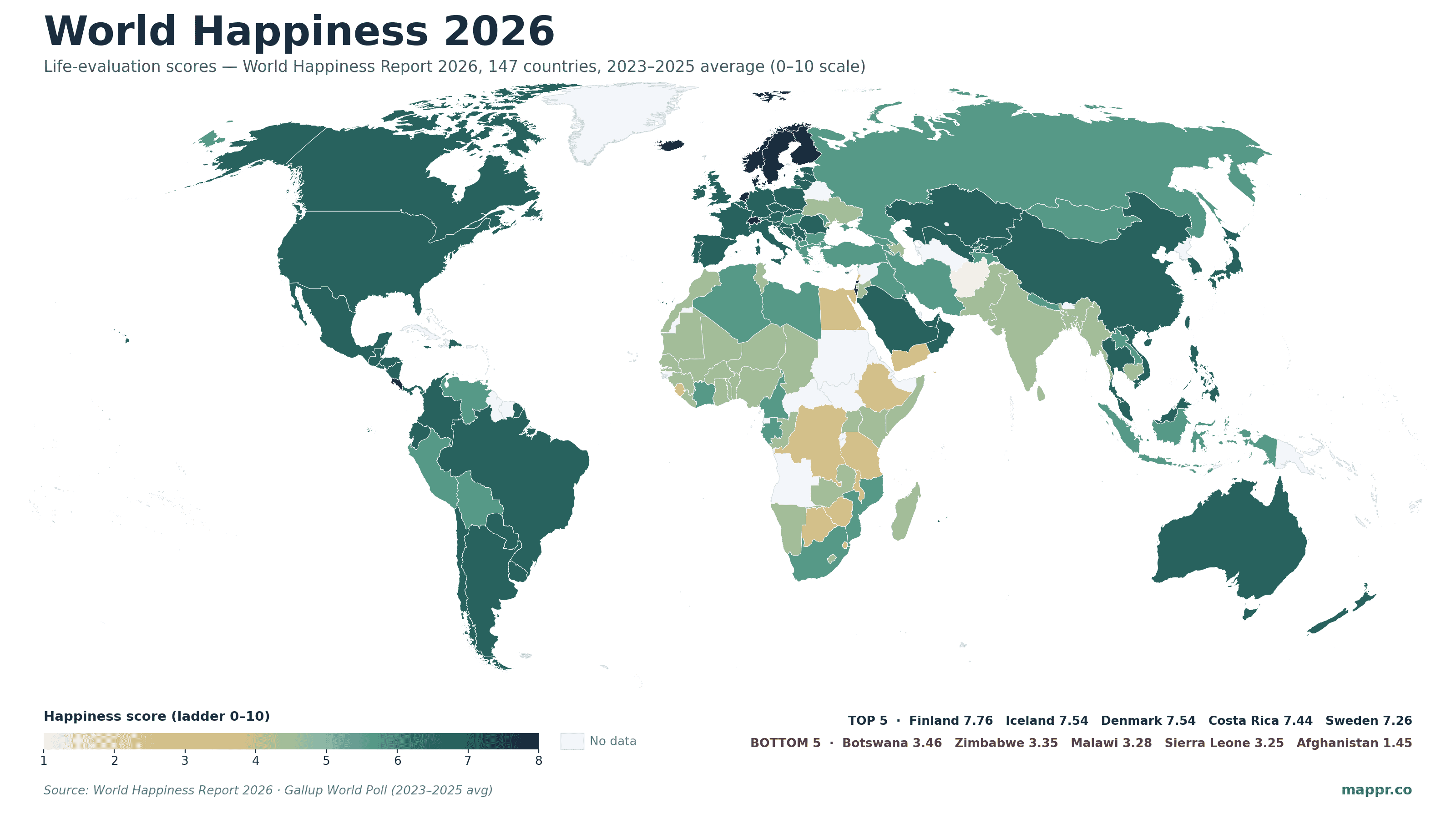
In 2026 the picture is as stark as ever. Finland takes first place for the ninth consecutive year with a score of 7.764 — and the rest of the Nordic bloc (Iceland, Denmark, Sweden, Norway) all sit inside the Top 6. Costa Rica breaks through to fourth, the highest-ever rank for any Latin American country. At the other end, Afghanistan stays last at 1.446 — a score that is less than one fifth of Finland’s and barely a third of its own 2016 level.
Between those poles sits a world of pattern: continental wealth helps but doesn’t guarantee happiness (the US is 23rd, the UK 29th), governance matters more than GDP at the margins, and wellbeing among young adults in English-speaking countries has fallen so sharply that the report’s editors call it the single most important finding of 2026. The global choropleth below shows the scale of it — dark Nordic teal at the top, warm cream across the Sahel and Central Africa, and mid-teal stretching through Europe, Latin America, and the Pacific.
The 20 Happiest Countries in 2026
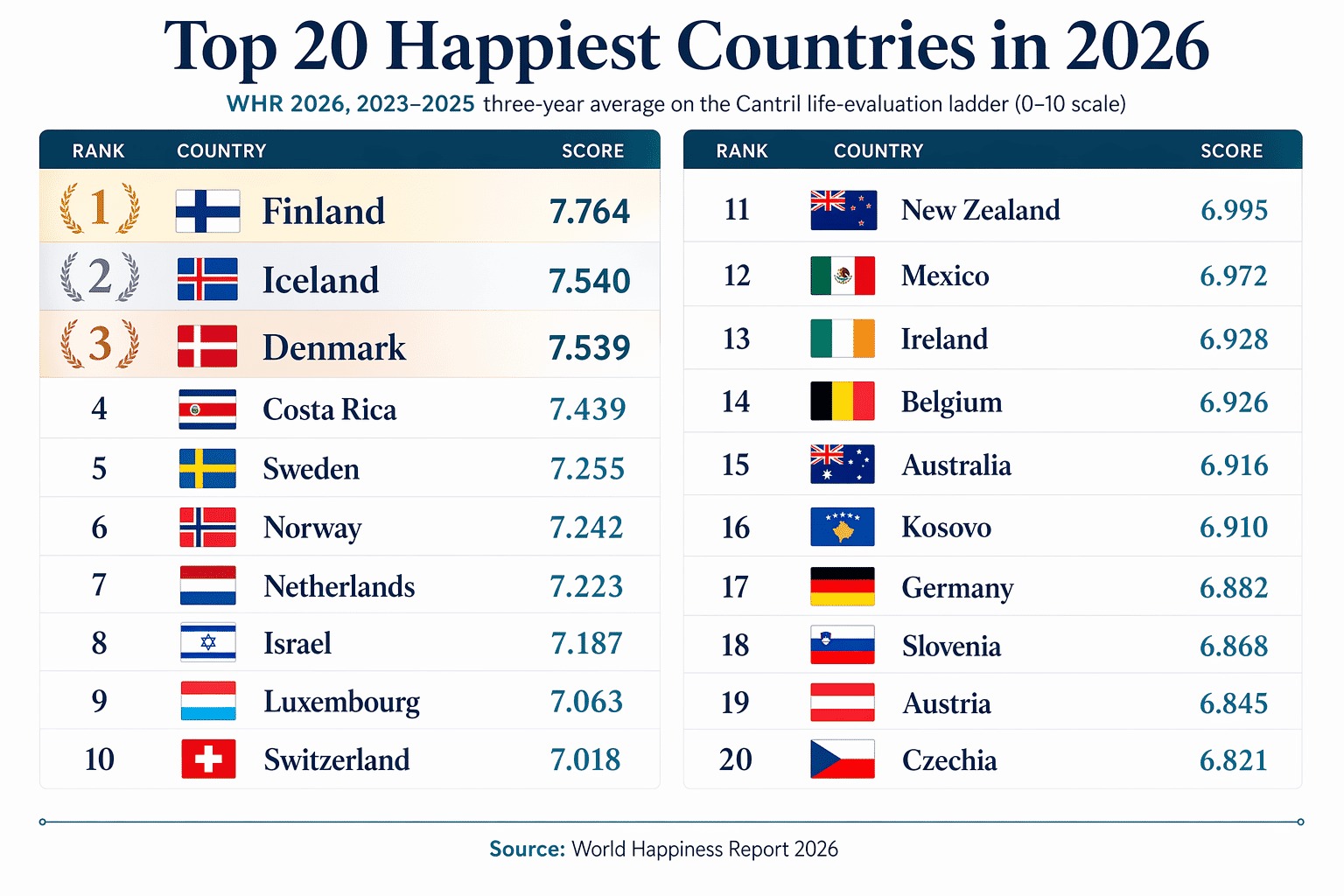
Finland’s 7.764 is comfortably ahead of second-placed Iceland (7.540) and third-placed Denmark (7.539) — a razor-thin one-thousandth separating Iceland from Denmark. Costa Rica’s jump to fourth with 7.439 is the headline shake-up of the 2026 list: it’s the first year any country outside Europe or Oceania has broken into the Top 5, and Costa Rica’s score now sits above Sweden’s. Mexico at 12th (6.972) and Kosovo at 16th (6.910) are the two other outside-Western-Europe names in the Top 20.
The United States sits at 23rd (6.816), below the United Arab Emirates (21st) and Saudi Arabia (22nd) — the first time two Gulf states have ranked above the US on the ladder. The United Kingdom (29th, 6.694) and Canada (25th, 6.741) are also outside the Top 20, along with Japan (61st, 6.130) and France (35th, 6.586). Czechia, Slovenia, and Austria round out the Top 20, reflecting Central Europe’s slow but steady climb on the ladder over the past decade.
| Rank | Country | Score |
|---|---|---|
| 1 | 🇫🇮 Finland | 7.764 |
| 2 | 🇮🇸 Iceland | 7.540 |
| 3 | 🇩🇰 Denmark | 7.539 |
| 4 | 🇨🇷 Costa Rica | 7.439 |
| 5 | 🇸🇪 Sweden | 7.255 |
| 6 | 🇳🇴 Norway | 7.242 |
| 7 | 🇳🇱 Netherlands | 7.223 |
| 8 | 🇮🇱 Israel | 7.187 |
| 9 | 🇱🇺 Luxembourg | 7.063 |
| 10 | 🇨🇭 Switzerland | 7.018 |
| 11 | 🇳🇿 New Zealand | 6.995 |
| 12 | 🇲🇽 Mexico | 6.972 |
| 13 | 🇮🇪 Ireland | 6.928 |
| 14 | 🇧🇪 Belgium | 6.926 |
| 15 | 🇦🇺 Australia | 6.916 |
| 16 | 🇽🇰 Kosovo | 6.910 |
| 17 | 🇩🇪 Germany | 6.882 |
| 18 | 🇸🇮 Slovenia | 6.868 |
| 19 | 🇦🇹 Austria | 6.845 |
| 20 | 🇨🇿 Czechia | 6.821 |
Why the Nordics Keep Winning
The Finland-leads story is now nine years old, and it’s no longer a surprise — it’s a pattern. Five of the Top 7 countries in 2026 are Nordic: Finland, Iceland, Denmark, Sweden, Norway. They share a remarkably consistent profile: high levels of institutional trust, low corruption, compressed income distributions, universal healthcare, generous parental leave, short commutes, and — critically — extremely high social-support scores when Gallup asks people “if you were in trouble, do you have relatives or friends you can count on?”
The WHR’s six explanatory factors — GDP per capita, social support, healthy life expectancy, freedom to make life choices, generosity, and absence of corruption — don’t determine the happiness scores (the scores come directly from the ladder question), but they explain most of the variation between countries. On every one of those six factors, the Nordics sit near the global ceiling. Benchmarks matter too: Finns aren’t comparing themselves to Afghans, they’re comparing themselves to neighbours. When everyone around you is doing fine, your own “rung on the ladder” self-assessment tends upward.
Costa Rica and the Latin American Surprise
The other big 2026 story is Latin America. Costa Rica (4th, 7.439) and Mexico (12th, 6.972) are both above the United States, and Uruguay (31st), El Salvador (37th), Panama (39th), and Guatemala (42nd) all sit inside the Top 42. This isn’t a statistical artefact — it’s a consistent multi-year pattern researchers call the “Latin American paradox”: life-evaluation scores that are higher than GDP per capita, life expectancy, and institutional quality alone would predict.
The WHR and Gallup both attribute the gap to social fabric. Latin American respondents consistently report the strongest family ties, the most frequent positive social interactions, and the highest self-reported “enjoyment yesterday” scores of any region. Costa Rica specifically also scores high on environmental quality, political stability (no standing army since 1948), and education spending — a combination that now places it above most of Western Europe on the ladder.
The 15 Unhappiest Countries in 2026
Afghanistan is last at 1.446 — a score so low it’s genuinely an outlier. The gap between Afghanistan and 146th-placed Sierra Leone (3.251) is larger than the gap between Sierra Leone and Cyprus at 62nd. Afghan women specifically report an average life evaluation of 1.26, the lowest of any population subgroup ever recorded in the Gallup World Poll.
The rest of the bottom 15 is dominated by two clusters: conflict-affected states (Yemen, DR Congo, Lebanon, Sierra Leone) and sub-Saharan African economies with severe poverty and low state capacity (Malawi, Zimbabwe, Botswana, Zambia). Egypt (139th, 3.862) and Sri Lanka (134th, 4.013) are the two middle-income outliers in the bottom group — both tied to prolonged economic crises since 2022.
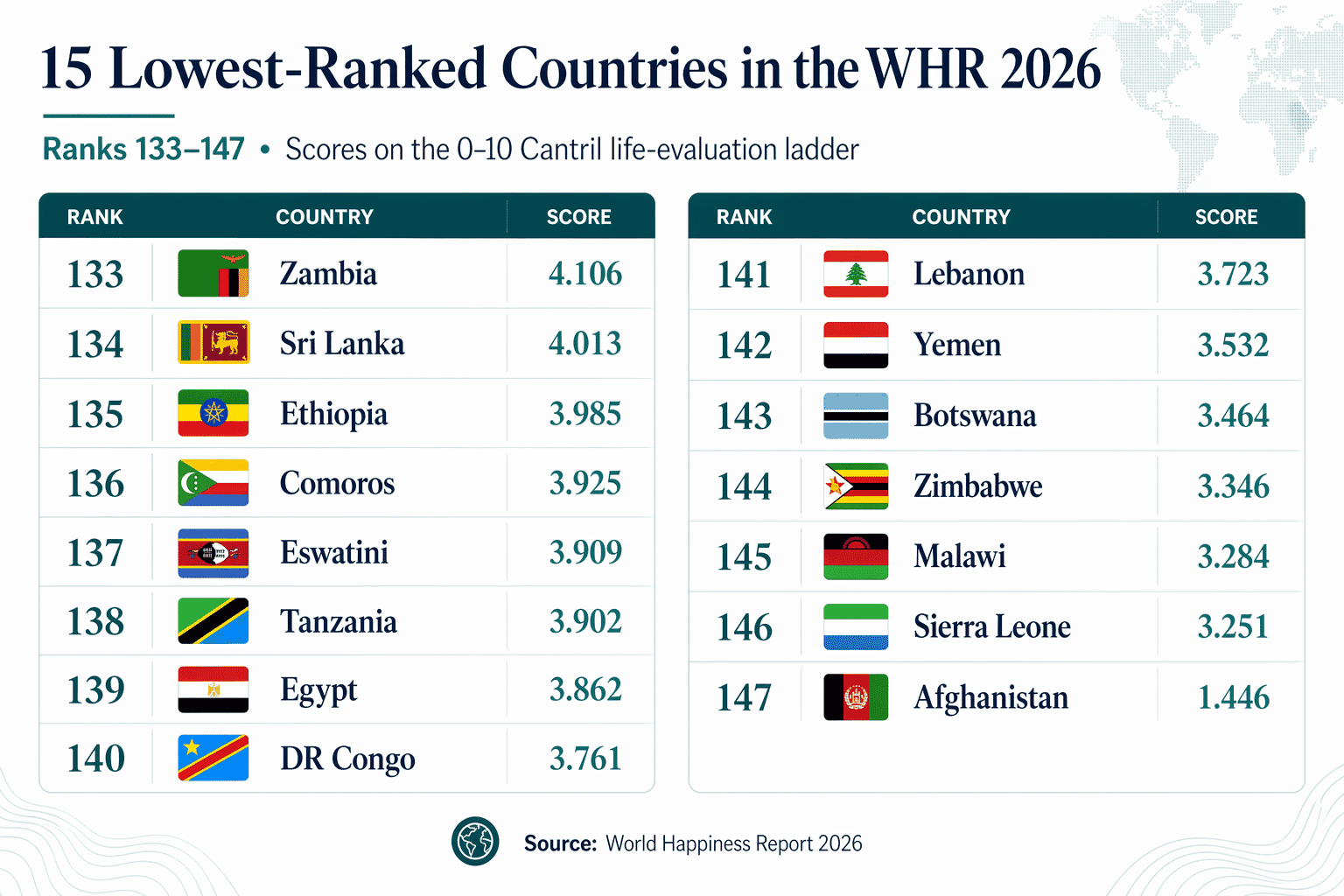
| Rank | Country | Score |
|---|---|---|
| 133 | 🇿🇲 Zambia | 4.106 |
| 134 | 🇱🇰 Sri Lanka | 4.013 |
| 135 | 🇪🇹 Ethiopia | 3.985 |
| 136 | 🇰🇲 Comoros | 3.925 |
| 137 | 🇸🇿 Eswatini | 3.909 |
| 138 | 🇹🇿 Tanzania | 3.902 |
| 139 | 🇪🇬 Egypt | 3.862 |
| 140 | 🇨🇩 DR Congo | 3.761 |
| 141 | 🇱🇧 Lebanon | 3.723 |
| 142 | 🇾🇪 Yemen | 3.532 |
| 143 | 🇧🇼 Botswana | 3.464 |
| 144 | 🇿🇼 Zimbabwe | 3.346 |
| 145 | 🇲🇼 Malawi | 3.284 |
| 146 | 🇸🇱 Sierra Leone | 3.251 |
| 147 | 🇦🇫 Afghanistan | 1.446 |
The Big 2026 Finding: Young-Adult Wellbeing Collapse in English-Speaking Countries
The headline chart in the 2026 report isn’t about country rankings at all — it’s about age. In the US, Canada, UK, Australia, and New Zealand, the life-evaluation score for people under 25 has fallen 0.81 points between the 2006–2011 window and the 2020–2025 window. That’s a larger decline than the hit any anglophone country took during the 2008 financial crisis or the pandemic. In every one of the five English-speaking countries, young adults now score below the over-60 population on the ladder — a reversal of the historical age gradient.
The WHR’s editors link the collapse to heavy social-media use. Girls who use social media seven or more hours per day show substantially lower life-satisfaction scores across every region the poll covers; the association is weaker but still present for boys. The report also notes a striking willingness-to-pay finding: a significant share of heavy users say they would pay meaningful money to have never had access to a product they nevertheless continue to use — a classic collective-action trap.
How the Ranking Is Calculated
The core WHR score comes from a single question Gallup asks ~1,000 adults per country per year: “Please imagine a ladder with steps numbered from 0 at the bottom to 10 at the top. The top of the ladder represents the best possible life for you and the bottom represents the worst possible life for you. On which step of the ladder would you say you personally feel you stand at this time?” This is the Cantril life-evaluation ladder. Country scores are three-year averages to smooth out single-year sample noise — the 2026 report averages the 2023, 2024, and 2025 Gallup World Polls.
The report then explains those scores using six factors: (1) log GDP per capita, (2) social support, (3) healthy life expectancy at birth, (4) freedom to make life choices, (5) generosity (share who donated money recently), and (6) perceptions of corruption. Together these six variables explain roughly three quarters of the cross-country variance in happiness. The factors don’t set the rankings — the ladder question does — but they help make the scores intelligible. A “dystopia” baseline (a hypothetical country with the world’s worst score on every factor) is used as the zero point of the decomposition.
All rankings and scores are from the World Happiness Report 2026, published 20 March 2026. Underlying life-evaluation data comes from the Gallup World Poll (2023–2025 three-year average).
Image Sources
- World-happiness choropleth and hero image — Mappr editorial – Choropleth generated from WHR 2026 data; hero illustration generated by Mappr.