Key Takeaways
- Germany is Europe's only majority-renter country — 52.8%. More than half of German households rent their home. No other major European economy comes close. Germany's combination of strong tenant protections, the Mietspiegel rent reference system, and deep private rental-housing investment make renting a stable lifetime option.
- Türkiye is second-highest at 43.1%. A rapidly urbanising country with Istanbul alone housing ~16 million people. Rental rates have spiked through the post-2021 lira crisis, but population growth keeps total household formation above housing supply.
- Romania has the lowest tenant share — 6.8%. More than 93% of Romanians own their home. The inheritance of mass communist-era housing privatisation in the early 1990s turned nearly all residents into owners. Croatia (8.6%) and Hungary (10.2%) are the next lowest.
- EU average is roughly 30% tenants. Across the 22 EU countries in this dataset, the unweighted average tenancy rate is about 25–30%. Western and Nordic Europe skew higher; Southern and Central/Eastern Europe skew lower.
- Nordic split: Denmark 41.6%, Sweden 35.4%, Finland 33.1%, Norway 20.0%. Three Nordics rank in the continent's top 7 for renting; Norway stands out with much lower tenant share and a strong homeownership norm supported by tax incentives.
How likely are you to rent the home you live in? In Europe, the answer depends massively on the country you were born in. Germany is the only major European economy where the majority of households rent — 52.8% of the population lives in a rented dwelling. At the other extreme, barely 7% of Romanians rent; the rest own. Between those two poles lie patterns that reflect a century of different policy choices on housing finance, rent control, tax treatment, and — in much of Central and Eastern Europe — the privatisation of state-owned housing in the 1990s.
This page ranks 24 European countries by tenancy rate in 2025 — the latest Eurostat release. Data source: Eurostat’s ilc_lvho02 series (share of population living in rented dwellings). Several EU countries haven’t reported 2025 data yet and are therefore not in the ranking below; we’ll refresh the page when the remaining figures publish.
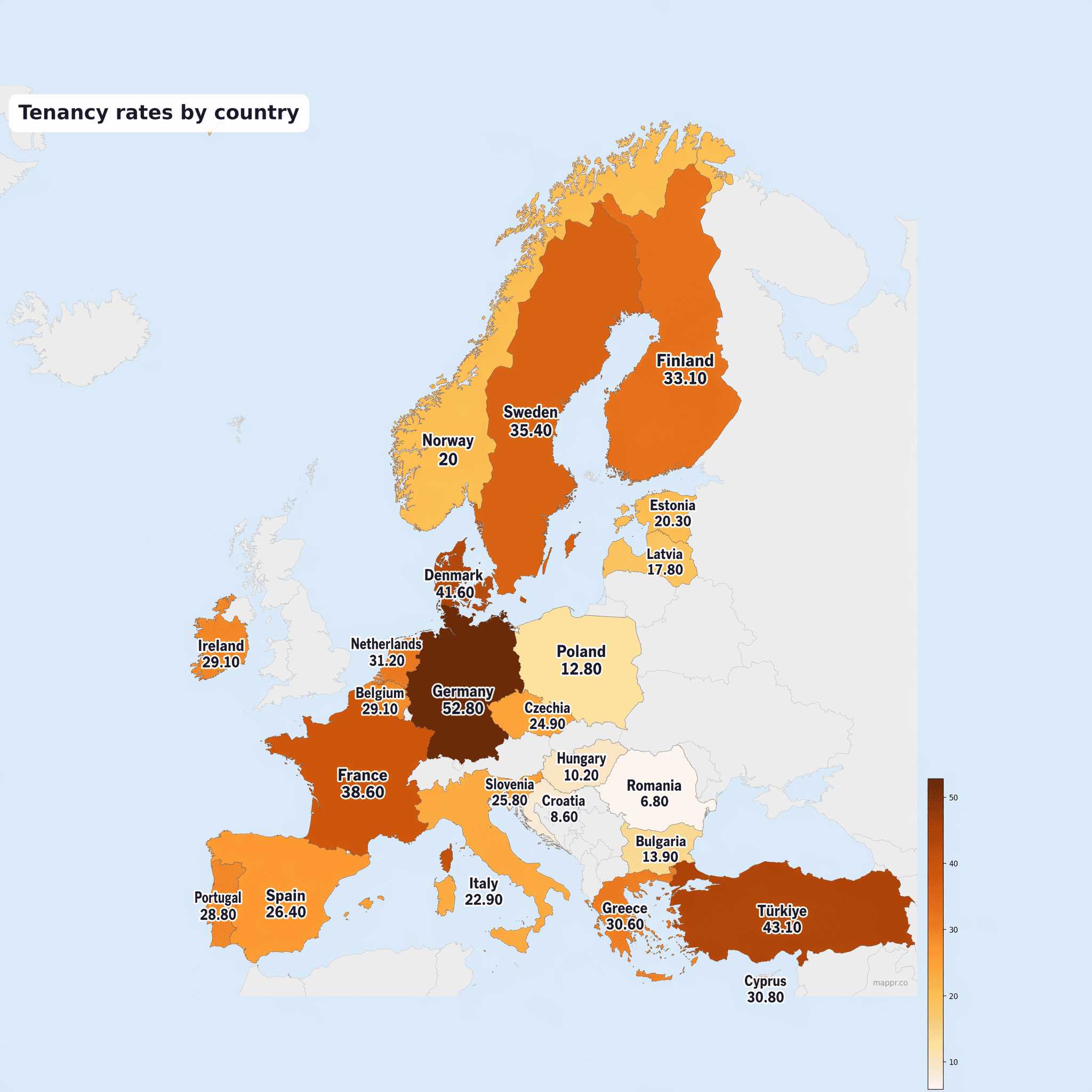
Full Ranking: European Tenancy Rates, 2025
The table below lists all 24 countries from highest to lowest tenancy rate. The implied homeownership share (100 minus the tenant share) is in the right-most column for convenient comparison.
| Rank | Country | Tenants | Owners |
|---|---|---|---|
| 1 | 🇩🇪 Germany | 52.8% | 47.2% |
| 2 | 🇹🇷 Türkiye | 43.1% | 56.9% |
| 3 | 🇩🇰 Denmark | 41.6% | 58.4% |
| 4 | 🇫🇷 France | 38.6% | 61.4% |
| 5 | 🇸🇪 Sweden | 35.4% | 64.6% |
| 6 | 🇫🇮 Finland | 33.1% | 66.9% |
| 7 | 🇳🇱 Netherlands | 31.2% | 68.8% |
| 8 | 🇨🇾 Cyprus | 30.8% | 69.2% |
| 9 | 🇬🇷 Greece | 30.6% | 69.4% |
| 10 | 🇧🇪 Belgium | 29.1% | 70.9% |
| 11 | 🇮🇪 Ireland | 29.1% | 70.9% |
| 12 | 🇵🇹 Portugal | 28.8% | 71.2% |
| 13 | 🇪🇸 Spain | 26.4% | 73.6% |
| 14 | 🇸🇮 Slovenia | 25.8% | 74.2% |
| 15 | 🇨🇿 Czechia | 24.9% | 75.1% |
| 16 | 🇮🇹 Italy | 22.9% | 77.1% |
| 17 | 🇪🇪 Estonia | 20.3% | 79.7% |
| 18 | 🇳🇴 Norway | 20.0% | 80.0% |
| 19 | 🇱🇻 Latvia | 17.8% | 82.2% |
| 20 | 🇧🇬 Bulgaria | 13.9% | 86.1% |
| 21 | 🇵🇱 Poland | 12.8% | 87.2% |
| 22 | 🇭🇺 Hungary | 10.2% | 89.8% |
| 23 | 🇭🇷 Croatia | 8.6% | 91.4% |
| 24 | 🇷🇴 Romania | 6.8% | 93.2% |
Regional Patterns: A Continent in Three Bands
🏢 Rental-Majority & High-Tenancy: Germany, Türkiye, Denmark, France
Germany (52.8%) is Europe’s — and essentially the world’s — outlier: a rich, stable, democratic country where more than half the population rents. The reason is institutional. German rental housing is protected by the Mietspiegel rent-reference system, unlimited-duration tenancy contracts, and strong legal protections against eviction. That makes renting a viable lifetime choice, and a large share of newly built housing is financed explicitly as rental stock by institutional investors and housing co-operatives. France (38.6%) shows a similar but softer pattern — Parisian housing scarcity alone pushes the national average up.
Türkiye (43.1%) is second-highest for different reasons: a young, urbanising population and persistent housing-cost inflation through the 2022–2025 lira crisis. Denmark (41.6%), Sweden (35.4%), and Finland (33.1%) carry strong rental cultures supported by extensive municipal (allmännyttan in Sweden) and non-profit housing sectors.
🏘️ Mixed-Tenure: Most of Western and Southern Europe
A large middle band, roughly 22–32% tenants, includes the Netherlands (31.2%), Cyprus (30.8%), Greece (30.6%), Belgium and Ireland (both 29.1%), Portugal (28.8%), Spain (26.4%), Slovenia (25.8%), Czechia (24.9%), and Italy (22.9%). Most of these have a mortgage-financed ownership culture balanced by an active — if smaller — private rental sector, often skewed toward larger cities and younger adults.
🏠 Homeownership Belt: Central and Eastern Europe
The cluster of countries with under 20% tenants is striking: Latvia (17.8%), Bulgaria (13.9%), Poland (12.8%), Hungary (10.2%), Croatia (8.6%), and Romania (6.8%). All were part of the communist bloc, and all underwent mass housing privatisation between roughly 1990 and 1995: state-owned apartments were sold to sitting tenants at deeply subsidised prices, instantly creating a nation of owner-occupiers. A full generation later, that initial endowment is inherited, renovated, and rarely traded. New build is often financed for owner-occupation rather than rental.
Why Germany Rents — and Everyone Else Doesn’t
The short answer to why German tenant share is roughly eight times Romania’s is: rental is a culturally and institutionally equivalent choice to ownership in Germany, whereas in most of the rest of Europe it’s treated as a transitional or second-best option. Four factors reinforce this:
- Tenant protections. German rental law makes unlimited-duration contracts standard. Eviction requires narrow legal grounds; annual rent increases are capped by the Mietspiegel. In Spain or Romania, by comparison, short-duration tenancies and less-generous eviction protections push renters toward eventual ownership.
- Tax treatment. Germany does not treat imputed rent on owner-occupied housing as tax-free income — unlike much of Europe, which implicitly subsidises ownership. The mortgage-interest deduction is minimal compared with the USA or the Netherlands.
- Institutional rental investment. German insurers, pension funds, and listed REITs (Vonovia, LEG Immobilien) own roughly 3 million housing units combined. Institutional landlords in the UK or France are much smaller relative to their rental stock.
- Post-war legacy. Large-scale reconstruction of German cities after 1945 was financed through a social-rental model, creating decades of high-quality rental stock that never converted to owner-occupation.
The Post-Communist Ownership Shock
The opposite story explains the Eastern European cluster. Between 1989 and 1995, most former Soviet-bloc countries transferred ownership of state-built apartments to sitting tenants, either for free or at symbolic prices. In Romania, the Legea 112/1995 and earlier decrees transferred ownership of almost the entire urban housing stock to the people living in it. Similar programmes ran in Hungary, Poland, Bulgaria, and the three Baltic states.
This created the highest homeownership rates in the world — often above 90% — almost overnight. The second-order effect is still visible 30 years later: with no large private rental sector to develop, the institutional frameworks (landlord regulation, professional property management, tenant-rights law) that support a mature rental market simply didn’t form. New build since 2000 has mostly been financed for owner-occupation, reinforcing the pattern. Romania’s 6.8% tenancy rate is the natural endpoint of that trajectory.
How Eurostat Measures Tenancy
The headline series used here is ilc_lvho02: distribution of population by tenure status. Eurostat collects the data through EU-SILC (the annual Statistics on Income and Living Conditions survey) — a multi-stage probability sample of roughly 130,000 households across participating countries. “Tenant” here covers all renters: market-rate private tenants, social-housing tenants, subsidised renters, and people living in tied accommodation (e.g. employer-owned housing). “Owner” covers outright owners and owners with a mortgage. The share is calculated over population, not over households, so couples and families count once each.
Two caveats for interpretation. First, data vintage: Eurostat releases the previous year’s figures on a rolling schedule, so not all 27 EU members have 2025 data yet — Austria, Luxembourg, Lithuania, Slovakia, and Malta are missing from our ranking above. They’ll be added in a future refresh. Second, the “tenant” share says nothing about affordability: a country can have a high tenant share because the rental market works well (Germany) or because ownership is simply out of reach (parts of urban Türkiye). The separate Eurostat housing-cost-burden indicator is the better lens for affordability.
All figures are the 2025 share of population living in a rented dwelling, from Eurostat. Countries shown are those with 2025 data available at publication date.