
Key Takeaways
- Luxembourg leads at €2,638/month. The highest statutory minimum wage in Europe — roughly 4.8× Bulgaria's €551 at the bottom of the EU range.
- 22 EU countries have a national minimum wage. Six don't — Italy, Austria, Finland, Denmark, and Sweden rely entirely on sector-level collective agreements between unions and employers.
- The West–East gap is still roughly 4×. Western-European statutory minimums (€1,800–€2,700) sit well above Central-European ones (€700–€1,250). The ratio has narrowed since 2015 but remains the defining feature of the map.
- UK post-Brexit: €1,969 at 2025 FX. Britain's statutory minimum (£12.21/hour × 40h × 4.33 weeks) converts to roughly €1,969/month — between Belgium and France in euro terms.
- EU Directive 2022/2041 now binds member states. The Adequate Minimum Wages Directive, in force October 2024, requires EU countries with statutory minimums to benchmark them against 60% of gross median wage or 50% of gross average wage, and to strengthen collective-bargaining coverage.
The monthly minimum wage is the lowest gross monthly salary an employer is legally required to pay full-time workers. In Europe, how that floor is set splits the continent into three groups: 22 EU countries plus the UK set a statutory national minimum written into law; five Nordic countries (plus Italy, Austria, and Switzerland) set wage floors through collective agreements negotiated sector by sector; and the non-EU Balkans and Türkiye set their own statutory minimums that sit well below EU levels once converted to euros.
This map and ranking reflect the January 2025 values from Eurostat’s monthly minimum-wage database (earn_mw_cur), with non-EU values added from national labour ministries and converted at the S1 2025 exchange rate. Where a country has no statutory national minimum — Italy, Austria, Finland, Denmark, Sweden, Norway, Iceland, and Switzerland — the map shades the country differently and leaves the column blank, since there is no single legal figure to report.
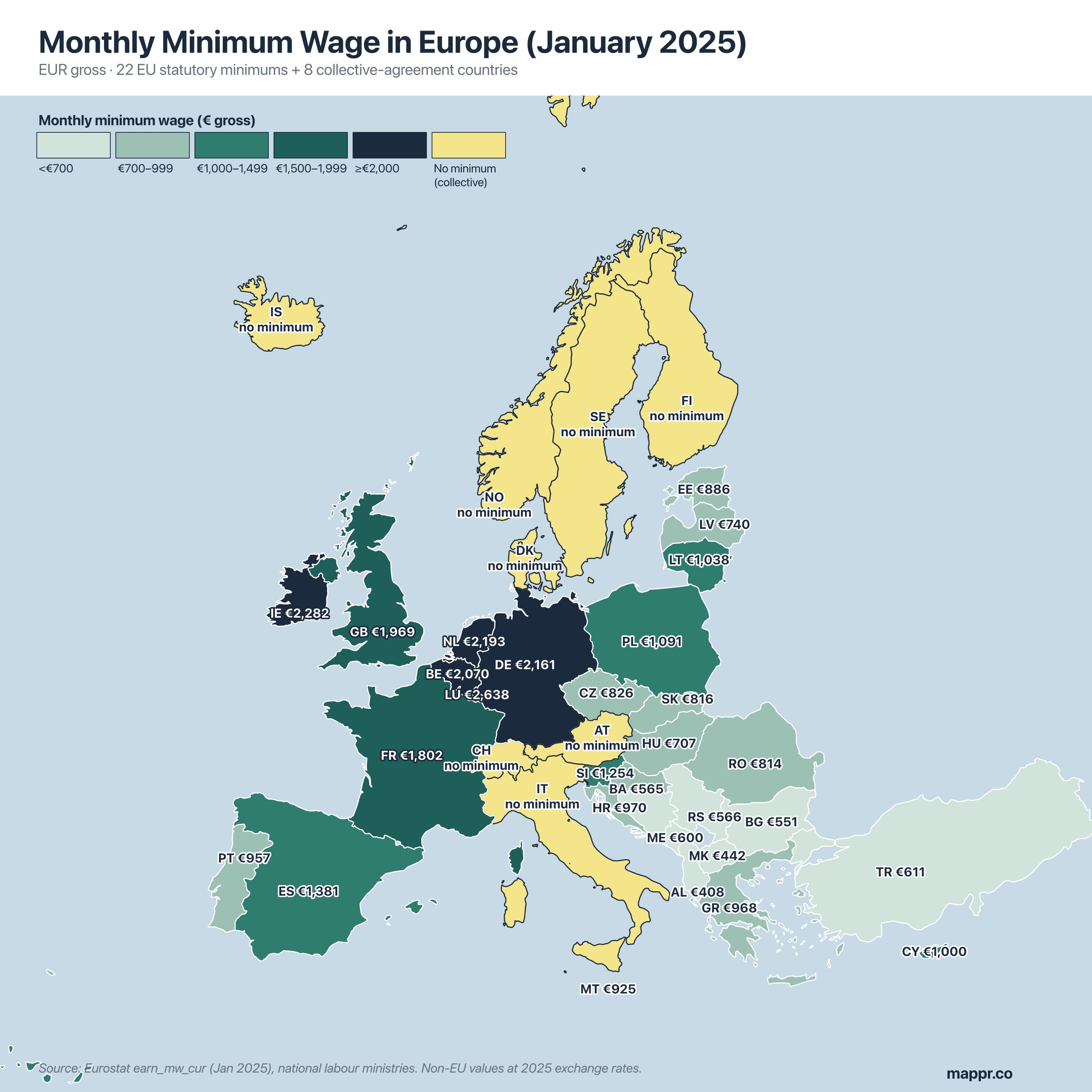
Full Ranking: European Minimum Wages, January 2025
The table below lists every European country that operates a national statutory minimum wage, ranked highest to lowest in euros per month, followed by the non-EU countries where the same system applies. Eight further countries — Italy, Austria, Finland, Denmark, Sweden, Norway, Iceland, and Switzerland — set wages through collective bargaining instead and are covered in their own section below.
| Rank | Country | Monthly (EUR) | Region |
|---|---|---|---|
| 1 | 🇱🇺 Luxembourg | €2,638 | EU |
| 2 | 🇮🇪 Ireland | €2,282 | EU |
| 3 | 🇳🇱 Netherlands | €2,193 | EU |
| 4 | 🇩🇪 Germany | €2,161 | EU |
| 5 | 🇧🇪 Belgium | €2,070 | EU |
| 6 | 🇫🇷 France | €1,802 | EU |
| 7 | 🇪🇸 Spain | €1,381 | EU |
| 8 | 🇸🇮 Slovenia | €1,254 | EU |
| 9 | 🇵🇱 Poland | €1,091 | EU |
| 10 | 🇱🇹 Lithuania | €1,038 | EU |
| 11 | 🇨🇾 Cyprus | €1,000 | EU |
| 12 | 🇭🇷 Croatia | €970 | EU |
| 13 | 🇬🇷 Greece | €968 | EU |
| 14 | 🇵🇹 Portugal | €957 | EU |
| 15 | 🇲🇹 Malta | €925 | EU |
| 16 | 🇪🇪 Estonia | €886 | EU |
| 17 | 🇨🇿 Czechia | €826 | EU |
| 18 | 🇸🇰 Slovakia | €816 | EU |
| 19 | 🇷🇴 Romania | €814 | EU |
| 20 | 🇱🇻 Latvia | €740 | EU |
| 21 | 🇭🇺 Hungary | €707 | EU |
| 22 | 🇧🇬 Bulgaria | €551 | EU |
| 23 | 🇬🇧 United Kingdom | €1,969 | Non-EU |
| 24 | 🇹🇷 Turkey | €611 | Non-EU |
| 25 | 🇲🇪 Montenegro | €600 | Non-EU |
| 26 | 🇷🇸 Serbia | €566 | Non-EU |
| 27 | 🇧🇦 Bosnia and Herzegovina | €565 | Non-EU |
| 28 | 🇲🇰 North Macedonia | €442 | Non-EU |
| 29 | 🇦🇱 Albania | €408 | Non-EU |
The Three Tiers of European Minimum Wages
🏛️ Tier 1 — Western Europe: €1,800–€2,700/month
Luxembourg (€2,638), Ireland (€2,282), the Netherlands (€2,193), Germany (€2,161), Belgium (€2,070), and France (€1,802) form the high band. All six index their statutory minimum to some combination of median wage, inflation, and collective-bargaining benchmarks. Germany’s €12.82/hour floor (introduced 2022 and indexed since) is the largest-coverage single jump in European minimum-wage history, affecting roughly 6 million workers on introduction.
💶 Tier 2 — Southern & Central Europe: €700–€1,400/month
Spain (€1,381), Slovenia (€1,254), Poland (€1,091), Lithuania (€1,038), Cyprus (€1,000), Croatia (€970), Greece (€968), Portugal (€957), and Malta (€925) make up the upper portion of this band. Below €900 sit Estonia (€886), Czechia (€826), Slovakia (€816), Romania (€814), Latvia (€740), Hungary (€707), and Bulgaria (€551). Poland’s minimum has climbed more than 75% in EUR terms since 2019 — the fastest increase of any EU country over that stretch.
🌍 Tier 3 — Non-EU Europe & Western Balkans: €400–€650/month
Outside the EU, the statutory minimums drop sharply. Türkiye (€611), Montenegro (€600), Serbia (€566), Bosnia and Herzegovina (€565, Federation of BiH), North Macedonia (€442), and Albania (€408) all sit below the lowest EU figure. High inflation and currency volatility — especially the Turkish lira — make euro-converted figures here move substantially between data points; the Türkiye value above reflects the January 2025 FX snapshot, not the mid-year or end-of-year exchange rate.
The United Kingdom, no longer an EU member, is the notable non-EU exception on the high end. Its National Living Wage of £12.21/hour for workers 21 and over (from 1 April 2025) translates to roughly €1,969/month at a 40-hour week and the January 2025 exchange rate — between Belgium and France in euro terms.
The Collective-Agreement Model (No National Minimum)
Eight European countries deliberately operate without a national statutory minimum wage: Italy, Austria, Finland, Denmark, Sweden, Norway, Iceland, and Switzerland. In these countries, wage floors are negotiated between unions and employer associations at the sector level, and the resulting collective agreements cover 80–100% of workers — a much higher share than in countries that rely on a statutory minimum.
The outcome is that effective minimums in Denmark, Sweden, and Norway sit comfortably above the EU statutory top (Luxembourg’s €2,638). Danish hospitality workers, for example, earn around €18/hour (~€3,100/month full-time) under the Horesta agreement; Norwegian construction workers are guaranteed roughly €22/hour through Fellesforbundet. Italy is the outlier in this group — its collective-bargaining coverage is high on paper but concentrated in regulated sectors, and the country has been repeatedly flagged by the OECD as a candidate for a statutory floor. Switzerland has no national minimum but the cantons of Geneva, Neuchâtel, Jura, Ticino, and Basel-Stadt have introduced their own cantonal minimums (€4,000+ in Geneva).
How Minimum Wages Are Set in Europe
Statutory minimum wages are adjusted in three broadly different ways. The first is full-indexation: Luxembourg, France, and Belgium automatically index their minimum to inflation (and in some cases productivity), so the headline figure changes without a political decision. The second is government decree after tripartite consultation: Germany, Portugal, Spain, and most of Central and Eastern Europe set a new figure once a year after unions, employers, and government review a report from an expert commission. The third is referendum or legislative vote, the rarest path — used for extraordinary increases, such as Poland’s step-change in 2023–2024.
Since October 2024, EU member states that operate a statutory minimum are bound by Directive (EU) 2022/2041 on adequate minimum wages. The directive doesn’t mandate a specific number, but it requires each country to benchmark its minimum against either 60% of the gross median wage or 50% of the gross average wage, to involve social partners in setting it, and — crucially — to strengthen collective-bargaining coverage where it falls below 80%. The directive leaves the collective-agreement-only countries (Denmark, Sweden, Italy, etc.) untouched but tightens the floor for everyone else.
What the Headline Numbers Miss
Monthly EUR figures are useful for comparison but obscure three things. Purchasing power: €700 in Sofia buys considerably more than €2,000 in Paris. Eurostat’s PPS-adjusted series (part of the same earn_mw_cur dataset) narrows the gap between the extremes by roughly 40%. Working hours: statutory minimums are usually quoted per month assuming a full-time week, but the standard work-week is 35 hours in France, 40 in Germany, and 38 in Ireland — so hourly equivalents tell a slightly different story. Tax wedge: the gross-to-net conversion varies from about 20% in Ireland to over 45% in Germany at minimum-wage income — take-home pay ranking shuffles meaningfully once payroll taxes are subtracted.
All three of these deserve their own map. The headline EUR comparison above is the right starting point for the “where is it higher vs lower” question — but if you’re choosing between jobs in Berlin and Warsaw, the PPS figure and tax wedge are what actually end up in your bank account.
All figures are monthly minimum wage in EUR gross, January 2025. EU data from Eurostat series earn_mw_cur; non-EU values from national labour ministries and converted at January 2025 exchange rates. Collective-agreement countries have no national statutory minimum.


