
Key Takeaways
- 44 countries, five continents. FlixBus runs intercity coach services in around 44 countries across Europe, North America, South America, Asia and Australia, with over 300,000 daily connections.
- Europe is the heartland. 36 of FlixBus's markets are in Europe, from Portugal and Ireland in the west to Ukraine and Turkey in the east. The brand was founded in Munich, Germany in 2011.
- Big in North America too. FlixBus operates across the United States, Canada and Mexico, and owns the iconic Greyhound brand in the US.
- South America: Brazil, Chile, Peru. FlixBus has pushed into three South American markets, with Brazil its largest network on the continent.
- Newest frontiers: India and Australia. FlixBus launched in India in 2025 and reached Australia by late 2025, its first market in Oceania.
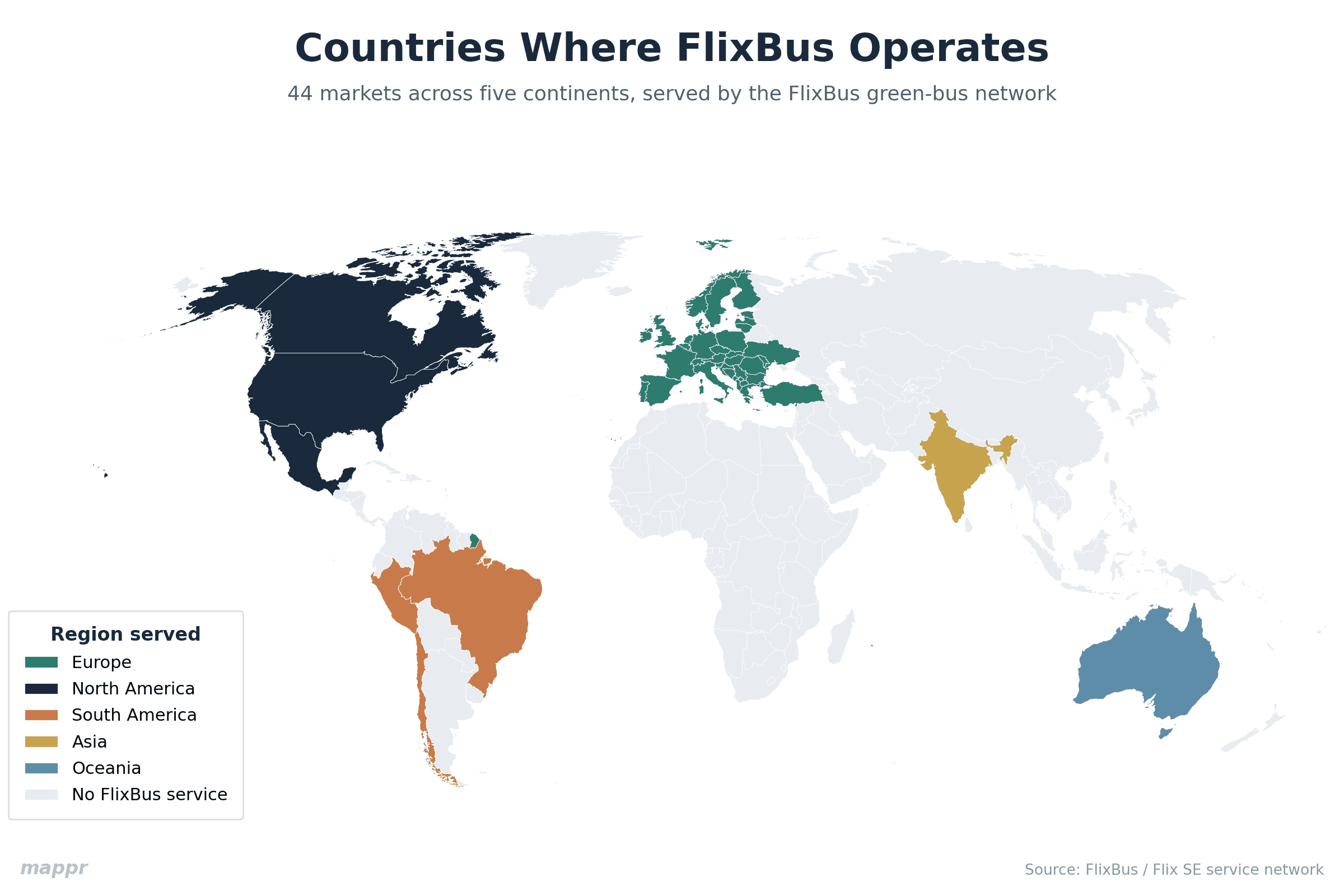
FlixBus has grown from a single German startup in 2011 into one of the largest intercity bus networks on the planet. Its instantly recognizable green coaches now run in around 44 countries across five continents, carrying passengers on more than 300,000 daily connections. The map below shows every country where FlixBus currently operates, colour-coded by region.
FlixBus is owned by Flix SE, a Munich-based mobility company that also runs FlixTrain and, in the United States, the historic Greyhound brand. Rather than owning its own buses, FlixBus uses an asset-light model: it provides the brand, the technology and the booking platform, while regional coach operators run the actual vehicles. That structure is what has let it expand into so many countries so quickly.
🇪🇺 Europe: the core network
Europe is FlixBus territory. The company was born in Germany and built its dense web of routes across the continent before expanding overseas. Today it serves roughly 36 European countries, reaching from Portugal and Ireland in the west to Ukraine and Turkey in the east. It also runs cross-border services into Kosovo, even though Pristina is served via routes from neighbouring countries rather than a domestic network.
The full European list: Albania, Austria, Belgium, Bosnia and Herzegovina, Bulgaria, Croatia, Czechia, Denmark, Estonia, Finland, France, Germany, Greece, Hungary, Ireland, Italy, Latvia, Lithuania, Luxembourg, Moldova, Montenegro, the Netherlands, North Macedonia, Norway, Poland, Portugal, Romania, Serbia, Slovakia, Slovenia, Spain, Sweden, Switzerland, Turkey, Ukraine and the United Kingdom. FlixBus entered Turkey in 2019 by acquiring Kâmil Koç, one of the country’s largest coach operators, giving it a foothold that straddles Europe and Asia.
🇺🇸 North America: FlixBus and Greyhound
FlixBus launched in the United States in 2018 and has expanded steadily ever since. In 2021 it acquired Greyhound, the legendary American intercity bus company, and now runs both brands side by side. FlixBus also operates in Canada and Mexico, giving it a presence in all three North American countries.
🌎 South America: Brazil, Chile and Peru
South America is FlixBus’s newest growth region after Europe and North America. It started in Brazil, which remains its biggest network on the continent, and has since added routes in Chile and Peru. The green buses now connect major cities across all three countries.
🇮🇳 Asia and Australia: the newest frontiers
FlixBus’s most recent expansions push it well beyond its European roots. It launched in India in 2025, entering one of the world’s largest and most competitive bus markets. Later that year it reached Australia, its first market in Oceania, with services along the populous east coast. Together with Turkey, these markets give FlixBus a genuine presence on five continents.
How FlixBus covers so many countries
The reason FlixBus can operate in dozens of countries comes down to its business model. It does not own a fleet of buses or employ the drivers. Instead, local and regional coach companies provide the vehicles and staff, while FlixBus supplies the brand, the green livery, the route planning, the pricing and the booking app. This asset-light approach lowers the cost of entering a new market and lets the company scale across borders far faster than a traditional operator that has to buy buses and hire drivers everywhere it goes.
The bottom line
In just over a decade, FlixBus has gone from a German upstart to a global intercity network spanning around 44 countries on five continents. Europe remains its stronghold with 36 markets, but its push into the Americas, India and Australia shows the green-bus model travels well. Expect the map to keep filling in as FlixBus eyes more markets in the years ahead.
Data and references (FlixBus / Flix SE service network, research as of June 2026):