
Key Takeaways
- A record 165,000 on the move. Henley & Partners forecasts 165,000 dollar millionaires will relocate to a new country in 2026, the largest wealth migration ever recorded, up from 142,000 in 2025.
- The UAE is the magnet. The United Arab Emirates leads the world with a net gain of about 9,800 millionaires, who bring an estimated USD 63 billion in assets, just ahead of the United States (+7,500).
- The UK leads the exodus. Britain is the biggest loser on record, on track to shed a net 16,500 millionaires after its non-dom tax overhaul, more than double China's 7,800 departures.
- Singapore tops wealth mobility. Singapore ranks first on Henley's new Wealth Mobility Competitiveness Score (79.5 out of 100), a benchmark of how well a country attracts and retains globally mobile wealth.
The world’s rich have never been so willing to pack up and leave. According to the Henley & Partners Private Wealth Migration Report 2026, released in June, a record 165,000 dollar millionaires are expected to move to a new country this year, up from 142,000 in 2025 and the largest migration of private wealth ever tracked. The flows are lopsided: a handful of tax-friendly hubs are absorbing the world’s high-net-worth individuals (HNWIs), while a few traditional wealth centers, led by the United Kingdom, are watching them go.
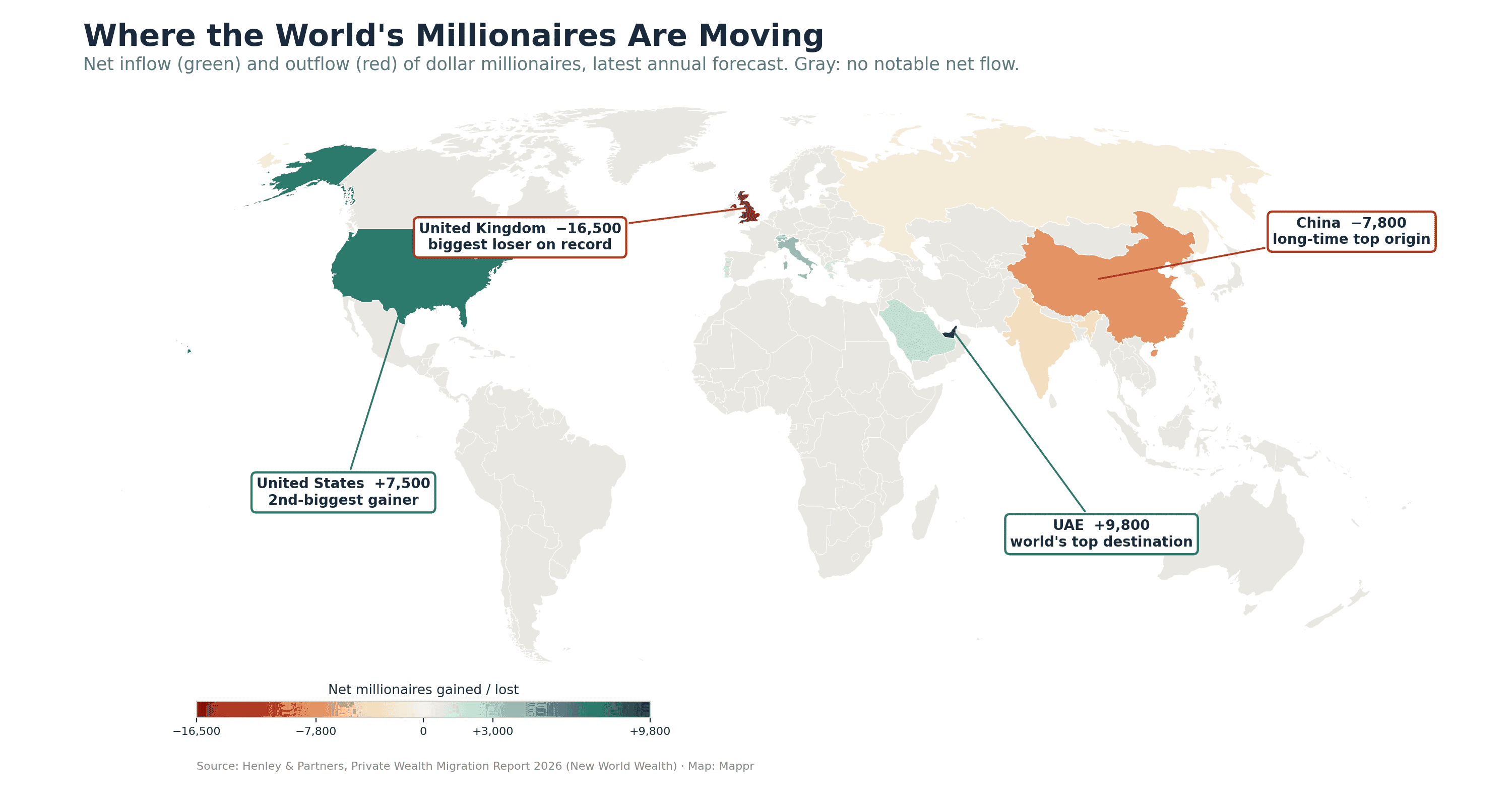
Where the world’s millionaires are moving
Green countries are net gainers of millionaires; red countries are net losers. The Gulf, the United States and Southern Europe are pulling wealth in, while the UK, China, India and South Korea are the biggest sources of departing millionaires.
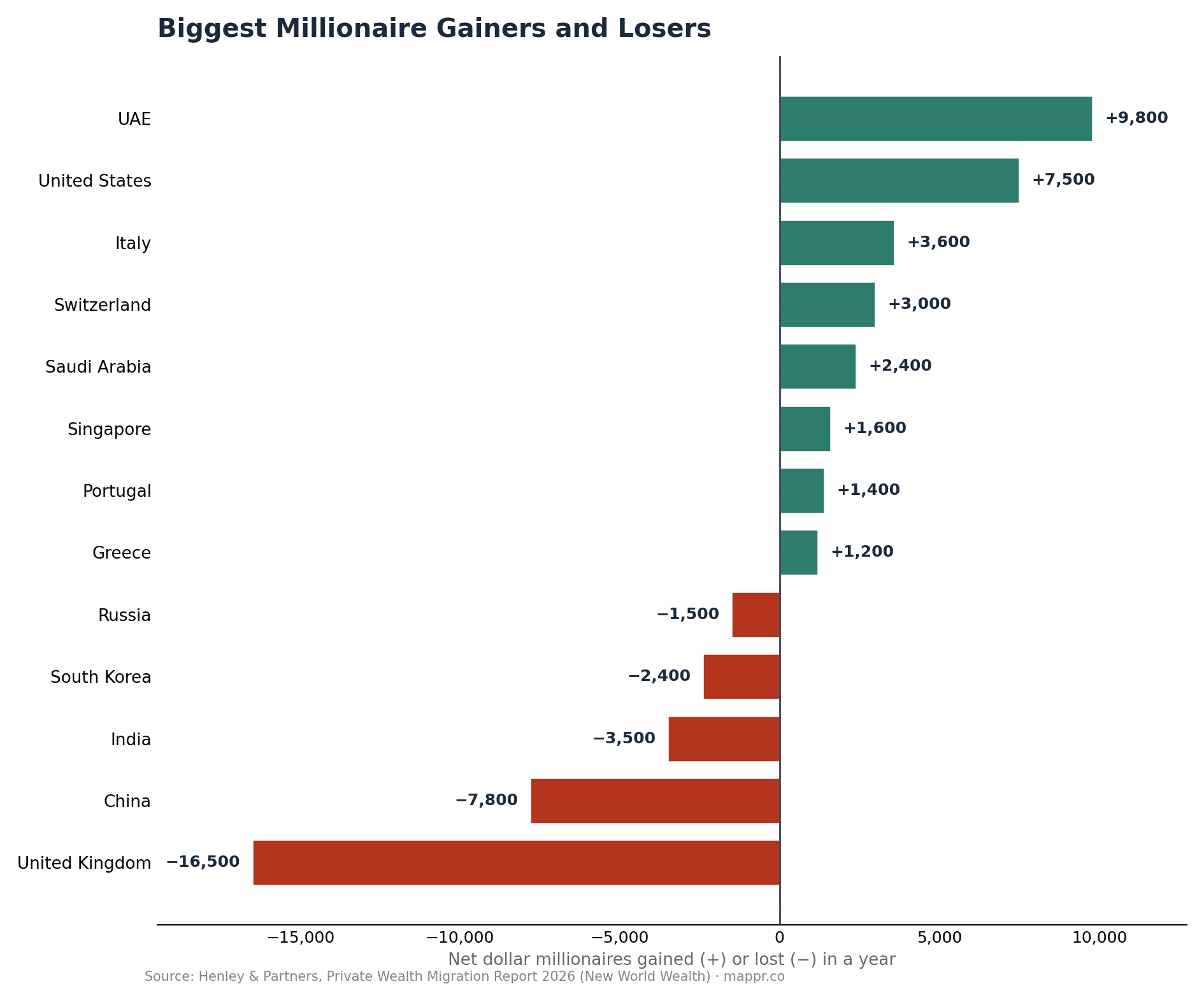
The biggest gainers and losers
The UAE has topped the inflow table for three straight years, but the headline story is the United Kingdom. Britain is forecast to lose a net 16,500 millionaires, the steepest outflow any country has ever recorded and more than double China’s, the nation that had led the departure rankings every year since 2014.
Net wealth migration
Millionaire Movers, 2026
Net dollar millionaires gained (green) or lost (red) in a year. Source: Henley & Partners.
| Country | Net change | Why |
|---|---|---|
| United Arab Emirates | ▲ 9,800 | World's top destination; ~USD 63bn in assets |
| United States | ▲ 7,500 | Deep capital markets and entrepreneurial pull |
| Italy | ▲ 3,600 | Flat-tax regime for new residents |
| Switzerland | ▲ 3,000 | Long-standing safe-haven banking |
| Saudi Arabia | ▲ 2,400 | Fast-rising Gulf wealth hub |
| Singapore | ▲ 1,600 | Tops the new Wealth Mobility score |
| Portugal | ▲ 1,400 | Golden-visa legacy and lifestyle |
| Greece | ▲ 1,200 | Non-dom flat-tax incentives |
| Russia | ▼ 1,500 | Sanctions and isolation |
| South Korea | ▼ 2,400 | Tax and succession pressures |
| India | ▼ 3,500 | Lifestyle and business migration |
| China | ▼ 7,800 | Capital controls and slower growth |
| United Kingdom | ▼ 16,500 | Non-dom reform triggers an exodus |
Why Britain is hemorrhaging millionaires
The UK’s reversal is largely self-inflicted. In 2025 the government abolished the 200-year-old non-domiciled (non-dom) tax regime, which had let wealthy foreign residents shield overseas income from UK tax, and pulled worldwide assets into the inheritance-tax net. Henley reports that applications for alternative residence and citizenship from UK-based clients jumped 15% year on year, with Italy, Greece, Switzerland and the UAE the most common destinations. London, once Europe’s uncontested wealth capital, is now the continent’s biggest net exporter of millionaires.
The new magnets: the Gulf, Asia and Southern Europe
Three clusters are absorbing the outflow. The Gulf, led by the UAE and Saudi Arabia, offers zero income tax, political stability and golden-visa residence. Asia’s financial hubs, above all Singapore, keep drawing wealth from Hong Kong, mainland China and Indonesia. And Southern Europe, through Italy’s flat tax, Greece’s non-dom scheme and Portugal’s residence routes, has turned favorable tax treatment into a wealth-attraction strategy. The United States remains a powerful draw on the strength of its capital markets, despite ranking only mid-table on structural competitiveness.
Singapore tops the new wealth-mobility score
The 2026 edition is the report’s biggest revamp since 2023. Alongside the flow figures, Henley introduced the Wealth Mobility Competitiveness Score, a 0-to-100 index benchmarking jurisdictions across institutional quality, rule of law, financial sophistication, tax policy and capital mobility, using World Bank, IMF, OECD and Global Peace Index data. Singapore leads the world at 79.5, reflecting its stability, financial depth and ability to both attract and retain mobile capital. The framework reflects a shift in how the wealthy think: rather than picking a single new home, Henley notes, they increasingly assemble a portfolio of jurisdictions for residence, business and family, making any single migration count less meaningful than the structural pull of each destination.
About the data
Figures are from the Henley & Partners Private Wealth Migration Report 2026, published 16 June 2026, using underlying data from New World Wealth. “Millionaires” are individuals with liquid investable wealth of USD 1 million or more. Net migration figures are the latest full-year forecast of HNWIs changing their country of residence; the 165,000 total is the 2026 projection. The Wealth Mobility Competitiveness Score is Henley’s new structural index introduced in the 2026 edition. Henley advises on residence and citizenship programs, so its data should be read in that context.