Key Takeaways
- Mining is spread out, refining is not. Critical minerals are dug up in dozens of countries, but the processing that turns raw ore into usable material is overwhelmingly concentrated in one: China.
- China refines 19 of 20 strategic minerals. The IEA finds China is the leading refiner for 19 of 20 strategic minerals, with an average share of about 70%. For rare earths and graphite it is close to 90%.
- Rare earths tell the story best. China mines about 61% of the world's rare earths but refines around 90% of them. It even processes minerals it barely mines, such as cobalt (76%) which comes mostly from the DR Congo.
- That chokepoint is now a weapon. Since 2025 China has rolled out escalating export controls on rare earths and magnets. The IEA warns the concentration puts trillions of dollars of downstream manufacturing outside China at risk.
- The grip is loosening, slowly. Rare-earth refining outside China is finally growing: China's share eased from above 90% to about 85% between 2023 and 2025 as new plants in the US and Malaysia came online.
The clean-energy and technology boom runs on a short list of minerals: the rare earths in wind turbines and electric-motor magnets, the lithium, cobalt, nickel and graphite in batteries, and the copper in almost everything electrified. The world worries about where these come out of the ground. The bigger vulnerability is somewhere else entirely: where they are processed.
Mining is fairly spread out. Refining, the step that turns raw ore into battery-grade or magnet-grade material, is one of the most concentrated activities on Earth. The map below shows the gap, using rare earths as the clearest example.
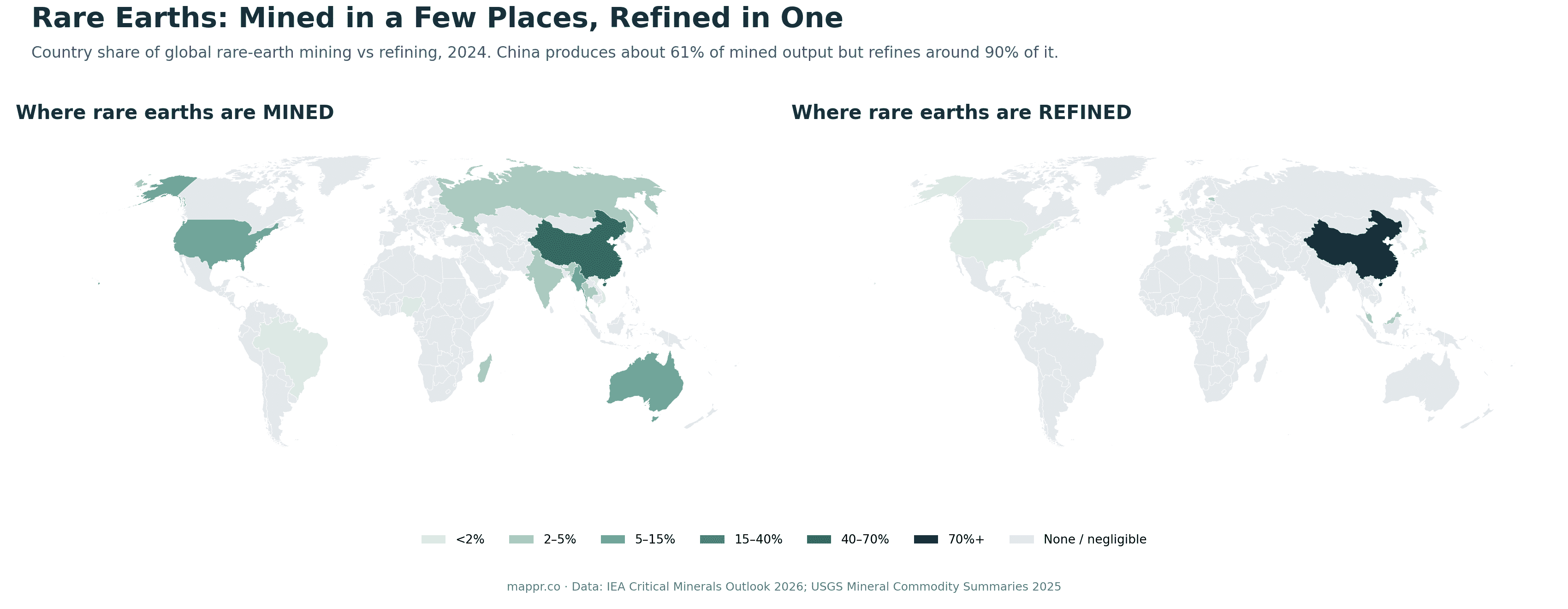
On the left, rare-earth mining is shared between China, the United States, Myanmar and Australia. On the right, refining collapses onto a single country. China mines about 61% of the world’s rare earths but refines roughly 90% of them. The raw material leaves the ground in several places and then funnels through Chinese processing plants before it can be used.
China refines almost everything, even what it barely mines
Rare earths are not the exception. According to the IEA’s Global Critical Minerals Outlook 2026, China is the leading refiner for 19 of the 20 strategic minerals it tracks, with an average share of around 70%.
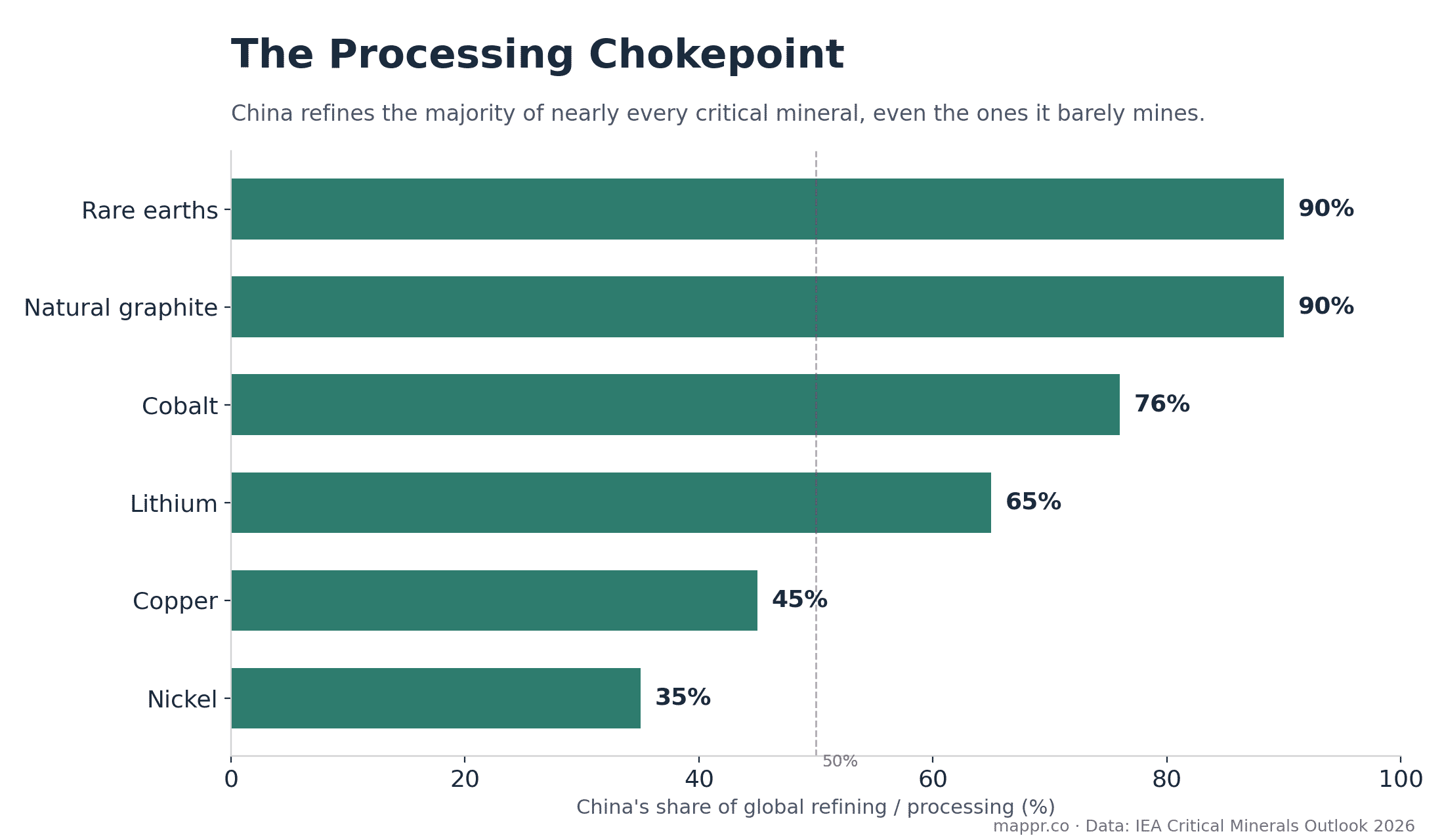
The striking part is that China’s processing dominance does not depend on Chinese mines. Cobalt is dug up mostly in the Democratic Republic of the Congo, yet China refines about 76% of it. Natural graphite and lithium follow the same pattern. Whoever owns the mine, the ore still tends to travel to China to be turned into something a factory can use.
Who mines and who refines, mineral by mineral
The table below pairs the top mine producers with the top refiners for each of the six minerals that matter most to batteries, magnets and the grid. Read across each row and the same shift keeps appearing: a spread of miners, then a much shorter list of processors.
| Mineral | Top miners | Top refiners / processors |
|---|---|---|
| Rare earths | China 61%, US 12%, Myanmar 8% | China ~90%, Malaysia 4%, Estonia 2% |
| Lithium | Australia 33%, Chile 24%, China 18% | China 65%, Chile 29%, Argentina 3% |
| Cobalt | DR Congo 76%, Indonesia 9%, Russia 4% | China 76%, Finland 5%, Canada 3% |
| Nickel | Indonesia 55%, Philippines 11%, Russia 5% | Indonesia 43%, China 29%, Japan 6% |
| Natural graphite | China 78%, Madagascar 6%, Mozambique 5% | China ~90%, rest minimal |
| Copper | Chile 23%, DR Congo 13%, Peru 10% | China 45%, Chile 8%, Japan 6% |
Why this map suddenly matters
A processing chokepoint is only a problem if someone decides to squeeze it. Since 2025, China has done exactly that. It began with export controls on seven heavy rare earths and the magnets made from them in April 2025, expanded them in October to cover foreign-made products containing Chinese rare earths, then paused the broadest measures at the Busan summit in November while keeping the underlying licensing system in place. Further additions followed into 2026.
The IEA’s July 2026 assessment put a number on the stakes: the concentration of refining leaves trillions of dollars of manufacturing outside China, from carmakers to defence contractors, exposed to a single country’s licensing decisions. Magnets that cost a few dollars can idle an entire assembly line if they stop arriving.
The grip is loosening, but slowly
There is a countertrend, and the map hints at it. Rare-earth refining outside China is finally being built. China’s share of global rare-earth refining eased from above 90% to about 85% between 2023 and 2025 as new separation plants came online in the United States and Malaysia. It is a small crack in a very concentrated system, and closing the gap for minerals like graphite and heavy rare earths will take years and a lot of capital.
For now, the story of critical minerals is not really about who owns the mines. It is about who runs the refineries. For more on the transition these materials feed, see our maps of renewable electricity by country and gold reserves by country. We’ll update this page as the IEA and USGS release new figures.