Key Takeaways
- 30.5 million refugees, 117 million displaced. UNHCR's 2025 data counts 30.5 million refugees by country of asylum — part of a broader 42.5 million refugees and 117 million forcibly displaced people worldwide.
- Germany, Türkiye and Iran host the most. Each shelters roughly 2.5–2.7 million refugees, followed by Uganda, Pakistan and Chad — five of the top ten are developing countries.
- Per person, the load is heaviest in the poorest places. Lebanon hosts about 124 refugees per 1,000 residents, Chad 70 and Jordan 47 — and the GDP-relative burden falls overwhelmingly on low-income states.
- A few crises drive most of it. Venezuela, Syria, Ukraine and Afghanistan are the largest sources of displaced people — 6.5, 5.5, 5.3 and 4.8 million respectively.
- Counting method changes the map. Map refugees only and Germany leads; count everyone needing protection and the United States and Colombia jump to the top, because most Venezuelans are classed separately from refugees.
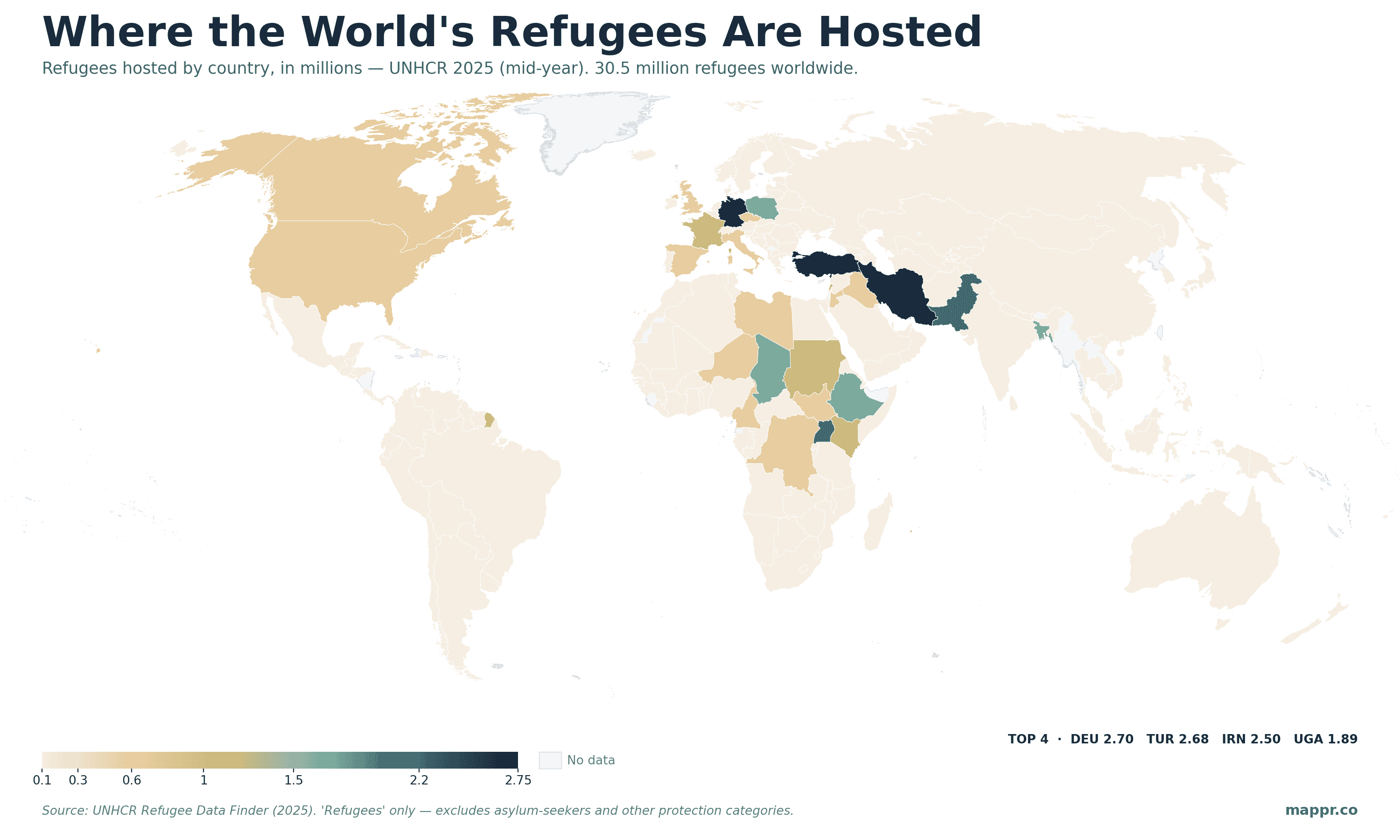
Every year on 20 June, World Refugee Day marks one of the defining crises of our time. As of mid-2025, the UN refugee agency (UNHCR) counted 117.3 million people forcibly displaced worldwide — and about 30.5 million refugees hosted across the countries mapped below. A question often lost in the headline numbers: where do they actually go? The answer upends a common assumption — most of the world’s refugees are sheltered not by rich Western states, but by the developing countries next to conflict.
How Many Refugees Are There?
It depends on how you count. UNHCR’s 2025 data records 30.5 million refugees by country of asylum — the cleanest measure of “where refugees are hosted,” and the one mapped above. A broader UNHCR headline of 42.5 million refugees adds people in refugee-like situations, others needing international protection, and Palestinians under UNRWA. Wider still, 117.3 million people are forcibly displaced once you include the 64 million internally displaced within their own countries and 8.4 million asylum-seekers awaiting a decision. Notably, the total fell from a record 123 million at the end of 2024 — the first decline in years.
Who Hosts the World’s Refugees?
By absolute numbers, the largest hosts are Germany, Türkiye and Iran — each with around 2.5 to 2.7 million refugees — followed by Uganda, Pakistan and Chad. Türkiye’s are overwhelmingly Syrian, Iran’s mostly Afghan, and Germany’s a mix led by Ukrainians and Syrians. Strikingly, half of the top ten are lower-income countries bordering conflict.
| Rank | Host country | Refugees | Asylum-seekers |
|---|---|---|---|
| 1 | 🇩🇪 Germany | 2,703,856 | 320,133 |
| 2 | 🇹🇷 Türkiye | 2,680,658 | 132,383 |
| 3 | 🇮🇷 Iran | 2,497,514 | 0 |
| 4 | 🇺🇬 Uganda | 1,887,594 | 39,990 |
| 5 | 🇵🇰 Pakistan | 1,547,260 | 220,540 |
| 6 | 🇹🇩 Chad | 1,430,067 | 8,791 |
| 7 | 🇧🇩 Bangladesh | 1,143,178 | 35 |
| 8 | 🇪🇹 Ethiopia | 1,015,145 | 64,674 |
| 9 | 🇵🇱 Poland | 1,013,082 | 13,250 |
| 10 | 🇸🇩 Sudan | 832,566 | 48,998 |
| 11 | 🇫🇷 France | 751,218 | 77,412 |
| 12 | 🇱🇧 Lebanon | 719,482 | 7,429 |
The Burden Looks Very Different Per Person
Raw totals favour big countries. Measured against population, the strain falls hardest on small or poor states near conflict. Lebanon hosts about 124 refugees for every 1,000 residents — more than one in eight people — with Chad, Moldova, South Sudan and Jordan close behind. And relative to the size of their economies, the load is concentrated almost entirely in low-income countries: Chad, South Sudan, Lebanon and Uganda carry the heaviest GDP-relative burden of all.
| Host country | Refugees per 1,000 residents | Refugees |
|---|---|---|
| 🇱🇧 Lebanon | 123.9 | 719,482 |
| 🇹🇩 Chad | 70.4 | 1,430,067 |
| 🇲🇩 Moldova | 55.5 | 133,256 |
| 🇸🇸 South Sudan | 48.6 | 580,926 |
| 🇯🇴 Jordan | 46.8 | 541,165 |
| 🇦🇲 Armenia | 45.5 | 138,054 |
| 🇱🇾 Libya | 42.8 | 315,661 |
| 🇺🇬 Uganda | 37.7 | 1,887,594 |
| 🇨🇿 Czechia | 34.9 | 381,013 |
| 🇨🇾 Cyprus | 34.8 | 47,249 |
| Host country | Refugees per $1B of GDP | Income group |
|---|---|---|
| 🇹🇩 Chad | 73,266 | Low income |
| 🇸🇸 South Sudan | 48,419 | Low income |
| 🇱🇧 Lebanon | 35,833 | Lower-middle |
| 🇺🇬 Uganda | 35,013 | Low income |
| 🇧🇮 Burundi | 33,822 | Low income |
| 🇨🇫 Central African Rep. | 19,762 | Low income |
| 🇳🇪 Niger | 19,715 | Low income |
| 🇸🇩 Sudan | 16,761 | Low income |
Where the World’s Refugees Come From
A handful of crises generate most of the world’s displaced. Venezuela tops the list with about 6.5 million people in a refugee-like situation, followed by Syria (5.5 million), Ukraine (5.3 million) and Afghanistan (4.8 million). South Sudan and Sudan round out the top tier — and Sudan’s civil war was the single biggest source of new displacement in 2025, pushing millions into Chad, Egypt, South Sudan and beyond.
Why the Map Changes If You Count Differently
One caveat worth understanding: the map above counts refugees only. Switch to the broadest measure — refugees plus asylum-seekers plus “others needing international protection” — and the picture flips toward the Americas. The United States becomes the single largest host on that basis (driven by millions of pending asylum cases), and Colombia and Peru leap up the ranking. The reason is technical but important: the roughly 6.5 million Venezuelans living abroad are mostly counted as “other people in need of international protection,” not as refugees — so they don’t appear on the refugees-only map, even though Colombia alone shelters millions of them.
A Rare Year of Returns
For all the grim records, mid-2025 carried a flicker of better news. Roughly 2 million refugees returned home in the first half of the year — about five times as many as a year earlier. The largest movement was to Syria, where some 526,000 people went back after the fall of the Assad regime. Afghans and Sudanese also returned in large numbers — enough to pull the global total down for the first time in years, even as new wars, in Sudan above all, kept the crisis far from over.
Refugee figures are from UNHCR's 2025 (mid-year) data via the Refugee Data Finder; population and GDP denominators from the World Bank. 'Refugees' excludes asylum-seekers and other protection categories unless stated.