Key Takeaways
- The scale: ~49,000 crossings in 24 hours. What began Thursday as an estimated 2,000 to 3,000 crossings was revised drastically upward: Spain's Interior Ministry says about 49,000 people entered Ceuta in roughly 24 hours, more than half the city's population. Ceuta's president put the figure as high as 60,000. The military deployed to Ceuta and to Melilla, which saw 300 to 400 crossings of its own.
- A mounting death toll. By mid-August the toll had reached at least 100 in Ceuta, with 11 more on the Moroccan side at Fnideq, for a total of at least 111 dead. Some drowned; others were crushed trying to climb the breakwater and fence. It is the deadliest event in the enclaves' modern history.
- Geography is the whole story. Ceuta is 18.5 km² of Spain, and therefore of the European Union, attached to Morocco. An 8 km double fence seals the land border, so most crossings happen by sea, swimming around the breakwaters at El Tarajal and Benzú.
- The only route that's growing. EU-wide irregular crossings fell 37% in the first half of 2026, but the Western Mediterranean route into Spain rose 17%, the only major route to increase, according to Frontex.
- An echo of 2021. May 2021's crisis, 8,000 people in two days, was the previous record. This surge was roughly six times larger in a single day, and unlike 2021 it appears driven not by a diplomatic rupture but by a Spanish Supreme Court ruling and rumors spread around it.
Spain is deploying its military to Ceuta, its small enclave on the North African coast, after an estimated 49,000 people crossed from Morocco in roughly 24 hours starting July 30, 2026, by far the largest border surge in the enclave’s history. At least 100 people died in Ceuta, and 111 including the Moroccan side, most of them in the water, the deadliest crossing in the enclaves’ history.
To understand why this keeps happening in the same few hundred meters of coastline, you need a map. Ceuta is one of the strangest borders on Earth: 18.5 square kilometers of the European Union attached to Africa, sealed off by an 8 km double fence that ends, on both sides, at a beach.
Where the crossings happen
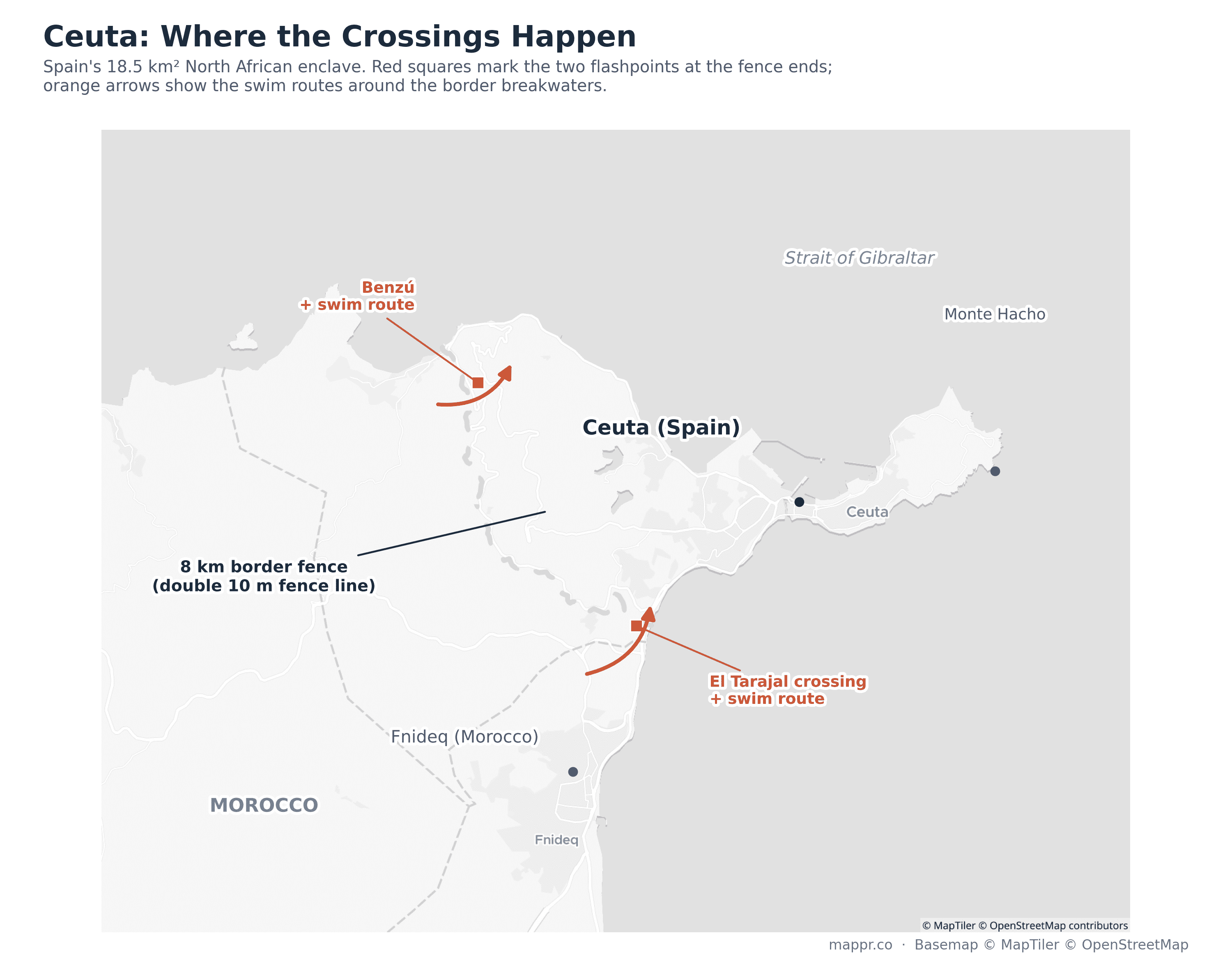
The land border is effectively closed: a parallel pair of 10-meter fences runs the full 8 km from Benzú on the northern shore to El Tarajal in the south, where Ceuta’s only official crossing to Morocco sits next to a beach. So the pressure concentrates at the two points where the fence meets the sea.
That is where this week’s surge unfolded. Crowds gathered on the Moroccan side near Fnideq and swam around the border breakwaters, many using inflatable inner tubes; others came over the fence itself or ran along the breakwater rocks. On Tuesday, July 28 alone, Spanish and Moroccan coastguards rescued about 600 people from the water in a single day, and Ceuta declared a humanitarian emergency as its reception facilities overflowed.
Casualties and latest updates
Latest developments
- August 5 to 17 (latest): The death toll is revised upward to at least 100 in Ceuta, and 111 including 11 deaths at Fnideq on the Moroccan side, as more bodies are recovered and identified. Almost everyone who crossed has now returned to Morocco, but an estimated 862 unaccompanied minors remain in Ceuta under legal protection from return. The European fallout hardens: France reimposes checks at its border with Spain, Finland, the Czech Republic, Sweden, Denmark and Austria back suspending Schengen with Spain, and 22 EU heads of government sign a joint letter blaming Spain’s migration policy as a “pull factor.” The European Commission offers Frontex support for surveillance and returns.
- August 4 (latest): The crisis stabilizes. Spain says about 70,000 of the roughly 72,000 who crossed have now been returned to Morocco, with an estimated 2,500 to 5,000 migrants still in Ceuta, many camped near the shoreline. Crossings have stopped since 1 August. EU home affairs ministers hold an emergency video conference on the response, and Morocco confirms 11 deaths on its side of the border.
- August 2: The death toll rises to at least 72 as five more bodies are found along Ceuta’s coastline, and Spanish officials warn it may climb further. More than 1,000 people have been treated by health services since Thursday. The Civil Guard begins DNA and fingerprint identification of the dead, expected to take about a week.
- August 1 to 2: The wider fallout lands: 22 EU member states call for coordinated border action, Italy suspends Schengen passport-free travel with Spain, and Spain begins installing a floating barrier off Ceuta’s coast. Residents of Ceuta shut down a far-right anti-migrant rally in the city. More than 48,000 of those who crossed have already returned to Morocco.
- July 31 (evening): The toll rises sharply as recoveries continue: Spanish authorities cite at least 57 dead by Friday evening (Reuters), up from 18 reported in the morning and 34 at midday. The Interior Ministry revises the scale of the surge to about 49,000 crossings in roughly 24 hours, and says most people have already gone back: roughly 48,300 returned to Morocco by evening, at one point at a rate of about 150 per minute. On the Moroccan side, authorities deploy water cannon at the Fnideq gates to push crowds back.
- July 31 (afternoon): Prime Minister Pedro Sánchez visits Ceuta with Interior Minister Fernando Grande-Marlaska. Officials link the surge to a Spanish Supreme Court ruling earlier in July, which barred summary returns of migrants intercepted at sea en route to Ceuta or Melilla; Sánchez says smuggling networks amplified the ruling with false rumors that the border was effectively open. Melilla records 300 to 400 crossings of its own overnight, and troops reinforce both enclaves.
- July 31 (morning): Spanish military units begin arriving to reinforce the Civil Guard along the fence and the shoreline. Regional president Juan Jesús Vivas says reception centers are “collapsed and saturated” after more than 1,500 sea arrivals in about a week, and calls for sustained support from Madrid.
- July 30: The surge peaks: Spanish state broadcaster TVE reports 2,000 to 3,000 people crossed in a single day, swimming around the breakwaters and breaching sections of the fence. At least nine people die in the attempt. Spain announces it will deploy the military to restore order at the border.
- July 28: Spanish and Moroccan coastguards rescue about 600 people attempting the swim in one day. Ceuta declares a humanitarian emergency as its single reception center overflows.
- July 26: The Civil Guard calls it “Tragic Sunday” after four people are found dead following swim attempts, as the surge begins building over the weekend.
Why Ceuta? Spain’s African enclaves
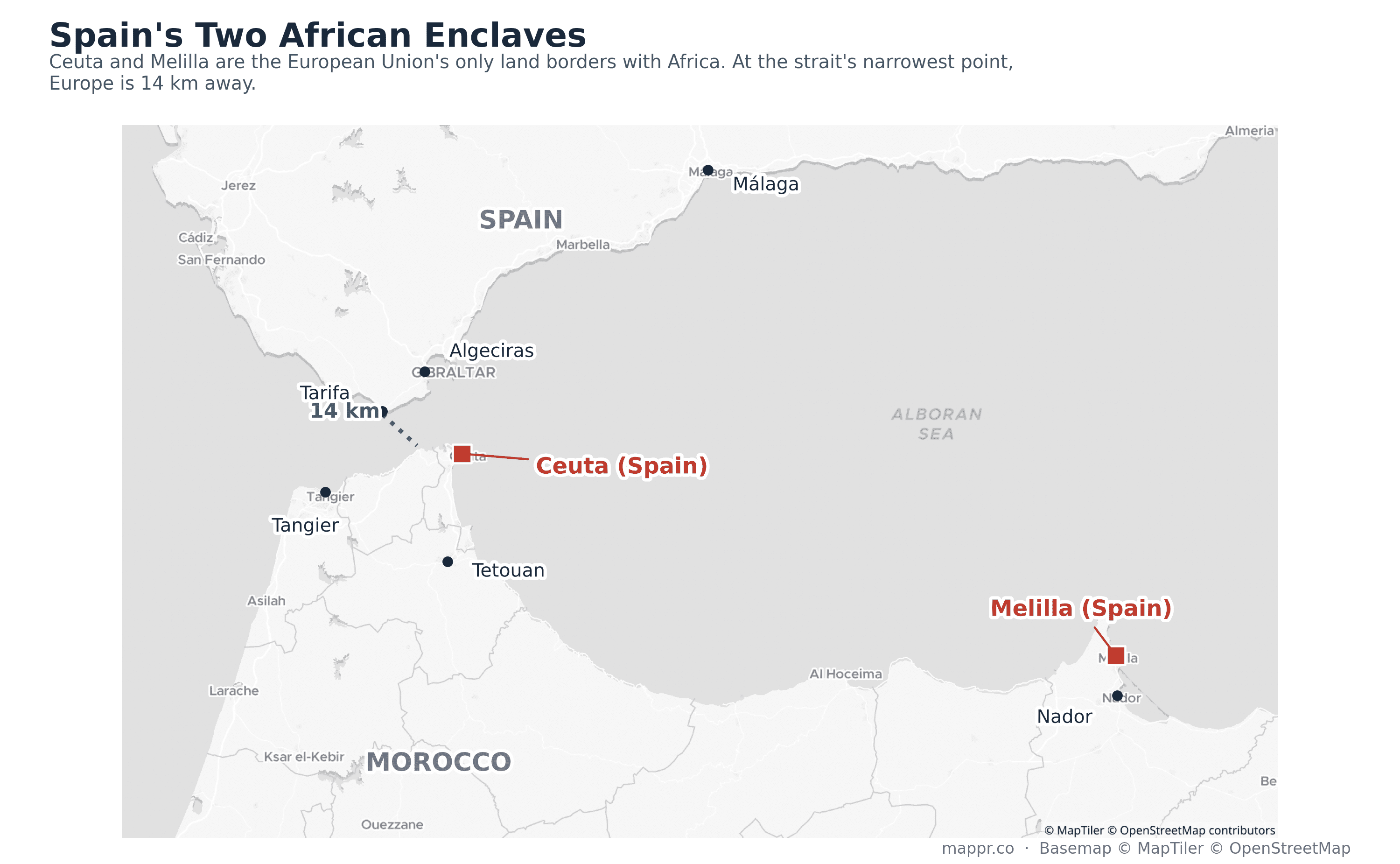
Ceuta and its sister city Melilla, about 380 km east along the coast, are the European Union’s only land borders with Africa. Both are fully Spanish territory: their residents are EU citizens, and setting foot on their soil means setting foot in Spain. Ceuta has been ruled from the Iberian Peninsula since the Portuguese took it in 1415 (it passed to Spain in 1580), and Melilla has been Spanish since 1497, centuries before Morocco existed as a modern state.
Morocco has claimed both cities since its independence in 1956, and the enclaves have repeatedly become pressure valves in the relationship between Rabat and Madrid. In May 2021, when relations soured over Western Sahara, Moroccan border guards briefly stood aside and more than 8,000 people walked and swam into Ceuta in 48 hours. This week dwarfed that: roughly 49,000 crossings in a single day. But the driver looks different. Officials point to a Spanish Supreme Court ruling earlier in July that barred summary returns of migrants intercepted at sea, and to smuggling networks spreading rumors that the door had opened; Morocco, far from standing aside, deployed water cannon to hold crowds back at the gates.
The wider geography does the rest. At its narrowest point, the Strait of Gibraltar puts mainland Europe just 14 km from Africa, a gap we covered in our guide to the world’s most important straits. But crossing the open strait requires a boat and calm seas. Reaching Ceuta requires swimming a few hundred meters around a breakwater. For people already in northern Morocco, the enclave is the shortest path to EU soil that exists anywhere.
The only migration route that’s growing
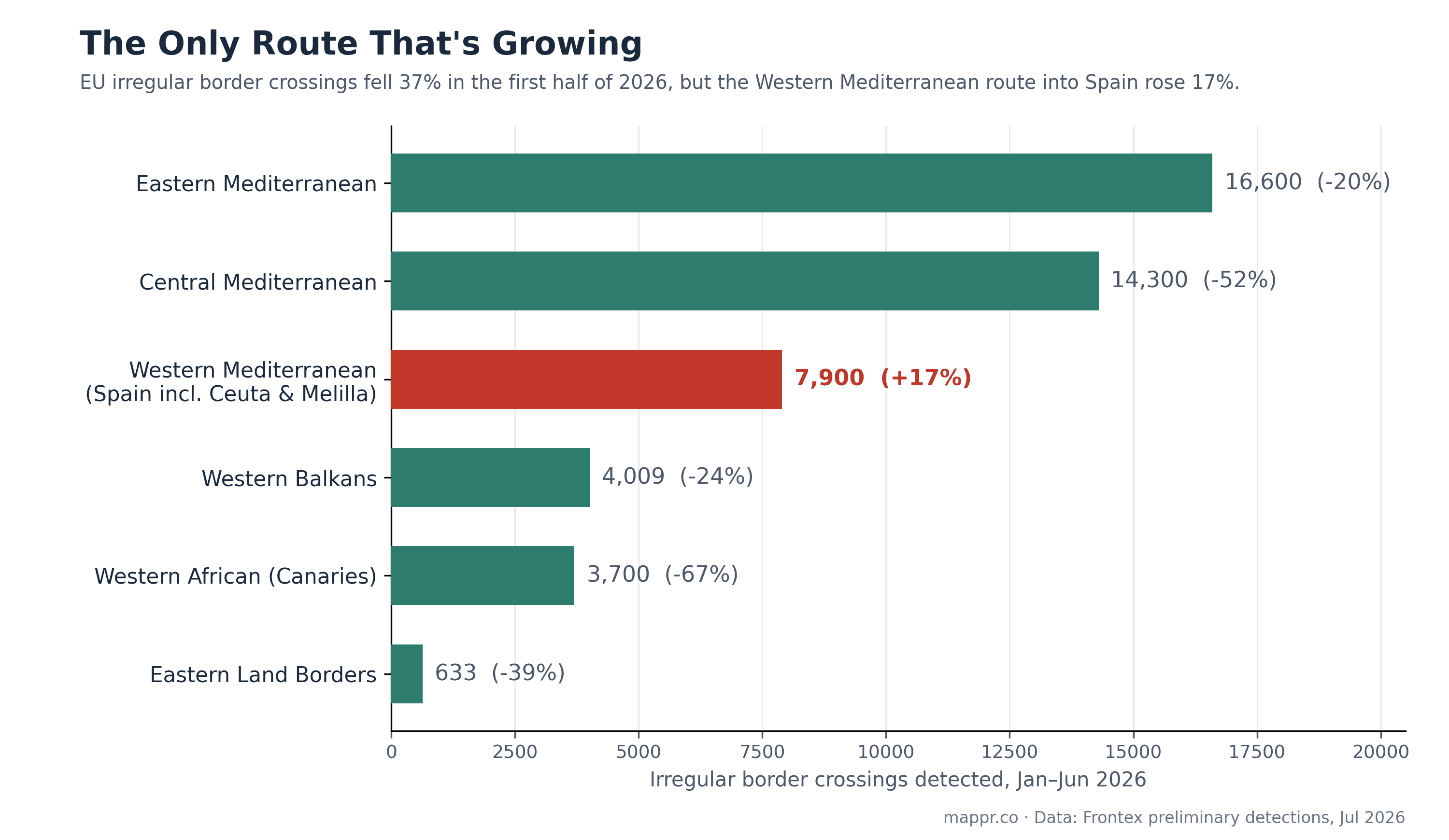
The surge cuts against the broader European trend. Frontex, the EU’s border agency, recorded just over 49,000 irregular crossings in the first half of 2026, down 37% year-on-year, with the Western African route to the Canaries down 67% and the Central Mediterranean down by more than half.
The Western Mediterranean route into Spain is the exception: up 17%, the only major route to grow. Frontex attributes the rise mainly to departures shifting toward Algeria as controls tightened in Morocco and on neighboring routes, with the Balearic Islands absorbing nearly half of the route’s arrivals. Ceuta’s week shows the other face of the same pressure: when sea routes tighten, the enclaves’ fences and breakwaters become the fallback.
The human cost runs through all of it. According to the International Organization for Migration, nearly 1,300 people have died in the Mediterranean so far this year, and Ceuta’s regional president says around 60 bodies were spotted in the waters off the city in the past year alone.
What happens next
The military deployment buys Ceuta control of the shoreline, but not a solution. The city of 83,000 has a single reception center, and a large share of this week’s arrivals are reported to be unaccompanied minors, who under Spanish law cannot simply be returned and become the city’s responsibility, a recurring point of crisis since 2021.
The bigger questions are diplomatic: whether Rabat tightens control on its side of the fence, and what Madrid offers in return. That dynamic, more than any fence, has always decided how many people reach Ceuta’s beaches. We’ll keep this page and the maps updated as the situation develops.
Sources: