Key Takeaways
- About 476 million people, across 90 countries. Indigenous peoples make up roughly 6% of the world's population and belong to more than 5,000 distinct groups. Around 70% of them live in the Asia-Pacific region.
- Marked on 9 August. This map is published for the International Day of the World's Indigenous Peoples. The 2026 UN theme is "Indigenous Peoples and AI: Defending Rights, Shaping Futures."
- Two very different maps. By share of population, the leaders are places like Greenland, Bolivia and Guatemala. By sheer numbers, China and India dominate, together accounting for close to half the world total.
- Greenland stands alone. Around 89% of Greenland's population is Inuit, the highest indigenous share of any country or territory on the map.
- The numbers come with real caveats. "Indigenous" is defined differently in every country. Some count by self-identification, others by language, and a few by broad ethnic-minority categories, so the figures are estimates, not a precise ranking.
Today, 9 August, is the International Day of the World’s Indigenous Peoples. There are roughly 476 million of them, spread across some 90 countries and more than 5,000 distinct groups, from the Inuit of the Arctic to the Adivasi of India and the Maya of Central America. That is about 6% of humanity. The map below shows where they make up the largest share of the population.
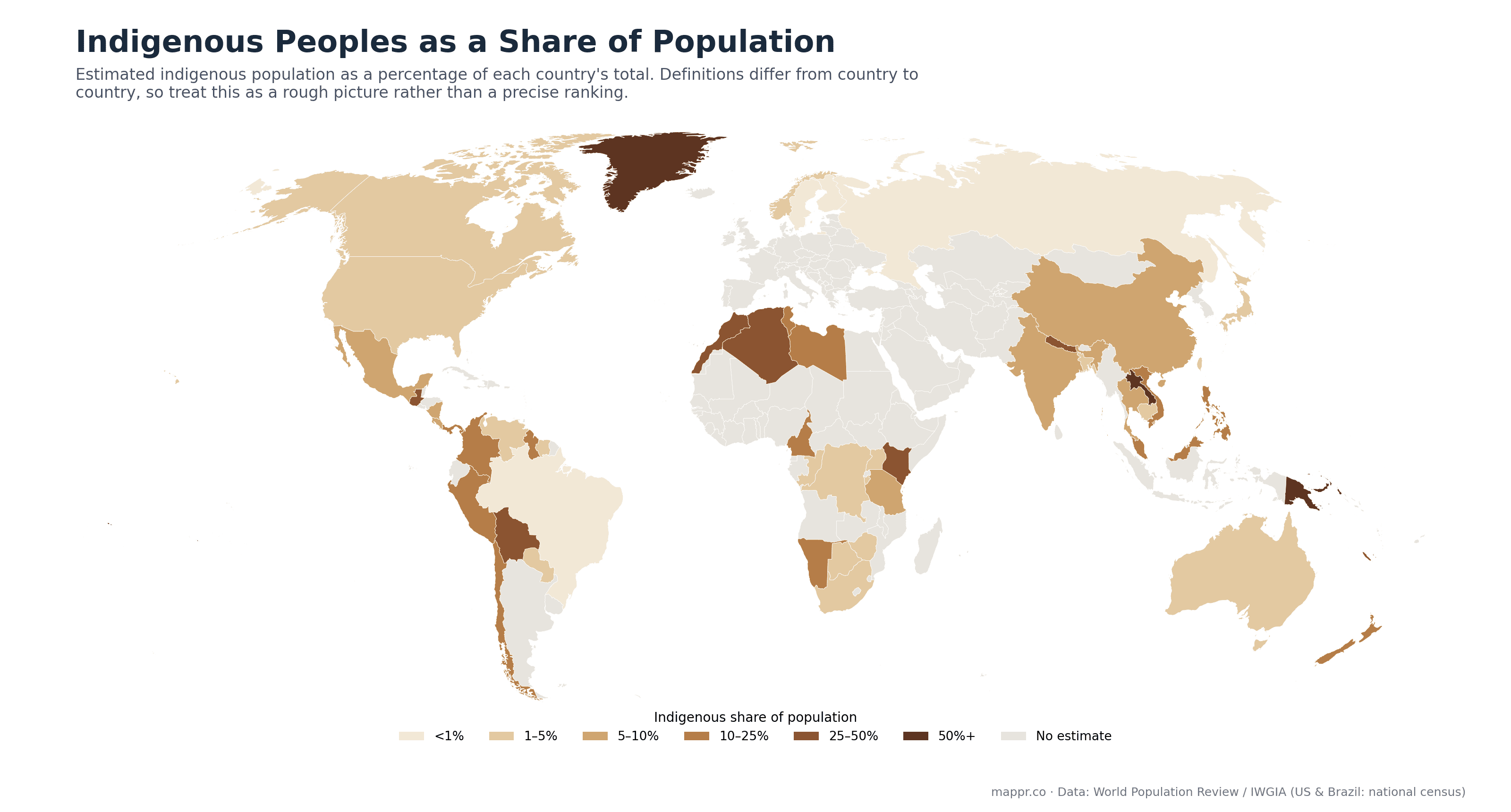
The darkest countries are where indigenous peoples are a large part of, or even most of, the population. Greenland tops the list, with around 89% Inuit. Several Pacific island nations and territories are close behind, and in Latin America both Bolivia (about 41%) and Guatemala (about 44%) are near the top. Pockets of the Andes, Southeast Asia and North Africa also stand out.
Where the most indigenous people actually live
Share of population and total numbers tell two different stories. Switch from percentages to raw headcount and the map’s centre of gravity shifts dramatically to Asia, home to roughly 70% of the world’s indigenous people.
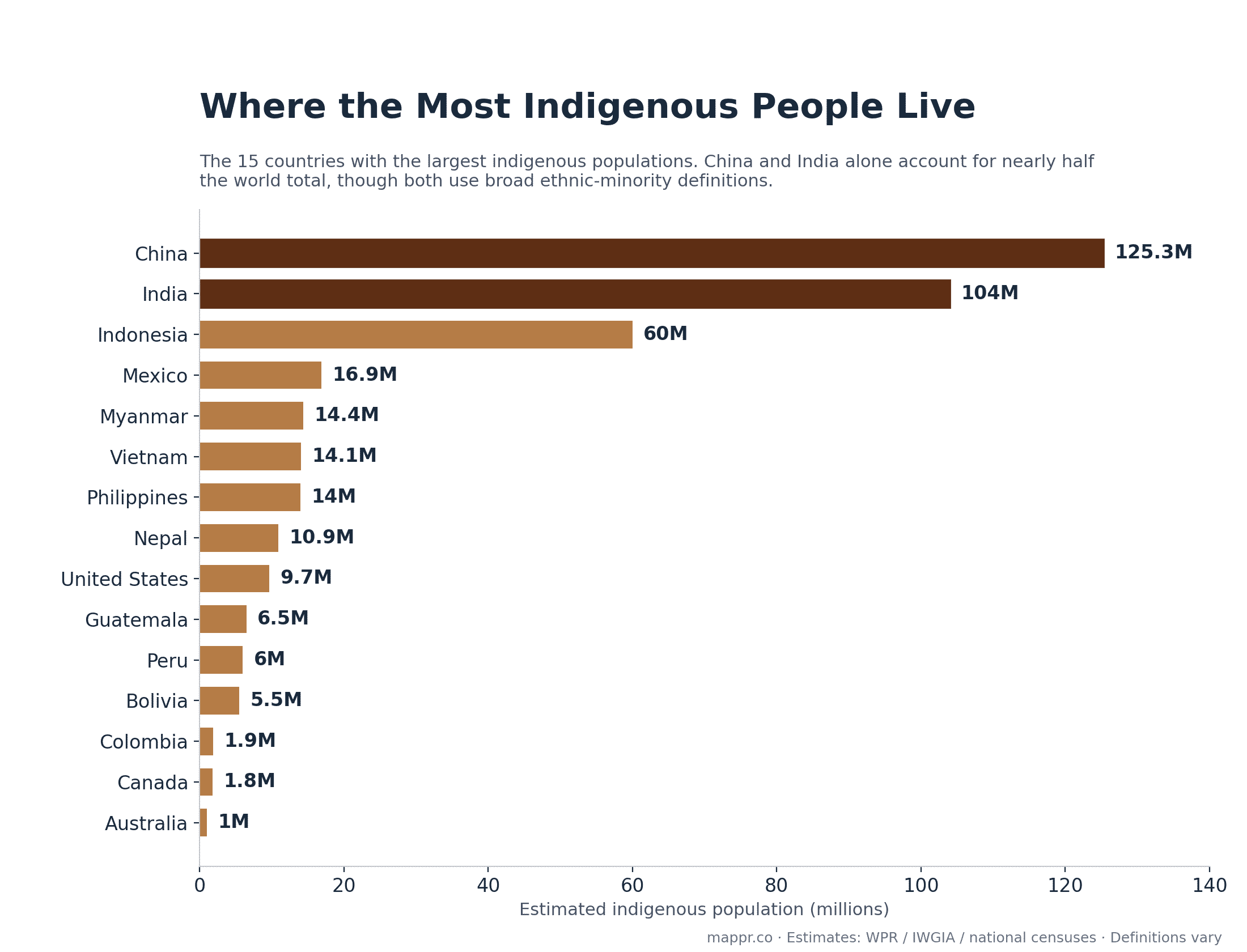
China and India alone account for close to half the world total, with roughly 125 million and 104 million people respectively. Both figures rest on broad ethnic-minority definitions, and whether all of those groups would describe themselves as indigenous is genuinely debated. After the two giants come Indonesia, Mexico, Myanmar, Vietnam and the Philippines, before the more familiar names of Latin America and the settler-colonial states of the Americas and Oceania.
Why the numbers are slippery
It is worth being honest about what these maps can and cannot show. Because there is no agreed international definition, national statistics count very different things, and several countries are still processing 2026 census data. A country can appear to have few indigenous people simply because it counts them narrowly, or many because it counts them broadly. The gap between the share map and the numbers map is not an error; it is a reflection of how contested and varied the very idea of “indigenous” is around the world. What the maps do show clearly is that indigenous peoples are a substantial and global presence, on every inhabited continent, and far from a historical footnote.