Key Takeaways
- 181 countries, one clear geography. The Women, Peace and Security Index 2025/26 (Georgetown University) scores how women fare on inclusion, justice and security. The bottom of the table is a band running from the Sahel through Central Africa to the Middle East and Afghanistan; the top is dominated by Nordic Europe.
- Afghanistan is last, again. Afghanistan scores 0.279, the worst of all 181 countries, after Taliban edicts stripped women of schooling, work and movement. Denmark leads at 0.939, more than three times higher. Yemen, the Central African Republic, Syria and Sudan complete the bottom five.
- War and patriarchy feed each other. Nearly every bottom-20 country is in conflict or fragile: where states collapse, women's rights collapse fastest. The index's authors find the gap between the best and worst countries keeps widening.
- The bias is global, not just legal. The UNDP's Gender Social Norms Index finds about 9 in 10 people worldwide, women included, hold at least one bias against women, and roughly a quarter believe a man is justified in beating his wife. Patriarchy persists in attitudes even where laws improve.
- Parity is still a century away. The WEF's Global Gender Gap Report 2025 puts the world at 68.8% of the way to parity and estimates 123 years to close the gap at the current pace. Even top-ranked Iceland, 16 straight years at #1, has closed only 92.6% of its gap.
“Patriarchy” is easy to argue about and hard to measure. But several major research programs now do exactly that, scoring countries on how much power, safety and opportunity women actually have. The most comprehensive fresh reading is the Women, Peace and Security Index 2025/26, published in October 2025 by Georgetown University’s Institute for Women, Peace and Security with the Peace Research Institute Oslo. It ranks 181 countries on 13 indicators across three dimensions: inclusion (education, jobs, financial access, parliament seats), justice (legal discrimination, son bias, access to courts) and security (intimate partner violence, community safety, proximity to conflict).
We mapped the full index below, alongside what three other landmark studies (the UNDP’s Gender Social Norms Index, the OECD’s Social Institutions and Gender Index, and the WEF’s Global Gender Gap Report 2025) say about where patriarchal laws, institutions and attitudes remain strongest.
The Map: Where Women Fare Worst
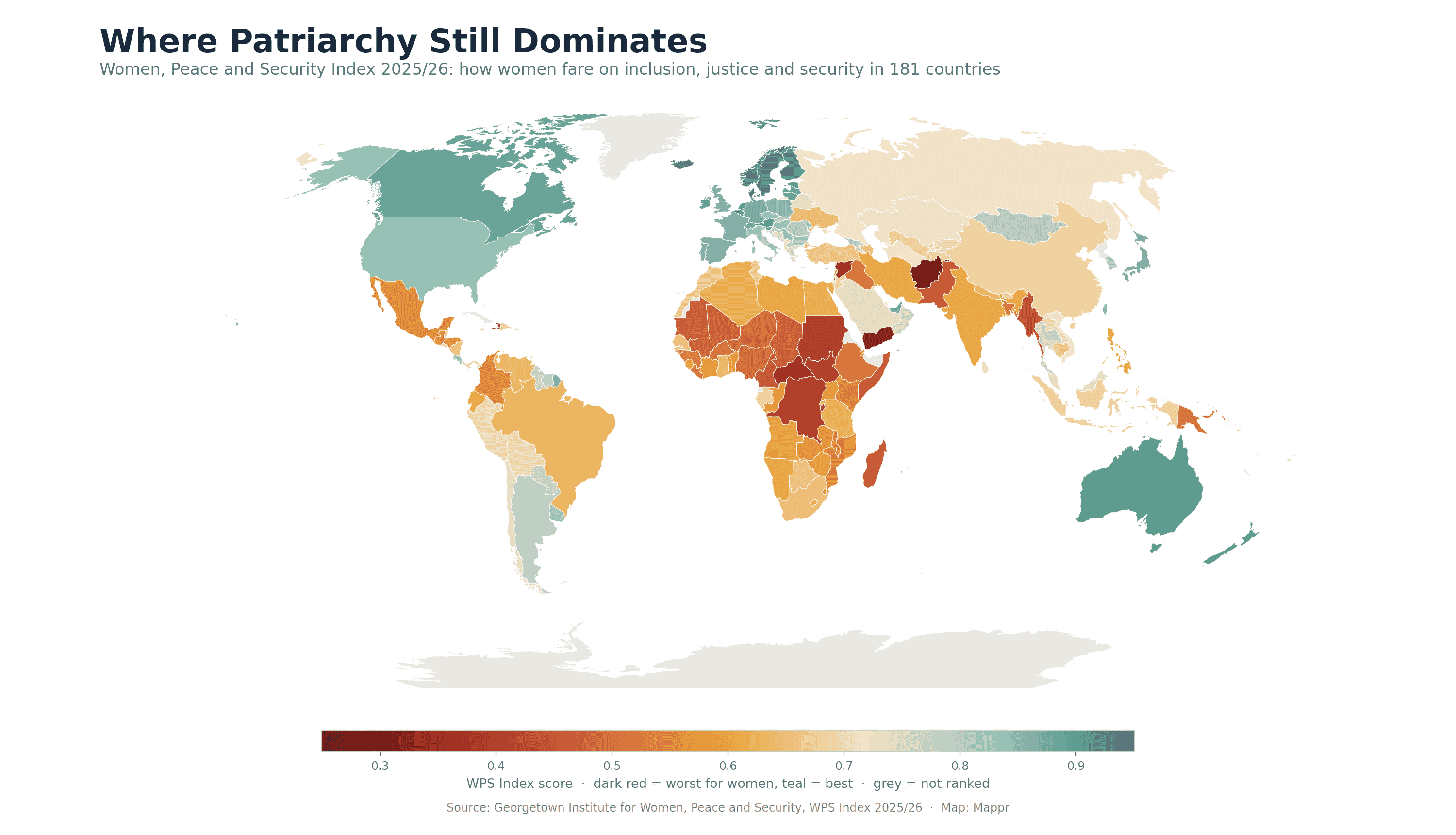
The geography is stark. The deepest reds form a band from the Sahel (Mali, Niger, Chad, Mauritania) through Central Africa (DR Congo, Central African Republic, Burundi, Cameroon) to the Middle East and South Asia (Yemen, Syria, Sudan, Pakistan, Afghanistan), plus Haiti and Myanmar. At the other pole sits Nordic Europe: Denmark, Iceland, Sweden, Norway and Finland fill the top five, and a Danish woman’s composite score (0.939) is more than three times an Afghan woman’s (0.279).
Explore the Data: Interactive Map
Hover or tap any country to see its exact score and rank out of 181. Zoom in for the small states the static map cannot show.
The 20 Countries Where Patriarchy Dominates Most
| Rank (of 181) | Country | WPS Index score |
|---|---|---|
| 181 | Afghanistan | 0.279 |
| 180 | Yemen | 0.323 |
| 179 | Central African Republic | 0.362 |
| 178 | Syria | 0.364 |
| 177 | Sudan | 0.397 |
| 176 | Haiti | 0.399 |
| 175 | DR Congo | 0.405 |
| 174 | Burundi | 0.407 |
| 173 | South Sudan | 0.411 |
| 172 | Myanmar | 0.442 |
| 171 | Cameroon | 0.451 |
| 170 | Somalia | 0.455 |
| 169 | Pakistan | 0.462 |
| 168 | Madagascar | 0.466 |
| 167 | Palestine | 0.469 |
| 166 | Mauritania | 0.475 |
| 165 | Chad | 0.476 |
| 164 | Mali | 0.478 |
| 163 | Niger | 0.492 |
| 162 | Nigeria | 0.495 |
Two threads tie this list together. The first is conflict: nearly every country on it is at war, emerging from war, or effectively without a functioning state. The index’s authors are blunt about the link: armed conflict and state collapse hit women first and hardest, and the gap between the best and worst countries keeps widening.
The second is institutionalized male control. Afghanistan is the extreme case: since 2021 the Taliban have banned girls from secondary school and university, barred women from most work and public spaces, and restricted their movement without a male guardian. But quieter versions of the same architecture (guardianship rules, unequal inheritance, child marriage, impunity for domestic violence) run through most of the bottom 20.
What the Other Studies Show
Attitudes: the UNDP Gender Social Norms Index
Patriarchy is not only written into laws; it lives in heads. The UNDP’s Gender Social Norms Index, drawn from World Values Survey data covering most of the world’s population, finds that about 9 in 10 people, women included, hold at least one fundamental bias against women. Roughly half believe men make better political leaders, about 40% believe men make better business executives, and around a quarter believe a man is justified in beating his wife.
Institutions: the OECD’s SIGI
The OECD’s Social Institutions and Gender Index measures discrimination baked into laws, customs and practices across 179 countries: child marriage, inheritance rules, guardianship, access to land and credit. Its 2023 global report found that 40% of the world’s women and girls live in countries where institutional discrimination is high or very high, and all 18 countries in its worst category are in Africa or Asia, closely mirroring the WPS map above.
Outcomes: the WEF Global Gender Gap
The World Economic Forum’s Global Gender Gap Report 2025 measures outcome gaps in pay, education, health and political power across 148 economies. The world has closed 68.8% of its overall gender gap, and at the current pace the WEF estimates 123 years to full parity. No country has finished the job: Iceland, first for the 16th consecutive year, has closed 92.6% of its gap.
The Flip Side: Where Patriarchy Is Weakest
| Rank | Country | WPS Index score |
|---|---|---|
| 1 | Denmark | 0.939 |
| 2 | Iceland | 0.932 |
| 3 | Sweden | 0.924 |
| 3 | Norway | 0.924 |
| 5 | Finland | 0.921 |
| 6 | Luxembourg | 0.918 |
| 7 | Belgium | 0.912 |
| 8 | Netherlands | 0.905 |
| 9 | New Zealand | 0.898 |
| 9 | Austria | 0.898 |
The top ten is Northern and Western Europe plus New Zealand. What the leaders share is less about wealth alone (several Gulf states are far richer per head than New Zealand) and more about decades of legal equality, high female labor participation, political representation and low levels of violence. Even here the WEF numbers are a reminder that “best in the world” still is not parity.
Why This Matters
These indexes converge on one conclusion: the status of women is one of the strongest single predictors of how a country is doing overall. The WPS Index correlates tightly with peacefulness, democracy and development; the countries where patriarchy dominates most are also the world’s hungriest, most violent and most fragile. Measuring it, mapping it and tracking it edition to edition is how change becomes visible. We will update this map when the next WPS Index lands in 2027.
Full Table: All 181 Countries Ranked
The complete 2025/26 Women, Peace and Security Index, sortable and searchable. Type a country name in the search box, or click a column header to re-sort by rank or score.
| Rank | Country | WPS Index Score (2025/26) |
|---|---|---|
| 1 | Denmark | 0.939 |
| 2 | Iceland | 0.932 |
| 3 | Norway | 0.924 |
| 3 | Sweden | 0.924 |
| 5 | Finland | 0.921 |
| 6 | Luxembourg | 0.918 |
| 7 | Belgium | 0.912 |
| 8 | Netherlands | 0.905 |
| 9 | Austria | 0.898 |
| 9 | New Zealand | 0.898 |
| 11 | Australia | 0.896 |
| 11 | Estonia | 0.896 |
| 13 | Ireland | 0.891 |
| 14 | Slovenia | 0.889 |
| 15 | Lithuania | 0.887 |
| 16 | Canada | 0.885 |
| 17 | Latvia | 0.884 |
| 17 | Singapore | 0.884 |
| 19 | Switzerland | 0.877 |
| 20 | United Arab Emirates | 0.872 |
| 21 | Germany | 0.869 |
| 22 | Japan | 0.866 |
| 23 | France | 0.864 |
| 23 | United Kingdom | 0.864 |
| 25 | Spain | 0.862 |
| 26 | Portugal | 0.861 |
| 27 | Poland | 0.854 |
| 27 | Taiwan | 0.854 |
| 29 | Serbia | 0.844 |
| 30 | Malta | 0.841 |
| 31 | United States | 0.840 |
| 32 | Czechia | 0.832 |
| 32 | Hungary | 0.832 |
| 34 | Costa Rica | 0.824 |
| 35 | Uruguay | 0.822 |
| 36 | Moldova | 0.821 |
| 37 | South Korea | 0.815 |
| 38 | Bulgaria | 0.814 |
| 39 | Italy | 0.811 |
| 40 | Seychelles | 0.810 |
| 41 | Hong Kong | 0.809 |
| 42 | Barbados | 0.807 |
| 43 | Romania | 0.801 |
| 44 | Mongolia | 0.799 |
| 45 | Georgia | 0.798 |
| 46 | Slovakia | 0.797 |
| 47 | Argentina | 0.791 |
| 48 | Croatia | 0.788 |
| 49 | Grenada | 0.787 |
| 49 | North Macedonia | 0.787 |
| 51 | Suriname | 0.779 |
| 52 | Cyprus | 0.770 |
| 52 | Guyana | 0.770 |
| 54 | Paraguay | 0.768 |
| 55 | Bahrain | 0.765 |
| 56 | Armenia | 0.762 |
| 57 | Thailand | 0.761 |
| 58 | Oman | 0.755 |
| 59 | Bosnia and Herzegovina | 0.753 |
| 60 | Greece | 0.752 |
| 61 | Montenegro | 0.743 |
| 62 | Cabo Verde | 0.741 |
| 63 | Belarus | 0.739 |
| 63 | Chile | 0.739 |
| 63 | Palau | 0.739 |
| 63 | Saudi Arabia | 0.739 |
| 67 | Malaysia | 0.738 |
| 68 | Albania | 0.731 |
| 68 | Fiji | 0.731 |
| 70 | Kuwait | 0.723 |
| 70 | Qatar | 0.723 |
| 72 | Kazakhstan | 0.722 |
| 73 | Viet Nam | 0.721 |
| 74 | Turkmenistan | 0.720 |
| 75 | Russian Federation | 0.718 |
| 76 | Puerto Rico | 0.707 |
| 77 | Sri Lanka | 0.706 |
| 78 | Maldives | 0.704 |
| 79 | Jamaica | 0.703 |
| 80 | Bolivia | 0.701 |
| 80 | Peru | 0.701 |
| 82 | Kosovo | 0.700 |
| 83 | Lao PDR | 0.698 |
| 84 | Israel | 0.697 |
| 84 | Kyrgyzstan | 0.697 |
| 86 | Panama | 0.696 |
| 87 | El Salvador | 0.691 |
| 88 | Jordan | 0.686 |
| 89 | China | 0.685 |
| 89 | Samoa | 0.685 |
| 89 | Tajikistan | 0.685 |
| 89 | Tonga | 0.685 |
| 89 | Trinidad and Tobago | 0.685 |
| 94 | Gabon | 0.679 |
| 94 | Mauritius | 0.679 |
| 96 | Indonesia | 0.678 |
| 97 | Dominican Republic | 0.675 |
| 98 | Uzbekistan | 0.674 |
| 99 | Bhutan | 0.673 |
| 100 | Tunisia | 0.671 |
| 101 | Marshall Islands | 0.670 |
| 102 | Morocco | 0.668 |
| 102 | Timor-Leste | 0.668 |
| 104 | Belize | 0.667 |
| 104 | Cambodia | 0.667 |
| 106 | Türkiye | 0.664 |
| 107 | Nicaragua | 0.659 |
| 108 | Botswana | 0.658 |
| 108 | Solomon Islands | 0.658 |
| 110 | Senegal | 0.657 |
| 111 | Azerbaijan | 0.653 |
| 112 | Kiribati | 0.652 |
| 113 | Federated States of Micronesia | 0.648 |
| 113 | South Africa | 0.648 |
| 115 | Vanuatu | 0.646 |
| 116 | Ukraine | 0.645 |
| 117 | Ghana | 0.639 |
| 118 | Venezuela | 0.638 |
| 119 | Brazil | 0.632 |
| 120 | Nepal | 0.631 |
| 121 | Rwanda | 0.624 |
| 121 | Tanzania | 0.624 |
| 123 | Algeria | 0.621 |
| 124 | São Tomé and Príncipe | 0.620 |
| 125 | Egypt | 0.617 |
| 126 | Lesotho | 0.614 |
| 127 | Ecuador | 0.612 |
| 128 | Iran | 0.608 |
| 128 | Libya | 0.608 |
| 128 | Namibia | 0.608 |
| 131 | India | 0.607 |
| 131 | Philippines | 0.607 |
| 133 | Angola | 0.601 |
| 133 | Sierra Leone | 0.601 |
| 135 | Comoros | 0.590 |
| 135 | Zimbabwe | 0.590 |
| 137 | Côte d’Ivoire | 0.589 |
| 138 | Benin | 0.587 |
| 138 | Uganda | 0.587 |
| 140 | Congo | 0.583 |
| 141 | Lebanon | 0.575 |
| 142 | Zambia | 0.566 |
| 143 | Togo | 0.562 |
| 144 | Guatemala | 0.561 |
| 144 | Honduras | 0.561 |
| 146 | Djibouti | 0.560 |
| 147 | Mexico | 0.558 |
| 148 | Eswatini | 0.556 |
| 149 | Colombia | 0.551 |
| 150 | Malawi | 0.549 |
| 151 | Mozambique | 0.548 |
| 152 | Kenya | 0.542 |
| 153 | Gambia | 0.528 |
| 154 | Guinea | 0.527 |
| 155 | Bangladesh | 0.526 |
| 156 | Ethiopia | 0.516 |
| 157 | Liberia | 0.512 |
| 158 | Iraq | 0.510 |
| 159 | Guinea-Bissau | 0.508 |
| 160 | Burkina Faso | 0.507 |
| 160 | Papua New Guinea | 0.507 |
| 162 | Nigeria | 0.495 |
| 163 | Niger | 0.492 |
| 164 | Mali | 0.478 |
| 165 | Chad | 0.476 |
| 166 | Mauritania | 0.475 |
| 167 | Palestine | 0.469 |
| 168 | Madagascar | 0.466 |
| 169 | Pakistan | 0.462 |
| 170 | Somalia | 0.455 |
| 171 | Cameroon | 0.451 |
| 172 | Myanmar | 0.442 |
| 173 | South Sudan | 0.411 |
| 174 | Burundi | 0.407 |
| 175 | Democratic Republic of the Congo | 0.405 |
| 176 | Haiti | 0.399 |
| 177 | Sudan | 0.397 |
| 178 | Syrian Arab Republic | 0.364 |
| 179 | Central African Republic | 0.362 |
| 180 | Yemen | 0.323 |
| 181 | Afghanistan | 0.279 |