
Since it first became available to the public in 1993, the internet has reshaped the modern world, transforming how we access information, work and communicate.
The countries with the fastest internet are those with the most modern infrastructure, above all widespread fibre-to-the-home networks. This page ranks the fastest fixed broadband in the world using the Ookla Speedtest Global Index (May 2026). The headline change this year is a new leader: the Maldives has overtaken long-time champion Singapore, while fibre-rich newcomers such as France, Iceland and Vietnam have surged up the table and China has slipped out of the top 25. Start with the interactive map, then explore the full ranking below.
Interactive World Map with Internet Speed
List of Fastest Internet (Broadband) by Country
| Rank | vs 2023 | Country | Median Mbps |
|---|---|---|---|
| 1 | new | Maldives | 675.02 |
| 2 | -1 | Singapore | 440.49 |
| 3 | – | United Arab Emirates | 379.19 |
| 4 | -2 | Chile | 364.30 |
| 5 | +8 | France | 352.77 |
| 6 | -1 | Hong Kong (SAR) | 350.53 |
| 7 | new | Iceland | 336.72 |
| 8 | +6 | Macau (SAR) | 315.69 |
| 9 | -2 | United States | 306.86 |
| 10 | +2 | Switzerland | 300.70 |
| 11 | new | Vietnam | 291.82 |
| 12 | -4 | Denmark | 289.14 |
| 13 | -3 | Romania | 287.47 |
| 14 | -8 | Thailand | 286.11 |
| 15 | new | Israel | 283.82 |
| 16 | new | Taiwan | 279.57 |
| 17 | -8 | Spain | 273.81 |
| 18 | -2 | Canada | 272.69 |
| 19 | new | Peru | 262.29 |
| 20 | new | South Korea | 252.67 |
| 21 | new | Portugal | 251.79 |
| 22 | -2 | Hungary | 244.53 |
| 23 | -5 | Kuwait | 243.32 |
| 24 | -9 | Japan | 232.02 |
| 25 | new | Qatar | 230.50 |
1. Maldives
May 2026 median download speed: 675.02 Mbps
The fastest fixed internet in the world now belongs to the Maldives, a result almost nobody would have predicted a few years ago. An aggressive nationwide fibre-to-the-home rollout across the archipelago has pushed the country’s median download speed to a remarkable 675 Mbps, far ahead of every other nation on Earth.
The scale of the lead is striking: the Maldives is more than 230 Mbps faster than second-placed Singapore. Concentrating population on a relatively small number of islands has made blanket fibre coverage achievable, and the tourism-driven economy has every incentive to keep connectivity world-class.
2. Singapore
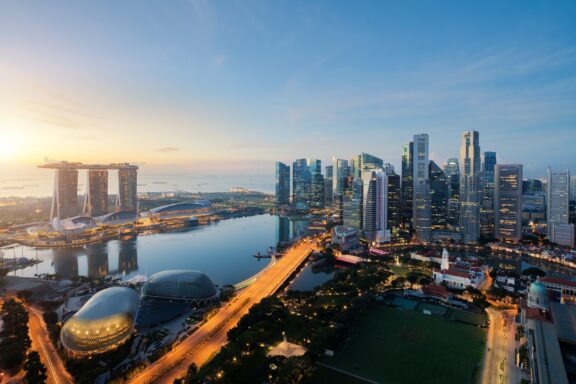
May 2026 median download speed: 440.49 Mbps
For years Singapore held the number-one spot, and it remains a global powerhouse for connectivity at around 440 Mbps. The compact, high-tech city-state has invested heavily in fibre-optic infrastructure, giving almost every household access to ultra-fast broadband.
Singapore has been overtaken only by the Maldives’ extraordinary surge. Its own speeds continue to climb year on year, and it still comfortably leads the rest of Asia for fixed broadband.
3. United Arab Emirates
May 2026 median download speed: 379.19 Mbps
The United Arab Emirates holds firm at number three for fixed broadband, and it is the clear world leader for mobile. Providers Etisalat and du offer nationwide 5G, and more than 99% of the population is online.
The UAE’s investment in digital infrastructure is part of a wider push to position the country as a technology and business hub, and it shows in both its fixed and mobile rankings.
4. Chile
May 2026 median download speed: 364.30 Mbps
Chile has the fastest fixed internet in the Americas, north or south, at around 364 Mbps. It briefly held the global top spot back in 2022 before Singapore and now the Maldives pulled ahead, and it remains a fibre standout.
Sustained investment in fibre-optic infrastructure has kept Chile far ahead of its regional neighbours, though mobile speeds still lag behind its fixed connections.
5. France
May 2026 median download speed: 352.77 Mbps
France is one of the biggest climbers on this list, leaping into the global top five. The country’s long-running France Très Haut Débit fibre programme has finally paid off, bringing full-fibre connections to the vast majority of households.
That national rollout, aimed at replacing older copper lines entirely, has transformed France from a mid-table performer into one of the fastest countries in Western Europe.
6. Hong Kong (SAR)
May 2026 median download speed: 350.53 Mbps
Hong Kong, a special administrative region of China, packs some of the densest fibre infrastructure anywhere into a very small area. That density translates into a median download speed of around 350 Mbps.
High-rise living makes fibre deployment efficient, and fierce competition among providers keeps both speeds and adoption high across the territory.
7. Iceland
May 2026 median download speed: 336.72 Mbps
Iceland is a new entrant to the global elite, and a natural fit for it. Near-universal fibre coverage and a small, concentrated population have pushed the island nation’s median download speed above 336 Mbps.
Iceland has long prioritised digital connectivity as a way to offset its remoteness, and its fibre network now reaches even sparsely populated rural areas.
8. Macau (SAR)
May 2026 median download speed: 315.69 Mbps
Like Hong Kong, Macau is a special administrative region of China rather than an independent country, and it is another example of how compact, densely built territories can deliver blistering broadband. Macau’s median download speed sits above 315 Mbps.
The territory’s main provider, CTM, has steadily upgraded its fibre network, and both fixed and mobile speeds have climbed sharply in recent years.
9. United States
May 2026 median download speed: 306.86 Mbps
The United States remains firmly in the top ten, with a median download speed above 300 Mbps. Providers such as Comcast, Charter and AT&T have expanded fibre and high-speed cable across much of the country.
Speeds still vary widely between well-served cities and rural areas, but large federal investments in broadband infrastructure continue to narrow that gap.
10. Switzerland
May 2026 median download speed: 300.70 Mbps
Switzerland rounds out the global top ten at almost exactly 300 Mbps. Providers including Swisscom, Sunrise and Salt have built out extensive fibre networks, and mobile speeds are among the fastest in Europe too.
The country’s wealth and compact geography make high-quality infrastructure easier to deliver, and government policy has pushed steadily for faster minimum speeds.
11. Vietnam
May 2026 median download speed: 291.82 Mbps
Vietnam is the standout story of Southeast Asia, vaulting into the global top fifteen for fixed broadband while also ranking among the world’s fastest for mobile. A rapid fibre rollout has driven median download speeds close to 292 Mbps.
Government-backed digital-economy targets and intense competition among local carriers have made fast, affordable internet widely available across the country.
12. Denmark
May 2026 median download speed: 289.14 Mbps
Denmark continues to deliver top-tier broadband at nearly 290 Mbps, backed by one of the widest 5G footprints in Europe. Its mobile speeds rank even higher than its fixed connections.
TDC NET provides 5G coverage to almost the entire country, and Denmark consistently leads the Nordic region for both availability and speed.
13. Romania
May 2026 median download speed: 287.47 Mbps
Romania has a long-standing reputation for fast, affordable internet, and it lives up to it with a median download speed close to 287 Mbps. It has ranked in or near the global top ten for well over a decade.
A competitive market, widespread fibre adoption and low prices have made Romania one of the best-value broadband markets anywhere in the world.
14. Thailand
May 2026 median download speed: 286.11 Mbps
Thailand remains a Southeast Asian leader at around 286 Mbps, trailing only Singapore and Vietnam in the region. Fibre access has expanded rapidly across the country.
Carriers such as AIS and True have continued to invest in both fibre and 5G, keeping Thailand well inside the global top fifteen.
15. Israel
May 2026 median download speed: 283.82 Mbps
Israel is another new entry near the top of the table, at close to 284 Mbps. After years of relatively modest fixed speeds, a national wholesale fibre rollout has dramatically accelerated household connections.
The upgrade programme has been one of the fastest fibre transitions anywhere, moving Israel from the middle of the pack into the global elite in just a few years.
16. Taiwan
May 2026 median download speed: 279.57 Mbps
Taiwan makes the top twenty at around 280 Mbps, powered by extensive fibre infrastructure from Chunghwa Telecom and rivals. The island has long been a manufacturing hub for the very technology that underpins fast networks.
Dense urban living and strong competition have kept Taiwan’s broadband both fast and widely available.
17. Spain
May 2026 median download speed: 273.81 Mbps
Spain boasts some of the highest full-fibre coverage in Europe, with a median download speed close to 274 Mbps. What was once a rural connectivity weakness has largely been solved by an aggressive national fibre build-out.
Spanish operators rolled out fibre earlier and more widely than most of their European peers, and the country now sits comfortably in the global top twenty.
18. Canada
May 2026 median download speed: 272.69 Mbps
Canada‘s vast geography makes nationwide connectivity a challenge, yet it still posts a median download speed above 272 Mbps. Urban centres enjoy world-class fibre while remote regions remain harder to reach.
Federal investment aimed at connecting every Canadian by 2030 continues to lift speeds, especially outside the big cities.
19. Peru
May 2026 median download speed: 262.29 Mbps
Peru is one of several Latin American countries riding a fibre wave, entering the global top twenty at around 262 Mbps. It joins Chile and, on mobile, Brazil as evidence of how quickly the region is catching up.
Heavy investment in fibre-optic infrastructure has transformed Peru’s fixed broadband in a remarkably short space of time.
20. South Korea
May 2026 median download speed: 252.67 Mbps
South Korea is famous as one of the world’s most wired societies, and it still delivers around 253 Mbps. If it now sits at number twenty rather than the very top, that is a measure of how fast the rest of the world has moved, not of any decline at home.
South Korea also ranks among the global leaders for mobile download speeds, and near-universal fibre coverage remains the envy of much larger nations.
More About Internet Speeds Around the World
What makes a country’s internet speed fast?
The speed of a country’s internet depends largely on infrastructure. The types of connection used to deliver the internet have a large impact on speed: fibre-optic cables provide far faster and more reliable connections than older copper lines. Widespread fibre-to-the-home coverage is the single biggest factor behind every country near the top of this list.
How fast is Starlink internet?
Starlink, the satellite internet service from SpaceX, delivers typical residential download speeds of roughly 100 to 130 Mbps, reaching around 128 Mbps in the United States in early 2026 according to Ookla. That is slower than top-tier fibre but a transformative option for rural and remote areas beyond the reach of cables.
Which countries have the fastest mobile download speeds?
The United Arab Emirates leads the world for mobile download speeds at around 736 Mbps, followed by Qatar at about 639 Mbps. Kuwait, South Korea and Vietnam round out the global top five, showing how the Gulf states and parts of Asia dominate mobile connectivity.
Which country has the slowest internet in the world?
Among countries in the Ookla ranked index, Turkmenistan has the slowest fixed broadband, with a median download speed of just 2.2 Mbps as of May 2026. Afghanistan, Libya, Ethiopia and Yemen also sit near the bottom of the table.
What makes a country’s internet speed slow?
Geographical features that are difficult to navigate, such as mountains, deserts and islands, can make it hard to build the infrastructure for widely available, high-speed internet. Outdated copper networks, limited competition, political instability and a lack of investment in telecommunications all contribute to slow internet in a country.
Speed is one thing, reach is another — see how many people are actually online in our map of internet users by country.


- Aerial View of Singapore Skyline at Dusk — © Travelpixs/Shutterstock