
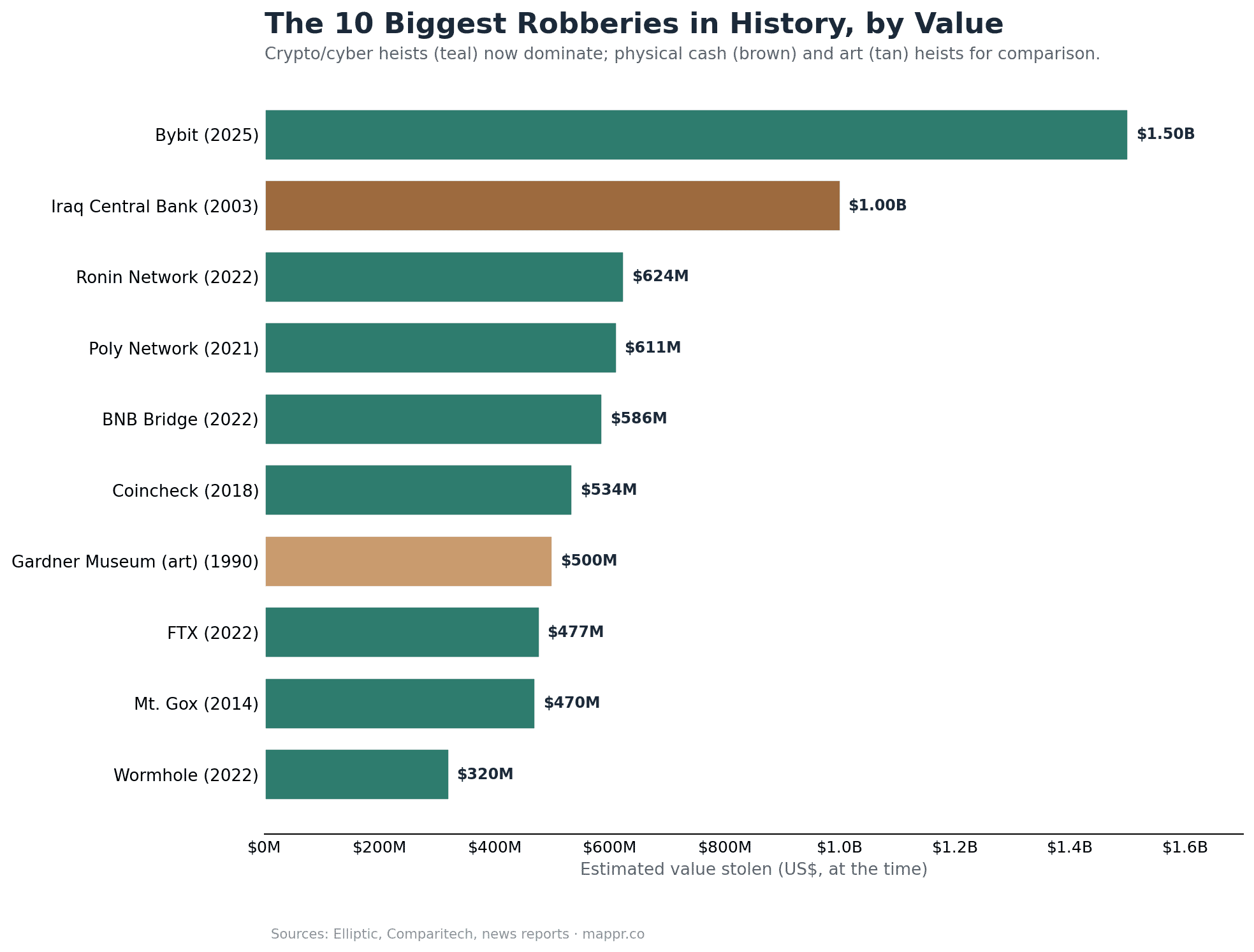
For most of history the “biggest robbery in the world” meant a daring physical heist — a bank vault, a museum, an armoured truck. That has changed. The largest theft ever recorded is now a crypto hack: the $1.5 billion drained from the exchange Bybit in February 2025. In fact, most of the biggest robberies of all time happened in the last few years, and almost all of them were digital. Here are the ten largest, ranked by the value stolen at the time.
Key Takeaways
- Bybit is the biggest ever. The $1.5 billion stolen from crypto exchange Bybit in February 2025 is the largest theft of any kind in history, blamed on North Korea's Lazarus Group.
- Crypto dominates the list. Eight of the ten biggest robberies of all time are crypto/cyber heists, most of them since 2021.
- The biggest physical heist. Iraq's Central Bank robbery (~$1 billion, 2003) by Qusay Hussein remains the largest physical cash theft ever.
- The biggest art theft. The 1990 Isabella Stewart Gardner Museum theft (~$500 million in art) is still unsolved and the works are still missing.
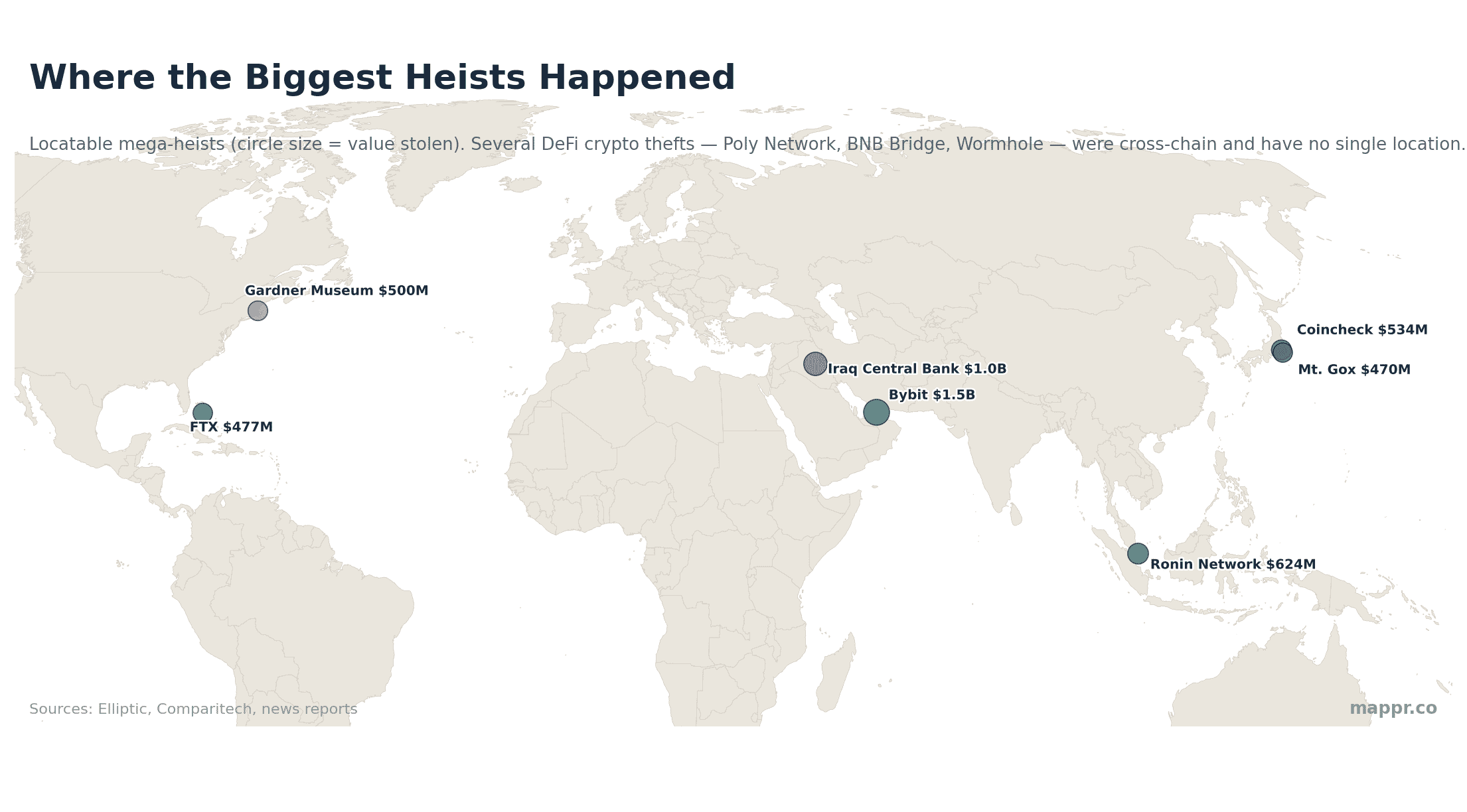
- Heists went borderless. Many of the largest thefts no longer have a location at all — they target cross-chain crypto bridges from anywhere in the world.
The 10 biggest robberies in the world
1. Bybit — $1.5 billion (2025)
North Korea’s Lazarus Group drained roughly $1.5 billion in Ethereum from the exchange’s cold wallets by tricking signers with a spoofed transaction interface — the single largest theft of any kind in history.
2. Iraq Central Bank — ~$1 billion (2003)
Days before the U.S. invasion, Qusay Hussein presented a handwritten note from his father Saddam and removed close to $1 billion in cash — the largest physical robbery ever recorded.
3. Ronin Network — $624 million (2022)
The Lazarus Group compromised validator keys on the Ronin blockchain bridge behind the game Axie Infinity and siphoned about $624 million in crypto.
4. Poly Network — $611 million (2021)
A hacker exploited a flaw in the cross-chain Poly Network protocol and took over $611 million — then, after public appeals, returned nearly all of it.
5. BNB Bridge — $586 million (2022)
An attacker forged proofs on Binance’s BNB cross-chain bridge to mint about $586 million; quick action froze a large share of it.
6. Coincheck — $534 million (2018)
Hackers drained more than $534 million in NEM tokens from the Japanese exchange’s internet-connected hot wallet.
7. Isabella Stewart Gardner Museum — ~$500 million (art) (1990)
Two thieves dressed as police officers stole 13 works — including a Vermeer and Rembrandts — that have never been recovered, the largest art theft in history.
8. FTX — $477 million (2022)
As FTX collapsed into bankruptcy, roughly $477 million was drained from the exchange’s wallets in an unexplained breach.
9. Mt. Gox — $470 million (2014)
Around 850,000 bitcoins were siphoned from the pioneering exchange over several years, worth about $470 million when the loss surfaced and far more today.
10. Wormhole — $320 million (2022)
An exploit of the Wormhole bridge between Solana and Ethereum let an attacker mint about $320 million in wrapped crypto.
Biggest robberies, ranked
| # | Heist | Value stolen | Year | Type | Location |
|---|---|---|---|---|---|
| 1 | Bybit | $1.5 billion | 2025 | Crypto | Dubai, UAE |
| 2 | Iraq Central Bank | ~$1 billion | 2003 | Cash | Baghdad, Iraq |
| 3 | Ronin Network | $624 million | 2022 | Crypto | (Axie Infinity bridge) |
| 4 | Poly Network | $611 million | 2021 | Crypto | (cross-chain DeFi) |
| 5 | BNB Bridge | $586 million | 2022 | Crypto | (Binance bridge) |
| 6 | Coincheck | $534 million | 2018 | Crypto | Tokyo, Japan |
| 7 | Isabella Stewart Gardner Museum | ~$500 million (art) | 1990 | Art | Boston, USA |
| 8 | FTX | $477 million | 2022 | Crypto | (Bahamas-based exchange) |
| 9 | Mt. Gox | $470 million | 2014 | Crypto | Tokyo, Japan |
| 10 | Wormhole | $320 million | 2022 | Crypto | (Solana–Ethereum bridge) |
Why digital heists took over
Physical robberies are limited by what thieves can physically carry and by the risk of being caught in the act. Crypto changed the maths: a single exploited line of code or one compromised key can move hundreds of millions of dollars across borders in minutes, with no getaway car required. State-backed groups — North Korea’s Lazarus Group above all — have turned this into an industry, and cross-chain “bridges” that connect different blockchains have become the favourite target. The result is that the record books, once full of bank vaults and stolen masterpieces, now read like a list of software breaches.


