
Compulsory military service — better known as conscription or “the draft” — is the legal obligation for citizens of a country to serve in its armed forces. Long viewed as a relic of the 20th century in much of the West, conscription has been making a quiet but unmistakable comeback since 2022, particularly across Europe. This guide maps the global picture as of 2026 — five distinct status types, from active conscription to having no military at all — with a closer look at the recent reinstatements, expansions and ongoing debates.
Key Takeaways
- ~60 countries still have active conscription. From Israel and South Korea to Greece, Turkey, Brazil and most of the post-Soviet space — the draft never went away in much of the world.
- Latvia reinstated conscription on January 1, 2024. Abolished in 2006, brought back as the 11-month State Defense Service in response to Russia's invasion of Ukraine.
- Croatia votes to follow in 2026. Parliament voted in October 2025 to reinstate compulsory service from 2026 — bringing the EU's mandatory-draft count to nine.
- Germany passes a hybrid voluntary-with-fallback law. The Bundestag approved the new Wehrdienstgesetz on December 5, 2025 (323-272). In force from January 1, 2026: voluntary service plus mandatory medical screening, with conscription kicking in if recruitment falls short.
- Sweden expands its gender-neutral model. Annual conscript intake is rising from ~8,000 in 2024 toward 10,000 by 2030 and 12,000 by 2035 under the 2025-2030 defence plan — and 24% of conscripts are now women.
Map of Compulsory Military Service Around the World (2026)
The map below shades every country by its current military service status, from active conscription (deep navy) through selective drafts and suspended-but-legal regimes, all the way to fully voluntary armies and the small handful of states with no standing military at all.
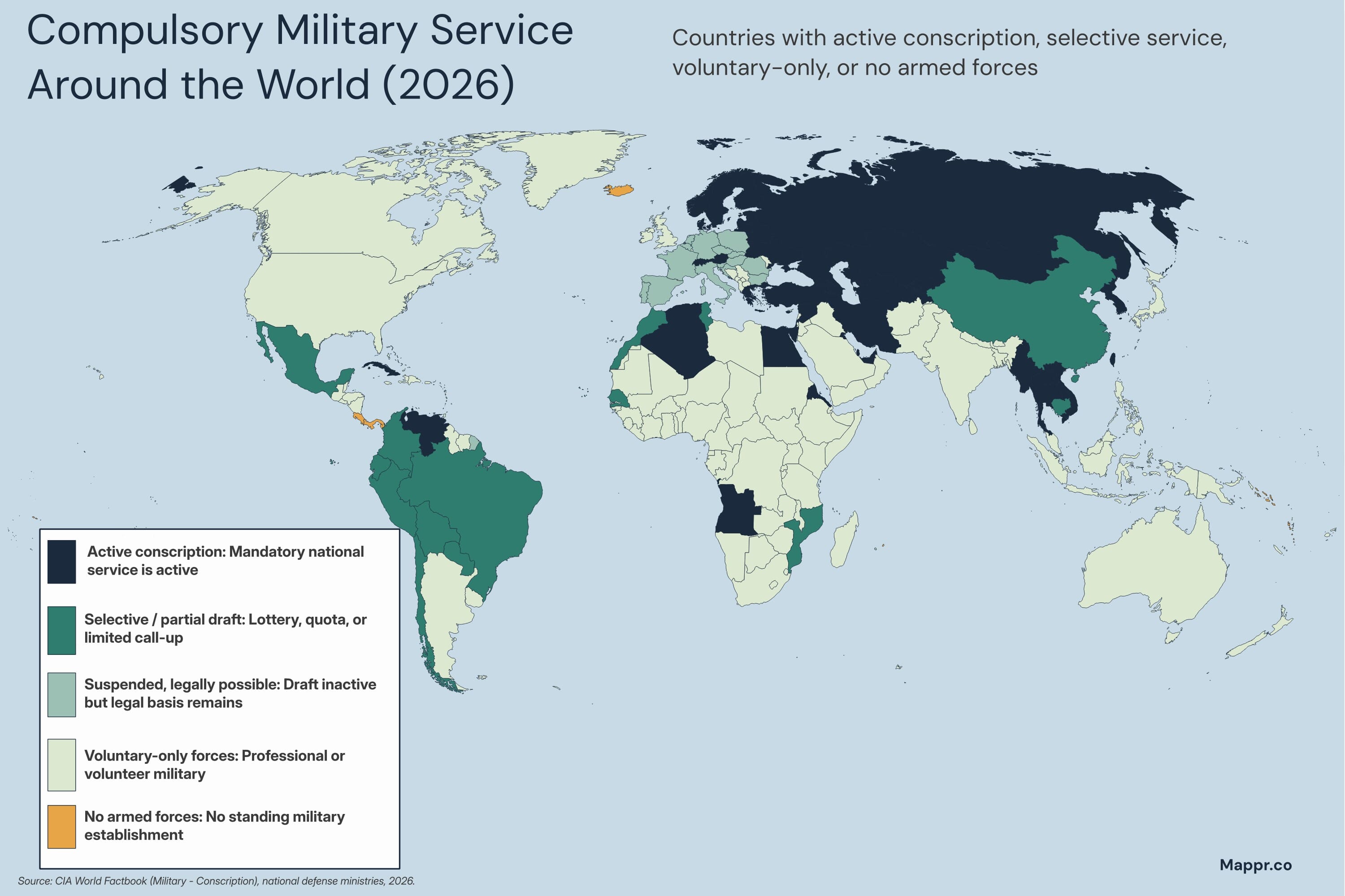
The Five Status Types Explained
1. Active conscription — mandatory national service is in force
Roughly 60 countries currently require some form of mandatory service from at least part of their citizenry. The most prominent active-conscription regimes include Israel (men and women, 32 and 24 months respectively), South Korea (men, 18-21 months), Singapore (men, 22-24 months), Iran (men, ~18 months), Russia (men, 12 months), Turkey (men, 6-12 months), Greece (men, 9-12 months), Cyprus (men, 14 months), Egypt, Algeria, Brazil, Mexico (in name only) and most of the former Soviet republics including Belarus, Ukraine, Armenia, Azerbaijan, Kazakhstan and the Central Asian states.
Within Europe specifically, EU member states with mandatory service in 2026 are Austria, Cyprus, Denmark, Estonia, Finland, Greece, Latvia, Lithuania and Sweden — with Croatia joining the list as its 2026 reinstatement takes effect. Denmark and Sweden apply conscription on a fully gender-neutral basis. Norway (NATO but non-EU) was the first European country to introduce gender-neutral conscription, in 2015.
2. Selective or partial draft — lottery, quota or limited call-up
Some countries have conscription on the books but only call up a small fraction of those eligible — through a lottery, a quota system or selection by skills. Mexico runs a token one-day-a-week program; Tunisia selects on a quota basis; Bermuda historically used a draw; Mongolia conscripts a portion of its eligible male population annually. Some Latin American countries — Bolivia, Ecuador, Paraguay, Venezuela — operate similar partial-draft systems where in-person service is reduced to short basic-training stints.
3. Suspended — legally possible but inactive
A growing group of countries — most across Western Europe — have not formally abolished conscription, but have suspended call-ups indefinitely while keeping the legal framework intact. This category includes France (suspended in 1997), Germany (suspended 2011, partially reactivated in 2026 — see below), Italy (suspended 2005), Spain (suspended 2001), Belgium, Netherlands, Czechia, Hungary, Romania, Bulgaria, Slovakia, Slovenia, Portugal and the United States (where the Selective Service registration for men aged 18-25 remains a legal requirement, but the last actual draft was in 1973).
4. Voluntary-only — professional or all-volunteer forces
The largest category covers countries that staff their militaries entirely through volunteers and professional recruitment. The United Kingdom, Canada, Australia, New Zealand, Japan, India, Pakistan, South Africa, Ireland and most of sub-Saharan Africa fall here, as do the Gulf states (with the partial exception of the UAE, which introduced conscription in 2014 and Kuwait, which reactivated it in 2017).
5. No armed forces — no standing military establishment
A small group of states maintain no standing military at all, relying on police forces, partner-state defence agreements, or — for the smallest island nations — simply on their geographic isolation. The list (shown in orange on the map) includes Costa Rica (which constitutionally abolished its military in 1948), Panama (1990), Iceland, Liechtenstein, Andorra, Monaco, Vatican City, San Marino, Mauritius, and several Pacific island states — Tuvalu, Kiribati, Marshall Islands, Micronesia, Nauru, Palau, Solomon Islands, Samoa, Vanuatu — as well as Caribbean micro-states Grenada, Saint Lucia, Dominica, Saint Vincent.
Conscription’s Comeback: Recent Changes Since 2022
The full-scale Russian invasion of Ukraine in February 2022 fundamentally reshaped European thinking on territorial defence — and the conscription map has shifted accordingly. Here are the most significant policy changes of the last four years.
🇱🇻 Latvia — back from 2024
Latvia formally abolished compulsory service in 2006. The Saeima passed Law No. 75 on the State Defense Service on April 19, 2023, and the new regime took effect on January 1, 2024. Male citizens aged 18-27 must serve either 11 months in the regular forces, five years in the National Guard, or complete a five-year reserve-officer programme. Women may volunteer. As of January 2026, conscripts make up roughly a quarter of Latvia’s national-service intake; the rest are volunteers, who receive a higher monthly allowance (€600 vs €300).
🇭🇷 Croatia — reinstating in 2026
Croatia suspended conscription in 2008. In October 2025 the Hrvatski Sabor voted to bring it back from 2026, lifting the count of EU member states with active conscription to nine. Service will be mandatory for men, with voluntary participation for women.
🇩🇪 Germany — voluntary now, conscription on standby
Germany suspended conscription in 2011. In December 2025, the Bundestag passed the new Wehrdienstgesetz by 323 votes to 272 — a hybrid law that came into force on January 1, 2026. Under the new system, the Bundeswehr expands through voluntary recruitment, but every male citizen turning 18 is required to undergo a medical screening. If voluntary numbers fall short of the 270,000 active-soldier target set for 2035, a separate triggering law can reactivate full conscription. Defence Minister Boris Pistorius has consistently framed the volunteer-first model as the consensus position of the CDU/CSU/SPD coalition.
🇸🇪 Sweden — expanding the gender-neutral model
Sweden suspended conscription in 2010 and reactivated it on a gender-neutral basis in 2017. With NATO accession completed on March 7, 2024, the 2025-2030 Defence Resolution scaled the conscript intake from ~8,000 a year in 2024 to 10,000 by 2030 and 12,000 by 2035, with four new brigades planned. The share of female conscripts has climbed from 20% in 2022 to 24% in 2023.
🇩🇰 Denmark — gender-neutral from 2025
Denmark already had male conscription, but in 2024 it announced it would extend full mandatory service to women — making the system gender-neutral from 2025. The decision was framed as part of a broader Nordic and Baltic effort to align force structures with NATO capability targets after the Ukraine war exposed deep recruitment gaps.
🇱🇹 Lithuania — tightened in 2026
Lithuania reactivated conscription in 2015 in direct response to Russia’s annexation of Crimea. Reforms taking effect in 2026 tightened the mandatory age range to 18-22 for males and continued the steady increase of annual call-up numbers.
The Voluntary-Service Wave
Alongside the return of compulsory service, several Western European countries have launched voluntary national-service programmes — short-term, paid, civilian-or-military pathways that stop short of full conscription. France, Belgium and Poland all announced new voluntary-service tracks during 2025, scheduled to launch from 2026, alongside Germany’s hybrid scheme. The political read is straightforward: governments want to lift recruitment numbers and rebuild a connection between civic life and defence, but face strong public resistance to a full reinstatement of the draft — particularly among younger voters.
Conscription status, recent changes and country-level details are drawn from the official sources, defence ministries and reporting cited below.
Primary Sources:
- Conscription as an element in European Union preparedness — EPRS Briefing – European Parliamentary Research Service, 2025 — overview of EU member-state conscription policies.
- Latvia: New Law Introduces Compulsory Military Service Starting in January 2024 – US Library of Congress Global Legal Monitor — Law No. 75 on the State Defense Service.
News and Reference:
- German parliament approves conscription scheme to boost the Bundeswehr – Defense News, December 5, 2025 — Bundestag passes the new Wehrdienstgesetz.
- Germany inches closer to bringing back mandatory military service – Euronews, November 13, 2025 — context on Germany's volunteer-with-fallback model.
- Latvia's Renewed Conscription Turns Two – Foreign Policy Research Institute, June 2025 — implementation review of Latvia's State Defense Service.
- Defence: Which European countries have mandatory and voluntary military service? – Euronews, April 27, 2026 — current EU snapshot.
- Conscription in Sweden – Wikipedia — gender-neutral model, intake numbers, 2025-2030 Defence Resolution.
- Military service — Wikipedia – Country-by-country status reference, cross-checked against primary sources.
Image Sources:
- Map: Mappr editorial – Created by Mappr.co using QGIS and Natural Earth basemap data.


