
Key Facts: The Icelandic Króna
- ISO 4217 code: ISK · Symbol: kr. Plural krónur. Subdivided formally into 100 aurar; aurar coins withdrawn in 2003.
- Central bank: Seðlabanki Íslands (est. 1961). Reykjavík-based. Governor Ásgeir Jónsson since August 2019. Inflation-targeting regime at 2.5%.
- Policy rate: 7.50% (March 2026) · Inflation: ~5.2%. Iceland has one of Europe's highest policy rates. Central Bank raised rate by 25 bp in March 2026 to combat persistent inflation.
- 1 USD ≈ 121.22 ISK. The króna has been relatively stable against the dollar over the past year — slightly stronger (USD fell from 125.77).
- Famous for the 2008 banking collapse. Iceland's three main banks collapsed within a week in October 2008; the króna lost 50% in months. The currency has since been rebuilt under strict capital controls (now lifted).
What Is the Currency of Iceland?
Iceland’s currency is the Icelandic króna (plural krónur, symbol kr, ISO 4217 code ISK). It has been Iceland’s currency since 1885, when Iceland — then a Danish dependency — began minting its own krónur within the Scandinavian Monetary Union. The króna is subdivided formally into 100 aurar, but aurar coins were withdrawn in 2003 and prices are always in whole krónur today.
The króna is issued by Seðlabanki Íslands, the Central Bank of Iceland, founded on 7 April 1961. Iceland is not an EU member — an application was lodged in 2009 during the banking crisis but formally withdrawn in 2015. The króna is a managed float with periodic central-bank FX intervention.
Icelandic Króna to US Dollar — 1-Year Chart
The chart tracks USD/ISK daily close over the past year. The króna’s drivers: Central Bank of Iceland policy rate (7.5% — one of Europe’s highest), tourism receipts (tourism is ~8% of GDP), aluminium prices (Iceland is a significant smelter), and fish-export receipts.
Line chart. Daily close, ISK per USD · Source: Yahoo Finance · Updated nightly. Data table with 2 rows and 131 columns follows.
| Oct 21 | Oct 23 | Oct 28 | Oct 30 | Nov 03 | Nov 05 | Nov 07 | Nov 11 | Nov 13 | Nov 17 | Nov 19 | Nov 21 | Nov 25 | Nov 27 | Dec 01 | Dec 03 | Dec 05 | Dec 09 | Dec 11 | Dec 15 | Dec 17 | Dec 19 | Dec 23 | Dec 26 | Dec 30 | Jan 02 | Jan 06 | Jan 08 | Jan 12 | Jan 14 | Jan 16 | Jan 20 | Jan 22 | Jan 26 | Jan 28 | Jan 30 | Feb 03 | Feb 05 | Feb 09 | Feb 11 | Feb 13 | Feb 17 | Feb 19 | Feb 23 | Feb 25 | Feb 27 | Mar 03 | Mar 05 | Mar 09 | Mar 11 | Mar 13 | Mar 17 | Mar 19 | Mar 23 | Mar 25 | Mar 27 | Mar 30 | Apr 01 | Apr 05 | Apr 07 | Apr 09 | Apr 13 | Apr 15 | Apr 19 | Apr 21 | Apr 23 | Apr 27 | Apr 29 | May 03 | May 05 | May 07 | May 11 | May 13 | May 17 | May 19 | May 21 | May 25 | May 27 | May 31 | Jun 02 | Jun 04 | Jun 08 | Jun 10 | Jun 14 | Jun 16 | Jun 18 | Jun 22 | Jun 24 | Jun 28 | Jun 30 | Jul 02 | Jul 06 | Jul 08 | Jul 12 | Jul 14 | Jul 16 | Jul 20 | Jul 22 | Jul 26 | Jul 28 | Jul 30 | Aug 03 | Aug 05 | Aug 09 | Aug 11 | Aug 13 | Aug 17 | Aug 19 | Aug 23 | Aug 25 | Aug 27 | Aug 31 | Sep 02 | Sep 06 | Sep 08 | Sep 10 | Sep 14 | Sep 16 | Sep 20 | Sep 22 | Sep 24 | Sep 28 | Sep 30 | Oct 04 | Oct 06 | Oct 08 | Oct 12 | Oct 14 | Oct 18 | Oct 20 | |
|---|---|---|---|---|---|---|---|---|---|---|---|---|---|---|---|---|---|---|---|---|---|---|---|---|---|---|---|---|---|---|---|---|---|---|---|---|---|---|---|---|---|---|---|---|---|---|---|---|---|---|---|---|---|---|---|---|---|---|---|---|---|---|---|---|---|---|---|---|---|---|---|---|---|---|---|---|---|---|---|---|---|---|---|---|---|---|---|---|---|---|---|---|---|---|---|---|---|---|---|---|---|---|---|---|---|---|---|---|---|---|---|---|---|---|---|---|---|---|---|---|---|---|---|---|---|---|---|---|---|---|
| ISK per USD | 121.77 | 122.11 | 122.44 | 123.81 | 125.21 | 127.17 | 126.3 | 126.22 | 126.52 | 126.52 | 126.47 | 127.15 | 127.3 | 126.4 | 127.68 | 127.51 | 127.67 | 127.66 | 126.7 | 126.1 | 125.67 | 125.59 | 125.5 | 125.29 | 124.91 | 124.98 | 125.53 | 125.77 | 126.18 | 125.62 | 125.65 | 125.31 | 124.95 | 122.97 | 120.53 | 120.88 | 122.76 | 122.4 | 122.41 | 121.67 | 122.05 | 122.07 | 122.62 | 122.69 | 122.09 | 121.12 | 122.57 | 124.07 | 124.75 | 125.19 | 125.04 | 124.23 | 124.62 | 123.97 | 123.51 | 124.03 | 124.87 | 124.28 | 125.15 | 122.74 | 122.36 | 121.57 | 121.49 | 121.83 | 122.15 | 122.78 | 122.04 | 122.78 | 122.33 | 121.93 | 122.29 | 121.61 | 122.27 | 123.35 | 123.25 | 123.47 | 123.12 | 122.96 | 122.78 | 123.09 | 123.37 | 124.09 | 124.02 | 123.98 | 124.08 | 125.55 | 125.71 | 126.7 | 126.18 | 125.7 | 125.36 | 125.55 | 125.07 | 125.45 | 125.22 | 124.83 | 124.98 | 125.36 | 125.19 | 124.6 | 123.45 | 123.1 | 122.4 | 123.1 | 122.71 | 122.99 | 122.46 | 121.51 | 120.93 | 120.65 | 120.01 | 120.9 | 121.05 | 120.92 | 120.45 | 120.29 | 120.92 | 121.57 | 120.98 | 120.6 | 120.31 | 120.2 | 120.65 | 121.57 | 121.62 | 121.71 | 121.75 | 121.54 | 121.04 | 121.01 |
Over the past 12 months the króna has strengthened slightly from about 125 to 121 ISK per USD — a modest ~3.5% move in the króna’s favour. Iceland’s 7.50% policy rate is well above the dollar’s yield, providing carry support for the króna.
Banknotes and Coins
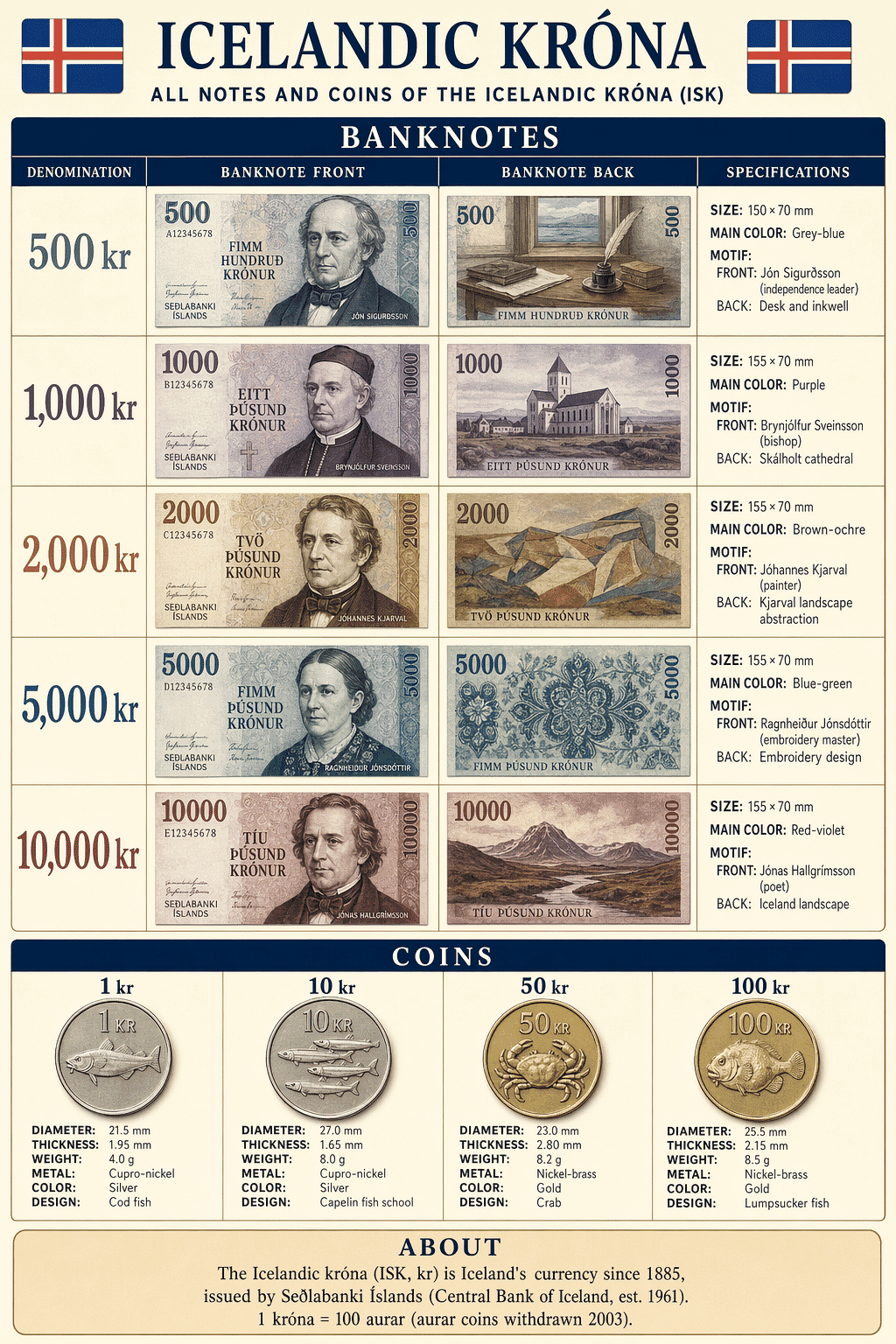
Iceland’s current banknote series (2013+) honours Icelandic scholars and reformers, including several pioneering women. The series is relatively small — just four denominations in active use.
| Denomination | Figure / Motif | Context | Colour |
|---|---|---|---|
| 500 kr | Jón Sigurðsson | Icelandic independence leader, 19th c. | Grey-blue |
| 1,000 kr | Brynjólfur Sveinsson | Lutheran bishop, preserver of medieval Icelandic manuscripts | Purple |
| 2,000 kr | Jóhannes Kjarval | Landscape painter, 1885–1972 | Brown-ochre |
| 5,000 kr | Ragnheiður Jónsdóttir | 17th-century embroidery master, educator of Icelandic women | Blue-green |
| 10,000 kr | Jónas Hallgrímsson | Romantic poet and naturalist, ‘national poet’ | Red-violet |
Coins come in four denominations, all stamped with iconic Icelandic imagery.
| Denomination | Composition & Design | Notes |
|---|---|---|
| 1 kr | Copper-nickel; cod fish | Since 1981 |
| 10 kr | Copper-nickel; capelin fish (school) | Since 1984 |
| 50 kr | Nickel-brass; crab | Since 1987 |
| 100 kr | Nickel-brass; lumpsucker fish | Since 1995 |
History of The Króna
The króna’s most dramatic chapter was the 2008–2009 banking collapse, when Iceland’s three main commercial banks (Kaupthing, Landsbanki, Glitnir) failed within a single week in October 2008. The króna lost roughly 50% of its value against major currencies; Iceland imposed strict capital controls that lasted from November 2008 to March 2017.
| Year | Event |
|---|---|
| 1885 | First Icelandic króna issued under Danish colonial authority, par with Danish krone. |
| 1944 | Iceland declares independence from Denmark on 17 June; króna becomes fully sovereign. |
| 1961 | Seðlabanki Íslands established on 7 April. |
| 1981 | 1,000-to-1 redenomination: one new króna = 100 old aurar. |
| 2001 | Central Bank of Iceland adopts inflation targeting at 2.5%. |
| 2008 | Banking collapse 6–9 October; all three major banks enter receivership. |
| 2008 | Capital controls imposed 28 November; króna floats only within narrow bands for 9 years. |
| 2009 | Iceland applies for EU membership (July); later withdrawn in 2015. |
| 2017 | Capital controls finally lifted 12 March. |
| 2024–2025 | Rate-hiking cycle peaks at 9.25%; cuts begin late 2024. |
| 2026 | Central Bank raises rate to 7.50% in March 2026 on inflation concerns. |
The Icelandic Economy and the Króna
Iceland is the smallest economy in Europe by population — roughly 400,000 people — but has an outsized tourism sector (over 2 million visitors per year, ~8% of GDP), significant energy-intensive industries (aluminium smelting, data centres) powered by its abundant geothermal and hydroelectric resources, and a large fisheries sector. The króna has historically been volatile for a developed-economy currency because of the small domestic market.
On monetary policy, Seðlabanki Íslands runs an inflation-targeting regime at 2.5% CPI. After the post-pandemic inflation episode — peak of 10.2% in February 2023 — the Central Bank held rates very high for longer than most peers. The March 2026 meeting actually hiked the policy rate by 25 bp to 7.50% after inflation came in above forecast; Governor Jónsson cited wage growth and fiscal spending as ongoing concerns. Iceland thus sits at one of Europe’s highest policy rates alongside Hungary and Romania.
Using Krónur in Iceland
Iceland is almost entirely cashless. Card payments work everywhere — even solo hot-pot operators in remote hot springs typically have contactless readers. Visa and Mastercard dominate; American Express is patchy. Iceland’s domestic card scheme (Valitor) has largely merged with Visa. Many small businesses no longer keep cash at all.
Typical prices in krónur (2026): espresso in Reykjavík 650–900 kr; a bowl of soup 2,400–3,500 kr; a main course 3,800–6,500 kr in a mid-range restaurant; a pint of beer 1,400–2,200 kr; a mid-range Reykjavík hotel room 32,000–60,000 kr. Iceland is among Europe’s most expensive countries — plan accordingly. ATMs (hraðbanki) at Arion banki, Íslandsbanki, and Landsbankinn work well for foreign cards. Skip Keflavík airport money-changers — their rates are poor.
The Króna in Regional Context
Iceland is part of the Nordic bloc but, unlike Denmark, Norway, or Sweden, operates a smaller and more volatile currency. All Nordics have different monetary regimes: Finland in the euro, Denmark pegged to the euro, Iceland / Norway / Sweden free-floating with independent inflation targets.
| Country | Code | Regime | Inflation | Policy rate |
|---|---|---|---|---|
| 🇮🇸 Iceland | ISK | Managed float | ~5.2% | 7.50% |
| 🇳🇴 Norway | NOK | Free float | 3.0% | 4.00% |
| 🇸🇪 Sweden | SEK | Free float | 0.9% (2026f) | 1.75% |
| 🇩🇰 Denmark | DKK | ERM II peg | 1.8% | 1.60% |
| 🇫🇮 Finland | EUR | Eurosystem | 2.3% | 2.00% |
| 🇬🇧 United Kingdom | GBP | Free float | ~4% | 3.75% |
Frequently Asked Questions
What is the currency of Iceland?
Iceland’s currency is the Icelandic króna (plural krónur, symbol kr, ISO 4217 code ISK). It has been Iceland’s currency since 1885.
Is Iceland in the Eurozone?
No. Iceland is not even an EU member — it is part of the European Economic Area via EFTA. An EU application was lodged in July 2009 during the banking crisis but withdrawn in March 2015. There is no active path to EU or euro membership.
Who manages Icelandic monetary policy?
Seðlabanki Íslands (Central Bank of Iceland), founded 7 April 1961, Reykjavík. Its current Governor is Ásgeir Jónsson, who took office on 20 August 2019. The bank targets 2.5% CPI inflation.
What is the current Central Bank of Iceland policy rate?
The policy rate is 7.50% as of March 2026, after a 25-basis-point hike. It is one of the highest in Europe alongside Hungary (6.25%), Romania (6.50%), and Turkey (37%).
How many krónur is one US dollar worth?
At the latest daily close, 1 USD ≈ 121.22 ISK. The króna has strengthened slightly — about 3.5% — against the US dollar over the past 12 months.
What happened to Iceland’s króna in 2008?
During the Icelandic banking collapse of 6–9 October 2008, all three of Iceland’s major commercial banks — Kaupthing, Landsbanki, and Glitnir — entered receivership within a single week. Total bank assets were roughly 10× Icelandic GDP, making recapitalisation impossible. The króna lost about 50% of its value against the euro; Iceland imposed strict capital controls on 28 November 2008 that lasted until 12 March 2017. The banks were resolved, depositors made whole, and the króna eventually rebuilt.
Why is Iceland so expensive despite the króna’s 2008 crash?
Iceland’s domestic market is tiny (population ~400,000), so goods benefit from fewer economies of scale; the country imports nearly all food and consumer goods; and wages are high in nominal terms. The króna’s post-2017 recovery also reversed some of the 2008 cheapness. Today Iceland consistently ranks among Europe’s top three most expensive countries for visitors, alongside Switzerland and Norway.
Data current to April 2026 — Central Bank of Iceland and Statistics Iceland releases.

