
Key Facts: The Swiss Franc
- ISO 4217 code: CHF · Symbol: Fr. Subdivided into 100 centimes/Rappen/centesimi/rap (4 national languages, 4 names for the subunit). Also the official currency of Liechtenstein.
- Central bank: Swiss National Bank (est. 1907). Dual-headquartered in Bern and Zürich. Chairman Martin Schlegel since 1 October 2024. Policy target: CPI inflation between 0% and 2%.
- Policy rate: 0.00% · Inflation: 0.5% (2026f). The only zero policy rate in major economies. SNB held at 0% at the March 2026 assessment. Inflation currently very low and possibly briefly negative again in 2026.
- 1 USD ≈ 0.7811 CHF. The franc has appreciated ~3.5% against the dollar over the past 12 months — consistent with its long-term safe-haven trend.
- World's largest FX reserves relative to GDP. SNB reserves ≈ 150% of Swiss GDP, built up defending the 1.20 EUR floor (2011–2015) and resisting subsequent safe-haven inflows.
What Is the Currency of Switzerland?
The currency of Switzerland is the Swiss franc (symbol Fr, ISO 4217 code CHF). It has been Switzerland’s currency since 1850, when the new Federal Constitution replaced more than 800 local cantonal currencies with a single national unit. The franc is subdivided into 100 centimes (French), Rappen (German), centesimi (Italian), or rap (Romansh) — reflecting Switzerland’s four official languages. It is also the official currency of Liechtenstein under the 1980 Swiss–Liechtenstein Currency Treaty.
The franc is issued by the Swiss National Bank (SNB), founded on 20 June 1907, with dual headquarters in Bern and Zürich. Switzerland is not an EU member and has no plans to adopt the euro — a stance reaffirmed by voters in a 2001 referendum.
Swiss Franc to US Dollar — 1-Year Chart
The chart tracks USD/CHF over the past year — a closely-watched pair because the franc is one of only three currencies (alongside the US dollar and Japanese yen) treated as a global safe haven. When risk aversion rises, capital flows into CHF, typically pushing the pair lower.
Line chart. Daily close, CHF per USD · Source: Yahoo Finance · Updated nightly. Data table with 2 rows and 132 columns follows.
| Oct 21 | Oct 23 | Oct 28 | Oct 30 | Nov 03 | Nov 05 | Nov 07 | Nov 11 | Nov 13 | Nov 17 | Nov 19 | Nov 21 | Nov 25 | Nov 27 | Dec 01 | Dec 03 | Dec 05 | Dec 09 | Dec 11 | Dec 15 | Dec 17 | Dec 19 | Dec 23 | Dec 26 | Dec 30 | Jan 02 | Jan 06 | Jan 08 | Jan 12 | Jan 14 | Jan 16 | Jan 20 | Jan 22 | Jan 26 | Jan 28 | Jan 30 | Feb 03 | Feb 05 | Feb 09 | Feb 11 | Feb 13 | Feb 17 | Feb 19 | Feb 23 | Feb 25 | Feb 27 | Mar 03 | Mar 05 | Mar 09 | Mar 11 | Mar 13 | Mar 17 | Mar 19 | Mar 23 | Mar 25 | Mar 27 | Mar 30 | Apr 01 | Apr 05 | Apr 07 | Apr 09 | Apr 13 | Apr 15 | Apr 19 | Apr 21 | Apr 23 | Apr 27 | Apr 29 | May 03 | May 05 | May 07 | May 11 | May 13 | May 17 | May 19 | May 21 | May 25 | May 27 | May 31 | Jun 02 | Jun 04 | Jun 08 | Jun 10 | Jun 14 | Jun 16 | Jun 18 | Jun 22 | Jun 24 | Jun 28 | Jun 30 | Jul 02 | Jul 06 | Jul 08 | Jul 12 | Jul 14 | Jul 16 | Jul 20 | Jul 22 | Jul 26 | Jul 28 | Jul 30 | Aug 03 | Aug 05 | Aug 09 | Aug 11 | Aug 13 | Aug 17 | Aug 19 | Aug 23 | Aug 25 | Aug 27 | Aug 31 | Sep 02 | Sep 06 | Sep 08 | Sep 10 | Sep 14 | Sep 16 | Sep 20 | Sep 22 | Sep 24 | Sep 28 | Sep 30 | Oct 04 | Oct 06 | Oct 08 | Oct 12 | Oct 14 | Oct 18 | Oct 20 | Oct 22 | |
|---|---|---|---|---|---|---|---|---|---|---|---|---|---|---|---|---|---|---|---|---|---|---|---|---|---|---|---|---|---|---|---|---|---|---|---|---|---|---|---|---|---|---|---|---|---|---|---|---|---|---|---|---|---|---|---|---|---|---|---|---|---|---|---|---|---|---|---|---|---|---|---|---|---|---|---|---|---|---|---|---|---|---|---|---|---|---|---|---|---|---|---|---|---|---|---|---|---|---|---|---|---|---|---|---|---|---|---|---|---|---|---|---|---|---|---|---|---|---|---|---|---|---|---|---|---|---|---|---|---|---|---|
| CHF per USD | 0.8 | 0.8 | 0.79 | 0.8 | 0.8 | 0.81 | 0.81 | 0.81 | 0.8 | 0.79 | 0.8 | 0.81 | 0.81 | 0.8 | 0.8 | 0.8 | 0.8 | 0.81 | 0.8 | 0.8 | 0.8 | 0.79 | 0.79 | 0.79 | 0.79 | 0.79 | 0.79 | 0.8 | 0.8 | 0.8 | 0.8 | 0.8 | 0.8 | 0.78 | 0.76 | 0.76 | 0.78 | 0.78 | 0.78 | 0.77 | 0.77 | 0.77 | 0.77 | 0.77 | 0.77 | 0.77 | 0.78 | 0.78 | 0.78 | 0.78 | 0.79 | 0.79 | 0.79 | 0.79 | 0.79 | 0.79 | 0.8 | 0.79 | 0.8 | 0.79 | 0.79 | 0.78 | 0.78 | 0.78 | 0.78 | 0.79 | 0.79 | 0.79 | 0.78 | 0.78 | 0.78 | 0.78 | 0.78 | 0.79 | 0.79 | 0.79 | 0.78 | 0.79 | 0.78 | 0.79 | 0.79 | 0.8 | 0.8 | 0.79 | 0.79 | 0.8 | 0.81 | 0.81 | 0.81 | 0.81 | 0.8 | 0.81 | 0.81 | 0.81 | 0.81 | 0.81 | 0.81 | 0.81 | 0.82 | 0.82 | 0.81 | 0.81 | 0.81 | 0.81 | 0.81 | 0.81 | 0.81 | 0.8 | 0.8 | 0.8 | 0.8 | 0.81 | 0.81 | 0.81 | 0.81 | 0.81 | 0.82 | 0.83 | 0.82 | 0.82 | 0.83 | 0.83 | 0.84 | 0.83 | 0.83 | 0.83 | 0.83 | 0.83 | 0.82 | 0.83 | 0.82 |
Over the past 12 months the franc has strengthened from roughly 0.81 to 0.7811 CHF per USD — about 3.5% in the franc’s favour. This continues a multi-decade appreciation trend that the SNB has repeatedly tried to slow, most dramatically by capping the franc at 1.20 per EUR between 2011 and 2015.
Swiss Franc Banknotes and Coins
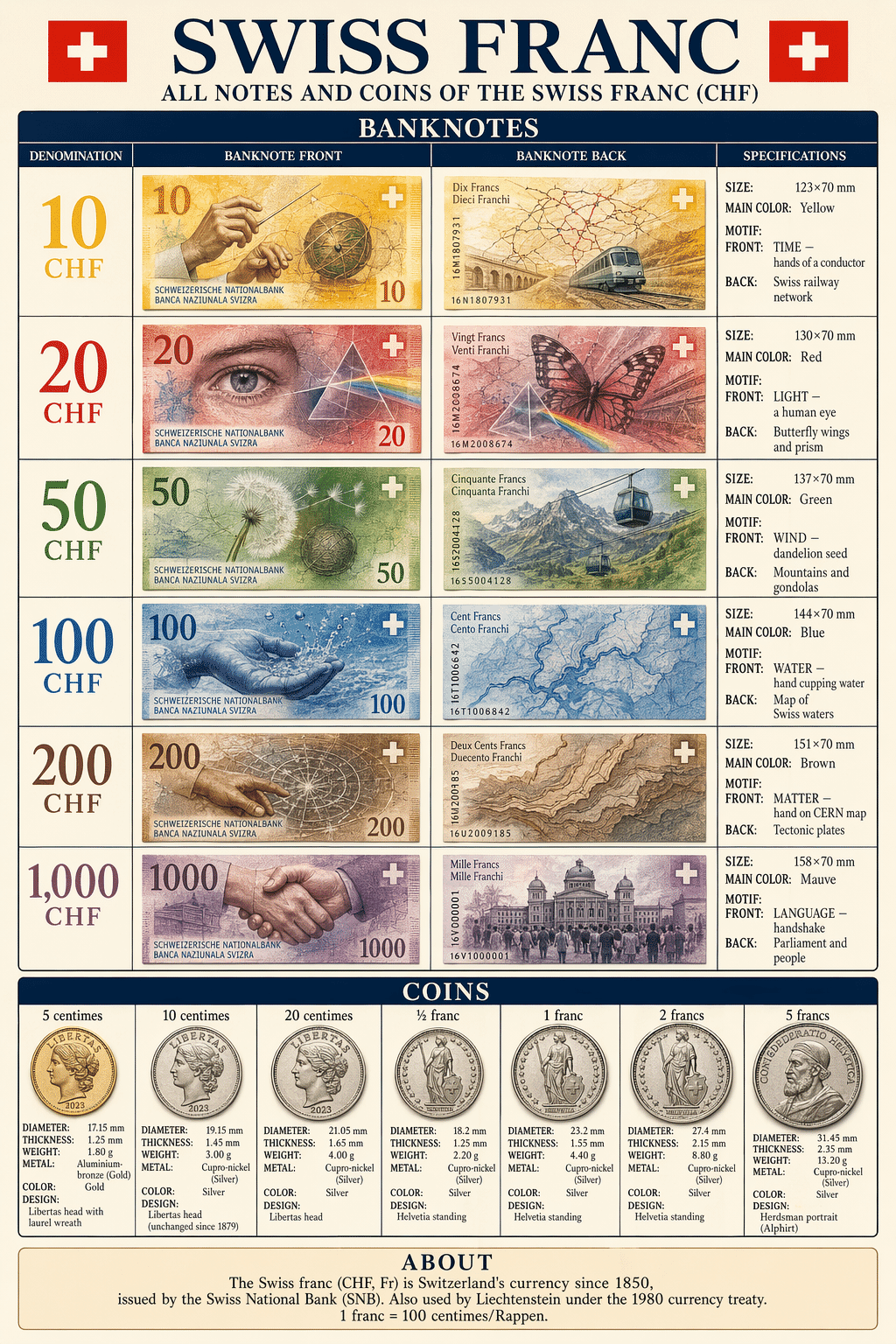
Switzerland’s current 9th series of banknotes, released between 2016 and 2019, is unusual in European currency design: it contains no portraits. Each denomination centres on an abstract theme — Time, Light, Wind, Water, Matter, Language — reflecting Switzerland’s openness to the world. The notes were designed by Manuela Pfrunder and include some of the world’s most advanced anti-counterfeiting features.
| Denomination | Theme | Release | Colour |
|---|---|---|---|
| CHF 10 | Time — pocket-watch motif, ‘conductor’s hand’ | 9th series, 2017 release | Yellow |
| CHF 20 | Light — human eye, butterfly wing diffraction | 2017 release | Red |
| CHF 50 | Wind — dandelion seed in flight | 2016 release | Green |
| CHF 100 | Water — hand cupping water | 2019 release | Blue |
| CHF 200 | Matter — hand on hadron-collider map | 2018 release | Brown |
| CHF 1,000 | Language — handshake, words of world | 2019 release | Mauve |
Swiss coins carry a remarkable record: the 10-centime coin’s design has been unchanged since 1879, making it the oldest original circulating coin design in the world. All franc coins use either a Libertas head or an allegorical Helvetia figure.
| Denomination | Design | Notes |
|---|---|---|
| 5 centimes (5 Rp / 5 ct) | Aluminium-bronze; Libertas head in a laurel wreath | Since 1981 |
| 10 centimes | Cupro-nickel; Libertas head (unchanged since 1879 — oldest circulating coin design in the world) | 1879 design |
| 20 centimes | Cupro-nickel; Libertas head | 1850 onwards |
| ½ franc, 1 franc, 2 francs | Cupro-nickel; allegorical ‘Helvetia’ standing figure | 1875+ designs |
| 5 francs | Cupro-nickel; head of Swiss herdsman | 1931 design |
History of the Swiss Franc
The modern franc’s 175-year history spans two world wars, Bretton Woods and its collapse, Latin Monetary Union membership, and — in this century — two striking monetary-policy innovations: the 2011–2015 peg against the euro and the 2014–2022 negative policy rate, which at one point reached −0.75%.
| Year | Event |
|---|---|
| 1850 | Swiss franc introduced by the new Federal Constitution, replacing 800+ local cantonal currencies. |
| 1865 | Switzerland joins the Latin Monetary Union with France, Belgium, Italy — common 5-gram silver coin. |
| 1907 | Swiss National Bank (SNB) opens on 20 June; granted sole note-issuing authority. |
| 1936 | Franc devalued 30% following France’s abandonment of the gold bloc. |
| 1973 | Bretton Woods ends; Swiss franc begins floating — rapid appreciation. |
| 1999 | Franc remains outside the euro as Switzerland (non-EU) declines membership. |
| 2011–2015 | SNB introduces a 1.20 CHF per EUR floor (Sep 2011) as safe-haven flows surge; removed abruptly on 15 January 2015, franc jumps 30% in minutes. |
| 2014–2022 | Negative policy rate of −0.75% — the deepest in the world at the time. |
| 2024 | Martin Schlegel becomes Chairman of the SNB Governing Board on 1 October, replacing Thomas Jordan after 13 years. |
| 2025–2026 | SNB cuts the policy rate to 0.00% at the March 2026 meeting — the only major central bank at zero. |
The Swiss Economy and the Franc
Switzerland is the 20th-largest economy by nominal GDP but one of the wealthiest by GDP per capita (top five globally). Its 2025 export mix centres on pharmaceuticals, watches, machinery, and precision instruments; Switzerland is also the world’s largest gold refining hub, handling around 70% of global gold flows. The combination produces a persistent current-account surplus, which is the structural driver behind the franc’s long-term appreciation.
On monetary policy, the SNB targets CPI inflation between 0% and 2% — an asymmetric target that explains why Swiss policy rates often sit far below the Eurozone’s. Inflation has been unusually subdued, falling to 0.5% forecast for 2026; Chairman Schlegel has noted that the rate may briefly turn negative again during 2026. The policy rate is 0.00%, the only zero among major central banks, with the SNB’s large FX reserves available as the main tool if further easing is needed.
Using the Franc in Switzerland (and Liechtenstein)
Card payment is near-universal in Switzerland — Visa, Mastercard, and the domestic Maestro/PostFinance networks work essentially everywhere, including public transport (SBB ticket machines), mountain gondolas, and rural restaurants. Twint, the domestic mobile-payment app used by a majority of Swiss adults, is the preferred method in smaller establishments. Euros are widely accepted in retail, but change is given in CHF and the rate is usually poor.
Typical prices in CHF (2026): espresso in a café 4.00–5.50 CHF; a quick lunch 18–28 CHF; a sit-down dinner 40–75 CHF; a Zürich or Geneva half-fare transit ticket 4.60 CHF; a mid-range hotel 180–300 CHF. Switzerland is among the most expensive countries in Europe — plan accordingly. ATMs (Bankomat, Geldautomat, Bancomat) at UBS, PostFinance, and Raiffeisen branches are widespread and typically free for foreign cards.
The Franc in European Context
Switzerland and Liechtenstein are the only European countries on the Swiss franc. All Swiss neighbours use the euro. The UK, Scandinavia, and Poland are the other major non-euro Western-European currencies.
| Country | Code | Regime | Inflation | Policy rate |
|---|---|---|---|---|
| 🇨🇭 Switzerland | CHF | Free float (SNB managed) | 0.5% (2026f) | 0.00% |
| 🇱🇮 Liechtenstein | CHF | Uses Swiss franc via 1980 treaty | follows Swiss | follows Swiss |
| 🇪🇺 Eurozone | EUR | ECB (free float) | 2.6% | 2.00% |
| 🇬🇧 United Kingdom | GBP | Free float | ~4% | 3.75% |
| 🇳🇴 Norway | NOK | Free float | 3.0% | 4.00% |
| 🇸🇪 Sweden | SEK | Free float | 0.9% | 1.75% |
Frequently Asked Questions
What is the currency of Switzerland?
The currency of Switzerland is the Swiss franc (symbol Fr or CHF, ISO 4217 code CHF). It has been Switzerland’s currency since 1850, and it is also the official currency of Liechtenstein under a customs-union treaty dating from 1980. The franc is subdivided into 100 centimes in French, Rappen in German, centesimi in Italian, and rap in Romansh.
Is Switzerland in the Eurozone?
No. Switzerland is not an EU member and therefore not in the Eurozone. Swiss voters rejected EU membership in a 2001 referendum and have no plans to join. Euros are accepted in many shops (especially in tourist areas), but change is typically given in Swiss francs.
Who manages Swiss monetary policy?
The Swiss National Bank (SNB), founded 1907, with dual headquarters in Bern and Zürich. Its current Chairman is Martin Schlegel, who took over on 1 October 2024 from Thomas Jordan. The SNB targets price stability, defined as CPI inflation below 2% annually but above zero, without a symmetric target.
What is the current SNB policy rate?
The SNB policy rate is 0.00% as of the March 2026 monetary-policy assessment, following a cutting cycle driven by very low Swiss inflation. Switzerland is currently the only major economy with a zero policy rate.
How many Swiss francs is one US dollar worth?
At the latest daily close, 1 USD = approximately 0.7811 CHF. The Swiss franc has appreciated roughly 3.5% against the dollar over the past 12 months, continuing its long-term trend as a safe-haven currency.
Why is the Swiss franc considered a safe-haven currency?
Three factors: Switzerland’s long-standing political neutrality and banking secrecy culture; a persistent current-account surplus that automatically supports the franc; and a central bank with vast FX reserves (roughly 150% of Swiss GDP — among the highest ratios globally). During global crises, investors buy francs, which is why the SNB periodically intervenes to prevent excessive appreciation.
What is on Swiss banknotes?
The current 9th series of Swiss banknotes, issued between 2016 and 2019, is unique in European currency design: it does not feature any historical figures. Instead each denomination is organised around one of six abstract themes — Time (10 CHF), Light (20), Wind (50), Water (100), Matter (200), and Language (1000). The designs by Manuela Pfrunder are organised around Switzerland’s openness to the world.
All data current to April 2026 — SNB, SFSO, and OECD releases.

