
Key Facts: The Czech Koruna
- ISO 4217 code: CZK · Symbol: Kč. The koruna circulates alongside 6 banknote denominations (100–5,000 Kč) and 6 coin denominations (1–50 Kč). Haléř subunits were withdrawn in 2008.
- Central bank: Česká národní banka (est. 1993). Prague-based. Governor Aleš Michl since 1 July 2022. Inflation-targeting mandate with a 2% target (±1 pp).
- Policy rate: 3.50% · Inflation: 1.9% (Mar 2026). CNB two-week repo rate at 3.50% since May 2025. Inflation has converged close to target after peaking at 18% in late 2022.
- 1 USD ≈ 20.71 CZK. Latest daily close. The koruna has appreciated about 5% against the dollar over the past 12 months.
- Outside the Eurozone. The Czech Republic is an EU member (since 2004) but has not set a target date for euro adoption. The country is not in ERM II and there is no active preparation to join.
What Is the Currency of the Czech Republic?
The currency of the Czech Republic is the Czech koruna (symbol Kč, ISO 4217 code CZK). It has been the country’s currency since 8 February 1993, following the dissolution of Czechoslovakia, when the Czech koruna replaced the short-lived Czechoslovak koruna. The koruna’s subunit is the haléř (100 haléřů = 1 Kč), though haléř coins were withdrawn from circulation in 2008 and retail prices are rounded to whole korunas.
Monetary policy is set by the Česká národní banka (Czech National Bank, CNB) in Prague, an EU central bank that has operated under an inflation-targeting regime since 1998. Its current Governor is Aleš Michl (since July 2022). The koruna is freely floating.
Czech Koruna to US Dollar — 1-Year Chart
The chart shows the daily close of the koruna against the US dollar over the past twelve months. The koruna’s exchange rate is driven primarily by the CNB–ECB–Fed policy-rate differential, capital flows into EU-aligned assets, and the broader euro-area cycle (because the Czech economy trades disproportionately with Germany).
Line chart. Daily close, CZK per 1 USD · Source: Yahoo Finance · Updated nightly. Data table with 2 rows and 131 columns follows.
| Oct 12 | Oct 14 | Oct 16 | Oct 20 | Oct 22 | Oct 27 | Oct 29 | Oct 31 | Nov 04 | Nov 06 | Nov 10 | Nov 12 | Nov 14 | Nov 18 | Nov 20 | Nov 24 | Nov 26 | Nov 28 | Dec 02 | Dec 04 | Dec 08 | Dec 10 | Dec 12 | Dec 16 | Dec 18 | Dec 22 | Dec 24 | Dec 29 | Dec 31 | Jan 05 | Jan 07 | Jan 09 | Jan 13 | Jan 15 | Jan 19 | Jan 21 | Jan 23 | Jan 27 | Jan 29 | Feb 02 | Feb 04 | Feb 06 | Feb 10 | Feb 12 | Feb 16 | Feb 18 | Feb 20 | Feb 24 | Feb 26 | Mar 02 | Mar 04 | Mar 06 | Mar 10 | Mar 12 | Mar 16 | Mar 18 | Mar 20 | Mar 24 | Mar 26 | Mar 29 | Mar 31 | Apr 02 | Apr 06 | Apr 08 | Apr 12 | Apr 14 | Apr 16 | Apr 20 | Apr 22 | Apr 26 | Apr 28 | Apr 30 | May 04 | May 06 | May 10 | May 12 | May 14 | May 18 | May 20 | May 24 | May 26 | May 28 | Jun 01 | Jun 03 | Jun 07 | Jun 09 | Jun 11 | Jun 15 | Jun 17 | Jun 21 | Jun 23 | Jun 25 | Jun 29 | Jul 01 | Jul 05 | Jul 07 | Jul 09 | Jul 13 | Jul 15 | Jul 19 | Jul 21 | Jul 23 | Jul 27 | Jul 29 | Aug 02 | Aug 04 | Aug 06 | Aug 10 | Aug 12 | Aug 16 | Aug 18 | Aug 20 | Aug 24 | Aug 26 | Aug 30 | Sep 01 | Sep 03 | Sep 07 | Sep 09 | Sep 13 | Sep 15 | Sep 17 | Sep 21 | Sep 23 | Sep 27 | Sep 29 | Oct 01 | Oct 05 | Oct 07 | Oct 12 | |
|---|---|---|---|---|---|---|---|---|---|---|---|---|---|---|---|---|---|---|---|---|---|---|---|---|---|---|---|---|---|---|---|---|---|---|---|---|---|---|---|---|---|---|---|---|---|---|---|---|---|---|---|---|---|---|---|---|---|---|---|---|---|---|---|---|---|---|---|---|---|---|---|---|---|---|---|---|---|---|---|---|---|---|---|---|---|---|---|---|---|---|---|---|---|---|---|---|---|---|---|---|---|---|---|---|---|---|---|---|---|---|---|---|---|---|---|---|---|---|---|---|---|---|---|---|---|---|---|---|---|---|
| CZK per USD | 20.94 | 20.95 | 20.74 | 20.84 | 20.91 | 20.87 | 20.85 | 21.01 | 21.11 | 21.18 | 21.04 | 20.91 | 20.77 | 20.83 | 20.92 | 21.05 | 20.88 | 20.8 | 20.8 | 20.66 | 20.79 | 20.83 | 20.6 | 20.67 | 20.76 | 20.77 | 20.59 | 20.59 | 20.62 | 20.62 | 20.67 | 20.82 | 20.79 | 20.8 | 20.86 | 20.73 | 20.64 | 20.4 | 20.27 | 20.51 | 20.57 | 20.57 | 20.32 | 20.41 | 20.43 | 20.46 | 20.59 | 20.51 | 20.49 | 20.6 | 20.97 | 20.99 | 20.95 | 21.1 | 21.38 | 21.16 | 21.12 | 21.01 | 21.11 | 21.31 | 21.19 | 21.23 | 21.22 | 20.89 | 20.86 | 20.62 | 20.64 | 20.6 | 20.78 | 20.78 | 20.78 | 20.77 | 20.86 | 20.69 | 20.65 | 20.73 | 20.83 | 20.84 | 20.88 | 20.85 | 20.84 | 20.81 | 20.86 | 20.85 | 20.97 | 20.93 | 20.87 | 20.8 | 20.96 | 21.09 | 21.25 | 21.34 | 21.22 | 21.27 | 21.14 | 21.21 | 21.19 | 21.31 | 21.08 | 21.19 | 21.2 | 21.25 | 21.23 | 21.06 | 20.96 | 20.96 | 21.01 | 20.99 | 21.01 | 20.9 | 20.88 | 20.64 | 20.65 | 20.7 | 20.81 | 20.85 | 20.78 | 20.8 | 20.85 | 20.89 | 21.03 | 21.17 | 21.19 | 21.44 | 21.4 | 21.52 | 21.74 | 21.78 | 21.78 | 21.75 |
Over the past 12 months the koruna has strengthened: 1 USD bought roughly 21.7 CZK a year ago and about 20.71 CZK today — a 5% move in the koruna’s favour. Steady 3.50% CNB rates and broader dollar weakness have both contributed.
Czech Koruna Banknotes and Coins
Czech koruna banknotes feature six Czech historical and cultural figures, one per denomination. All notes were designed by artist Oldřich Kulhánek and have been gradually refreshed with upgraded security features. A 20 Kč and 50 Kč banknote existed in earlier series but were withdrawn.
| Denomination | Figure | Known for | Colour |
|---|---|---|---|
| 100 Kč | Charles IV | Holy Roman Emperor, founder of Charles University (1348) | Green |
| 200 Kč | Jan Amos Komenský (Comenius) | Pedagogue and philosopher, 1592–1670 | Brown-orange |
| 500 Kč | Božena Němcová | Writer, author of “Babička” (1855) | Red-brown |
| 1,000 Kč | František Palacký | Historian, father of the Czech national revival | Purple-lilac |
| 2,000 Kč | Ema Destinnová | Operatic soprano, 1878–1930 | Olive-green |
| 5,000 Kč | Tomáš Garrigue Masaryk | First president of Czechoslovakia, 1918–1935 | Grey-blue |
Coins are issued in six denominations from 1 Kč to 50 Kč. Their reverse designs lean heavily on Czech history — from the crown of St. Wenceslas to a stylised Prague cityscape.
| Denomination | Composition & Design | Series |
|---|---|---|
| 1 Kč | Nickel-plated steel; St. Wenceslas’ crown reverse | Since 1993 |
| 2 Kč | Nickel-plated steel; Great Moravian earring motif | Since 1993 |
| 5 Kč | Nickel-plated steel; Charles Bridge motif | Since 1993 |
| 10 Kč | Copper-plated steel; Brno cathedral | Since 1993 |
| 20 Kč | Brass-plated steel; equestrian statue of St. Wenceslas | Since 1993 |
| 50 Kč | Bi-metallic; stylised Prague cityscape | Since 1993 |
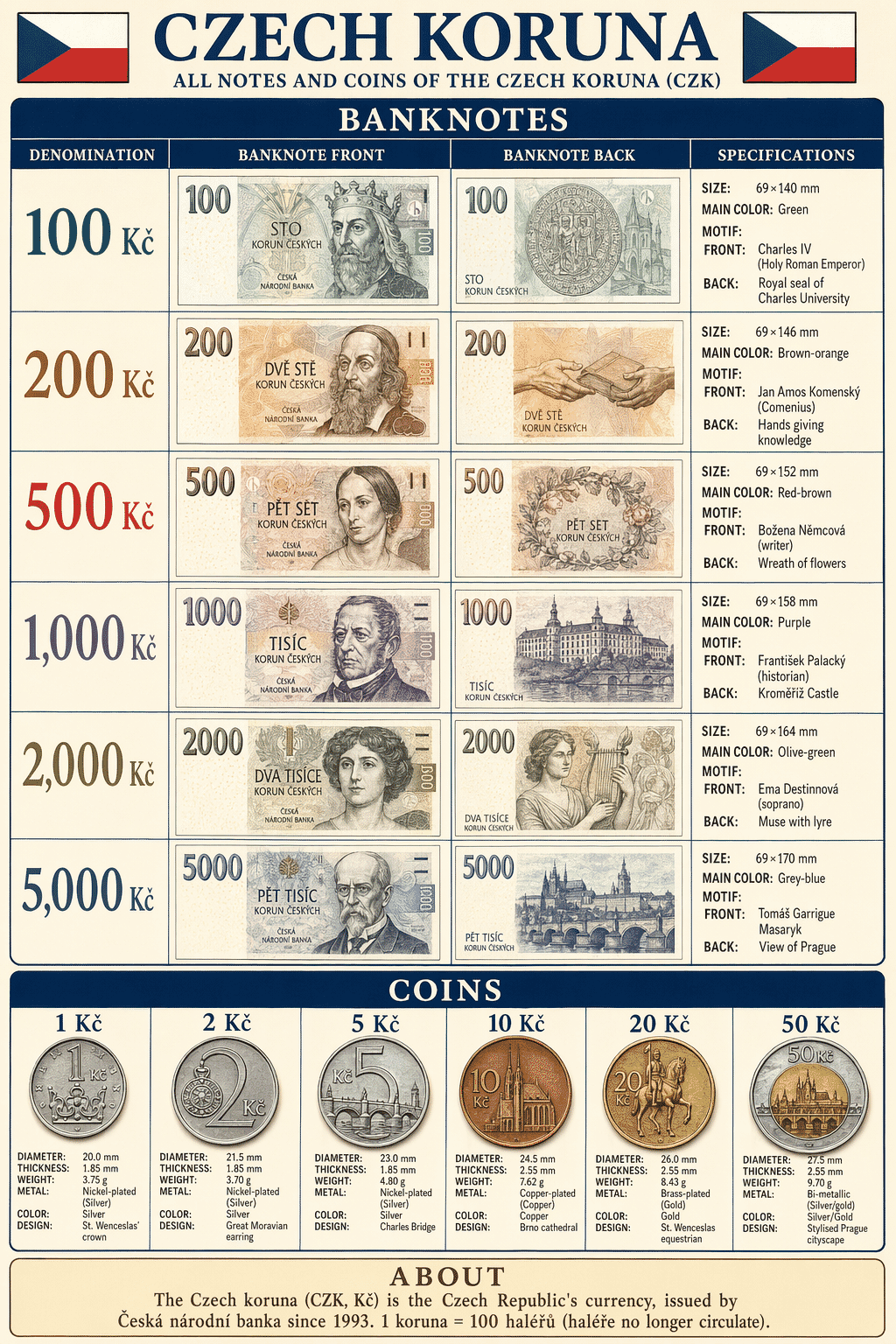
History of the Czech Koruna
The koruna name reaches back to the gold-standard Austro-Hungarian krone introduced in 1892. After 1918, Czechoslovakia inherited the name for its own currency; after the 1993 split, the Czech Republic kept it. The post-1993 koruna has had three distinct exchange-rate regimes: a peg, then a free float, then a brief unilateral floor against the euro from 2013 to 2017 — a rare episode of a central bank deliberately weakening its own currency to fight deflation.
| Year | Event |
|---|---|
| 1892 | Austro-Hungarian Empire adopts the gold-standard krone (koruna). |
| 1919 | After the collapse of Austria-Hungary, Czechoslovakia introduces its own koruna (Kčs) in February. |
| 1993 | Dissolution of Czechoslovakia on 1 January; Czech koruna (CZK) introduced 8 February 1993 following a short currency union with Slovakia. |
| 1997 | Czech National Bank (CNB) achieves full independence; inflation targeting formally adopted. |
| 1999 | Transition from fixed exchange rate to managed float, then a fully floating CZK. |
| 2013 | CNB introduces an exchange-rate commitment (a floor at 27 CZK per EUR) to avoid deflation. |
| 2017 | Exchange-rate commitment ended on 6 April; CZK returns to a fully floating regime. |
| 2022 | Aleš Michl takes office as CNB Governor on 1 July amid post-pandemic inflation peaking at 18%. |
| 2023 | CNB completes its monetary-policy review; holds rate at 7.00% for much of the year. |
| 2024–2025 | Rate-cutting cycle takes the two-week repo rate to 3.50% by May 2025. |
| 2026 | CNB holds at 3.50% through the first quarter; inflation running near the 2% target after a sharp disinflation. |
The Czech Economy and the Koruna
The Czech Republic is a small, open, manufacturing-heavy economy — sometimes called Europe’s “assembly line”. Its 2025 export mix is dominated by motor vehicles and parts, machinery, electronics, and metals, with Germany taking roughly 32% of exports. That structure anchors the koruna’s behaviour tightly to the euro-area industrial cycle.
On monetary policy, the CNB has run an inflation-targeting regime with a 2% point target and a ±1 pp tolerance band since 1998. After inflation peaked at 18% in late 2022, the fastest pace since the communist era, the CNB held rates at 7.00% for much of 2023 before beginning a cutting cycle in 2024. The two-week repo rate has been held at 3.50% since May 2025; March 2026 CPI came in at 1.9%, and the CNB’s forecast sees 1.6% for the full year 2026.
Using the Koruna in the Czech Republic
Card acceptance is excellent across the Czech Republic. In Prague, Brno, Ostrava, Plzeň, and all major tourist centres, Visa and Mastercard work almost universally — including on public transport, in supermarkets, and for beer-garden tabs. Contactless is standard. Outside the cities, small hospody (pubs), village shops, and some cultural attractions may still be cash-only. Prague taxis reliably accept cards; always insist on the meter.
Typical prices in koruna (2026): a half-litre of beer in a Prague hospoda 40–60 Kč; a Czech lunch menu 150–220 Kč; coffee in a café 50–80 Kč; a single 90-minute Prague transport ticket 40 Kč; a mid-range Prague hotel room 2,500–4,500 Kč. ATMs are abundant — Česká spořitelna, ČSOB, Komerční banka, and UniCredit Bank all offer straightforward withdrawals for foreign cards. Avoid airport Euronet machines, which can quote poor exchange rates with aggressive “dynamic currency conversion” prompts.
The Koruna Among Central European Currencies
The Czech Republic sits in a cluster of Central European countries that split between two monetary camps: euro adopters (Slovakia 2009, Slovenia 2007) and free-floaters (Czechia, Hungary, Poland). The three floating currencies all operate under inflation targets but with markedly different policy rates in 2026.
| Country | Code | Regime | Inflation | Policy rate |
|---|---|---|---|---|
| 🇨🇿 Czech Republic | CZK | Free float (CNB inflation target) | 1.9% (Mar 2026) | 3.50% |
| 🇵🇱 Poland | PLN | Free float (NBP inflation target) | 4.2% | 5.75% |
| 🇭🇺 Hungary | HUF | Free float (MNB inflation target) | 4.3% | 6.50% |
| 🇸🇰 Slovakia | EUR (since 2009) | Eurosystem (free float) | 2.9% | 2.00% |
| 🇦🇹 Austria | EUR | Eurosystem (free float) | 2.7% | 2.00% |
| 🇩🇪 Germany | EUR | Eurosystem (free float) | 2.6% | 2.00% |
Frequently Asked Questions
What is the currency of the Czech Republic?
The currency of the Czech Republic is the Czech koruna (symbol Kč, ISO 4217 code CZK). Its subunit is the haléř (100 haléřů = 1 koruna), though haléř coins were withdrawn from active circulation in 2008 and cash prices are now rounded to the whole koruna.
Is the Czech Republic in the Eurozone?
No. The Czech Republic is an EU member (since 2004) and is treaty-bound to eventually adopt the euro, but successive governments have declined to set a target date. There is no active preparation for euro adoption as of 2026. The Czech Republic is not in ERM II (the euro’s waiting room); there is no political consensus to join it.
Who manages Czech monetary policy?
The Czech National Bank (Česká národní banka, CNB) headquartered in Prague. Its current Governor is Aleš Michl, who took office on 1 July 2022. The CNB Bank Board sets the key two-week repo rate, currently 3.50%, and targets inflation at 2% with a tolerance band of ±1 percentage point.
How many korunas is one US dollar worth?
At the latest daily close, 1 USD = approximately 20.71 CZK. The koruna has strengthened roughly 5% against the dollar over the past 12 months, reflecting a combination of a narrower CNB–Fed rate gap and broader dollar softness. The chart above shows the full year’s daily movement.
Who are on Czech koruna banknotes?
The current series features six historical figures: Charles IV on the 100 Kč note, Jan Amos Komenský (Comenius) on the 200 Kč, Božena Němcová on the 500 Kč, František Palacký on the 1,000 Kč, Ema Destinnová on the 2,000 Kč, and Tomáš Garrigue Masaryk on the 5,000 Kč. All banknotes were designed by the artist Oldřich Kulhánek.
Can I use euros in the Czech Republic?
Euros are widely accepted at hotels, tourist restaurants in Prague, major department stores, and at airport shops — but you will usually receive a poor exchange rate, and change is often given in korunas. For everyday spending outside tourist zones, you’ll need korunas. ATMs are plentiful; all major Czech banks (Česká spořitelna, ČSOB, Komerční banka, UniCredit Bank) dispense korunas.
What happened to the Czech koruna exchange-rate cap?
Between November 2013 and April 2017 the CNB maintained a one-sided commitment to keep the koruna weaker than 27 CZK per EUR, intervening in FX markets to prevent appreciation. The commitment was a tool to avoid deflation when interest rates were already at zero. It was lifted on 6 April 2017; the koruna subsequently traded in a wider range but has rarely moved far from the 24–26 CZK/EUR band.
All data current to April 2026 — policy-rate and inflation figures from the CNB's March 2026 decision.

