
Key Facts: The Convertible Mark
- ISO 4217 code: BAM · Symbol: KM. Full name konvertibilna marka (Latin) / конвертибилна марка (Cyrillic). Subdivided into 100 fening.
- Pegged to EUR: 1 EUR = 1.95583 BAM. A currency board established in 1997 — the same fixed rate Germany's Deutsche Mark had to the euro. The peg has been unbroken for 28 years.
- Central bank: Central Bank of Bosnia & Herzegovina. Sarajevo-based, est. 1997. Governor Jasmina Selimović (since 2021). Cannot set independent policy rate — operates under the currency-board rules.
- Banknotes exist in two parallel versions. Each denomination has a Latin-script version for the Federation of BiH and a Cyrillic-script version for Republika Srpska — both fully interchangeable nationwide.
- EU candidate since 2022. Not in the Eurozone and not in ERM II. Because of the currency-board peg, the conversion rate to euro is essentially pre-set at 1.95583 KM = 1 EUR whenever adoption eventually happens.
What Is the Currency of Bosnia and Herzegovina?
Bosnia and Herzegovina’s currency is the convertible mark (konvertibilna marka in Latin, конвертибилна марка in Cyrillic; symbol KM, ISO 4217 code BAM). It has been BiH’s currency since 22 June 1998, two and a half years after the Dayton Peace Agreement ended the Bosnian War. Subdivided into 100 fening.
The convertible mark is issued by the Central Bank of Bosnia and Herzegovina (CBBH), established 1997. The currency is managed under a currency-board arrangement: every BAM in circulation is fully backed by euro reserves, and the exchange rate is fixed at 1 EUR = 1.95583 BAM — the same conversion the Deutsche Mark had to the euro in 1999. The peg has never been adjusted.
Euro to US Dollar — 1-Year Chart
Because the convertible mark is rigidly pegged to the euro at 1.95583 BAM = 1 EUR, the BAM/USD rate simply mirrors EUR/USD multiplied by 1.95583. The chart below shows EUR/USD directly; the BAM/USD rate derives from it.
Line chart. Daily close, USD per 1 EUR · Source: Yahoo Finance · Updated nightly. Data table with 2 rows and 132 columns follows.
| Oct 21 | Oct 23 | Oct 28 | Oct 30 | Nov 03 | Nov 05 | Nov 07 | Nov 11 | Nov 13 | Nov 17 | Nov 19 | Nov 21 | Nov 25 | Nov 27 | Dec 01 | Dec 03 | Dec 05 | Dec 09 | Dec 11 | Dec 15 | Dec 17 | Dec 19 | Dec 23 | Dec 26 | Dec 30 | Jan 02 | Jan 06 | Jan 08 | Jan 12 | Jan 14 | Jan 16 | Jan 20 | Jan 22 | Jan 26 | Jan 28 | Jan 30 | Feb 03 | Feb 05 | Feb 09 | Feb 11 | Feb 13 | Feb 17 | Feb 19 | Feb 23 | Feb 25 | Feb 27 | Mar 03 | Mar 05 | Mar 09 | Mar 11 | Mar 13 | Mar 17 | Mar 19 | Mar 23 | Mar 25 | Mar 27 | Mar 30 | Apr 01 | Apr 05 | Apr 07 | Apr 09 | Apr 13 | Apr 15 | Apr 19 | Apr 21 | Apr 23 | Apr 27 | Apr 29 | May 03 | May 05 | May 07 | May 11 | May 13 | May 17 | May 19 | May 21 | May 25 | May 27 | May 31 | Jun 02 | Jun 04 | Jun 08 | Jun 10 | Jun 14 | Jun 16 | Jun 18 | Jun 22 | Jun 24 | Jun 28 | Jun 30 | Jul 02 | Jul 06 | Jul 08 | Jul 12 | Jul 14 | Jul 16 | Jul 20 | Jul 22 | Jul 26 | Jul 28 | Jul 30 | Aug 03 | Aug 05 | Aug 09 | Aug 11 | Aug 13 | Aug 17 | Aug 19 | Aug 23 | Aug 25 | Aug 27 | Aug 31 | Sep 02 | Sep 06 | Sep 08 | Sep 10 | Sep 14 | Sep 16 | Sep 20 | Sep 22 | Sep 24 | Sep 28 | Sep 30 | Oct 04 | Oct 06 | Oct 08 | Oct 12 | Oct 14 | Oct 18 | Oct 20 | Oct 22 | |
|---|---|---|---|---|---|---|---|---|---|---|---|---|---|---|---|---|---|---|---|---|---|---|---|---|---|---|---|---|---|---|---|---|---|---|---|---|---|---|---|---|---|---|---|---|---|---|---|---|---|---|---|---|---|---|---|---|---|---|---|---|---|---|---|---|---|---|---|---|---|---|---|---|---|---|---|---|---|---|---|---|---|---|---|---|---|---|---|---|---|---|---|---|---|---|---|---|---|---|---|---|---|---|---|---|---|---|---|---|---|---|---|---|---|---|---|---|---|---|---|---|---|---|---|---|---|---|---|---|---|---|---|
| USD per EUR | 1.16 | 1.16 | 1.17 | 1.16 | 1.15 | 1.15 | 1.15 | 1.16 | 1.16 | 1.16 | 1.16 | 1.15 | 1.15 | 1.16 | 1.16 | 1.16 | 1.16 | 1.16 | 1.17 | 1.17 | 1.17 | 1.17 | 1.18 | 1.18 | 1.18 | 1.18 | 1.17 | 1.17 | 1.16 | 1.16 | 1.16 | 1.16 | 1.17 | 1.19 | 1.2 | 1.2 | 1.18 | 1.18 | 1.18 | 1.19 | 1.19 | 1.18 | 1.18 | 1.18 | 1.18 | 1.18 | 1.17 | 1.16 | 1.15 | 1.16 | 1.15 | 1.15 | 1.15 | 1.16 | 1.16 | 1.15 | 1.15 | 1.16 | 1.15 | 1.17 | 1.17 | 1.18 | 1.18 | 1.17 | 1.17 | 1.17 | 1.17 | 1.17 | 1.17 | 1.17 | 1.17 | 1.18 | 1.17 | 1.16 | 1.16 | 1.16 | 1.16 | 1.16 | 1.16 | 1.16 | 1.16 | 1.15 | 1.15 | 1.16 | 1.16 | 1.15 | 1.14 | 1.14 | 1.14 | 1.14 | 1.14 | 1.14 | 1.14 | 1.14 | 1.14 | 1.14 | 1.14 | 1.14 | 1.14 | 1.14 | 1.15 | 1.15 | 1.16 | 1.16 | 1.15 | 1.15 | 1.16 | 1.17 | 1.17 | 1.17 | 1.17 | 1.16 | 1.16 | 1.16 | 1.16 | 1.16 | 1.15 | 1.15 | 1.15 | 1.14 | 1.14 | 1.14 | 1.13 | 1.13 | 1.13 | 1.12 | 1.12 | 1.12 | 1.12 | 1.12 | 1.13 |
Over the past 12 months EUR/USD has moved in a 1.10–1.18 range. The implied BAM/USD has therefore moved between roughly 1.66 and 1.78 BAM per USD. Since Bosnia’s currency board means CBBH does not set an independent monetary policy, the relevant policy context is the ECB’s 2.00% deposit rate.
Banknotes and Coins
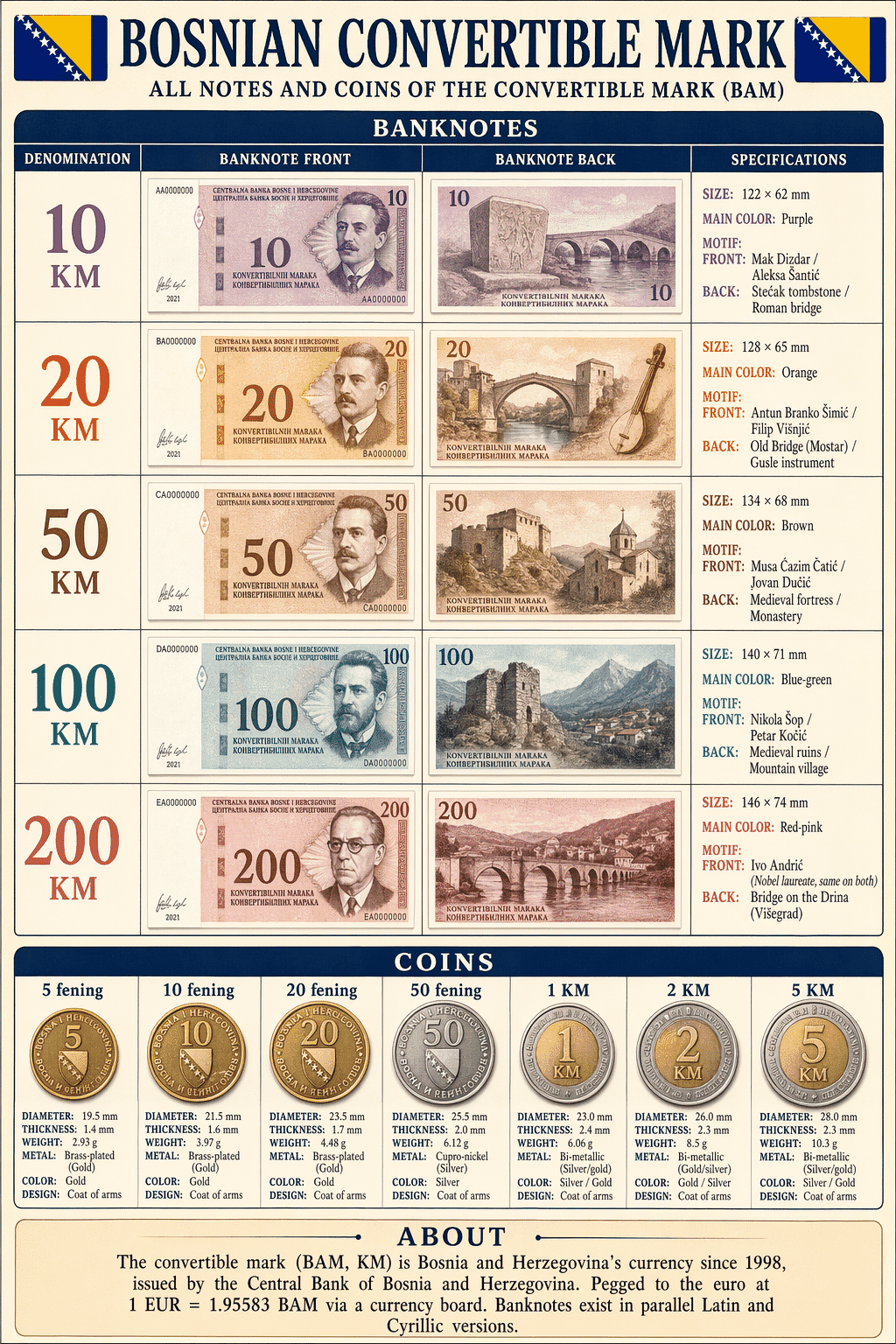
Bosnia’s banknotes are unique in European currency design: each denomination is issued in two parallel versions — one with Latin script featuring Federation of BiH figures, one with Cyrillic script featuring Republika Srpska figures. Both versions are fully interchangeable and legal tender across the whole country.
| Denomination | Figure / Motif | Context | Colour |
|---|---|---|---|
| 10 KM | Mak Dizdar (Latin) / Aleksa Šantić (Cyrillic) | Both 20th-c. Bosnian poets | Purple |
| 20 KM | Antun Branko Šimić (Latin) / Filip Višnjić (Cyrillic) | Poet / Serbian-Bosnian epic singer | Orange |
| 50 KM | Musa Ćazim Ćatić (Latin) / Jovan Dučić (Cyrillic) | Both poets | Brown |
| 100 KM | Nikola Šop (Latin) / Petar Kočić (Cyrillic) | Poet / writer and political figure | Blue-green |
| 200 KM | Ivo Andrić | Nobel laureate, 1961 — SAME on both versions | Red-pink |
Coins come in five denominations, all with the official coat of arms of Bosnia and Herzegovina on the obverse and a common motif on the reverse.
| Denomination | Composition & Design | Notes |
|---|---|---|
| 5 fening | Brass-plated steel | Since 1998 |
| 10 fening | Brass-plated steel | Since 1998 |
| 20 fening | Brass-plated steel | Since 1998 |
| 50 fening | Cupro-nickel | Since 1998 |
| 1 KM, 2 KM, 5 KM | Bi-metallic | Since 2000 |
History of The Convertible Mark
The convertible mark was created from scratch in 1997 as part of the post-Dayton reconstruction of Bosnia’s monetary system. Before it, Bosnia had no single national currency — Federation of BiH used the Bosnian dinar, Republika Srpska used the Republika Srpska dinar (also called the srpski dinar), and the German mark circulated widely. The currency-board design was chosen for credibility and has held for nearly three decades.
| Year | Event |
|---|---|
| 1992 | Bosnia and Herzegovina declares independence 3 March. |
| 1992–1995 | Bosnian War; multiple parallel currencies circulate; German mark widely used for stability. |
| 1995 | Dayton Peace Agreement signed 14 December, establishes post-war BiH state. |
| 1997 | Central Bank of Bosnia and Herzegovina established; currency-board law adopted. |
| 1998 | 22 June: convertible mark (KM) introduced, replacing the Bosnian dinar and Republika Srpska dinar at varying rates. |
| 2002 | Peg re-expressed from DEM to EUR at the same rate (1 EUR = 1.95583 KM). |
| 2021 | Jasmina Selimović becomes Governor of CBBH. |
| 2022 | Bosnia and Herzegovina granted EU candidate status. |
| 2026 | Peg enters its 28th year unbroken — one of the world’s longest continuous currency-board pegs. |
The Bosnian Economy and the Convertible Mark
Bosnia and Herzegovina is a small Western-Balkan economy — population ~3.2 million, GDP around $28 billion nominal. The economy is concentrated in services, light manufacturing (automotive parts, footwear, wood products), and remittances from the Bosnian diaspora in Germany, Austria, Switzerland, and Scandinavia, which together account for about 8% of GDP. Tourism has grown rapidly since 2015, especially in Mostar, Sarajevo, and the Dinaric mountains.
The currency-board arrangement means CBBH has no independent monetary policy. Its mandate is to maintain the fixed BAM/EUR peg by ensuring that every BAM issued is backed by euro reserves. The central bank’s ‘policy rate’ is simply the ECB’s rate transmitted through the peg. Inflation therefore tracks the euro area closely; 2026 Bosnian inflation is forecast around 2.5–3%, close to the ECB’s 2% target.
Using Convertible Marks in Bosnia
Cash is still dominant in Bosnia, though card acceptance has improved. In Sarajevo, Mostar, and Banja Luka, Visa and Mastercard work in chain cafés, larger restaurants, supermarkets, and hotels. Smaller family-run places, village shops, and taxis often accept only cash. Euros are widely accepted informally — especially in tourist areas — though change comes in marks.
Typical prices in KM (2026): espresso in a Sarajevo café 2–3 KM; a ćevapi dinner 10–18 KM; a meal in a mid-range restaurant 20–40 KM; a pint of beer 4–6 KM; a mid-range Sarajevo hotel room 100–180 KM. ATMs at UniCredit Bank, Raiffeisen Bank, and Sparkasse Bank are widespread. Euros can also be withdrawn from some ATMs, but locals mostly use KM.
The Convertible Mark in Regional Context
Bosnia sits in the Western Balkans with a patchwork of monetary regimes. Three of Bosnia’s neighbours use the euro in different ways: Croatia (full Eurosystem since 2023), Montenegro and Kosovo (unilateral euro), while Serbia and North Macedonia retain their own currencies.
| Country | Code | Regime | Inflation | Policy rate |
|---|---|---|---|---|
| 🇧🇦 Bosnia and Herzegovina | BAM | Currency board to EUR | ~2.5% | 2.00% (via peg) |
| 🇭🇷 Croatia | EUR | Eurosystem | 3.5% | 2.00% |
| 🇷🇸 Serbia | RSD | Managed float | ~3–4% | 5.75% |
| 🇲🇪 Montenegro | EUR (unilateral) | Uses euro | ~3% | 2.00% (ECB) |
| 🇲🇰 North Macedonia | MKD | De facto EUR peg | ~2% | ~6% |
| 🇦🇱 Albania | ALL | Managed float | 2.4% | 2.50% |
Frequently Asked Questions
What is the currency of Bosnia and Herzegovina?
Bosnia and Herzegovina’s currency is the convertible mark (Latin: konvertibilna marka, Cyrillic: конвертибилна марка; symbol KM, ISO 4217 code BAM). It has been BiH’s currency since 22 June 1998.
Why is it called the ‘convertible’ mark?
The name reflects the currency’s defining feature: under the 1997 currency-board law, each BAM is freely convertible to euros at the fixed rate 1 EUR = 1.95583 BAM. The name was chosen to signal credibility after the instability of wartime currencies. The ‘mark’ part honours the Deutsche Mark, which had been the de facto stable currency in Bosnia during and after the war.
Is BiH in the Eurozone?
No. Bosnia and Herzegovina is not an EU member — it is an EU candidate since December 2022. It is not in ERM II. However, because of its currency-board peg, the convertible mark’s rate to the euro is already fixed at 1.95583, so euro adoption if and when it happens would be at that same rate with no additional exchange-rate risk.
Who manages Bosnian monetary policy?
The Central Bank of Bosnia and Herzegovina (CBBH) — but only within the constraints of the currency-board arrangement. CBBH cannot set an independent policy rate; its job is to ensure every BAM in circulation is backed by euro reserves, maintaining the 1.95583 peg. Governor: Jasmina Selimović since 2021.
How many marks is one US dollar worth?
Because BAM is pegged to EUR at 1.95583, the BAM/USD rate mirrors EUR/USD × 1.95583. At the latest close with EUR/USD ≈ 1.18, 1 USD ≈ 1.66 BAM. The rate fluctuates only with EUR/USD.
Why are there two versions of each Bosnian banknote?
Because BiH is a federation of two entities — the Federation of Bosnia and Herzegovina (majority Bosniak and Croat) and Republika Srpska (majority Serb). The 1995 Dayton Agreement required the banknotes to reflect this balance. Each denomination from 10 KM to 100 KM is issued in two parallel versions: one in Latin script featuring Federation-associated figures (mostly poets from Bosniak and Croat traditions), one in Cyrillic script featuring RS-associated figures. Both are fully interchangeable, legal tender across the whole country. The 200 KM note, introduced later, carries the same design on both versions — Ivo Andrić, the only Nobel laureate from former Yugoslavia.
Can I use euros in Bosnia?
Yes, quite often — especially in Mostar, Sarajevo’s old town, and around popular tourist sites. Many hotels, restaurants, and tour operators accept euros informally. Change is usually given in KM at the peg rate (1 EUR = 1.95583 BAM), so there is no meaningful exchange-rate loss either way.
Data current to April 2026 — CBBH and the BH Statistics Agency.

