
Key Facts: The Macedonian Denar
- ISO 4217 code: MKD · Symbol: ден. Subdivided into 100 deni, though deni coins are no longer minted. The denar's name evokes the Roman denarius.
- Central bank: National Bank of the Republic of North Macedonia. Skopje-based, est. 1992. Implements a de facto peg to the euro around 61.5 MKD = 1 EUR — though officially described as 'exchange-rate targeting'.
- Policy rate: ~6% · Inflation: ~2%. NBRNM key rate tracks the ECB plus a structural spread to maintain the peg. Inflation has converged closely to the euro area's.
- 1 USD ≈ 52.17 MKD. The denar tracks EUR/USD almost exactly due to the peg — appreciated ~2.8% vs USD over the past 12 months.
- EU candidate since 2005, negotiations opened 2022. Accession negotiations formally opened 19 July 2022. North Macedonia is a long-time candidate country.
What Is the Currency of North Macedonia?
North Macedonia’s currency is the Macedonian denar (symbol ден or MKD, ISO 4217 code MKD). It has been North Macedonia’s currency since 26 April 1992, just a few months after the country (then the Republic of Macedonia) declared independence from Yugoslavia. The denar is subdivided formally into 100 deni, though deni coins are no longer in circulation.
The denar is issued by the National Bank of the Republic of North Macedonia (NBRNM). The bank operates a de facto peg to the euro at around 61.5 MKD = 1 EUR, describing the strategy officially as ‘targeting the nominal exchange rate of the denar against the euro’ — a managed float in formal language but a peg in practice.
Macedonian Denar to US Dollar — 1-Year Chart
The chart tracks USD/MKD daily close over the past year. Because the denar is pegged to the euro, the chart essentially mirrors EUR/USD. The NBRNM intervenes in FX markets whenever needed to keep the denar close to the 61.5 MKD = 1 EUR central rate.
Line chart. Daily close, MKD per USD · Source: Yahoo Finance · Updated nightly. Data table with 2 rows and 132 columns follows.
| Oct 15 | Oct 19 | Oct 21 | Oct 23 | Oct 28 | Oct 30 | Nov 03 | Nov 05 | Nov 07 | Nov 11 | Nov 13 | Nov 17 | Nov 19 | Nov 21 | Nov 25 | Nov 27 | Dec 01 | Dec 03 | Dec 05 | Dec 09 | Dec 11 | Dec 15 | Dec 17 | Dec 19 | Dec 23 | Dec 26 | Dec 30 | Jan 02 | Jan 06 | Jan 08 | Jan 12 | Jan 14 | Jan 16 | Jan 20 | Jan 22 | Jan 26 | Jan 28 | Jan 30 | Feb 03 | Feb 05 | Feb 09 | Feb 11 | Feb 13 | Feb 17 | Feb 19 | Feb 23 | Feb 25 | Feb 27 | Mar 03 | Mar 05 | Mar 09 | Mar 11 | Mar 13 | Mar 17 | Mar 19 | Mar 23 | Mar 25 | Mar 27 | Mar 30 | Apr 01 | Apr 05 | Apr 07 | Apr 09 | Apr 13 | Apr 15 | Apr 19 | Apr 21 | Apr 23 | Apr 27 | Apr 29 | May 03 | May 05 | May 07 | May 11 | May 13 | May 17 | May 19 | May 21 | May 25 | May 27 | May 31 | Jun 02 | Jun 04 | Jun 08 | Jun 10 | Jun 14 | Jun 16 | Jun 18 | Jun 22 | Jun 24 | Jun 28 | Jun 30 | Jul 02 | Jul 06 | Jul 08 | Jul 12 | Jul 14 | Jul 16 | Jul 20 | Jul 22 | Jul 26 | Jul 28 | Jul 30 | Aug 03 | Aug 05 | Aug 09 | Aug 11 | Aug 13 | Aug 17 | Aug 19 | Aug 23 | Aug 25 | Aug 27 | Aug 31 | Sep 02 | Sep 06 | Sep 08 | Sep 10 | Sep 14 | Sep 16 | Sep 20 | Sep 22 | Sep 24 | Sep 28 | Sep 30 | Oct 04 | Oct 06 | Oct 08 | Oct 12 | Oct 14 | Oct 16 | |
|---|---|---|---|---|---|---|---|---|---|---|---|---|---|---|---|---|---|---|---|---|---|---|---|---|---|---|---|---|---|---|---|---|---|---|---|---|---|---|---|---|---|---|---|---|---|---|---|---|---|---|---|---|---|---|---|---|---|---|---|---|---|---|---|---|---|---|---|---|---|---|---|---|---|---|---|---|---|---|---|---|---|---|---|---|---|---|---|---|---|---|---|---|---|---|---|---|---|---|---|---|---|---|---|---|---|---|---|---|---|---|---|---|---|---|---|---|---|---|---|---|---|---|---|---|---|---|---|---|---|---|---|
| MKD per USD | 52.53 | 51.99 | 52.73 | 52.65 | 52.49 | 52.72 | 52.26 | 53.18 | 52.9 | 52.83 | 52.7 | 52.54 | 52.75 | 52.98 | 52.99 | 52.68 | 52.66 | 52.63 | 52.54 | 52.58 | 52.21 | 51.55 | 52.01 | 52.13 | 51.95 | 51.9 | 51.91 | 52.07 | 52.15 | 52.32 | 52.03 | 52.46 | 52.63 | 52.47 | 52.35 | 51.26 | 50.89 | 51.11 | 51.87 | 51.83 | 51.28 | 51.47 | 51.53 | 51.63 | 51.9 | 51.89 | 51.96 | 51.88 | 52.32 | 52.6 | 52.17 | 52.71 | 53.12 | 53.22 | 53.38 | 52.31 | 52.67 | 53.04 | 53.42 | 52.8 | 53.15 | 52.43 | 52.33 | 52.01 | 51.85 | 51.63 | 52.12 | 52.37 | 52.19 | 52.37 | 52.18 | 52.32 | 52.18 | 51.93 | 52.23 | 52.67 | 52.7 | 52.67 | 52.58 | 52.61 | 52.46 | 52.65 | 52.69 | 53.07 | 53.05 | 52.87 | 52.71 | 53.4 | 53.55 | 53.88 | 53.7 | 53.59 | 53.56 | 53.48 | 53.59 | 53.58 | 53.56 | 53.47 | 53.56 | 53.58 | 53.72 | 53.62 | 52.99 | 53.07 | 52.86 | 51.65 | 52.92 | 52.97 | 52.75 | 52.3 | 52.25 | 52.32 | 52.41 | 52.57 | 52.7 | 52.55 | 52.53 | 52.61 | 52.88 | 53.28 | 53.16 | 53.34 | 53.69 | 53.76 | 53.95 | 54.29 | 54.28 | 54.52 | 54.78 | 54.8 | 54.76 |
Over the past 12 months the denar has moved in step with the euro — from about 53.7 to 52.2 MKD per USD — a ~2.8% move in the denar’s favour in line with EUR/USD. Without the peg the denar would be considerably more volatile.
Banknotes and Coins
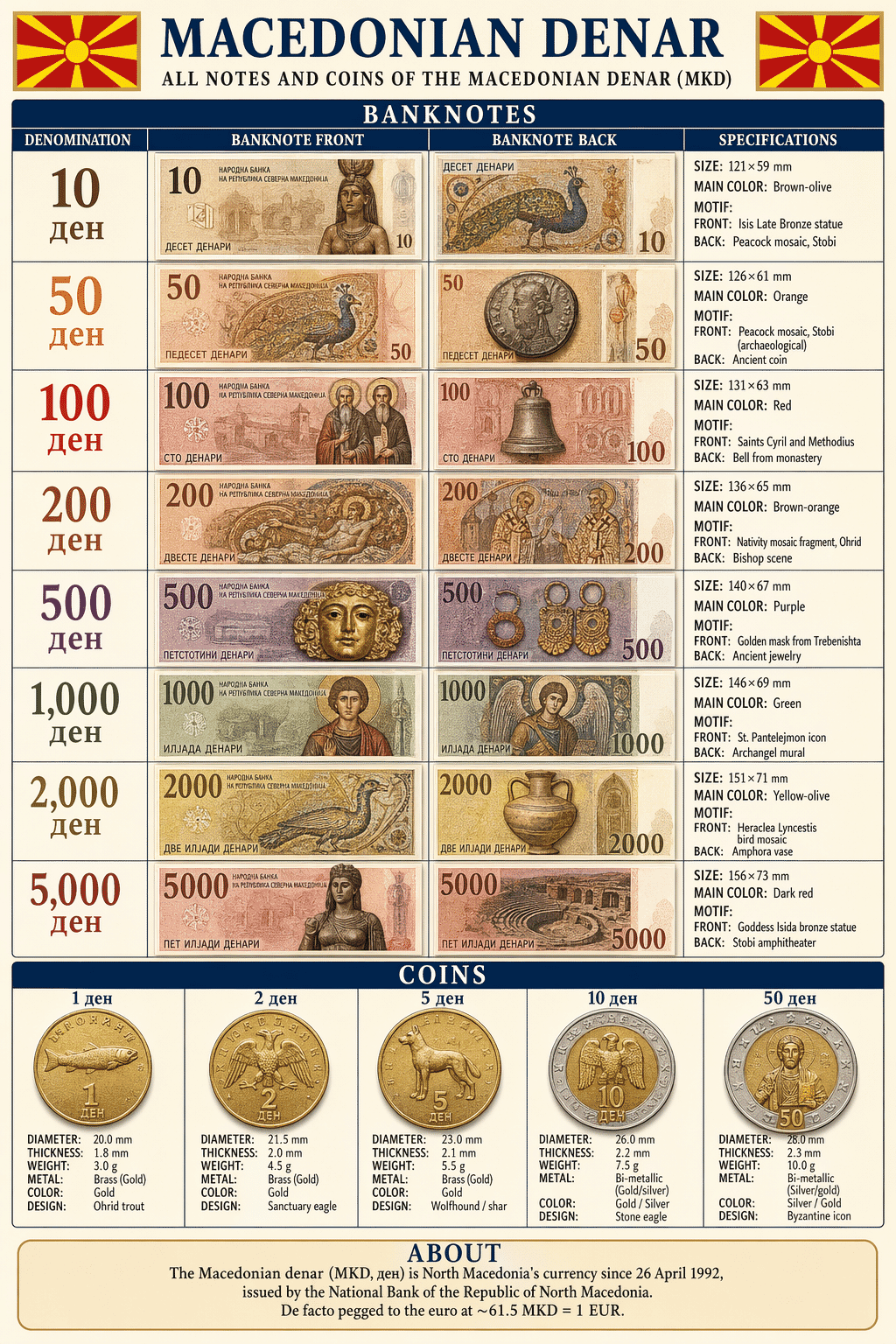
Macedonian denar banknotes honour Byzantine-era and national-awakening figures, alongside one denomination featuring iconic Ohrid architecture.
| Denomination | Figure / Motif | Context | Colour |
|---|---|---|---|
| 10 ден | Ohrid Lake landscape | With a fresco of Byzantine saint | Blue |
| 50 ден | Stobi archaeological site mosaic | Roman-era city in present-day N. Macedonia | Orange |
| 100 ден | Byzantine Saints Cyril and Methodius | The ‘Apostles to the Slavs’, 9th c. | Red |
| 200 ден | Mosaic of the Nativity from St. Sophia, Ohrid | Byzantine art motif | Brown-orange |
| 500 ден | Golden mask from Trebenishta | Ancient Macedonian archaeological find | Purple |
| 1,000 ден | St. Pantelejmon monastery icon | Byzantine saint | Green |
| 2,000 ден | Heraclea Lyncestis bird mosaic | From Roman-era Heraclea in Bitola | Yellow-olive |
| 5,000 ден | Goddess Isida bronze statue | Roman-Egyptian cult figure | Dark red |
Coins come in six denominations, from 1 to 50 denari.
| Denomination | Composition & Design | Notes |
|---|---|---|
| 1 ден | Brass | Since 1993 |
| 2 денари | Brass | Since 1993 |
| 5 денари | Brass | Since 1993 |
| 10 денари | Bi-metallic | Since 2008 |
| 50 денари | Bi-metallic | Higher-value coin |
History of The Denar
The denar is a young currency — just over three decades old — but its name evokes a much deeper history: the Roman denarius silver coin that circulated across the Balkans for centuries. Modern North Macedonia chose the name in 1992 as a nod to regional monetary continuity.
| Year | Event |
|---|---|
| 1991 | Yugoslav Republic of Macedonia declares independence 8 September. |
| 1992 | Denar introduced on 26 April, replacing the Yugoslav dinar. |
| 1992 | National Bank of the Republic of Macedonia founded. |
| 1995 | Major denomination reform: new denar introduced at 100:1 after high inflation. |
| 2002 | De facto EUR peg begins; NBRNM keeps denar close to 61.5 MKD = 1 EUR. |
| 2005 | North Macedonia granted EU candidate status. |
| 2019 | Country renamed from ‘Republic of Macedonia’ to ‘Republic of North Macedonia’ under the Prespa Agreement; central bank renamed accordingly. |
| 2022 | EU accession negotiations formally opened on 19 July. |
| 2024–2026 | Denar remains stable against the euro; NBRNM policy rate tracks ECB with structural spread. |
The Macedonian Economy and the Denar
North Macedonia is a small Western-Balkan economy of about 1.8 million people. Its 2025 export mix is dominated by manufactured goods — catalysts for cars, steel, textiles — produced in specialised economic zones near the capital Skopje. Germany is the main destination for both exports and foreign-direct investment. Remittances from the Macedonian diaspora add roughly 3% of GDP, smaller than in neighbouring Albania or Kosovo.
Because the denar is pegged to the euro, NBRNM’s policy rate mechanically tracks the ECB’s with a structural positive spread — typically 2–4 pp. As of early 2026 the key rate is around 6%, consistent with the ECB’s 2.00% deposit rate plus a peg premium. Inflation has converged close to the euro area’s; the 2026 forecast is roughly 2%, which is what the peg is designed to deliver.
Using Denari in North Macedonia
Card acceptance is good in Skopje and Ohrid, with Visa and Mastercard working in chain cafés, supermarkets, hotels, and most restaurants. Cash remains the norm in smaller towns and rural areas. Euros are often accepted informally in tourist zones but change comes in denari.
Typical prices in denari (2026): espresso 80–130 ден; a traditional lunch 250–450 ден; a meal in a mid-range restaurant 600–1,200 ден; a pint of local beer 150–230 ден; a mid-range Skopje hotel room 3,000–5,500 ден. ATMs at Komercijalna banka, Stopanska banka, and NLB Banka are reliable for foreign cards.
The Denar in Regional Context
North Macedonia is surrounded by a mix of monetary regimes: Bulgaria (recently into the euro), Greece (Eurozone), Albania (floating lek), Serbia (floating dinar), and Kosovo (unilateral euro use).
| Country | Code | Regime | Inflation | Policy rate |
|---|---|---|---|---|
| 🇲🇰 North Macedonia | MKD | De facto EUR peg (~61.5 MKD/EUR) | ~2% | ~6% |
| 🇧🇬 Bulgaria | EUR (since 2026) | Eurosystem | ~2.3% | 2.00% |
| 🇬🇷 Greece | EUR | Eurosystem | 2.8% | 2.00% |
| 🇦🇱 Albania | ALL | Managed float | 2.4% | 2.50% |
| 🇷🇸 Serbia | RSD | Managed float | ~3–4% | 5.75% |
| 🇽🇰 Kosovo | EUR (unilateral) | Uses euro | ~2% | 2.00% (ECB) |
Frequently Asked Questions
What is the currency of North Macedonia?
North Macedonia’s currency is the Macedonian denar (symbol ден or MKD, ISO 4217 code MKD). It has been North Macedonia’s currency since 26 April 1992.
Is North Macedonia in the Eurozone?
No. North Macedonia is an EU candidate country, with accession negotiations formally opened on 19 July 2022. The denar is not in ERM II, though it is pegged de facto to the euro at approximately 61.5 MKD = 1 EUR.
Why is the Macedonian denar pegged to the euro?
The NBRNM introduced the informal peg in 2002 as an anchor for price and macroeconomic stability in a small, open economy heavily dependent on EU trade. The strategy has worked: denar volatility against the euro has been among the lowest of any non-EU European currency, and Macedonian inflation has converged close to the euro area’s.
How many denari is one US dollar worth?
At the latest daily close, 1 USD ≈ 52.17 MKD. The denar’s rate against the dollar is essentially driven by EUR/USD plus small technical movements within the ~61.5 MKD/EUR band.
Is the denar accepted anywhere outside North Macedonia?
Generally no. The denar is freely convertible but not widely traded or accepted outside North Macedonia. In neighbouring Kosovo, the euro is the standard. Most travellers should exchange back to euros or dollars before leaving the country.
Can I use euros in North Macedonia?
Many hotels, tour operators, and larger restaurants in Skopje and Ohrid will accept euros informally, though change is typically given in denari and the rate is rarely as good as the peg. For everyday spending, use denari — either from an ATM or a multi-currency card.
What is on Macedonian banknotes?
The notes honour Byzantine and national-awakening figures, plus archaeological finds. Saints Cyril and Methodius (the ‘Apostles to the Slavs’, 9th c.) appear on the 100 denar note. Other notes show mosaics from Roman-era Stobi and Heraclea Lyncestis, the ‘Goddess Isida’ bronze, and the golden mask from Trebenishta.
Data current to April 2026 — NBRNM and State Statistical Office releases.

