
Key Facts: The Swedish Krona
- ISO 4217 code: SEK · Symbol: kr. Plural kronor. Subdivided formally into 100 öre, but no øre coins have been in circulation since 2010.
- Central bank: Sveriges Riksbank (est. 1668 — world's oldest). Stockholm-based. Governor Erik Thedéen since 1 January 2023. Inflation-targeting mandate at 2% CPIF.
- Policy rate: 1.75% · Inflation forecast 0.9% (2026). Held at 1.75% since September 2025, through the 4th consecutive meeting in March 2026. CPIF inflation is now running below target.
- 1 USD ≈ 9.16 SEK. The krona has appreciated ~3.7% against the US dollar over the past 12 months.
- One of the most cashless economies in the world. Cash usage <10% of POS transactions. The Swish real-time payment app is used by over 80% of Swedish adults.
What Is the Currency of Sweden?
The currency of Sweden is the Swedish krona (plural kronor, symbol kr, ISO 4217 code SEK). Krona literally means ‘crown’. The krona has been Sweden’s currency since 1873, when the Scandinavian Monetary Union linked it with the Danish and Norwegian krone at par against gold — a union that effectively ended in 1914 but left the three countries with currencies of the same name.
The krona is issued by Sveriges Riksbank, founded in 1668 — the world’s oldest central bank still in operation. Sweden has been an EU member since 1995 but rejected the euro in a 14 September 2003 referendum. Unlike Denmark, Sweden holds no formal opt-out, but successive governments have declined to submit a new application for euro membership.
Swedish Krona to US Dollar — 1-Year Chart
The chart tracks USD/SEK daily close over the past year. The krona’s drivers: Riksbank–Fed–ECB policy-rate differentials, risk sentiment (the krona trades as a mild pro-cyclical currency, selling off in risk-off episodes), and Swedish export performance.
Line chart. Daily close, SEK per USD · Source: Yahoo Finance · Updated nightly. Data table with 2 rows and 131 columns follows.
| Oct 12 | Oct 14 | Oct 16 | Oct 20 | Oct 22 | Oct 27 | Oct 29 | Oct 31 | Nov 04 | Nov 06 | Nov 10 | Nov 12 | Nov 14 | Nov 18 | Nov 20 | Nov 24 | Nov 26 | Nov 28 | Dec 02 | Dec 04 | Dec 08 | Dec 10 | Dec 12 | Dec 16 | Dec 18 | Dec 22 | Dec 24 | Dec 29 | Dec 31 | Jan 05 | Jan 07 | Jan 09 | Jan 13 | Jan 15 | Jan 19 | Jan 21 | Jan 23 | Jan 27 | Jan 29 | Feb 02 | Feb 04 | Feb 06 | Feb 10 | Feb 12 | Feb 16 | Feb 18 | Feb 20 | Feb 24 | Feb 26 | Mar 02 | Mar 04 | Mar 06 | Mar 10 | Mar 12 | Mar 16 | Mar 18 | Mar 20 | Mar 24 | Mar 26 | Mar 29 | Mar 31 | Apr 02 | Apr 06 | Apr 08 | Apr 12 | Apr 14 | Apr 16 | Apr 20 | Apr 22 | Apr 26 | Apr 28 | Apr 30 | May 04 | May 06 | May 10 | May 12 | May 14 | May 18 | May 20 | May 24 | May 26 | May 28 | Jun 01 | Jun 03 | Jun 07 | Jun 09 | Jun 11 | Jun 15 | Jun 17 | Jun 21 | Jun 23 | Jun 25 | Jun 29 | Jul 01 | Jul 05 | Jul 07 | Jul 09 | Jul 13 | Jul 15 | Jul 19 | Jul 21 | Jul 23 | Jul 27 | Jul 29 | Aug 02 | Aug 04 | Aug 06 | Aug 10 | Aug 12 | Aug 16 | Aug 18 | Aug 20 | Aug 24 | Aug 26 | Aug 30 | Sep 01 | Sep 03 | Sep 07 | Sep 09 | Sep 13 | Sep 15 | Sep 17 | Sep 21 | Sep 23 | Sep 27 | Sep 29 | Oct 01 | Oct 05 | Oct 07 | Oct 12 | |
|---|---|---|---|---|---|---|---|---|---|---|---|---|---|---|---|---|---|---|---|---|---|---|---|---|---|---|---|---|---|---|---|---|---|---|---|---|---|---|---|---|---|---|---|---|---|---|---|---|---|---|---|---|---|---|---|---|---|---|---|---|---|---|---|---|---|---|---|---|---|---|---|---|---|---|---|---|---|---|---|---|---|---|---|---|---|---|---|---|---|---|---|---|---|---|---|---|---|---|---|---|---|---|---|---|---|---|---|---|---|---|---|---|---|---|---|---|---|---|---|---|---|---|---|---|---|---|---|---|---|---|
| SEK per USD | 9.51 | 9.54 | 9.42 | 9.42 | 9.41 | 9.38 | 9.37 | 9.44 | 9.48 | 9.55 | 9.54 | 9.45 | 9.4 | 9.48 | 9.54 | 9.54 | 9.53 | 9.47 | 9.45 | 9.38 | 9.4 | 9.35 | 9.25 | 9.28 | 9.3 | 9.27 | 9.16 | 9.14 | 9.19 | 9.23 | 9.2 | 9.22 | 9.17 | 9.19 | 9.2 | 9.12 | 9 | 8.94 | 8.82 | 8.92 | 8.9 | 9.06 | 8.92 | 8.89 | 8.91 | 8.96 | 9.07 | 9.06 | 9.01 | 9.07 | 9.26 | 9.22 | 9.14 | 9.24 | 9.45 | 9.27 | 9.29 | 9.33 | 9.35 | 9.48 | 9.45 | 9.41 | 9.45 | 9.32 | 9.32 | 9.17 | 9.19 | 9.12 | 9.2 | 9.24 | 9.26 | 9.23 | 9.29 | 9.24 | 9.24 | 9.29 | 9.4 | 9.38 | 9.33 | 9.31 | 9.29 | 9.25 | 9.31 | 9.39 | 9.46 | 9.48 | 9.44 | 9.4 | 9.51 | 9.59 | 9.73 | 9.74 | 9.71 | 9.72 | 9.64 | 9.7 | 9.66 | 9.71 | 9.59 | 9.67 | 9.71 | 9.76 | 9.72 | 9.64 | 9.5 | 9.51 | 9.51 | 9.49 | 9.58 | 9.52 | 9.53 | 9.47 | 9.49 | 9.52 | 9.61 | 9.62 | 9.53 | 9.59 | 9.59 | 9.7 | 9.78 | 9.82 | 9.84 | 9.92 | 9.93 | 9.99 | 10.04 | 10.04 | 10 | 9.99 |
Over the past 12 months the krona has strengthened from roughly 9.52 to 9.16 SEK per USD — about 3.7% in the krona’s favour. Governor Thedéen’s relatively cautious stance at 1.75% (vs the ECB’s 2.00%) has been crypto-balanced by Sweden’s current-account surplus.
Banknotes and Coins
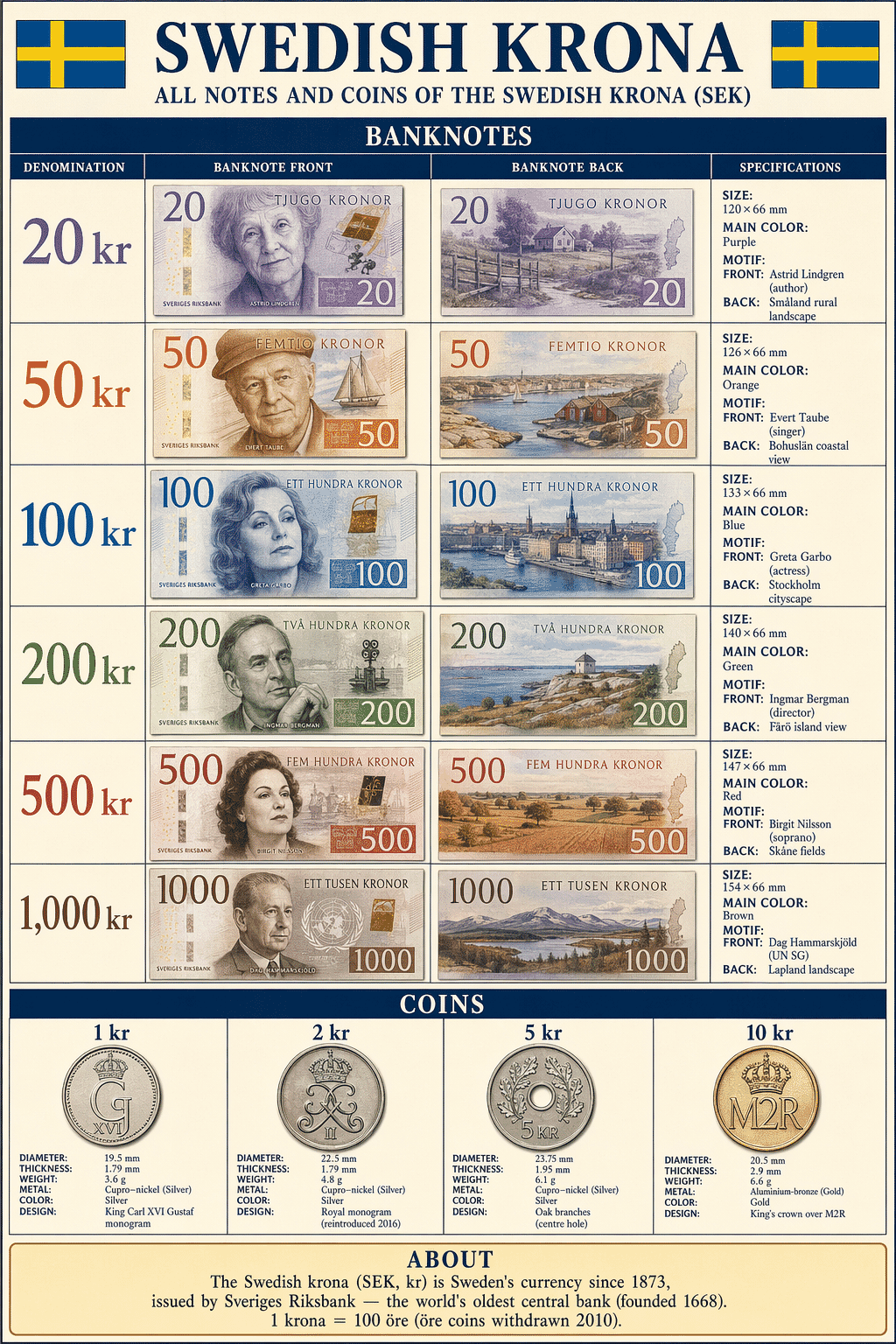
The current Swedish banknote series (2015–2016) features eight 20th-century Swedish cultural figures — each with a landscape or scene associated with their life on the reverse. It was designed by Göran Österlund and has won international banknote-design awards.
| Denomination | Figure / Motif | Context | Colour |
|---|---|---|---|
| 20 kr | Astrid Lindgren | Children’s author (Pippi Longstocking, 1945–2002) | Purple |
| 50 kr | Evert Taube | Singer-songwriter (Swedish West Coast) | Orange |
| 100 kr | Greta Garbo | Film actress (Hollywood, 1920s–40s) | Blue |
| 200 kr | Ingmar Bergman | Film director (Persona, The Seventh Seal) | Green |
| 500 kr | Birgit Nilsson | Operatic soprano, Wagner specialist | Red |
| 1,000 kr | Dag Hammarskjöld | UN Secretary-General (1953–1961) | Brown |
Sweden uses four coin denominations: 1, 2, 5, and 10 kronor. Small-change coins (25 öre, 50 öre, 1 kr coin of earlier design) have been withdrawn.
| Denomination | Composition & Design | Notes |
|---|---|---|
| 1 kr | Cupro-nickel; King Carl XVI Gustaf portrait | Since 2016 (new design with King’s older portrait) |
| 2 kr | Cupro-nickel | Reintroduced 2016 after 45-year absence |
| 5 kr | Cupro-nickel with centre hole, older design | Since 1972 (hole design) |
| 10 kr | Aluminium-bronze, King Carl XVI Gustaf | Since 1991 |
History of The Krona
The krona emerged from the 1873 Scandinavian Monetary Union, which for 40 years allowed Danish, Norwegian, and Swedish coins to circulate interchangeably. The 20th-century krona weathered two world wars, the end of gold convertibility, a brief ERM experiment, and a 1992 currency crisis before settling into the current inflation-targeting regime in 1993.
| Year | Event |
|---|---|
| 1873 | Scandinavian Monetary Union; krona replaces the Swedish riksdaler. |
| 1914 | SMU effectively ends with the outbreak of WWI. |
| 1931 | Sweden leaves the gold standard on 27 September, days after the UK. |
| 1951 | Sweden joins the IMF system of pegged rates against the US dollar. |
| 1992 | Riksbank briefly raises overnight rate to 500% on 16 September defending the krona peg to ECU; floats the krona on 19 November. |
| 1993 | Riksbank introduces an explicit 2% CPI inflation target — one of the first in the world. |
| 2003 | Euro referendum on 14 September; 55.9% vote no. |
| 2009 | Repo rate briefly cut to 0.25% — a then-historic low. |
| 2015–2022 | Riksbank operates with negative rates (down to −0.50% in 2016) — a pioneer among advanced economies. |
| 2022–2024 | Post-pandemic rate-hike cycle peaks at 4.00% in September 2023. |
| 2025–2026 | Cutting cycle brings policy rate to 1.75%; held at 1.75% at the March 2026 meeting. |
The Swedish Economy and the Krona
Sweden is the 22nd-largest economy globally by nominal GDP and the Nordic region’s largest — slightly bigger than Norway and Denmark combined. The export mix is unusually diversified: motor vehicles, machinery, electronics, iron and steel, pharmaceuticals, and wood pulp all feature prominently. Sweden runs persistent current-account surpluses and has one of the EU’s strongest sovereign balance sheets (AAA-rated).
The Riksbank — founded 1668 and granted full independence in 1999 — pioneered the modern inflation-targeting framework. Its 2% CPIF target (CPI with fixed mortgage interest rates) has been the benchmark since 2017, replacing the older headline-CPI target. CPIF inflation has undershot target through late 2025 and is forecast at just 0.9% for 2026, before returning to 2% in 2027. The policy rate is 1.75%, held through four consecutive meetings from September 2025 to March 2026.
Using Kronor in Sweden
Sweden is one of the most cashless societies in the world. Less than 10% of point-of-sale transactions are in cash, and the share is still falling. Visa, Mastercard, contactless mobile wallets, and especially Swish — the real-time mobile payment app used by over 80% of Swedish adults — dominate. Many smaller businesses, cafés, and even some church collection boxes no longer accept cash at all.
Typical prices in kronor (2026): coffee in a Stockholm café 35–45 kr; lunch set (dagens lunch) 110–160 kr; a mid-range dinner 280–450 kr; a single SL (Stockholm transit) ticket 42 kr; a mid-range Stockholm hotel room 1,400–2,500 kr. ATMs (Bankomat) exist but are hard to find — they’ve been consolidated into the shared ‘Bankomat AB’ network operated by Handelsbanken, Nordea, SEB, and Swedbank. Foreign cards work reliably at them.
The Krona in Regional Context
Sweden, Norway, and Denmark all use a currency called krona/krone — a legacy of the 1873 Scandinavian Monetary Union. The three currencies have been fully independent since 1914 and trade against each other like any other pair.
| Country | Code | Regime | Inflation | Policy rate |
|---|---|---|---|---|
| 🇸🇪 Sweden | SEK | Free float (Riksbank CPIF target) | 0.9% (2026f) | 1.75% |
| 🇩🇰 Denmark | DKK | ERM II peg 7.46038 to EUR | 1.8% | 1.60% |
| 🇳🇴 Norway | NOK | Free float (Norges Bank target) | 3.0% | 4.00% |
| 🇫🇮 Finland | EUR (since 1999) | Eurosystem | 2.3% | 2.00% |
| 🇮🇸 Iceland | ISK | Managed float | 5.2% | 7.50% |
| 🇪🇪 Estonia | EUR (since 2011) | Eurosystem | 3.0% | 2.00% |
Frequently Asked Questions
What is the currency of Sweden?
Sweden’s currency is the Swedish krona (plural kronor, symbol kr, ISO 4217 code SEK). It has been Sweden’s currency since 1873. Formally the krona is subdivided into 100 öre, but no öre coins have been in circulation since 2010.
Is Sweden in the Eurozone?
No. Sweden is an EU member (since 1995) and is legally required to eventually adopt the euro, but Swedish voters rejected the euro in a 14 September 2003 referendum by 55.9% to 42.0%. Unlike Denmark, Sweden has no formal opt-out — but no Swedish government since has submitted a new application, and there are no plans to do so.
Who manages Swedish monetary policy?
The Sveriges Riksbank, founded 1668, making it the world’s oldest central bank still in operation. Its current Governor is Erik Thedéen, who took office on 1 January 2023. The Riksbank targets 2% CPIF inflation over the medium term.
What is the current Riksbank policy rate?
The policy rate is 1.75%, held since September 2025. The Riksbank maintained the rate through four consecutive meetings including March 2026, signalling that rates will likely stay at this level ‘for some time’ while CPIF inflation runs below target.
How many kronor is one US dollar worth?
At the latest daily close, 1 USD ≈ 9.16 SEK. The krona has strengthened about 3.7% against the US dollar over the past 12 months.
Can I use cash in Sweden? Can I avoid using cash?
Yes to both — but it’s genuinely harder to pay with cash than with a card. A number of Swedish establishments (including some bank branches!) no longer accept cash at all, or do so only reluctantly. If you bring a card that works internationally (Visa, Mastercard, or Apple Pay), you can travel through Sweden without ever needing kronor in physical form.
Who are on current Swedish banknotes?
Six 20th-century cultural figures, one per denomination: Astrid Lindgren (20 kr), Evert Taube (50 kr), Greta Garbo (100 kr), Ingmar Bergman (200 kr), Birgit Nilsson (500 kr), and Dag Hammarskjöld (1,000 kr). The series was introduced in 2015–2016 and has won international banknote-design awards.
All data current to April 2026 — Riksbank and Statistics Sweden releases.

