Key Takeaways
- Global terrorism deaths fell 28% to a near-20-year low. The 2026 Global Terrorism Index records 5,582 deaths from terrorism in 2025 across 2,944 incidents — both the lowest figures since 2007. Despite the decline, the impact is now more concentrated than at any point in two decades.
- Pakistan tops the index for the first time at 8.574. Pakistan recorded 1,139 terrorism deaths and 1,045 incidents in 2025 — its highest level since 2013, driven in part by the Taliban's return to power in Afghanistan in 2021 and the resurgence of Tehrik-i-Taliban Pakistan (TTP).
- Sub-Saharan Africa is the global epicentre — 6 of the top 10. Burkina Faso (8.324), Niger (7.816), Nigeria (7.792), Mali (7.586), Somalia (7.391), and DR Congo (7.171) all sit in the top 10. Just five countries — Pakistan, Burkina Faso, Nigeria, Niger, and DRC — accounted for nearly 70% of all terrorism deaths globally.
- Western terrorism fatalities rose 280% to 57. Despite the global decline, Western fatalities rose sharply — driven by antisemitism, Islamophobia, and politically motivated terrorism, with 93% of fatal Western attacks since 2021 being lone-wolf attacks. Youth radicalisation investigations have tripled since 2021.
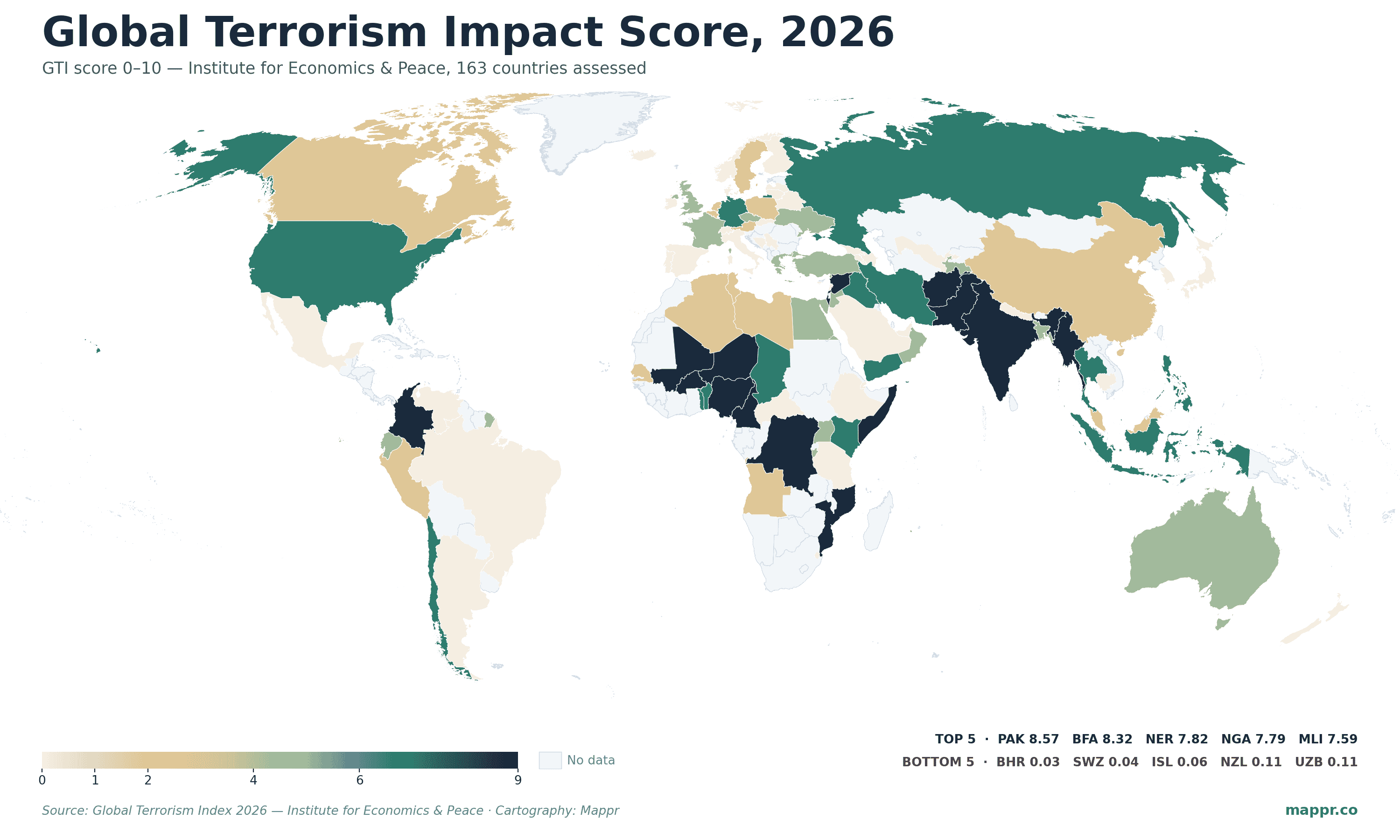
The Global Terrorism Index 2026, published by the Institute for Economics & Peace (IEP) in March 2026, measured the impact of terrorism in 163 countries over the 2025 calendar year. The headline finding is dual: the global picture is improving — deaths fell 28% to 5,582, the lowest since 2007 — but the burden has become highly concentrated. Just five countries (Pakistan, Burkina Faso, Nigeria, Niger, and the Democratic Republic of the Congo) account for nearly 70% of all terrorism deaths worldwide.
The 2026 edition delivers a first: Pakistan replaces Burkina Faso at the top of the index, with a composite score of 8.574 vs Burkina Faso’s 8.324. Pakistan recorded 1,139 deaths and 1,045 incidents in 2025 — its worst year since 2013, attributed by IEP analysts to TTP resurgence following the Taliban’s 2021 return to power in Afghanistan, plus strained relations with neighbours and a series of cross-border raids in 2024–25.
This post maps the GTI 2026 score for every country and unpacks the regional concentration, the Western lone-wolf trend, and what changed between the 2025 and 2026 editions of the index.
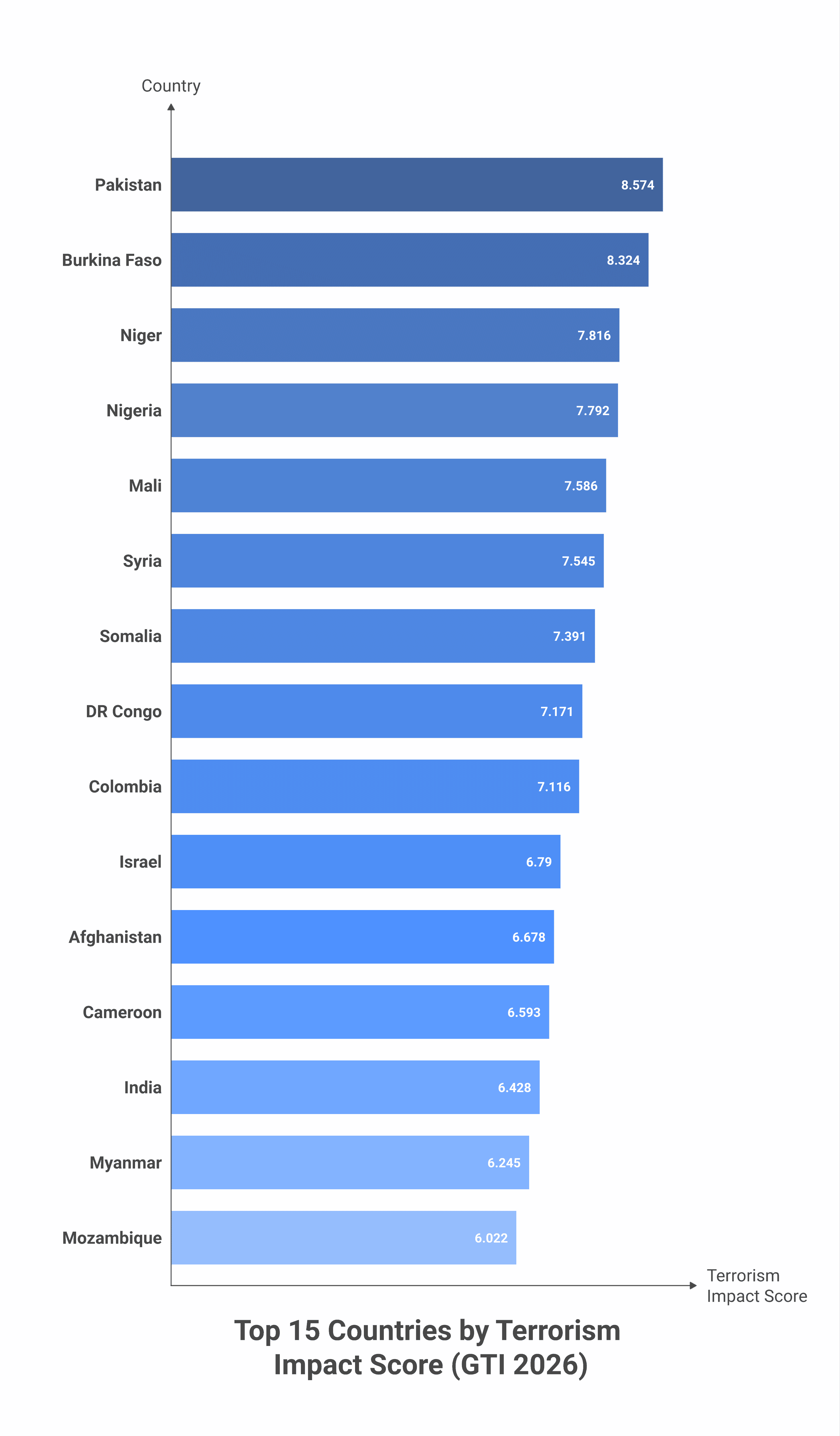
📋 GTI 2026 — Top 30 Most-Impacted Countries
Composite GTI score (0–10), 163 countries assessed. Score 0 = no measurable impact; 10 = highest measurable impact. Sourced directly from the IEP’s published 2026 report.
| Rank | Country | GTI 2026 Score | Region |
|---|---|---|---|
| 1 | 🇵🇰 Pakistan | 8.574 | South Asia |
| 2 | 🇧🇫 Burkina Faso | 8.324 | Sahel |
| 3 | 🇳🇪 Niger | 7.816 | Sahel |
| 4 | 🇳🇬 Nigeria | 7.792 | West Africa |
| 5 | 🇲🇱 Mali | 7.586 | Sahel |
| 6 | 🇸🇾 Syria | 7.545 | Levant |
| 7 | 🇸🇴 Somalia | 7.391 | East Africa |
| 8 | 🇨🇩 DR Congo | 7.171 | Central Africa |
| 9 | 🇨🇴 Colombia | 7.116 | South America |
| 10 | 🇮🇱 Israel | 6.79 | Middle East |
| 11 | 🇦🇫 Afghanistan | 6.678 | South Asia |
| 12 | 🇨🇲 Cameroon | 6.593 | Central Africa |
| 13 | 🇮🇳 India | 6.428 | South Asia |
| 14 | 🇲🇲 Myanmar | 6.245 | Southeast Asia |
| 15 | 🇲🇿 Mozambique | 6.022 | Southern Africa |
| 16 | 🇮🇶 Iraq | 5.822 | Middle East |
| 17 | 🇷🇺 Russia | 5.593 | Eastern Europe |
| 18 | 🇮🇷 Iran | 5.477 | Middle East |
| 19 | 🇧🇯 Benin | 5.434 | West Africa |
| 20 | 🇹🇭 Thailand | 5.275 | Southeast Asia |
| 21 | 🇰🇪 Kenya | 5.088 | East Africa |
| 23 | 🇵🇭 Philippines | 4.719 | Southeast Asia |
| 24 | 🇮🇩 Indonesia | 4.714 | Southeast Asia |
| 25 | 🇾🇪 Yemen | 4.653 | Middle East |
| 26 | 🇹🇩 Chad | 4.625 | Central Africa |
| 27 | 🇨🇱 Chile | 4.553 | South America |
| 28 | 🇺🇸 United States | 4.521 | North America |
| 29 | 🇩🇪 Germany | 4.447 | Western Europe |
| 30 | 🇹🇬 Togo | 4.305 | West Africa |
What the GTI Measures (and How It Differs from a Death Toll)
The Global Terrorism Index is a composite score, not a death toll. The methodology weights four indicators across the prior five-year window:
- Total terrorist incidents in the country (16% of the score)
- Total terrorism-related deaths (32%)
- Total terrorism-related injuries (32%)
- Total property damage from terrorist attacks (20%)
Each indicator is normalised on a 0–100 scale and weighted across the five-year window with a banded decay function (most recent year weighted highest). The composite is then rescaled to 0–10. The five-year window is what produces the GTI’s relative stability year-on-year — countries that have been impacted heavily over the past five years remain near the top even if they had a quieter year, and countries with sudden surges (e.g. Pakistan in 2025) take time to fully reflect in the score.
The data source is Terrorism Tracker, a database maintained by Dragonfly Intelligence. Incidents must meet GTI’s strict definition of terrorism: an act of intentional violence by a non-state actor, perpetrated for political, social, religious, ideological, or economic reasons, with the intent to coerce or intimidate beyond the immediate target. Wars between states, armed conflicts between organised armies, and cartel violence motivated solely by economic gain are excluded.
The Concentration Story: 5 Countries, 70% of Deaths
The 2026 report’s most consequential finding is concentration: five countries account for nearly 70% of all terrorism deaths worldwide.
- 🇵🇰 Pakistan — 1,139 deaths in 2025, primarily from TTP attacks in Khyber Pakhtunkhwa and Balochistan provinces. The deadliest attack was the Bannu garrison assault (March 2025) which killed 14 soldiers and dozens of civilians.
- 🇧🇫 Burkina Faso — JNIM (Jamaat Nusrat al-Islam wal-Muslimin) and ISGS (Islamic State Greater Sahara) operating across the country’s northern and eastern regions; civilian-targeted village attacks dominate the casualty profile.
- 🇳🇬 Nigeria — Boko Haram and ISWAP in the northeast plus growing JNIM activity in the northwest. The 2026 report documents a 4× increase in IS-attributed activity in Nigeria, with 92 attacks in 2025 vs 20 in 2024.
- 🇳🇪 Niger — Sahel-region operations from JNIM and ISGS spilling across borders from Mali and Burkina Faso. The 2024 coup and US/French troop withdrawals reduced counter-terrorism cooperation.
- 🇨🇩 Democratic Republic of the Congo — Allied Democratic Forces (ADF, IS-aligned) operations in North Kivu and Ituri provinces.
Six of the ten countries in the GTI’s top 10 are in sub-Saharan Africa, confirming the region’s status as the global epicentre of terrorism — a designation it first received in the 2022 edition and has held every year since. By contrast, deaths in the Middle East and North Africa fell 39% in 2025, with Syria’s downward trend continuing despite the December 2024 fall of the Assad regime.
Western Lone-Wolf Surge: A 280% Rise from a Low Base
Against the global decline, fatalities in Western countries rose 280% — from 15 deaths in 2024 to 57 in 2025. The IEP characterises the increase as driven by three intersecting motivations:
- Antisemitism-motivated attacks, particularly in the US, Germany, France, and Australia, in the wake of the post-October 2023 Israel-Hamas conflict
- Islamophobia-motivated attacks targeting mosques and Muslim community centres
- Politically motivated attacks from both far-right and far-left actors, with election-cycle escalation in the US, France, and the UK
Crucially, 93% of fatal terrorist attacks in the West since 2021 were lone-wolf attacks — individuals acting without direct organisational coordination, typically self-radicalised through online networks. IEP investigations into youth radicalisation tripled between 2021 and 2025, and the report dedicates a chapter to the role of online networks in funnelling young people toward violent action without traditional organisational membership.
The United States scores 4.521 on the GTI 2026 (rank 28), Germany 4.447 (29), Australia 3.732 (31), France 3.224 (35), and the United Kingdom 2.936 (38). All five rose modestly from 2025 readings.
The Major Organisations: IS Still Dominant
The 2026 report tracks four major organisational clusters:
- Islamic State (IS) and affiliates — responsible for just under 17% of all terrorist attacks worldwide in 2025. Most active in Syria (238 incidents), Nigeria (92 incidents, up 4× year-on-year), and the Sahel (via ISGS). Continues operating despite the 2017–2019 territorial defeat.
- JNIM (al-Qaeda Sahel affiliate) — the dominant force in Burkina Faso, Mali, and Niger; a key driver of the West Africa concentration.
- TTP (Tehrik-i-Taliban Pakistan) — the only major group to record an INCREASE in attributable deaths in 2025; the primary driver of Pakistan’s resurgence and ascent to #1.
- Al-Shabaab — Somalia-based; deaths attributable to the group declined for the third consecutive year in 2025, even as the group launched a major offensive that brought it within 50km of Mogadishu by mid-year.
The report also flags the joint US-Israeli military operation against Iran (28 February 2026) as the single largest known risk factor for future terrorism, citing Iran’s retaliatory missile strikes against Israel and US allies in the Gulf, plus its long-standing relationships with Hezbollah, Hamas, and various Iraqi militias.
Reading the Map Carefully
Three caveats matter for anyone using the GTI for analysis or comparison:
1. Score, not death toll. The GTI weights four indicators (incidents, deaths, injuries, property damage) over a five-year window. A country with one high-profile attack one year and zero attacks the next will sit between two countries with steady moderate activity. The composite design intentionally smooths volatility.
2. Definitions matter. The GTI excludes state-on-state war, organised armed-conflict deaths, and most cartel violence motivated by economic gain. That’s why Mexico (rank 87, score 0.325) appears low despite its much-higher overall homicide rate — most cartel violence falls outside the GTI’s definition. Likewise, Ukraine (rank 39, score 2.927) is scored only for non-state-actor incidents, not Russian military operations.
3. Counter-terrorism context isn’t captured. A country can score high because it experienced active terrorism OR because it absorbed cross-border attacks while neighbouring states deteriorated. Niger and Chad’s recent climbs reflect both — direct attacks plus refugee inflows from Mali and Sudan that brought new threats across the border.