
Key Facts: The Norwegian Krone
- ISO 4217 code: NOK · Symbol: kr. Subdivided formally into 100 øre; no øre coins since 2012.
- Central bank: Norges Bank (est. 1816). Oslo-based. Governor Ida Wolden Bache since March 2022 — the first woman to lead Norges Bank.
- Policy rate: 4.00% · Inflation ~3%. Held at 4.00% through January and March 2026. Forecast now suggests a HIKE to 4.25–4.50% by year-end — unusual in the current global cutting cycle.
- 1 USD ≈ 9.28 NOK. The krone has strengthened ~11.7% against the dollar over the past year — the strongest 12-month performance of any major European currency.
- Driven by oil & the Wealth Fund. Petroleum accounts for ~40% of Norwegian exports. The Government Pension Fund Global ($1.9 trillion+) is the world's largest sovereign wealth fund.
What Is the Currency of Norway?
Norway’s currency is the Norwegian krone (plural kroner, symbol kr, ISO 4217 code NOK). Krone means ‘crown’, and the Norwegian krone was introduced in 1875 as part of the Scandinavian Monetary Union with Denmark and Sweden. Formally the krone is subdivided into 100 øre, but no øre coins have been in circulation since 2012.
The krone is issued by Norges Bank, founded 14 June 1816 — one of Europe’s oldest continuously operating central banks. Norway is not an EU member; it rejected membership in referendums in 1972 and 1994, though it participates in the EU single market through the European Economic Area. The krone is freely floating.
Norwegian Krone to US Dollar — 1-Year Chart
The chart tracks USD/NOK daily close over the past year. The krone is one of the most oil-sensitive major currencies — Norway produces around 2 million barrels per day and petroleum is ~40% of exports. When oil rises, the krone typically strengthens.
Line chart. Daily close, NOK per USD · Source: Yahoo Finance · Updated nightly. Data table with 2 rows and 132 columns follows.
| Oct 21 | Oct 23 | Oct 28 | Oct 30 | Nov 03 | Nov 05 | Nov 07 | Nov 11 | Nov 13 | Nov 17 | Nov 19 | Nov 21 | Nov 25 | Nov 27 | Dec 01 | Dec 03 | Dec 05 | Dec 09 | Dec 11 | Dec 15 | Dec 17 | Dec 19 | Dec 23 | Dec 26 | Dec 30 | Jan 02 | Jan 06 | Jan 08 | Jan 12 | Jan 14 | Jan 16 | Jan 20 | Jan 22 | Jan 26 | Jan 28 | Jan 30 | Feb 03 | Feb 05 | Feb 09 | Feb 11 | Feb 13 | Feb 17 | Feb 19 | Feb 23 | Feb 25 | Feb 27 | Mar 03 | Mar 05 | Mar 09 | Mar 11 | Mar 13 | Mar 17 | Mar 19 | Mar 23 | Mar 25 | Mar 27 | Mar 30 | Apr 01 | Apr 05 | Apr 07 | Apr 09 | Apr 13 | Apr 15 | Apr 19 | Apr 21 | Apr 23 | Apr 27 | Apr 29 | May 03 | May 05 | May 07 | May 11 | May 13 | May 17 | May 19 | May 21 | May 25 | May 27 | May 31 | Jun 02 | Jun 04 | Jun 08 | Jun 10 | Jun 14 | Jun 16 | Jun 18 | Jun 22 | Jun 24 | Jun 28 | Jun 30 | Jul 02 | Jul 06 | Jul 08 | Jul 12 | Jul 14 | Jul 16 | Jul 20 | Jul 22 | Jul 26 | Jul 28 | Jul 30 | Aug 03 | Aug 05 | Aug 09 | Aug 11 | Aug 13 | Aug 17 | Aug 19 | Aug 23 | Aug 25 | Aug 27 | Aug 31 | Sep 02 | Sep 06 | Sep 08 | Sep 10 | Sep 14 | Sep 16 | Sep 20 | Sep 22 | Sep 24 | Sep 28 | Sep 30 | Oct 04 | Oct 06 | Oct 08 | Oct 12 | Oct 14 | Oct 18 | Oct 20 | Oct 22 | |
|---|---|---|---|---|---|---|---|---|---|---|---|---|---|---|---|---|---|---|---|---|---|---|---|---|---|---|---|---|---|---|---|---|---|---|---|---|---|---|---|---|---|---|---|---|---|---|---|---|---|---|---|---|---|---|---|---|---|---|---|---|---|---|---|---|---|---|---|---|---|---|---|---|---|---|---|---|---|---|---|---|---|---|---|---|---|---|---|---|---|---|---|---|---|---|---|---|---|---|---|---|---|---|---|---|---|---|---|---|---|---|---|---|---|---|---|---|---|---|---|---|---|---|---|---|---|---|---|---|---|---|---|
| NOK per USD | 10.06 | 9.97 | 9.99 | 10.01 | 10.12 | 10.22 | 10.19 | 10.13 | 10.07 | 10.08 | 10.11 | 10.2 | 10.23 | 10.2 | 10.12 | 10.12 | 10.11 | 10.12 | 10.08 | 10.11 | 10.18 | 10.15 | 10.1 | 9.99 | 10.04 | 10.05 | 10.04 | 10.08 | 10.08 | 10.09 | 10.11 | 10.06 | 9.97 | 9.74 | 9.59 | 9.53 | 9.69 | 9.67 | 9.68 | 9.51 | 9.53 | 9.5 | 9.52 | 9.49 | 9.56 | 9.55 | 9.57 | 9.62 | 9.63 | 9.63 | 9.69 | 9.67 | 9.6 | 9.57 | 9.69 | 9.69 | 9.73 | 9.72 | 9.76 | 9.58 | 9.5 | 9.44 | 9.38 | 9.38 | 9.33 | 9.33 | 9.28 | 9.32 | 9.28 | 9.25 | 9.29 | 9.18 | 9.16 | 9.32 | 9.27 | 9.23 | 9.25 | 9.28 | 9.24 | 9.29 | 9.34 | 9.47 | 9.47 | 9.49 | 9.47 | 9.74 | 9.69 | 9.85 | 9.93 | 9.91 | 9.85 | 9.78 | 9.76 | 9.78 | 9.68 | 9.66 | 9.67 | 9.59 | 9.58 | 9.68 | 9.53 | 9.54 | 9.52 | 9.5 | 9.49 | 9.5 | 9.42 | 9.33 | 9.3 | 9.31 | 9.32 | 9.34 | 9.32 | 9.3 | 9.22 | 9.27 | 9.33 | 9.42 | 9.41 | 9.44 | 9.52 | 9.54 | 9.62 | 9.62 | 9.55 | 9.56 | 9.57 | 9.49 | 9.43 | 9.4 | 9.35 |
Over the past 12 months the krone has strengthened dramatically from roughly 10.36 to 9.28 NOK per USD — an 11.7% move in the krone’s favour, the strongest 12-month gain of any major European currency. Higher oil prices (especially after the Middle East conflict) and Norges Bank’s surprising hawkish pivot have both contributed.
Banknotes and Coins
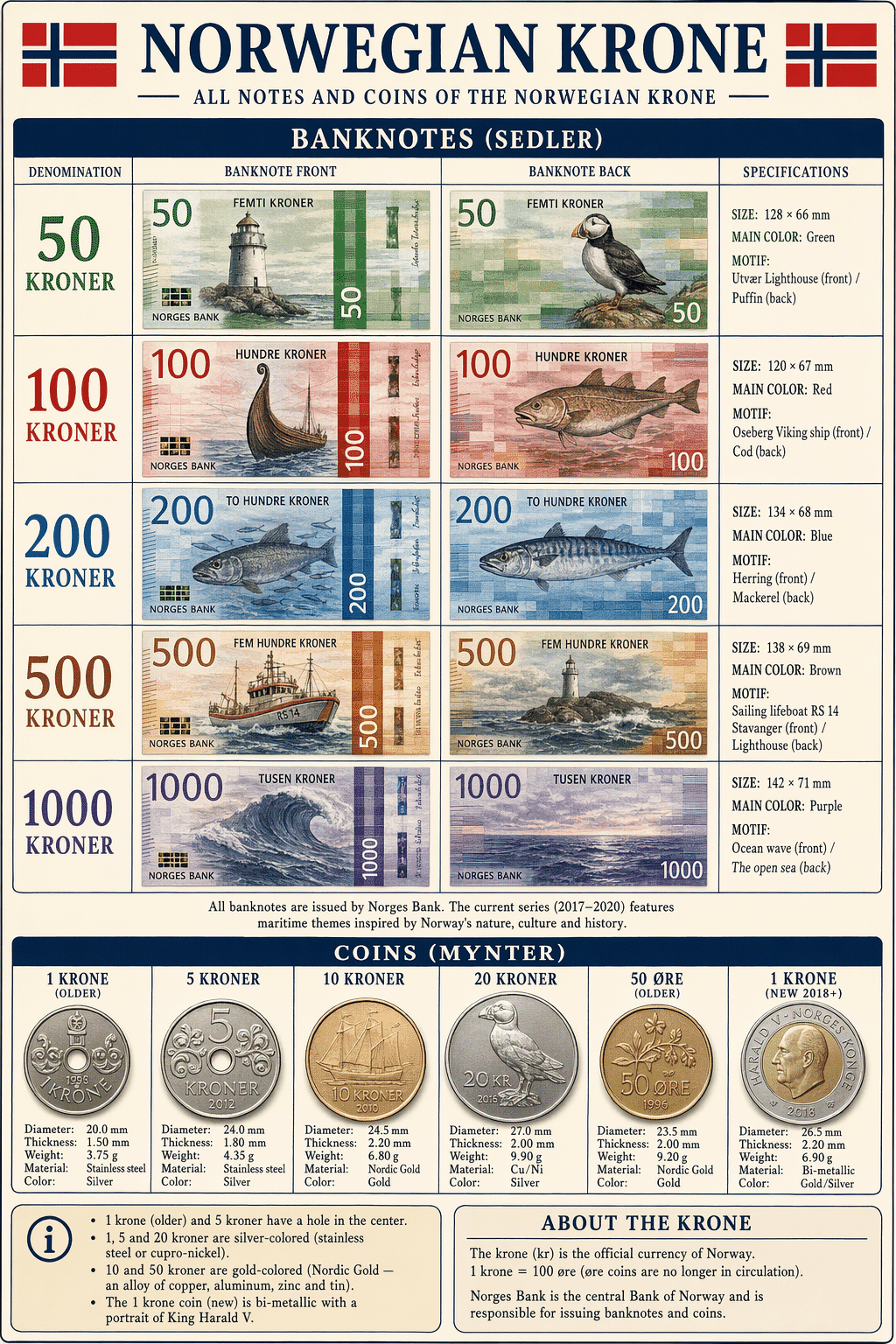
Norway’s current banknote series (2017–2019) is themed around “The Sea” — a nod to Norway’s maritime heritage. Each denomination pairs a sea-related obverse image (Viking ship, fish, lighthouse, lifeboat) with a more abstract sea-themed reverse. The series is considered one of the most design-forward banknote redesigns of the 2010s.
| Denomination | Figure / Motif | Context | Colour |
|---|---|---|---|
| 50 kr | Utvær Lighthouse | Norway’s westernmost lighthouse | Green |
| 100 kr | Gokstad ship | 9th-century Viking ship now in Oslo’s Viking Ship Museum | Red-brown |
| 200 kr | Cod (torsk) | The foundational species of Norway’s centuries-old fishing industry | Blue |
| 500 kr | Lifeboat RS-14 Stavanger | Rescue vessel representing Norway’s coastal heritage | Orange |
| 1,000 kr | Breaking wave | Abstract sea-horizon motif (most valuable note) | Purple |
Coins come in four denominations, all stamped with royal and natural motifs.
| Denomination | Composition & Design | Notes |
|---|---|---|
| 1 kr | Cupro-nickel with centre hole; stylised bird in flight | Since 1997 |
| 5 kr | Cupro-nickel with centre hole; King Harald V monogram | Since 1998 |
| 10 kr | Nordic gold; King Harald V portrait | Since 1996 |
| 20 kr | Nordic gold; royal monogram | Since 1994 |
History of The Krone
The krone is two centuries old in its modern form. Norway kept a krone peg to gold until 1931, then followed Britain off the gold standard, experimented with pegs throughout the Bretton Woods era, and finally adopted free float plus inflation targeting in 2001. The discovery of North Sea oil in 1969 transformed every part of Norwegian economic policy, including the exchange-rate regime.
| Year | Event |
|---|---|
| 1816 | Norges Bank founded on 14 June in Trondheim (later moved to Oslo). |
| 1875 | Norwegian krone adopted as part of the Scandinavian Monetary Union. |
| 1931 | Krone leaves the gold standard 27 September, following the UK. |
| 1969 | Ekofisk oil field discovered in the North Sea — transforms Norway’s economy. |
| 1990 | Government Petroleum Fund established (renamed Government Pension Fund Global in 2006); now the world’s largest sovereign wealth fund at $1.9T+. |
| 1992 | Krone briefly joined ECU peg; decoupled during the European FX crisis. |
| 2001 | Norges Bank adopts an inflation target of 2.5% (now 2%), krone free-floats. |
| 2021–2022 | Rate-hike cycle — first among G10 — takes policy rate from 0.00% to 1.75%. |
| 2023–2024 | Further hikes peak at 4.50%; rate then held through 2024–2025. |
| 2025 | Cuts reduce rate to 4.00% by early 2025; held through 2026 so far. |
| 2026 | March 2026 forecast unusual — Norges Bank now expects to raise rate to 4.25–4.50% by year-end, bucking global trend. |
The Norwegian Economy and the Krone
Norway is one of the world’s wealthiest countries by GDP per capita and has a unique economic structure dominated by offshore oil and gas, fisheries, and maritime industries. Petroleum accounts for about 40% of Norwegian exports and roughly 20% of government revenue. Norway has used this windfall prudently: oil revenues have been funnelled since 1996 into the Government Pension Fund Global, now worth over $1.9 trillion — the world’s largest sovereign wealth fund, with a stake in roughly 1.5% of global listed equities.
On monetary policy, Norges Bank targets 2% CPI-ATE inflation (excluding energy and tax effects). Inflation has run close to 3% since late 2024 — above target for longer than the Board would like. In a notable divergence from the global easing cycle, Norges Bank’s March 2026 forecast indicated that the policy rate is more likely to rise than fall during 2026, potentially reaching 4.25–4.50% by year-end. The current policy rate is 4.00%, held through January and March meetings.
Using the Krone in Norway
Norway is as cashless as Sweden — BankAxept (the domestic debit scheme), Visa, and Mastercard work essentially everywhere, including inter-city buses, ferries, and mountain hut reservations. The Vipps mobile-payment app is used for almost all peer-to-peer and small-merchant transactions. Cash is rarely needed.
Typical prices in kroner (2026): espresso in an Oslo café 45–60 kr; lunch special 180–260 kr; a pint of beer in a bar 85–125 kr (among the highest in Europe); a dinner at a mid-range restaurant 450–750 kr; an Oslo public-transport ticket 44 kr; a mid-range Oslo hotel room 1,400–2,400 kr. Norway is among Europe’s most expensive countries — budget accordingly. ATMs (minibank) at DNB, Nordea, SpareBank 1, and Handelsbanken branches are the most reliable for foreign cards.
The Krone in Regional Context
Norway is grouped with the other Nordic countries and is a member of the European Economic Area but not the EU. Denmark and Sweden share the ‘krone/krona’ name; Finland switched to the euro in 1999.
| Country | Code | Regime | Inflation | Policy rate |
|---|---|---|---|---|
| 🇳🇴 Norway | NOK | Free float | 3.0% | 4.00% |
| 🇸🇪 Sweden | SEK | Free float | 0.9% (2026f) | 1.75% |
| 🇩🇰 Denmark | DKK | ERM II peg to EUR | 1.8% | 1.60% |
| 🇫🇮 Finland | EUR | Eurosystem | 2.3% | 2.00% |
| 🇮🇸 Iceland | ISK | Managed float | 5.2% | 7.50% |
| 🇬🇧 United Kingdom | GBP | Free float | ~4% | 3.75% |
Frequently Asked Questions
What is the currency of Norway?
Norway’s currency is the Norwegian krone (plural kroner, symbol kr, ISO 4217 code NOK). It has been Norway’s currency since 1875. Formally subdivided into 100 øre, but no øre coins have been in circulation since 2012.
Is Norway in the Eurozone?
No. Norway is not an EU member — voters rejected membership in referendums in 1972 (53.5% no) and 1994 (52.2% no). Norway participates in the EU single market through the European Economic Area and applies most EU economic rules, but the country retains full monetary sovereignty and uses the krone.
Who manages Norwegian monetary policy?
Norges Bank, founded 1816. Its current Governor is Ida Wolden Bache, the first woman to lead the bank, who took office on 1 March 2022. Norges Bank targets 2% CPI-ATE inflation over the medium term.
What is the current Norges Bank policy rate?
The policy rate is 4.00% as of March 2026, held through both the January and March meetings. Unusually, Norges Bank’s forecast in March 2026 indicated that the rate is more likely to rise than fall during 2026, potentially reaching 4.25–4.50% by year-end — a notable divergence from the global easing cycle.
How many kroner is one US dollar worth?
At the latest daily close, 1 USD ≈ 9.28 NOK. The krone has strengthened roughly 11.7% against the dollar over the past 12 months — the strongest 12-month performance of any major European currency, driven by higher oil prices and Norges Bank’s hawkish pivot.
Why is the Norwegian krone so closely tied to oil prices?
Petroleum exports account for roughly 40% of Norway’s total exports, so Norway’s terms of trade move directly with Brent. Rising oil prices mean more dollars flowing into Norway, which must be converted to kroner — strengthening the currency. Falling oil has the opposite effect. The krone’s ‘beta’ to oil is among the highest of any developed-market currency.
What do Norwegian banknotes look like?
The current series, released 2017–2019, is themed around ‘The Sea’. The five notes feature: Utvær Lighthouse (50 kr), the Gokstad Viking ship (100), a cod (200), the rescue lifeboat RS-14 Stavanger (500), and an abstract breaking wave (1,000). The reverses are deliberately abstract sea-horizon images — a break with the portrait tradition of most currencies.
All data current to April 2026 — Norges Bank and Statistics Norway releases.

