
Key Facts: The Turkish Lira
- ISO 4217 code: TRY · Symbol: ₺. Subdivided into 100 kuruş. Current 'Turkish lira' since 2005 after a 1:1,000,000 redenomination from the old TL.
- Central bank: CBRT (est. 1930). Ankara-based. Governor Fatih Karahan since 2 February 2024 (fifth CBRT Governor in five years).
- Policy rate: 37% · Inflation target 16% for 2026. CBRT held at 37% at March 2026 meeting — first hold after 5 consecutive cuts. Inflation has come down sharply from 75% peak in May 2024.
- 1 USD ≈ 44.92 TRY. The lira has depreciated ~14.9% against the dollar over the past 12 months — one of only a few emerging-market currencies weaker YoY vs USD.
- One of the world's most dramatic recent FX stories. In 2019 USD/TRY was 5.7. In April 2026 it is ~45. The lira has lost roughly 87% of its dollar value in 6 years — a classic EM crisis FX trajectory.
What Is the Currency of Turkey?
Turkey’s currency is the Turkish lira (symbol ₺, ISO 4217 code TRY). It is subdivided into 100 kuruş. The current ‘Turkish lira’ has been in use since 1 January 2005, when it replaced the old Turkish lira (TRL) at a rate of 1 TRY = 1,000,000 TRL — the redenomination wiped six zeros off prices after decades of chronic high inflation.
The lira is issued by the Central Bank of the Republic of Türkiye (TCMB / CBRT), founded 3 October 1930. Turkey is not an EU member — its accession talks have been formally frozen since 2016 — and is not a Eurozone candidate. The lira has traded in a free but heavily managed float for much of the past decade.
Turkish Lira to US Dollar — 1-Year Chart
The chart tracks USD/TRY daily close over the past year. The lira’s trajectory has been dominated by successive Turkish political interventions in monetary policy, inflation running at multiple times the central-bank target, and periodic crisis FX flows.
Line chart. Daily close, TRY per USD · Source: Yahoo Finance · Updated nightly. Data table with 2 rows and 132 columns follows.
| Oct 21 | Oct 23 | Oct 28 | Oct 30 | Nov 03 | Nov 05 | Nov 07 | Nov 11 | Nov 13 | Nov 17 | Nov 19 | Nov 21 | Nov 25 | Nov 27 | Dec 01 | Dec 03 | Dec 05 | Dec 09 | Dec 11 | Dec 15 | Dec 17 | Dec 19 | Dec 23 | Dec 26 | Dec 30 | Jan 02 | Jan 06 | Jan 08 | Jan 12 | Jan 14 | Jan 16 | Jan 20 | Jan 22 | Jan 26 | Jan 28 | Jan 30 | Feb 03 | Feb 05 | Feb 09 | Feb 11 | Feb 13 | Feb 17 | Feb 19 | Feb 23 | Feb 25 | Feb 27 | Mar 03 | Mar 05 | Mar 09 | Mar 11 | Mar 13 | Mar 17 | Mar 19 | Mar 23 | Mar 25 | Mar 27 | Mar 30 | Apr 01 | Apr 05 | Apr 07 | Apr 09 | Apr 13 | Apr 15 | Apr 19 | Apr 21 | Apr 23 | Apr 27 | Apr 29 | May 03 | May 05 | May 07 | May 11 | May 13 | May 17 | May 19 | May 21 | May 25 | May 27 | May 31 | Jun 02 | Jun 04 | Jun 08 | Jun 10 | Jun 14 | Jun 16 | Jun 18 | Jun 22 | Jun 24 | Jun 28 | Jun 30 | Jul 02 | Jul 06 | Jul 08 | Jul 12 | Jul 14 | Jul 16 | Jul 20 | Jul 22 | Jul 26 | Jul 28 | Jul 30 | Aug 03 | Aug 05 | Aug 09 | Aug 11 | Aug 13 | Aug 17 | Aug 19 | Aug 23 | Aug 25 | Aug 27 | Aug 31 | Sep 02 | Sep 06 | Sep 08 | Sep 10 | Sep 14 | Sep 16 | Sep 20 | Sep 22 | Sep 24 | Sep 28 | Sep 30 | Oct 04 | Oct 06 | Oct 08 | Oct 12 | Oct 14 | Oct 18 | Oct 20 | Oct 22 | |
|---|---|---|---|---|---|---|---|---|---|---|---|---|---|---|---|---|---|---|---|---|---|---|---|---|---|---|---|---|---|---|---|---|---|---|---|---|---|---|---|---|---|---|---|---|---|---|---|---|---|---|---|---|---|---|---|---|---|---|---|---|---|---|---|---|---|---|---|---|---|---|---|---|---|---|---|---|---|---|---|---|---|---|---|---|---|---|---|---|---|---|---|---|---|---|---|---|---|---|---|---|---|---|---|---|---|---|---|---|---|---|---|---|---|---|---|---|---|---|---|---|---|---|---|---|---|---|---|---|---|---|---|
| TRY per USD | 41.97 | 42.03 | 41.96 | 41.9 | 42.04 | 42.07 | 42.16 | 42.23 | 42.25 | 42.31 | 42.33 | 42.44 | 42.44 | 42.44 | 42.47 | 42.45 | 42.5 | 42.55 | 42.61 | 42.68 | 42.71 | 42.79 | 42.82 | 42.85 | 42.94 | 42.99 | 43.04 | 43.04 | 43.11 | 43.15 | 43.27 | 43.28 | 43.3 | 43.39 | 43.41 | 43.46 | 43.47 | 43.52 | 43.47 | 43.63 | 43.73 | 43.72 | 43.76 | 43.81 | 43.85 | 43.96 | 43.97 | 43.94 | 44.08 | 44.09 | 44.19 | 44.18 | 44.32 | 44.29 | 44.34 | 44.46 | 44.47 | 44.49 | 44.58 | 44.57 | 44.64 | 44.7 | 44.73 | 44.85 | 44.92 | 44.98 | 45.03 | 45.17 | 45.19 | 45.23 | 45.22 | 45.39 | 45.43 | 45.49 | 45.58 | 45.71 | 45.9 | 45.89 | 45.9 | 45.95 | 46.06 | 46.11 | 46.15 | 46.26 | 46.31 | 46.42 | 46.47 | 46.51 | 46.62 | 46.65 | 46.72 | 46.82 | 46.87 | 46.99 | 47.03 | 47.1 | 47.18 | 47.21 | 47.35 | 47.38 | 47.5 | 47.54 | 47.55 | 47.69 | 47.75 | 47.88 | 47.9 | 47.94 | 48.05 | 48.11 | 47.99 | 48.27 | 48.32 | 48.42 | 48.46 | 48.59 | 48.62 | 48.67 | 48.77 | 48.84 | 48.95 | 49 | 49.03 | 49.15 | 49.2 | 49.32 | 49.34 | 49.41 | 49.52 | 49.58 | 49.62 |
Over the past 12 months the lira has depreciated from about 38 to 45 TRY per USD — a 15% fall, continuing a multi-year trend. Unlike most emerging-market currencies in 2025–2026, the lira has weakened against the dollar despite broad dollar softness, reflecting persistent (though improving) inflation concerns.
Banknotes and Coins
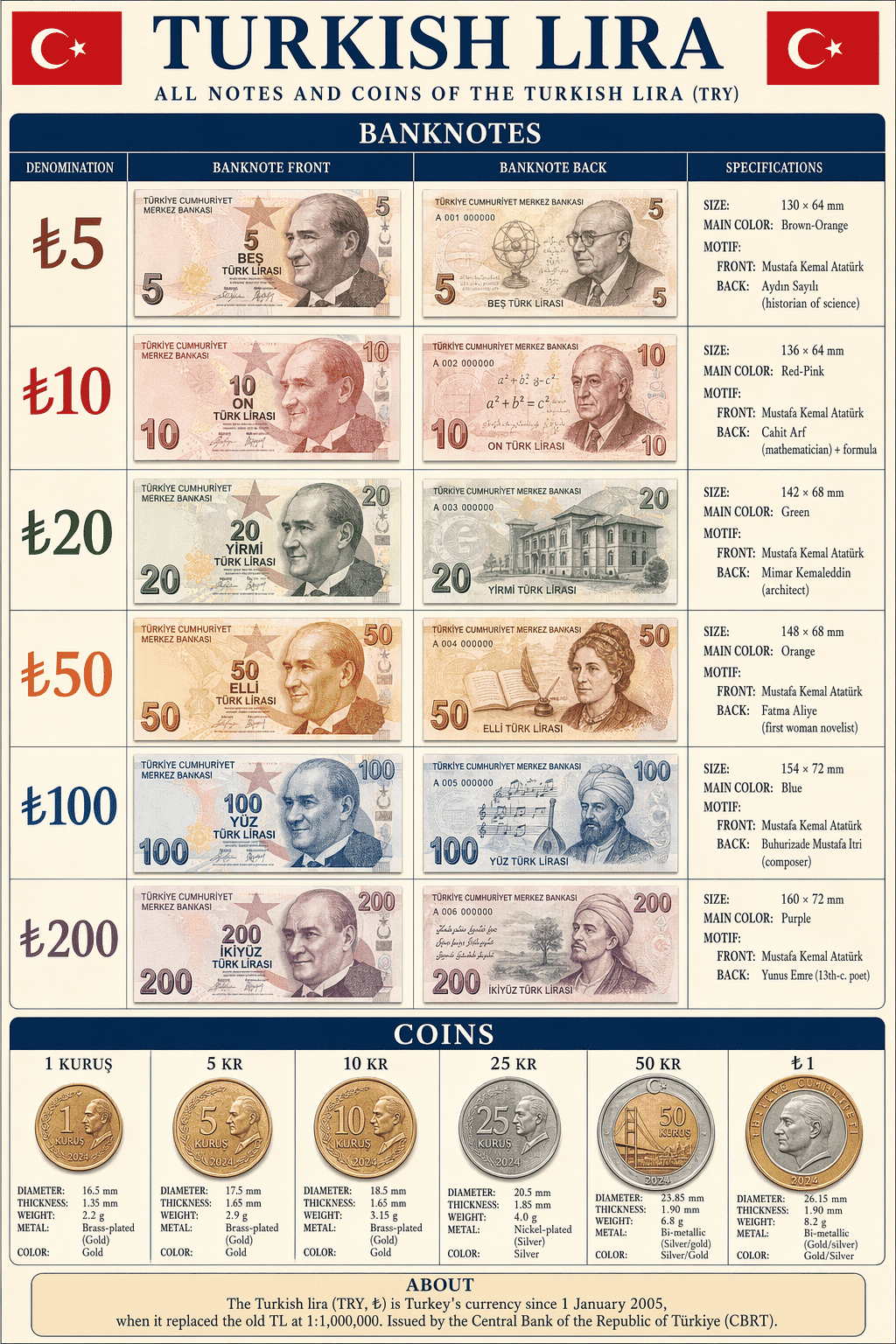
Current Turkish banknotes, the E-9 series issued from 2009, all feature Mustafa Kemal Atatürk — the founder of the Turkish Republic — on the obverse. The reverse side of each denomination honours a different Turkish cultural figure.
| Denomination | Figure / Motif | Context | Colour |
|---|---|---|---|
| ₺5 | Aydın Sayılı | Historian of science | Brown-orange |
| ₺10 | Cahit Arf | Mathematician (Arf invariant) | Red-pink |
| ₺20 | Mimar Kemaleddin | Architect, First Turkish National Architecture movement | Green |
| ₺50 | Fatma Aliye | Pioneering woman novelist | Orange |
| ₺100 | Buhurizade Mustafa Itri | 17th-century Ottoman classical composer | Blue |
| ₺200 | Yunus Emre | 13th-century Anatolian poet and mystic | Purple |
Coins come in six denominations, all with Atatürk on the obverse.
| Denomination | Composition & Design | Notes |
|---|---|---|
| 1 kuruş | Brass-plated steel | Rarely seen |
| 5 kuruş | Brass-plated steel | In circulation |
| 10 kuruş | Brass-plated steel | In circulation |
| 25 kuruş | Nickel-plated steel | In circulation |
| 50 kuruş | Bi-metallic | In circulation |
| ₺1 | Bi-metallic | In circulation; common |
History of The Lira
The modern lira’s history is a story of chronic inflation and successive reforms. The old Turkish lira lost six zeros to hyperinflation between 1970 and 2005; the ‘new Turkish lira’ (2005–2008) then dropped the ‘new’ qualifier in 2009. Since 2018, the lira has experienced multiple waves of sharp depreciation.
| Year | Event |
|---|---|
| 1844 | Ottoman lira introduced by Sultan Abdülmecid I. |
| 1927 | Turkish lira (TL) introduced in the new Republic; gold-backed. |
| 1930 | Central Bank of the Republic of Türkiye (TCMB) founded on 3 October. |
| 1980s–1990s | High chronic inflation; lira loses 6 zeros in real terms over two decades. |
| 2005 | 1 January: new ‘Yeni Türk Lirası’ (YTL) replaces old TL at 1 YTL = 1,000,000 TL. |
| 2009 | The ‘Yeni’ prefix is dropped; currency reverts to ‘Turkish Lira’ (TRY). |
| 2018 | August currency crisis — lira falls ~45% in weeks as US sanctions hit. |
| 2021 | President Erdoğan advocates unorthodox ‘cut rates to reduce inflation’ approach; lira depreciates sharply. |
| 2023 | Post-election pivot — orthodox policy returns under new leadership; CBRT hikes rate from 8.5% to 42.5%. |
| 2024 | Peak policy rate 50.0% (March); inflation peaks at 75% in May. Fatih Karahan becomes governor in February. |
| 2025 | Cutting cycle begins once inflation slows; rate falls through 2025–early 2026. |
| 2026 | Policy rate at 37% after March 2026 hold — the first meeting without a cut in six rounds. |
The Turkish Economy and the Lira
Turkey is the world’s 19th-largest economy and a manufacturing powerhouse — textiles, motor vehicles, home appliances, and steel account for most exports, alongside a large tourism sector that contributed over $55 billion in receipts in 2025. The Turkish economy has a chronic current-account deficit financed by capital inflows, which makes the lira particularly sensitive to global risk sentiment and US-dollar strength.
CBRT policy is one of the most politically charged in the world. After years of unorthodox rate cuts under previous leadership, the bank has returned to an orthodox high-rates framework since mid-2023. Policy rate peaked at 50% in March 2024 and has been cut gradually since. The March 2026 meeting held at 37% — the first hold after five consecutive cuts — reflecting caution about the Middle East energy-price shock. The 2026 inflation target is 16%, well above the 5% medium-term goal but consistent with a multi-year disinflation plan.
Using the Lira in Turkey
Card acceptance is good in Istanbul, Ankara, İzmir, Antalya, and tourist districts — Visa, Mastercard, and contactless work in chain shops, restaurants, petrol stations, and tram-ticket machines. Euros and US dollars are widely accepted at hotels in tourist areas, though the exchange rate is typically poor. Cash is still common in smaller cities, bazaars (especially Grand Bazaar haggling), and family-run lokanta restaurants.
Typical prices in lira (2026): Turkish tea at a lokanta 40–60 ₺; döner kebab 200–350 ₺; a meal in a mid-range restaurant 800–1,500 ₺; a single Istanbul transit card ride 45 ₺; a mid-range Istanbul hotel room 3,500–7,000 ₺. ATMs at Ziraat Bankası, İş Bankası, Garanti BBVA, and Akbank branches are reliable. Note: many Turkish merchants quote prices directly in USD or EUR for large items like gold jewellery or real estate — always confirm which currency the transaction is in.
The Lira in Regional Context
Turkey’s immediate FX neighbours are an unusual mix — the Eurozone to the west (through Greece and Bulgaria), Georgia and Armenia to the east, Iran and Iraq to the south-east, and Russia across the Black Sea. The regional comparison below covers eastern-Mediterranean peers and two emerging-market comparators.
| Country | Code | Regime | Inflation | Policy rate |
|---|---|---|---|---|
| 🇹🇷 Turkey | TRY | Managed float | Target 16% (2026) | 37.00% |
| 🇬🇷 Greece | EUR | Eurosystem | 2.8% | 2.00% |
| 🇧🇬 Bulgaria | EUR (since 1 Jan 2026) | Eurosystem | ~2.3% | 2.00% |
| 🇷🇺 Russia | RUB | Managed float | ~6% | 12.00%+ |
| 🇬🇪 Georgia | GEL | Managed float | ~4% | ~8% |
| 🇦🇷 Argentina | ARS | Crawling peg | ~120% (2025) | ~35% |
Frequently Asked Questions
What is the currency of Turkey?
The currency of Turkey (officially the Republic of Türkiye) is the Turkish lira (symbol ₺, ISO 4217 code TRY). It has been in its current form since 2005, when it replaced the old Turkish lira (TRL) at a ratio of 1 TRY = 1,000,000 TRL to remove decades of accumulated inflation zeros.
Is Turkey in the Eurozone or EU?
No. Turkey is not an EU member and is not a Eurozone candidate. Turkey applied for EEC membership in 1987 and formal EU accession talks opened in 2005, but they have been frozen since 2016 over rule-of-law and human-rights disputes. There is no active path to EU or euro membership.
Who manages Turkish monetary policy?
The Central Bank of the Republic of Türkiye (TCMB or CBRT), founded 3 October 1930. Its current Governor is Fatih Karahan, who took office on 2 February 2024 — the fifth CBRT Governor in five years, reflecting the political turbulence in Turkish monetary policy.
What is the current CBRT policy rate?
The CBRT policy rate is 37% as of the March 2026 Monetary Policy Committee meeting — the first hold after five consecutive cuts. It is down from a peak of 50% reached in March 2024 during the post-election orthodox-policy pivot.
How many lira is one US dollar worth?
At the latest daily close, 1 USD ≈ 45 TRY. The lira has depreciated roughly 15% against the dollar over the past 12 months, continuing a multi-year downward trend. In 2019, 1 USD bought about 5.7 TRY.
Why has the Turkish lira lost so much value?
Three main reasons: (1) chronic high inflation — at times exceeding 75% — erodes purchasing power; (2) a persistent current-account deficit requires constant FX inflows to fund; (3) a period of unorthodox monetary policy (roughly 2021–2023) that cut rates despite rising inflation, causing a loss of investor confidence. Since mid-2023, orthodox high-rates policy has returned under new central-bank leadership, and the pace of depreciation has slowed but not stopped.
Who is on Turkish banknotes?
Every Turkish banknote has Mustafa Kemal Atatürk — the founder of the Turkish Republic — on the obverse. The reverse of each denomination features a different Turkish cultural figure: historian Aydın Sayılı (₺5), mathematician Cahit Arf (₺10), architect Mimar Kemaleddin (₺20), novelist Fatma Aliye (₺50), composer Mustafa Itri (₺100), and poet Yunus Emre (₺200).
Data current to April 2026 — CBRT and TÜİK (Turkish Statistical Institute) releases.

