
Key Facts: The Ukrainian Hryvnia
- ISO 4217 code: UAH · Symbol: ₴. Subdivided into 100 kopiyky. Name traces to Kyivan Rus' hryvnia — a silver-weight unit dating to the 11th century.
- Central bank: National Bank of Ukraine (est. 1991). Kyiv-based. Governor Andriy Pyshnyy since 7 October 2022 (appointed during war).
- Policy rate: 15.00% · Inflation forecast 7.5% (2026). NBU cut rate 0.5 pp to 15% in January 2026, then held in March. Inflation falling from war-era peaks.
- 1 USD ≈ 43.64 UAH. The hryvnia has weakened ~6% against the dollar over the past year. Before Russia's February 2022 invasion, USD/UAH was ~27.
- Currency at war — but stable. Despite full-scale invasion since Feb 2022, NBU has maintained a managed-float regime since October 2023, after initial FX fixing. Reserve stability supported by Western aid and remittances.
What Is the Currency of Ukraine?
Ukraine’s currency is the hryvnia (symbol ₴, ISO 4217 code UAH). It has been Ukraine’s currency since 2 September 1996, when it replaced the transitional Ukrainian karbovanets (which had, in turn, replaced the Soviet rouble after independence in 1991). The hryvnia is subdivided into 100 kopiyky. The name honours the medieval Kyivan Rus’ hryvnia — a silver-weight unit of account used from the 11th century.
The hryvnia is issued by the National Bank of Ukraine (NBU), founded 20 March 1991. Since Russia’s full-scale invasion on 24 February 2022, the NBU has managed the hryvnia under war-era monetary frameworks: first a fixed peg, then (from October 2023) a managed float. Ukraine is not in the Eurozone; it is an EU candidate country since 23 June 2022, with formal accession negotiations opened on 25 June 2024.
Ukrainian Hryvnia to US Dollar — 1-Year Chart
The chart tracks USD/UAH daily close over the past year. The hryvnia’s trajectory is shaped by the war — Western aid disbursements, NBU FX interventions (drawing on reserves currently above $40 billion thanks to IMF and G7 support), and domestic inflation dynamics.
Line chart. Daily close, UAH per USD · Source: Yahoo Finance · Updated nightly. Data table with 2 rows and 132 columns follows.
| Sep 14 | Sep 16 | Sep 18 | Sep 22 | Sep 24 | Sep 28 | Sep 30 | Oct 02 | Oct 06 | Oct 08 | Oct 12 | Oct 14 | Oct 16 | Oct 20 | Oct 22 | Oct 27 | Oct 29 | Oct 31 | Nov 04 | Nov 06 | Nov 10 | Nov 12 | Nov 14 | Nov 18 | Nov 20 | Nov 24 | Nov 26 | Nov 28 | Dec 02 | Dec 04 | Dec 08 | Dec 10 | Dec 12 | Dec 16 | Dec 18 | Dec 22 | Dec 24 | Dec 29 | Dec 31 | Jan 05 | Jan 07 | Jan 09 | Jan 13 | Jan 15 | Jan 19 | Jan 21 | Jan 23 | Jan 27 | Jan 29 | Feb 02 | Feb 04 | Feb 06 | Feb 10 | Feb 12 | Feb 16 | Feb 18 | Feb 20 | Feb 24 | Feb 26 | Mar 02 | Mar 04 | Mar 06 | Mar 10 | Mar 12 | Mar 16 | Mar 18 | Mar 20 | Mar 24 | Mar 26 | Mar 29 | Mar 31 | Apr 02 | Apr 06 | Apr 08 | Apr 12 | Apr 14 | Apr 16 | Apr 20 | Apr 22 | Apr 26 | Apr 28 | Apr 30 | May 04 | May 06 | May 10 | May 12 | May 14 | May 18 | May 20 | May 24 | May 26 | May 28 | Jun 01 | Jun 03 | Jun 07 | Jun 09 | Jun 11 | Jun 15 | Jun 17 | Jun 21 | Jun 23 | Jun 25 | Jun 29 | Jul 01 | Jul 05 | Jul 07 | Jul 09 | Jul 13 | Jul 15 | Jul 19 | Jul 21 | Jul 23 | Jul 27 | Jul 29 | Aug 02 | Aug 04 | Aug 06 | Aug 10 | Aug 12 | Aug 16 | Aug 18 | Aug 20 | Aug 24 | Aug 26 | Aug 30 | Sep 01 | Sep 03 | Sep 07 | Sep 09 | Sep 13 | Sep 15 | |
|---|---|---|---|---|---|---|---|---|---|---|---|---|---|---|---|---|---|---|---|---|---|---|---|---|---|---|---|---|---|---|---|---|---|---|---|---|---|---|---|---|---|---|---|---|---|---|---|---|---|---|---|---|---|---|---|---|---|---|---|---|---|---|---|---|---|---|---|---|---|---|---|---|---|---|---|---|---|---|---|---|---|---|---|---|---|---|---|---|---|---|---|---|---|---|---|---|---|---|---|---|---|---|---|---|---|---|---|---|---|---|---|---|---|---|---|---|---|---|---|---|---|---|---|---|---|---|---|---|---|---|---|
| UAH per USD | 40.99 | 40.92 | 41.03 | 41.1 | 41.24 | 41.06 | 40.91 | 41.03 | 41.04 | 41.22 | 41.25 | 41.54 | 41.4 | 41.52 | 41.42 | 41.74 | 41.84 | 41.73 | 41.79 | 41.8 | 41.61 | 41.72 | 41.77 | 41.8 | 41.84 | 42.01 | 41.94 | 41.91 | 42.18 | 41.92 | 41.72 | 41.99 | 41.95 | 42 | 42.16 | 42.03 | 41.84 | 41.94 | 42.17 | 42.12 | 42.31 | 42.84 | 43.07 | 42.93 | 43.16 | 43.01 | 42.95 | 42.79 | 42.47 | 42.95 | 43 | 42.91 | 42.83 | 42.78 | 42.83 | 42.95 | 43.03 | 42.91 | 42.89 | 42.79 | 43.34 | 43.55 | 43.69 | 43.82 | 43.83 | 43.55 | 43.73 | 43.58 | 43.67 | 43.43 | 43.65 | 43.54 | 43.44 | 43.05 | 43.13 | 43.25 | 43.44 | 43.91 | 43.64 | 43.74 | 43.8 | 43.83 | 43.82 | 43.6 | 43.56 | 43.7 | 43.71 | 43.91 | 44.03 | 43.84 | 44.02 | 44 | 44.07 | 44.08 | 44.11 | 44.65 | 43.59 | 43.52 | 43.58 | 43.59 | 43.63 | 43.51 | 43.47 | 43.5 | 43.21 | 43.16 | 43.17 | 43.42 | 43.23 | 43.28 | 43.42 | 43.57 | 43.57 | 43.48 | 43.17 | 43.37 | 43.44 | 43.54 | 43.35 | 43.36 | 43.48 | 43.33 | 43.42 | 43.24 | 43.48 | 43.15 | 43.42 | 43.12 | 43.34 | 43.16 | 44.55 |
Over the past 12 months the hryvnia has weakened from about 41.15 to 43.64 UAH per USD — roughly 6% depreciation. This continues a controlled, gradual weakening rather than the catastrophic depreciation that happened in the first weeks of the 2022 invasion.
Banknotes and Coins
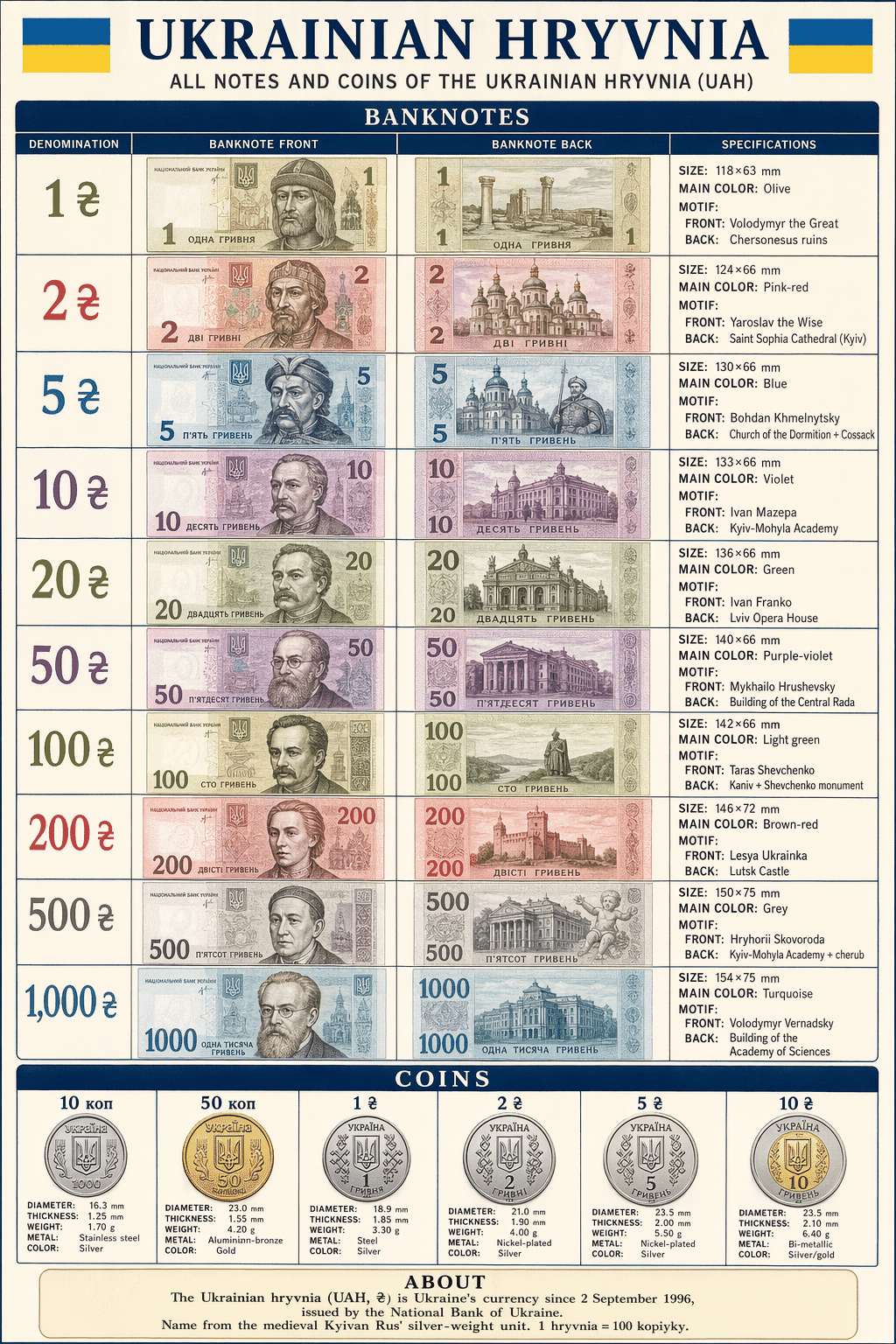
Ukrainian banknotes honour princes, hetmans, poets, and statesmen spanning a thousand years of Ukrainian history — from the medieval Kyivan Rus’ era to 20th-century figures.
| Denomination | Figure / Motif | Context | Colour |
|---|---|---|---|
| 1 ₴ | Volodymyr the Great | Grand Prince of Kyiv (980–1015), baptised Rus’ in 988 | Olive |
| 2 ₴ | Yaroslav the Wise | Grand Prince of Kyiv (1019–54), codified Rus’ law | Pink-red |
| 5 ₴ | Bohdan Khmelnytsky | 17th-century Cossack hetman | Blue |
| 10 ₴ | Ivan Mazepa | Cossack hetman, 1687–1709 | Violet |
| 20 ₴ | Ivan Franko | Ukrainian writer and polymath, 1856–1916 | Green |
| 50 ₴ | Mykhailo Hrushevsky | Historian, first president of the Ukrainian Central Rada | Purple-violet |
| 100 ₴ | Taras Shevchenko | National poet of Ukraine, 1814–1861 | Light green |
| 200 ₴ | Lesya Ukrainka | Writer and poet, 1871–1913 | Brown-red |
| 500 ₴ | Hryhorii Skovoroda | 18th-century philosopher and poet | Grey |
| 1,000 ₴ | Volodymyr Vernadsky | Scientist, founder of Ukrainian Academy of Sciences | Turquoise |
Coins come in several denominations in kopiyky and a 1 hryvnia coin. During the war, some small-denomination coins have become scarce in circulation.
| Denomination | Composition & Design | Notes |
|---|---|---|
| 10 копійок | Stainless steel; Ukrainian trident emblem | Since 1996 |
| 50 копійок | Aluminium-bronze | Since 1996 |
| 1 ₴ | Steel / brass-plated | Since 2018 |
| 2 ₴, 5 ₴, 10 ₴ | Commemorative / circulating coins | Issued in various designs |
History of The Hryvnia
The hryvnia’s modern history runs from the 1991 Soviet collapse through two major devaluations (1998 Asian-Russian crisis, 2014–2015 after Russia’s annexation of Crimea), and now through full-scale war. It has survived as a functioning currency thanks to NBU discipline and Western financial support.
| Year | Event |
|---|---|
| 1991 | Ukraine declares independence 24 August; NBU founded 20 March. |
| 1992 | Transitional karbovanets introduced during hyperinflation. |
| 1996 | Hryvnia introduced on 2 September at 1 ₴ = 100,000 karbovanets. |
| 1998 | Asian-Russian financial crisis: hryvnia weakens from 1.9 to 5.1 per USD. |
| 2008–2009 | Global financial crisis: hryvnia falls from 4.8 to 8.0 per USD. |
| 2014 | Russia annexes Crimea; war in Donbas begins; hryvnia falls from 8 to 25 per USD. |
| 2015 | NBU adopts inflation targeting after the 2014–15 crisis. |
| 2022 | 24 February: Russia launches full-scale invasion. NBU fixes hryvnia at 29.25 per USD. |
| 2022 | 7 October: Andriy Pyshnyy appointed NBU Governor. |
| 2023 | October: NBU ends fixed peg, moves to managed float at ~38 per USD. |
| 2024–2026 | Gradual, controlled depreciation continues under managed float; reserves above $40 billion. |
| 2026 | NBU cuts policy rate 0.5 pp to 15% in January; holds at 15% in March meeting. |
The Ukrainian Economy and the Hryvnia
Ukraine’s economy in 2026 is a wartime economy. The full-scale Russian invasion that began on 24 February 2022 caused a 29% GDP collapse in 2022; recovery has been partial, with growth of 3.5% in 2025 — still far below pre-war levels. The export mix has shifted: grain corridor disruptions reduced agricultural earnings, IT services have grown as a share, and military-related manufacturing has expanded. Critical external support comes from Western aid packages (EU, US, IMF, G7) — often exceeding $50 billion per year in combined financial and military assistance.
NBU monetary policy operates within extraordinary constraints. After initially fixing the hryvnia at 29.25 per USD in February 2022, NBU moved to a managed float in October 2023 with gradual, controlled depreciation. The policy rate is 15.00%, following a 0.5 pp cut in January 2026 and a hold in March. Inflation, which peaked at 26.6% in December 2022, is forecast at 7.5% for end-2026, with a target of 5% by 2028. NBU gross reserves stand above $40 billion — an order of magnitude higher than pre-war — thanks to sustained Western support.
Using Hryvni in Ukraine
Card acceptance remains strong in Kyiv, Lviv, and other cities far from the front lines. Visa, Mastercard, and the domestic Prostir system work in supermarkets, cafés, and transport. Cash is more common in regions closer to combat or affected by power cuts — during blackouts, card terminals go offline. Apple Pay and Google Pay work in most urban areas.
Typical prices in hryvni (2026): espresso in a Kyiv café 60–100 ₴; lunch set 200–350 ₴; meal at a mid-range restaurant 500–900 ₴; a pint of Ukrainian craft beer 120–180 ₴; a mid-range Kyiv hotel room 1,800–3,500 ₴. ATMs at PrivatBank, Oschadbank, Raiffeisen Bank, and Ukrsibbank are widely available. During air-raid alerts, some ATMs temporarily stop dispensing — always carry a modest cash buffer.
The Hryvnia in Regional Context
Ukraine’s monetary context in 2026 is unique. Peers include other EU candidates (Moldova, Serbia) and its most important economic partner, the EU itself. Russia — Ukraine’s largest pre-war trading partner — is sanctioned and effectively isolated from Ukraine’s FX system.
| Country | Code | Regime | Inflation | Policy rate |
|---|---|---|---|---|
| 🇺🇦 Ukraine | UAH | Managed float | 7.5% (2026f) | 15.00% |
| 🇲🇩 Moldova | MDL | Managed float | ~5–6% | 5.00% |
| 🇵🇱 Poland | PLN | Free float | ~2.5% | 4.00% |
| 🇷🇴 Romania | RON | Managed float | 3.9% (2026f) | 6.50% |
| 🇭🇺 Hungary | HUF | Free float | 2.1% | 6.25% |
| 🇹🇷 Turkey | TRY | Managed float | Target 16% | 37.00% |
Frequently Asked Questions
What is the currency of Ukraine?
Ukraine’s currency is the hryvnia (symbol ₴, ISO 4217 code UAH). It has been Ukraine’s currency since 2 September 1996.
Is Ukraine in the Eurozone?
No. Ukraine is not an EU member — it was granted EU candidate status on 23 June 2022, with accession negotiations formally opened on 25 June 2024. Euro adoption is not on the current agenda; the immediate priorities are war financing and eventual EU accession.
Who manages Ukrainian monetary policy?
The National Bank of Ukraine (NBU), founded 20 March 1991. Its current Governor is Andriy Pyshnyy, appointed on 7 October 2022 (during the full-scale war). NBU targets 5% CPI inflation in the medium term.
What is the current NBU policy rate?
The NBU key policy rate is 15.00%, after a 0.5 pp cut in January 2026 and a hold at 15% at the March 2026 meeting.
How many hryvni is one US dollar worth?
At the latest daily close, 1 USD ≈ 43.64 UAH. The hryvnia has weakened about 6% against the dollar over the past 12 months under the NBU’s managed-float regime. Before the February 2022 invasion, USD/UAH was around 27.
How has the war affected the hryvnia?
The war has been the dominant force on the hryvnia since February 2022. Initial response: NBU fixed the currency at 29.25 per USD and imposed strict capital controls. In October 2023, NBU switched to a managed float, since which the hryvnia has weakened gradually and predictably rather than in disruptive jumps. Reserves have been rebuilt above $40 billion through Western aid, which has allowed NBU to smooth volatility during periods of market stress.
Who are on Ukrainian banknotes?
A comprehensive cast from Ukrainian history: medieval princes Volodymyr the Great (1 ₴) and Yaroslav the Wise (2 ₴); Cossack hetmans Bohdan Khmelnytsky (5 ₴) and Ivan Mazepa (10 ₴); writers Ivan Franko (20 ₴), Taras Shevchenko (100 ₴, the national poet), Lesya Ukrainka (200 ₴); historian and first republic leader Mykhailo Hrushevsky (50 ₴); philosopher Hryhorii Skovoroda (500 ₴); and scientist Volodymyr Vernadsky (1,000 ₴).
Data current to April 2026 — NBU and State Statistics Service of Ukraine releases.

