
Key Facts: The Serbian Dinar
- ISO 4217 code: RSD · Symbol: дин. Plural dinari. Subdivided into 100 para; para coins no longer minted. The name dinar traces to medieval Serbian silver coinage.
- Central bank: National Bank of Serbia (est. 1884). Belgrade-based. Governor Jorgovanka Tabaković since August 2012, reappointed. Inflation-targeting mandate at 3% (±1.5 pp).
- Policy rate: 5.75% · Inflation: ~3%. NBS held at 5.75% through March 2026. Inflation moving within the 3%±1.5pp tolerance band.
- 1 USD ≈ 99.70 RSD. The dinar has strengthened ~2.3% against the dollar over the past 12 months. NBS runs a managed float with periodic FX interventions.
- EU candidate since 2012, negotiations ongoing. Not in the Eurozone and not in ERM II. No target date for euro adoption; complicated by the unresolved Kosovo question.
What Is the Currency of Serbia?
Serbia’s currency is the Serbian dinar (plural dinari, symbol дин or RSD, ISO 4217 code RSD). It has been Serbia’s national currency since the 2003 dissolution of the Yugoslav federation, though ‘dinar’ as a Serbian currency name traces back to medieval Serbian kings in the 13th century. The modern dinar is subdivided into 100 para, though para coins are no longer minted.
The dinar is issued by the National Bank of Serbia (NBS), founded in 1884 — making it one of Europe’s older central banks. Serbia is an EU candidate country (since 2012) and has been in formal accession negotiations since 2014, but is not in the Eurozone or in ERM II. The dinar operates as a managed float.
Serbian Dinar to US Dollar — 1-Year Chart
The chart tracks USD/RSD daily close over the past year. The dinar’s main drivers: NBS policy-rate moves, EU-fund inflows, remittances, and movements in EUR/USD (since Serbia’s FX framework targets the euro informally).
Line chart. Daily close, RSD per USD · Source: Yahoo Finance · Updated nightly. Data table with 2 rows and 131 columns follows.
| Oct 21 | Oct 23 | Oct 28 | Oct 30 | Nov 03 | Nov 05 | Nov 07 | Nov 11 | Nov 13 | Nov 17 | Nov 19 | Nov 21 | Nov 25 | Nov 27 | Dec 01 | Dec 03 | Dec 05 | Dec 09 | Dec 11 | Dec 15 | Dec 17 | Dec 19 | Dec 23 | Dec 26 | Dec 30 | Jan 02 | Jan 06 | Jan 08 | Jan 12 | Jan 14 | Jan 16 | Jan 20 | Jan 22 | Jan 26 | Jan 28 | Jan 30 | Feb 03 | Feb 05 | Feb 09 | Feb 11 | Feb 13 | Feb 17 | Feb 19 | Feb 23 | Feb 25 | Feb 27 | Mar 03 | Mar 05 | Mar 09 | Mar 11 | Mar 13 | Mar 17 | Mar 19 | Mar 23 | Mar 25 | Mar 27 | Mar 30 | Apr 01 | Apr 05 | Apr 07 | Apr 09 | Apr 13 | Apr 15 | Apr 19 | Apr 21 | Apr 23 | Apr 27 | Apr 29 | May 03 | May 05 | May 07 | May 11 | May 13 | May 17 | May 19 | May 21 | May 25 | May 27 | May 31 | Jun 02 | Jun 04 | Jun 08 | Jun 10 | Jun 14 | Jun 16 | Jun 18 | Jun 22 | Jun 24 | Jun 28 | Jun 30 | Jul 02 | Jul 06 | Jul 08 | Jul 12 | Jul 14 | Jul 16 | Jul 20 | Jul 22 | Jul 26 | Jul 28 | Jul 30 | Aug 03 | Aug 05 | Aug 09 | Aug 11 | Aug 13 | Aug 17 | Aug 19 | Aug 23 | Aug 25 | Aug 27 | Aug 31 | Sep 02 | Sep 06 | Sep 08 | Sep 10 | Sep 14 | Sep 16 | Sep 20 | Sep 22 | Sep 24 | Sep 28 | Sep 30 | Oct 04 | Oct 06 | Oct 08 | Oct 12 | Oct 14 | Oct 18 | Oct 20 | |
|---|---|---|---|---|---|---|---|---|---|---|---|---|---|---|---|---|---|---|---|---|---|---|---|---|---|---|---|---|---|---|---|---|---|---|---|---|---|---|---|---|---|---|---|---|---|---|---|---|---|---|---|---|---|---|---|---|---|---|---|---|---|---|---|---|---|---|---|---|---|---|---|---|---|---|---|---|---|---|---|---|---|---|---|---|---|---|---|---|---|---|---|---|---|---|---|---|---|---|---|---|---|---|---|---|---|---|---|---|---|---|---|---|---|---|---|---|---|---|---|---|---|---|---|---|---|---|---|---|---|---|
| RSD per USD | 100.55 | 100.41 | 100.12 | 100.56 | 100.02 | 101.57 | 101 | 100.9 | 100.59 | 99.76 | 100.69 | 101.21 | 101.37 | 100.67 | 100.12 | 100.47 | 100.32 | 100.36 | 99.88 | 98.91 | 99.8 | 100.08 | 99.29 | 99.07 | 99.19 | 99.46 | 99.65 | 99.96 | 99.79 | 100.27 | 100.61 | 100.31 | 100.13 | 98.24 | 97.19 | 97.62 | 99.04 | 98.95 | 98.25 | 98.28 | 98.41 | 98.6 | 99.11 | 98.55 | 99.64 | 99.01 | 99.86 | 100.44 | 99.94 | 100.62 | 101.4 | 101.6 | 101.94 | 100.29 | 100.6 | 101.32 | 102.39 | 100.73 | 101.88 | 100.31 | 99.89 | 99.26 | 98.89 | 98.89 | 99.47 | 100.05 | 99.64 | 99.98 | 100 | 99.69 | 99.97 | 99.17 | 99.69 | 99.94 | 100.61 | 100.55 | 100.39 | 100.54 | 100.18 | 100.52 | 100.56 | 101.32 | 101.23 | 98.38 | 100.61 | 101.94 | 102.19 | 102.88 | 99.96 | 102.3 | 102.25 | 102.07 | 102.24 | 99.72 | 102.23 | 102.04 | 102.31 | 102.35 | 100.1 | 102.62 | 101.39 | 101.5 | 101.04 | 98.48 | 101.17 | 101.2 | 100.85 | 100.37 | 97.43 | 100.37 | 100.55 | 100.53 | 100.75 | 97.98 | 100.39 | 100.59 | 101.1 | 101.81 | 99.15 | 102.45 | 102.73 | 102.89 | 103.24 | 101.25 | 103.85 | 104.18 | 104.68 | 104.75 | 101.37 | 104.17 |
Over the past 12 months the dinar has strengthened from about 102.1 to 99.7 RSD per USD — a ~2.3% move in the dinar’s favour. NBS’s steady 5.75% policy rate and improved EU-accession dynamics have helped support the currency.
Banknotes and Coins
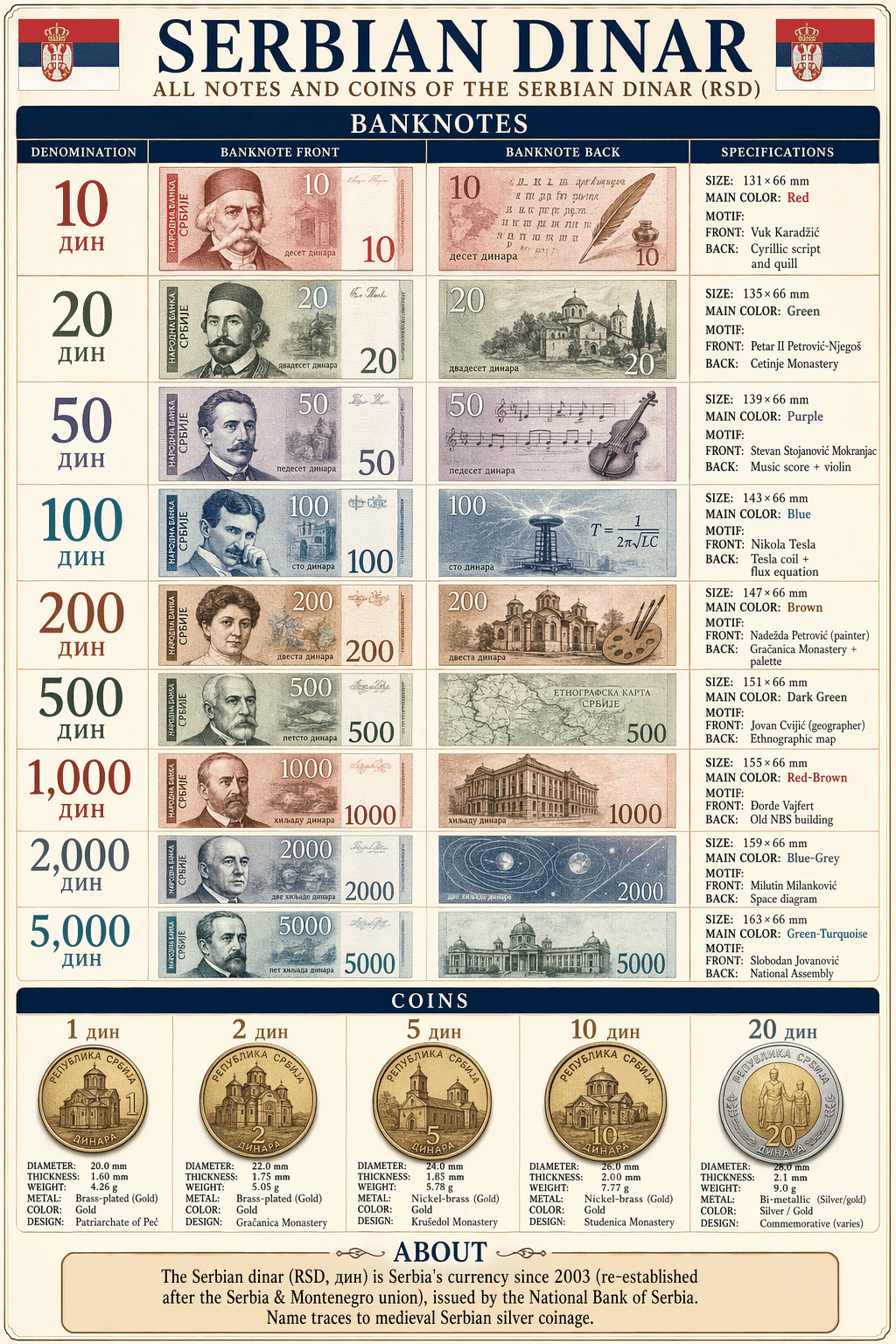
Serbian banknotes honour a distinguished cast of scientists, scholars, artists, and writers. Several are globally famous — Nikola Tesla (100 dinar) and Milutin Milanković (2,000 dinar) among them.
| Denomination | Figure / Motif | Context | Colour |
|---|---|---|---|
| 10 дин | Vuk Karadžić | Language reformer who codified modern Serbian Cyrillic | Red |
| 20 дин | Petar II Petrović-Njegoš | Montenegrin-Serbian poet-bishop | Green |
| 50 дин | Stevan Stojanović Mokranjac | Composer and ethnomusicologist | Purple |
| 100 дин | Nikola Tesla | Inventor / engineer (1856–1943), AC power system | Blue |
| 200 дин | Nadežda Petrović | Painter and activist, WWI medical volunteer | Brown |
| 500 дин | Jovan Cvijić | Geographer, founder of Balkan geographical science | Dark green |
| 1,000 дин | Đorđe Vajfert | Industrialist and long-serving NBS Governor (1890–1914) | Red-brown |
| 2,000 дин | Milutin Milanković | Mathematician-climatologist, ‘Milankovitch cycles’ | Blue-grey |
| 5,000 дин | Slobodan Jovanović | Historian, wartime prime minister | Green-turquoise |
Coins come in six denominations in active use.
| Denomination | Composition & Design | Notes |
|---|---|---|
| 1 дин | Brass-plated steel; Patriarchate of Peć motif | Since 2003 |
| 2 дин | Brass-plated steel; Gračanica monastery | Since 2003 |
| 5 дин | Nickel-brass; Krušedol monastery | Since 2003 |
| 10 дин | Nickel-brass; Studenica monastery | Since 2003 |
| 20 дин | Commemorative bi-metallic | Irregular issues |
History of The Dinar
The dinar’s modern chapter spans the breakup of Yugoslavia, hyperinflation that peaked in 1994 at the highest rate ever recorded globally (313 million percent per month), stabilisation, and the 2003 reconfiguration into today’s Serbian dinar. The 1990s Yugoslav dinar episode is a textbook example of monetary collapse.
| Year | Event |
|---|---|
| 1868 | First modern Serbian dinar issued by Prince Mihailo Obrenović. |
| 1884 | Privileged National Bank of the Kingdom of Serbia founded (precursor of NBS). |
| 1918 | After WWI, Serbian dinar replaced by the Yugoslav dinar in the new Kingdom of Serbs, Croats and Slovenes. |
| 1945–1992 | Socialist Federal Republic of Yugoslavia’s dinar undergoes multiple redenominations. |
| 1993–1994 | Hyperinflation — 313 million % monthly inflation in January 1994, the highest ever recorded. |
| 1994 | New ‘super dinar’ introduced at 1:1 with DM; inflation crushed within weeks. |
| 2003 | Serbia and Montenegro state union formalised; Serbian dinar re-established as distinct currency. |
| 2006 | Montenegro becomes independent; NBS takes full sovereignty over dinar. |
| 2008 | Serbia formally applies for EU membership. |
| 2012 | EU candidate status granted; Jorgovanka Tabaković becomes NBS Governor. |
| 2022–2024 | Post-pandemic rate-hike cycle peaks at 6.50% in mid-2023. |
| 2025–2026 | Policy rate held at 5.75% since late 2024; inflation moving within target band. |
The Serbian Economy and the Dinar
Serbia is the largest Western-Balkan economy — GDP around $84 billion nominal in 2025 — with a diversified mix of manufacturing (car parts from Fiat-Stellantis, mining for copper and lithium, steel, food processing), IT services, and agriculture. The economy has grown at ~3.5–4% annually through the mid-2020s. EU accession negotiations have been ongoing since 2014, with the unresolved Kosovo question remaining the chief obstacle.
NBS runs an inflation-targeting regime with a 3% CPI target (±1.5 pp tolerance). Post-pandemic inflation peaked around 16% in early 2023 but has since fallen back; March 2026 meetings expect inflation to remain within target throughout 2026. The policy rate is 5.75%, held at the March 2026 meeting for the 12th consecutive time.
Using Dinari in Serbia
Card acceptance is strong in Belgrade, Novi Sad, Niš, and other larger cities — Visa, Mastercard, and the domestic DinaCard scheme all work in cafés, supermarkets, hotels, and most restaurants. Cash is still used for small transactions, street food, taxi tips, and in rural areas. Euros are sometimes accepted informally at tourist-oriented businesses.
Typical prices in dinari (2026): espresso in a Belgrade café 130–200 дин; ćevapi lunch 450–750 дин; a mid-range meal 1,200–2,500 дин; a pint of beer 280–450 дин; a mid-range Belgrade hotel room 7,000–12,000 дин. ATMs at Raiffeisen Banka, Banca Intesa, and UniCredit Banka Srbija are reliable for foreign cards.
The Dinar in Regional Context
Serbia sits at the heart of the Western Balkans. Its neighbours include three Eurozone-using nations (Bulgaria, Croatia, Montenegro via unilateral use), two non-euro EU members (Hungary, Romania), and non-EU Bosnia and North Macedonia.
| Country | Code | Regime | Inflation | Policy rate |
|---|---|---|---|---|
| 🇷🇸 Serbia | RSD | Managed float | ~3% | 5.75% |
| 🇧🇦 Bosnia & Herzegovina | BAM | Currency board to EUR | ~2.5% | 2.00% (via peg) |
| 🇲🇰 North Macedonia | MKD | De facto EUR peg | ~2% | ~6% |
| 🇲🇪 Montenegro | EUR (unilateral) | Uses euro | ~3% | 2.00% (ECB) |
| 🇭🇷 Croatia | EUR | Eurosystem | 3.5% | 2.00% |
| 🇭🇺 Hungary | HUF | Free float | 2.1% | 6.25% |
Frequently Asked Questions
What is the currency of Serbia?
Serbia’s currency is the Serbian dinar (plural dinari, symbol дин, ISO 4217 code RSD). It has been Serbia’s national currency since 2003.
Is Serbia in the Eurozone?
No. Serbia is an EU candidate country since 2012, with accession negotiations ongoing. It is not in ERM II, and there is no target date for euro adoption. The unresolved Kosovo question is the chief obstacle to further EU progress.
Who manages Serbian monetary policy?
The National Bank of Serbia (NBS), headquartered in Belgrade, founded 1884. Its current Governor is Jorgovanka Tabaković, who took office in August 2012 and has been reappointed. NBS targets 3% CPI inflation (±1.5 percentage points).
What is the current NBS policy rate?
The NBS key policy rate is 5.75%, held at the March 2026 meeting. Alongside this, the deposit facility rate is 4.50% and the lending facility rate is 7.00%.
How many dinari is one US dollar worth?
At the latest daily close, 1 USD ≈ 99.7 RSD. The dinar has strengthened roughly 2.3% against the dollar over the past 12 months.
What does Kosovo use as a currency?
Kosovo uses the euro unilaterally — it adopted the Deutsche Mark in 1999 under UN administration, then switched to the euro when Germany did in 2002. Kosovo has no formal agreement with the ECB or EU on this (unlike San Marino, Monaco, Vatican, Andorra), but the arrangement has held for over two decades. The Serbian dinar is not used in Kosovo.
Who are on Serbian banknotes?
A remarkable collection of Serbian scientists and cultural figures: language reformer Vuk Karadžić (10 RSD), poet-bishop Njegoš (20), composer Mokranjac (50), inventor Nikola Tesla (100), painter Nadežda Petrović (200), geographer Jovan Cvijić (500), industrialist Đorđe Vajfert (1,000), climatologist-mathematician Milutin Milanković (2,000), and historian-PM Slobodan Jovanović (5,000).
Data current to April 2026 — NBS and SORS (Statistical Office of the Republic of Serbia) releases.

