
Key Facts: The Euro in Bulgaria
- Currency: Euro — since 1 January 2026. Bulgaria is the 21st country to adopt the euro, replacing the Bulgarian lev (BGN) at the fixed rate 1 EUR = 1.95583 BGN — the same rate it held under its currency board since 1999.
- Central bank: Bulgarian National Bank (BNB, est. 1879). Now a Eurosystem national central bank. Governor Dimitar Radev sits on the ECB Governing Council.
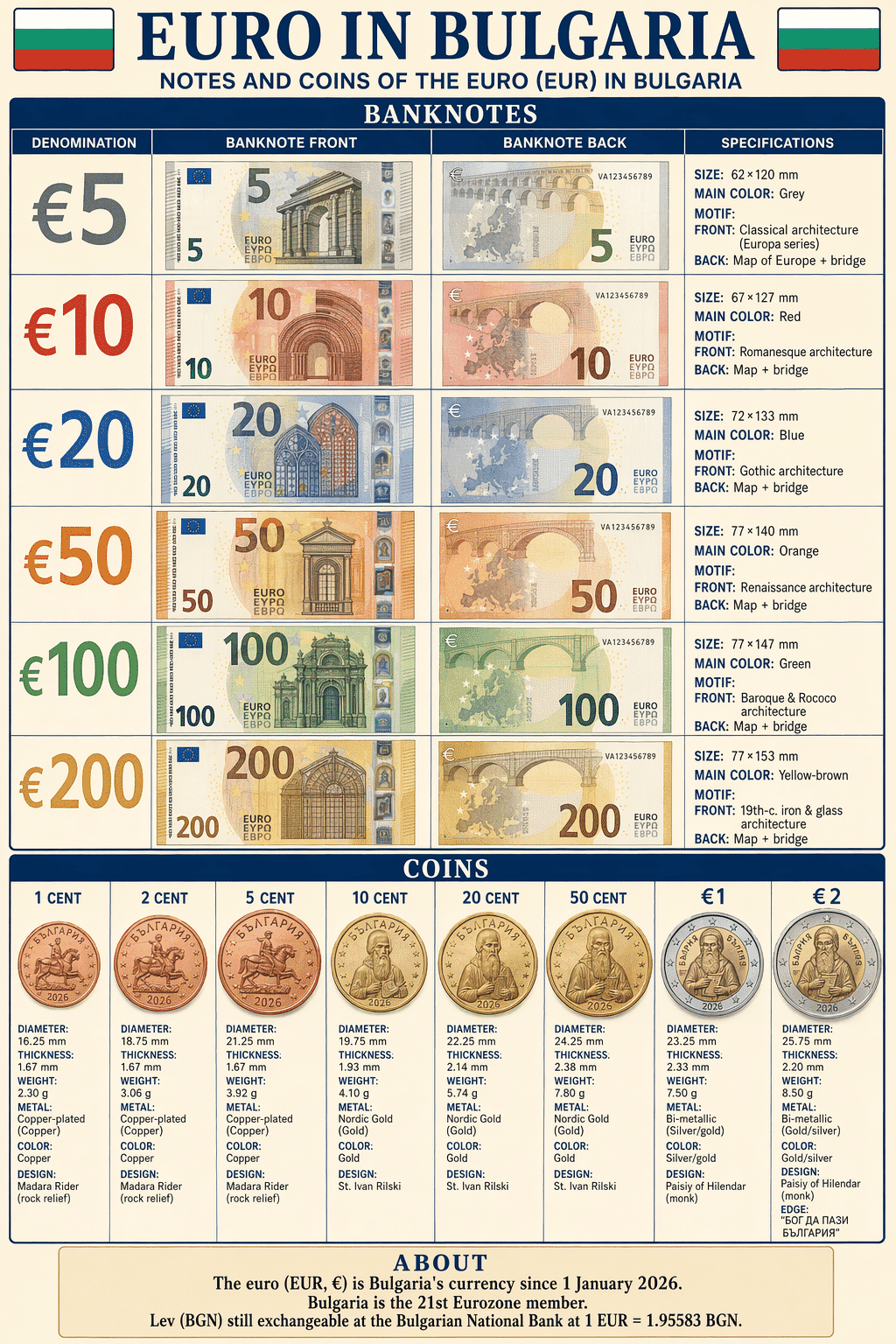
- Coins feature Cyrillic script and national heroes. Bulgaria's euro coin national reverses include the Madara Rider (1c–5c), Ivan Rilski (10c–50c), and Paisiy of Hilendar (€1–€2) — plus 'БОГ ДА ПАЗИ БЪЛГАРИЯ' ('God protect Bulgaria') on the edge.
- Lev still exchangeable at BNB. BGN lost legal-tender status on 31 January 2026 after a month of dual circulation. BNB will continue to exchange lev to euro indefinitely at the fixed rate.
- ECB deposit facility rate: 2.00%. Bulgaria's monetary policy is now set in Frankfurt by the ECB. Inflation rose temporarily to 2.3% in January 2026 after the changeover — well within the typical post-adoption range.
What Is the Currency of Bulgaria?
Bulgaria’s currency is the euro (symbol €, ISO 4217 code EUR). On 1 January 2026, Bulgaria became the 21st member of the Eurosystem, adopting the euro in place of the Bulgarian lev (BGN). It was the first country to join the euro since Croatia in 2023, and arrived after 27 years on a rock-solid currency board peg to the Deutsche Mark (then the euro).
The conversion was fixed at 1 EUR = 1.95583 BGN — the same rate Bulgaria had held since the 1997 currency-board law took effect in July 1999 (with minor adjustments for euro introduction in 2002). A one-month period of dual circulation followed adoption; the Bulgarian National Bank (BNB) will continue to exchange lev to euro at the fixed rate indefinitely.
Euro to US Dollar — 1-Year Chart
Bulgaria now shares the euro with 20 other Eurozone countries. The chart below tracks EUR/USD — the relevant reference rate for any euro user.
Line chart. Daily close, USD per 1 EUR · Source: Yahoo Finance · Updated nightly. Data table with 2 rows and 132 columns follows.
| Oct 21 | Oct 23 | Oct 28 | Oct 30 | Nov 03 | Nov 05 | Nov 07 | Nov 11 | Nov 13 | Nov 17 | Nov 19 | Nov 21 | Nov 25 | Nov 27 | Dec 01 | Dec 03 | Dec 05 | Dec 09 | Dec 11 | Dec 15 | Dec 17 | Dec 19 | Dec 23 | Dec 26 | Dec 30 | Jan 02 | Jan 06 | Jan 08 | Jan 12 | Jan 14 | Jan 16 | Jan 20 | Jan 22 | Jan 26 | Jan 28 | Jan 30 | Feb 03 | Feb 05 | Feb 09 | Feb 11 | Feb 13 | Feb 17 | Feb 19 | Feb 23 | Feb 25 | Feb 27 | Mar 03 | Mar 05 | Mar 09 | Mar 11 | Mar 13 | Mar 17 | Mar 19 | Mar 23 | Mar 25 | Mar 27 | Mar 30 | Apr 01 | Apr 05 | Apr 07 | Apr 09 | Apr 13 | Apr 15 | Apr 19 | Apr 21 | Apr 23 | Apr 27 | Apr 29 | May 03 | May 05 | May 07 | May 11 | May 13 | May 17 | May 19 | May 21 | May 25 | May 27 | May 31 | Jun 02 | Jun 04 | Jun 08 | Jun 10 | Jun 14 | Jun 16 | Jun 18 | Jun 22 | Jun 24 | Jun 28 | Jun 30 | Jul 02 | Jul 06 | Jul 08 | Jul 12 | Jul 14 | Jul 16 | Jul 20 | Jul 22 | Jul 26 | Jul 28 | Jul 30 | Aug 03 | Aug 05 | Aug 09 | Aug 11 | Aug 13 | Aug 17 | Aug 19 | Aug 23 | Aug 25 | Aug 27 | Aug 31 | Sep 02 | Sep 06 | Sep 08 | Sep 10 | Sep 14 | Sep 16 | Sep 20 | Sep 22 | Sep 24 | Sep 28 | Sep 30 | Oct 04 | Oct 06 | Oct 08 | Oct 12 | Oct 14 | Oct 18 | Oct 20 | Oct 22 | |
|---|---|---|---|---|---|---|---|---|---|---|---|---|---|---|---|---|---|---|---|---|---|---|---|---|---|---|---|---|---|---|---|---|---|---|---|---|---|---|---|---|---|---|---|---|---|---|---|---|---|---|---|---|---|---|---|---|---|---|---|---|---|---|---|---|---|---|---|---|---|---|---|---|---|---|---|---|---|---|---|---|---|---|---|---|---|---|---|---|---|---|---|---|---|---|---|---|---|---|---|---|---|---|---|---|---|---|---|---|---|---|---|---|---|---|---|---|---|---|---|---|---|---|---|---|---|---|---|---|---|---|---|
| USD per EUR | 1.16 | 1.16 | 1.17 | 1.16 | 1.15 | 1.15 | 1.15 | 1.16 | 1.16 | 1.16 | 1.16 | 1.15 | 1.15 | 1.16 | 1.16 | 1.16 | 1.16 | 1.16 | 1.17 | 1.17 | 1.17 | 1.17 | 1.18 | 1.18 | 1.18 | 1.18 | 1.17 | 1.17 | 1.16 | 1.16 | 1.16 | 1.16 | 1.17 | 1.19 | 1.2 | 1.2 | 1.18 | 1.18 | 1.18 | 1.19 | 1.19 | 1.18 | 1.18 | 1.18 | 1.18 | 1.18 | 1.17 | 1.16 | 1.15 | 1.16 | 1.15 | 1.15 | 1.15 | 1.16 | 1.16 | 1.15 | 1.15 | 1.16 | 1.15 | 1.17 | 1.17 | 1.18 | 1.18 | 1.17 | 1.17 | 1.17 | 1.17 | 1.17 | 1.17 | 1.17 | 1.17 | 1.18 | 1.17 | 1.16 | 1.16 | 1.16 | 1.16 | 1.16 | 1.16 | 1.16 | 1.16 | 1.15 | 1.15 | 1.16 | 1.16 | 1.15 | 1.14 | 1.14 | 1.14 | 1.14 | 1.14 | 1.14 | 1.14 | 1.14 | 1.14 | 1.14 | 1.14 | 1.14 | 1.14 | 1.14 | 1.15 | 1.15 | 1.16 | 1.16 | 1.15 | 1.15 | 1.16 | 1.17 | 1.17 | 1.17 | 1.17 | 1.16 | 1.16 | 1.16 | 1.16 | 1.16 | 1.15 | 1.15 | 1.15 | 1.14 | 1.14 | 1.14 | 1.13 | 1.13 | 1.13 | 1.12 | 1.12 | 1.12 | 1.12 | 1.12 | 1.13 |
Over the past 12 months the euro has moved in a 1.10–1.18 range against the dollar, closing recently near 1.18. The ECB’s 2.00% deposit rate is set in Frankfurt for all 21 Eurosystem members.
Banknotes and Coins
Bulgaria uses the same euro banknotes as the other 20 Eurosystem members — the “Europa” series introduced between 2013 and 2019.
| Denomination | Figure / Motif | Context | Colour |
|---|---|---|---|
| €5 Europa | Classical architecture | Shared with all Eurozone members | Grey |
| €10 | Romanesque architecture | — | Red |
| €20 | Gothic architecture | — | Blue |
| €50 | Renaissance architecture | — | Orange |
| €100 | Baroque & Rococo architecture | — | Green |
| €200 | 19th-century iron & glass architecture | — | Yellow-brown |
Euro coins have a national reverse unique to Bulgaria, chosen via public consultation. Bulgaria’s designs emphasise medieval and early-modern Bulgarian heritage, and — unusually — all Bulgarian coins carry the Cyrillic inscription ‘БОГ ДА ПАЗИ БЪЛГАРИЯ’ (‘God protect Bulgaria’) on the edge of the €1 and €2 coins.
| Denomination | Composition & Design | Notes |
|---|---|---|
| 1c, 2c, 5c | Copper-plated steel; the Madara Rider (8th-century UNESCO rock relief) | Since 2026 |
| 10c, 20c, 50c | Nordic gold; Saint Ivan Rilski (patron saint of Bulgaria) | Since 2026 |
| €1, €2 | Bi-metallic; Paisiy of Hilendar (18th-century monk, national-awakening figure) | Since 2026 |
History of The Euro in Bulgaria
Bulgaria’s currency path ran from Ottoman piastres to an unstable early-1990s lev, through a 1996 hyperinflation crisis, into the 1999 currency-board stabilisation, and finally into the euro. The 1997 currency-board law is one of the most successful monetary-stability frameworks ever implemented by a post-Communist state.
| Year | Event |
|---|---|
| 1880 | First modern lev introduced shortly after Bulgarian independence, pegged to the French franc. |
| 1879 | Bulgarian National Bank founded on 25 January — one of Europe’s oldest central banks. |
| 1923 | Bulgarian lev pegged to gold; suspended during WWI and inter-war crises. |
| 1952 | Second redenomination of the lev at 100:1. |
| 1996–1997 | Hyperinflation crisis; lev loses most of its value. |
| 1997 | Currency Board Arrangement adopted on 1 July, pegging lev to the Deutsche Mark at 1 DEM = 1,000 old lev. |
| 1999 | Third redenomination: 1 new lev = 1,000 old lev. Peg shifts to 1 DEM = 1 new lev; later 1.95583 BGN = 1 EUR. |
| 2007 | Bulgaria joins the EU on 1 January. Formal euro-adoption commitment begins. |
| 2020 | Lev joins ERM II on 10 July at the central rate 1.95583 BGN = 1 EUR. |
| 2025 | ECOFIN Council clears Bulgaria to adopt the euro; rate confirmed at 1.95583 BGN = 1 EUR. |
| 2026 | Bulgaria adopts the euro on 1 January, becoming the 21st Eurosystem member. |
The Bulgarian Economy and the Euro
Bulgaria is a small, open, EU economy heavily reliant on exports to the Eurozone. Machinery, chemicals, textiles, and food products dominate the export mix, and roughly 75% of Bulgarian exports go to the EU. Tourism contributes around 12% of GDP, with Black Sea resorts (Sunny Beach, Varna, Burgas) and winter destinations (Bansko) as the main draws. Euro adoption eliminates currency-conversion friction on most of Bulgaria’s external transactions.
On monetary policy, Bulgaria is now subject to the ECB’s 2% medium-term inflation target. The BNB has lost its independent policy-rate tool (it had effectively already given it up under the currency board, where the rate passively followed the market), but retains banking supervision, cash-handling, and statistical responsibilities as a Eurosystem national central bank. January 2026 inflation: 2.3%, a small temporary uptick from the pre-adoption level — ECB research consistently shows the euro-changeover price impact is about 0.3–0.4 pp.
Using Euros in Bulgaria
Card acceptance is strong in Sofia, Plovdiv, Varna, Burgas, and Black Sea resorts — Visa, Mastercard, and contactless work nearly everywhere. In smaller towns and rural Bulgaria, cash (now in euros) remains the default. Tipping (10%) is typically paid in cash. Many price tags still show dual pricing (BGN and EUR) through 2026 for consumer clarity.
Typical prices (2026): espresso in a Sofia café €1.20–€2.00; banitsa (cheese pastry) €1.00; lunch at a mehana €7–€12; mid-range dinner €18–€30; a mid-range Sofia hotel room €65–€120. ATMs at UniCredit Bulbank, DSK Bank, Bulgarian-American Credit Bank, and Postbank are widespread. Note: during the 2026 changeover, some rural ATMs may still dispense lev until bank inventories are replenished — if in doubt, use a bank-branch ATM in a city.
The Euro in Bulgaria in Regional Context
Bulgaria is now in the Eurozone alongside Germany, France, Italy, Spain, the Netherlands, and 15 others. Its immediate neighbours include non-euro Romania, non-euro Serbia and North Macedonia to the west, and non-euro Turkey to the south-east.
| Country | Code | Regime | Inflation | Policy rate |
|---|---|---|---|---|
| 🇧🇬 Bulgaria | EUR (since 2026) | Eurosystem | ~2.3% | 2.00% |
| 🇷🇴 Romania | RON | Managed float | 3.9% (2026f) | 6.50% |
| 🇬🇷 Greece | EUR | Eurosystem | 2.8% | 2.00% |
| 🇷🇸 Serbia | RSD | Managed float | ~3–4% | 5.75% |
| 🇲🇰 North Macedonia | MKD | De facto EUR peg | ~2% | ~6% |
| 🇹🇷 Turkey | TRY | Managed float | Target 16% | 37.00% |
Frequently Asked Questions
What is the currency of Bulgaria?
Bulgaria’s currency is the euro (€, ISO 4217 code EUR). Bulgaria adopted the euro on 1 January 2026, becoming the 21st member of the Eurosystem. The euro replaced the Bulgarian lev (BGN) at the fixed rate 1 EUR = 1.95583 BGN.
Is the Bulgarian lev still legal tender?
No. The lev ceased to be legal tender on 31 January 2026, after a one-month dual-circulation period. However, the Bulgarian National Bank (BNB) will continue to exchange lev to euro indefinitely at the fixed rate 1 EUR = 1.95583 BGN, at any of its branches.
Why did Bulgaria adopt the euro?
Bulgaria had been effectively ‘euroised’ for decades: its currency-board peg to the Deutsche Mark (since 1997) then the euro (since 1999) meant the BGN and EUR moved one-for-one. Roughly half of household deposits and most large loans were already denominated in euros. Formal adoption removed exchange-rate risk, lowered government borrowing costs, and eliminated FX fees on Bulgaria’s EU trade.
Who manages monetary policy for Bulgaria?
The European Central Bank (ECB) in Frankfurt, under President Christine Lagarde. The Bulgarian National Bank, still headed by Governor Dimitar Radev, is now a Eurosystem national central bank. Governor Radev sits on the ECB Governing Council and votes on euro-area monetary-policy decisions.
What do Bulgarian euro coins look like?
Bulgaria designed its own national reverses. The 1c–5c coins show the Madara Rider, an 8th-century rock relief UNESCO World Heritage Site. The 10c–50c coins show Saint Ivan Rilski, Bulgaria’s patron saint. The €1 and €2 coins show Paisiy of Hilendar, the 18th-century monk whose 1762 history of the Slavo-Bulgarians helped launch the Bulgarian national awakening. The edge of the €1 and €2 coins carries the Cyrillic motto ‘БОГ ДА ПАЗИ БЪЛГАРИЯ’ (‘God protect Bulgaria’).
How many euros was one lev worth?
The fixed conversion rate is 1 EUR = 1.95583 BGN, or equivalently 1 BGN ≈ €0.51. This rate — identical to the old Deutsche Mark’s euro conversion — has been held since 1999 under Bulgaria’s currency board and will remain the rate at which BNB exchanges remaining lev.
Did euro adoption cause inflation in Bulgaria?
Only marginally. Bulgarian CPI inflation rose to 2.3% in January 2026 — a small uptick from late-2025 levels, consistent with the 0.3–0.4 pp temporary effect the ECB has documented in previous euro changeovers. The currency-board peg meant Bulgarian prices had already fully converged to euro-area pricing dynamics long before 1 January 2026.
Data current to April 2026 — BNB and ECB releases surrounding the euro changeover.

