
Key Facts: The Albanian Lek
- ISO 4217 code: ALL · Symbol: L. Plural lekë. Subdivided into 100 qindarka; qindarka coins are no longer minted but remain legal tender.
- Central bank: Bank of Albania (est. 1925). Tirana-based. Governor Gent Sejko since February 2015, reappointed 2022. Inflation-targeting regime at 3%.
- Policy rate: 2.50% · Inflation: 2.4%. Bank of Albania has held the base rate at 2.5% through early 2026. Inflation has fallen back to 2.4%, close to the 3% target.
- 1 USD ≈ 80.80 ALL. The lek has strengthened ~6.4% against the dollar over the past 12 months — one of the strongest emerging-market performances.
- EU candidate since 2014; negotiations opened 2022. Not in the Eurozone and not in ERM II. Albania's informal 'euroisation' is growing — tourism revenue comes almost entirely in euros.
What Is the Currency of Albania?
Albania’s currency is the lek (plural lekë, symbol L, ISO 4217 code ALL). The name honours Alexander the Great (Aleksandri i Madh in Albanian), whose name Skanderbeg — Albania’s 15th-century national hero — also evokes. The lek is subdivided into 100 qindarka, though qindarka coins are no longer in active circulation.
The lek is issued by the Bank of Albania, founded in 1925. Albania is not an EU member — it is a candidate country, with accession negotiations opened in July 2022 — and is not in the Eurozone. The lek is a managed float.
Albanian Lek to US Dollar — 1-Year Chart
The chart tracks USD/ALL daily close over the past year. The lek’s main drivers: Albanian tourism receipts (tourism grew ~30% in 2024), remittances from the Albanian diaspora, Bank of Albania FX interventions, and movements in EUR/USD (since most Albanian FX flows are euro-denominated).
Line chart. Daily close, ALL per USD · Source: Yahoo Finance · Updated nightly. Data table with 2 rows and 132 columns follows.
| Oct 15 | Oct 19 | Oct 21 | Oct 23 | Oct 28 | Oct 30 | Nov 03 | Nov 05 | Nov 07 | Nov 11 | Nov 13 | Nov 17 | Nov 19 | Nov 21 | Nov 25 | Nov 27 | Dec 01 | Dec 03 | Dec 05 | Dec 09 | Dec 11 | Dec 15 | Dec 17 | Dec 19 | Dec 23 | Dec 26 | Dec 30 | Jan 02 | Jan 06 | Jan 08 | Jan 12 | Jan 14 | Jan 16 | Jan 20 | Jan 22 | Jan 26 | Jan 28 | Jan 30 | Feb 03 | Feb 05 | Feb 09 | Feb 11 | Feb 13 | Feb 17 | Feb 19 | Feb 23 | Feb 25 | Feb 27 | Mar 03 | Mar 05 | Mar 09 | Mar 11 | Mar 13 | Mar 17 | Mar 19 | Mar 23 | Mar 25 | Mar 27 | Mar 30 | Apr 01 | Apr 05 | Apr 07 | Apr 09 | Apr 13 | Apr 15 | Apr 19 | Apr 21 | Apr 23 | Apr 27 | Apr 29 | May 03 | May 05 | May 07 | May 11 | May 13 | May 17 | May 19 | May 21 | May 25 | May 27 | May 31 | Jun 02 | Jun 04 | Jun 08 | Jun 10 | Jun 14 | Jun 16 | Jun 18 | Jun 22 | Jun 24 | Jun 28 | Jun 30 | Jul 02 | Jul 06 | Jul 08 | Jul 12 | Jul 14 | Jul 16 | Jul 20 | Jul 22 | Jul 26 | Jul 28 | Jul 30 | Aug 03 | Aug 05 | Aug 09 | Aug 11 | Aug 13 | Aug 17 | Aug 19 | Aug 23 | Aug 25 | Aug 27 | Aug 31 | Sep 02 | Sep 06 | Sep 08 | Sep 10 | Sep 14 | Sep 16 | Sep 20 | Sep 22 | Sep 24 | Sep 28 | Sep 30 | Oct 04 | Oct 06 | Oct 08 | Oct 12 | Oct 14 | Oct 16 | |
|---|---|---|---|---|---|---|---|---|---|---|---|---|---|---|---|---|---|---|---|---|---|---|---|---|---|---|---|---|---|---|---|---|---|---|---|---|---|---|---|---|---|---|---|---|---|---|---|---|---|---|---|---|---|---|---|---|---|---|---|---|---|---|---|---|---|---|---|---|---|---|---|---|---|---|---|---|---|---|---|---|---|---|---|---|---|---|---|---|---|---|---|---|---|---|---|---|---|---|---|---|---|---|---|---|---|---|---|---|---|---|---|---|---|---|---|---|---|---|---|---|---|---|---|---|---|---|---|---|---|---|---|
| ALL per USD | 82.7 | 80.73 | 82.9 | 81.1 | 82.75 | 82.6 | 81.34 | 83.6 | 83.4 | 81.41 | 83 | 81.03 | 82.1 | 81.82 | 83.5 | 82.95 | 81.11 | 82.8 | 82.4 | 80.67 | 80.42 | 80.2 | 81.8 | 81.85 | 82 | 81.45 | 81.15 | 80.33 | 82.03 | 82.17 | 80.91 | 82.6 | 82.87 | 80.81 | 82.05 | 79.55 | 80.6 | 78.75 | 81.82 | 79.64 | 79.54 | 80.8 | 80.95 | 79.25 | 81.33 | 79.66 | 81.35 | 81.55 | 81.85 | 82.42 | 80.39 | 82.2 | 81.32 | 83.5 | 82.95 | 80.62 | 80.52 | 81 | 81.63 | 82.4 | 80.91 | 82.5 | 81.62 | 81.75 | 81 | 79.35 | 81.08 | 81.3 | 79.34 | 81.6 | 81.2 | 79.62 | 80.85 | 80.8 | 81.3 | 80.03 | 79.91 | 81.8 | 79.92 | 79.73 | 81.6 | 81.75 | 79.78 | 82.39 | 80.1 | 79.93 | 81.5 | 80.51 | 80.07 | 82.83 | 80.54 | 80.11 | 82 | 79.81 | 82 | 79.94 | 81.62 | 81.2 | 79.83 | 81.77 | 80.23 | 77.99 | 79.37 | 78.92 | 80.4 | 78.47 | 82.5 | 78.41 | 77.92 | 78.8 | 77.04 | 76.88 | 78.89 | 77.35 | 79.25 | 77.17 | 79 | 76.74 | 79.2 | 79 | 77.19 | 77.45 | 78.19 | 80.4 | 78.54 | 79.25 | 81.55 | 81.35 | 79.38 | 81.2 | 80.84 |
Over the past 12 months the lek has strengthened notably from about 86 to 81 ALL per USD — a 6.4% move in the lek’s favour. Surging tourism receipts and a strong construction cycle have both supported the currency.
Banknotes and Coins
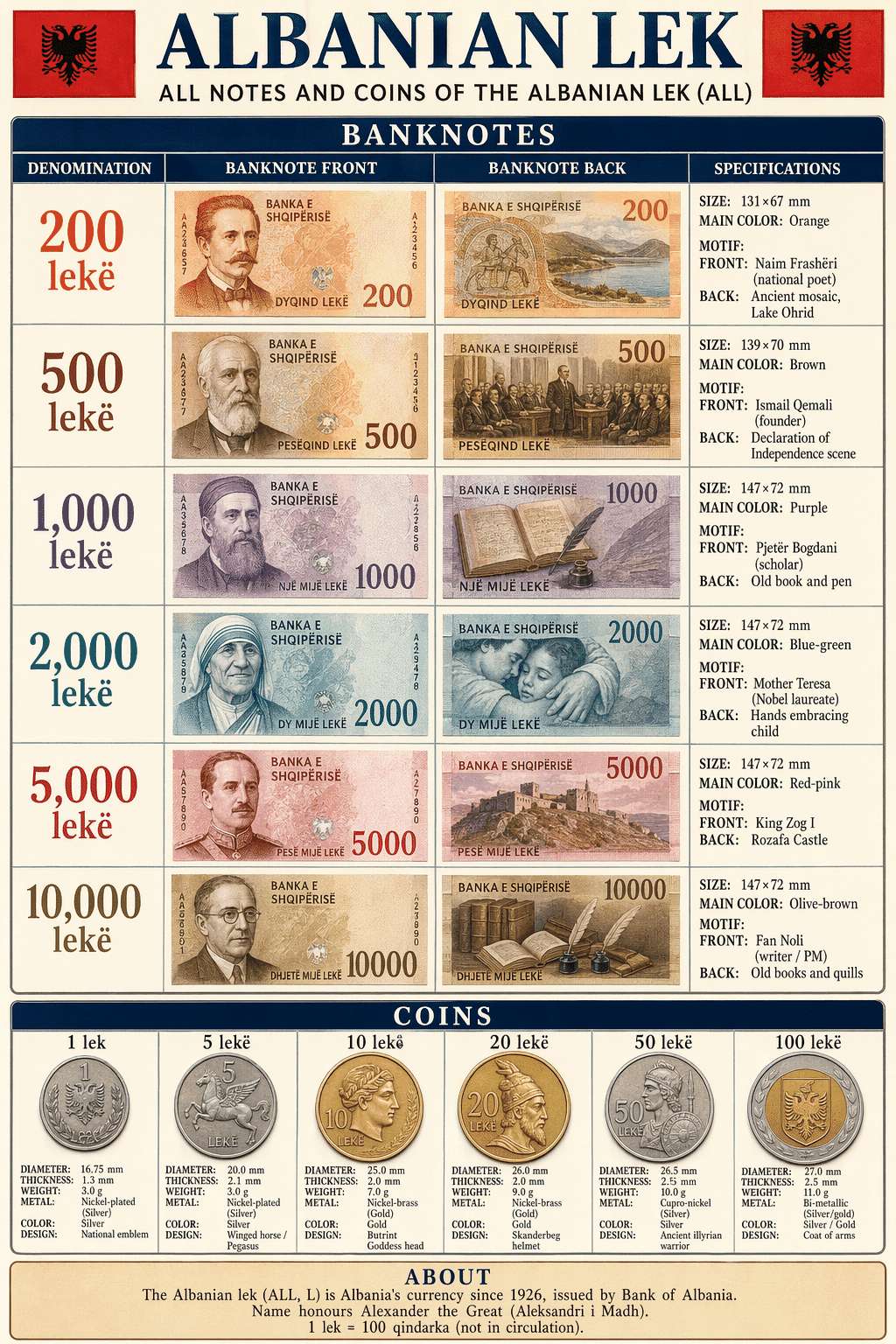
Current Albanian banknotes honour Albanian historical, literary, and humanitarian figures. The 10,000-lek note, the largest denomination, was introduced in 2017 to keep up with inflation and larger transaction sizes.
| Denomination | Figure / Motif | Context | Colour |
|---|---|---|---|
| 200 lekë | Naim Frashëri | National poet of the 19th-century Albanian Rilindja (national awakening) | Orange |
| 500 lekë | Ismail Qemali | Founder of independent Albania, 1912 | Brown |
| 1,000 lekë | Pjetër Bogdani | 17th-century scholar and writer | Purple |
| 2,000 lekë | Mother Teresa | Albanian Catholic nun, 1979 Nobel Peace Prize | Blue-green |
| 5,000 lekë | King Zog I | King of Albania 1928–1939 | Red-pink |
| 10,000 lekë | Fan Noli | Writer, politician, prime minister 1924 | Olive-brown |
Coins come in six denominations from 1 to 100 lekë.
| Denomination | Composition & Design | Notes |
|---|---|---|
| 1 lek | Nickel-plated steel | Smallest circulating denomination |
| 5 lekë | Nickel-plated steel | Since 1995 |
| 10 lekë | Nickel-brass | Since 1996 |
| 20 lekë | Nickel-brass | Since 1996 |
| 50 lekë | Cupro-nickel | Since 1996 |
| 100 lekë | Bi-metallic | Highest-denomination coin |
History of The Lek
The lek was introduced in 1926 by the new Albanian state under King Zog, replacing the Albanian franc. After WWII the currency came under strict communist control; post-1992 transition saw multiple periods of instability, including a 1997 pyramid-scheme collapse that wiped out the savings of most Albanian households and briefly destabilised the currency.
| Year | Event |
|---|---|
| 1913 | Albanian independence recognised; early Albanian franc circulates. |
| 1925 | Bank of Albania founded; first Albanian state currency. |
| 1926 | Albanian lek introduced; replaces the Albanian franc. |
| 1944–1992 | Communist rule; lek strictly controlled, non-convertible. |
| 1992 | Democratic transition begins; lek becomes freely convertible. |
| 1996–1997 | Pyramid-scheme crisis wipes out household savings; lek destabilised; 2,000 and 5,000-lek notes introduced. |
| 2009 | Bank of Albania formally adopts inflation targeting at 3%. |
| 2014 | Albania granted EU candidate status. |
| 2022 | EU accession negotiations formally opened. |
| 2025–2026 | Policy rate held at 2.50% through early 2026; inflation returning to target. |
The Albanian Economy and the Lek
Albania is a small, rapidly growing economy in the Western Balkans. Its 2025 growth was estimated at 3.8% — among Europe’s fastest. The economy has three main pillars: tourism (grew ~30% in 2024, now ~25% of GDP), remittances from the Albanian diaspora in Italy, Greece, and Germany (around 9% of GDP), and construction (booming thanks to tourism and FDI). All three channels bring euros into Albania, which is a key support for the lek.
Bank of Albania targets 3% CPI inflation (±1 pp). The post-pandemic peak of 8.3% in October 2022 has been followed by a steady disinflation. First-quarter 2026 inflation averaged 2.4%, just below target. The policy rate is 2.50% — quite low by regional standards — and Governor Gent Sejko has indicated rates will likely remain there while the country is on a clear path back to target.
Using Leks in Albania
Cash is still widely used in Albania, but card acceptance has expanded rapidly with tourism. In Tirana, Durrës, Sarandë, Ksamil, and other coastal resorts, Visa and Mastercard work in most restaurants, hotels, and chain shops. Smaller establishments, village cafés, and taxis often prefer cash. Many Albanian businesses informally accept euros — especially in tourist areas — though change is usually in leks at a moderate rate.
Typical prices in leks (2026): espresso 100–150 L; a byrek (cheese pie) 80–150 L; a full restaurant meal 900–1,800 L in Tirana, 1,500–3,000 L on the coast; a pint of Albanian beer 200–350 L; a mid-range Tirana hotel room 4,500–8,500 L. ATMs at Raiffeisen Bank, Credins Bank, and Intesa Sanpaolo Bank are reliable for foreign cards.
The Lek in Regional Context
Albania is part of the Western Balkans — a cluster of small non-EU states mostly using their own managed-float currencies. Of Albania’s immediate neighbours, only Greece is in the euro; North Macedonia, Kosovo (which uses the euro unilaterally), Montenegro (also uses euro unilaterally), and Serbia each have very different monetary arrangements.
| Country | Code | Regime | Inflation | Policy rate |
|---|---|---|---|---|
| 🇦🇱 Albania | ALL | Managed float | 2.4% (early 2026) | 2.50% |
| 🇲🇰 North Macedonia | MKD | De facto EUR peg | ~2% | ~6% |
| 🇷🇸 Serbia | RSD | Managed float | ~3–4% | 5.75% |
| 🇲🇪 Montenegro | EUR (unilateral) | Uses euro unilaterally | ~3% | 2.00% (ECB) |
| 🇽🇰 Kosovo | EUR (unilateral) | Uses euro unilaterally | ~2% | 2.00% (ECB) |
| 🇬🇷 Greece | EUR | Eurosystem | 2.8% | 2.00% |
Frequently Asked Questions
What is the currency of Albania?
Albania’s currency is the lek (plural lekë, symbol L, ISO 4217 code ALL), in use since 1926. The name honours Alexander the Great (Aleksandri i Madh in Albanian).
Is Albania in the Eurozone?
No. Albania is not an EU member — it is an EU candidate country, with accession negotiations opened in July 2022. It is not in ERM II and has no target date for euro adoption. Informally, euro usage is widespread in tourist areas.
Who manages Albanian monetary policy?
The Bank of Albania, founded 1925, headquartered in Tirana. Its current Governor is Gent Sejko, who took office in February 2015 and was reappointed for a second term in 2022. The bank targets 3% CPI inflation.
What is the current Bank of Albania policy rate?
The base rate is 2.50%, held through early 2026. Alongside this, the overnight deposit rate is 1.50% and the overnight loan rate is 3.50%.
How many leks is one US dollar worth?
At the latest daily close, 1 USD ≈ 81 ALL. The lek has strengthened about 6.4% against the dollar over the past 12 months, making it one of the stronger Balkan currencies in 2025–2026.
Can I use euros in Albania?
Yes, quite often — especially in tourist areas along the coast (Sarandë, Ksamil, Vlorë) and in Tirana. Many hotels and larger restaurants will accept euros, though change is usually in leks at a moderate rate. For best value, withdraw leks from an ATM or pay by card. Do not exchange cash at airport kiosks — the rates are poor.
Who are on Albanian banknotes?
Six historical figures: Naim Frashëri (200 L, national poet), Ismail Qemali (500 L, founder of the modern state), Pjetër Bogdani (1,000 L), Mother Teresa (2,000 L — born in Skopje to Albanian parents, Nobel Peace laureate), King Zog I (5,000 L), and Fan Noli (10,000 L, early-20th-c. politician and writer). Notable: Albania is one of relatively few countries to feature a religious figure (Mother Teresa) on its banknotes.
Data current to April 2026 — Bank of Albania and INSTAT releases.

