
Key Facts: The Romanian Leu
- ISO 4217 code: RON · Symbol: lei. Subdivided into 100 bani. Name means 'lion' — inherited from the 17th-century Dutch 'leeuwendaalder' silver coin.
- Central bank: Banca Națională a României (est. 1880). Bucharest-based. Governor Mugur Isărescu since 1990 — Europe's longest-serving central-bank governor.
- Policy rate: 6.50% · Inflation still elevated. BNR held rate at 6.50% at its April 7 2026 meeting. February 2026 inflation: 9.31%. Target: 2.5% (±1 pp).
- 1 USD ≈ 4.33 RON. The leu has been essentially flat against the USD for 12 months — BNR manages the exchange rate closely via reserve operations.
- EU member since 2007, not yet in Eurozone. Romania has no target date for euro adoption; not in ERM II. The leu is described as 'managed float' — the BNR intervenes to dampen volatility.
What Is the Currency of Romania?
Romania’s currency is the leu (plural lei, symbol lei, ISO 4217 code RON). The name means ‘lion’ and derives from the Dutch leeuwendaalder silver coin that circulated in the Romanian principalities in the 17th century. The modern leu is subdivided into 100 bani. The current ‘new leu’ (RON) was introduced on 1 July 2005 following a 1:10,000 redenomination to erase accumulated 1990s inflation.
The leu is issued by the Banca Națională a României (BNR), founded on 11 April 1880 — one of Europe’s oldest central banks. Romania has been an EU member since 1 January 2007 and is legally bound to eventually adopt the euro, but successive governments have declined to set a target date. The leu operates in a managed-float regime.
Romanian Leu to US Dollar — 1-Year Chart
The chart tracks USD/RON daily close over the past year. The leu’s quiet behaviour in the chart reflects BNR’s active management — the central bank intervenes in FX markets to keep the leu trading in a narrow band against the euro (and therefore indirectly against the dollar).
Line chart. Daily close, RON per USD · Source: Yahoo Finance · Updated nightly. Data table with 2 rows and 131 columns follows.
| Oct 12 | Oct 14 | Oct 16 | Oct 20 | Oct 22 | Oct 27 | Oct 29 | Oct 31 | Nov 04 | Nov 06 | Nov 10 | Nov 12 | Nov 14 | Nov 18 | Nov 20 | Nov 24 | Nov 26 | Nov 28 | Dec 02 | Dec 04 | Dec 08 | Dec 10 | Dec 12 | Dec 16 | Dec 18 | Dec 22 | Dec 24 | Dec 29 | Dec 31 | Jan 05 | Jan 07 | Jan 09 | Jan 13 | Jan 15 | Jan 19 | Jan 21 | Jan 23 | Jan 27 | Jan 29 | Feb 02 | Feb 04 | Feb 06 | Feb 10 | Feb 12 | Feb 16 | Feb 18 | Feb 20 | Feb 24 | Feb 26 | Mar 02 | Mar 04 | Mar 06 | Mar 10 | Mar 12 | Mar 16 | Mar 18 | Mar 20 | Mar 24 | Mar 26 | Mar 29 | Mar 31 | Apr 02 | Apr 06 | Apr 08 | Apr 12 | Apr 14 | Apr 16 | Apr 20 | Apr 22 | Apr 26 | Apr 28 | Apr 30 | May 04 | May 06 | May 10 | May 12 | May 14 | May 18 | May 20 | May 24 | May 26 | May 28 | Jun 01 | Jun 03 | Jun 07 | Jun 09 | Jun 11 | Jun 15 | Jun 17 | Jun 21 | Jun 23 | Jun 25 | Jun 29 | Jul 01 | Jul 05 | Jul 07 | Jul 09 | Jul 13 | Jul 15 | Jul 19 | Jul 21 | Jul 23 | Jul 27 | Jul 29 | Aug 02 | Aug 04 | Aug 06 | Aug 10 | Aug 12 | Aug 16 | Aug 18 | Aug 20 | Aug 24 | Aug 26 | Aug 30 | Sep 01 | Sep 03 | Sep 07 | Sep 09 | Sep 13 | Sep 15 | Sep 17 | Sep 21 | Sep 23 | Sep 27 | Sep 29 | Oct 01 | Oct 05 | Oct 07 | Oct 12 | |
|---|---|---|---|---|---|---|---|---|---|---|---|---|---|---|---|---|---|---|---|---|---|---|---|---|---|---|---|---|---|---|---|---|---|---|---|---|---|---|---|---|---|---|---|---|---|---|---|---|---|---|---|---|---|---|---|---|---|---|---|---|---|---|---|---|---|---|---|---|---|---|---|---|---|---|---|---|---|---|---|---|---|---|---|---|---|---|---|---|---|---|---|---|---|---|---|---|---|---|---|---|---|---|---|---|---|---|---|---|---|---|---|---|---|---|---|---|---|---|---|---|---|---|---|---|---|---|---|---|---|---|
| RON per USD | 4.38 | 4.38 | 4.34 | 4.36 | 4.37 | 4.37 | 4.36 | 4.39 | 4.41 | 4.42 | 4.39 | 4.38 | 4.37 | 4.38 | 4.4 | 4.41 | 4.4 | 4.38 | 4.38 | 4.36 | 4.37 | 4.37 | 4.33 | 4.33 | 4.33 | 4.33 | 4.31 | 4.32 | 4.33 | 4.34 | 4.35 | 4.36 | 4.36 | 4.36 | 4.38 | 4.34 | 4.33 | 4.29 | 4.25 | 4.29 | 4.31 | 4.32 | 4.27 | 4.28 | 4.29 | 4.29 | 4.33 | 4.32 | 4.31 | 4.31 | 4.39 | 4.38 | 4.38 | 4.4 | 4.46 | 4.41 | 4.39 | 4.38 | 4.4 | 4.43 | 4.4 | 4.41 | 4.41 | 4.36 | 4.35 | 4.31 | 4.32 | 4.32 | 4.34 | 4.34 | 4.34 | 4.43 | 4.44 | 4.48 | 4.43 | 4.43 | 4.45 | 4.46 | 4.5 | 4.5 | 4.5 | 4.5 | 4.5 | 4.52 | 4.55 | 4.54 | 4.52 | 4.51 | 4.54 | 4.57 | 4.61 | 4.6 | 4.59 | 4.59 | 4.57 | 4.59 | 4.57 | 4.59 | 4.56 | 4.58 | 4.59 | 4.59 | 4.6 | 4.56 | 4.54 | 4.55 | 4.56 | 4.54 | 4.54 | 4.52 | 4.53 | 4.49 | 4.5 | 4.51 | 4.53 | 4.53 | 4.51 | 4.51 | 4.51 | 4.53 | 4.55 | 4.58 | 4.59 | 4.63 | 4.63 | 4.65 | 4.75 | 4.76 | 4.77 | 4.76 |
Over the past 12 months USD/RON has moved only marginally — from roughly 4.32 to 4.33 RON per USD, effectively flat. This reflects BNR’s preference for low FX volatility; the leu has historically been far less volatile than peer currencies like the Polish złoty or Hungarian forint.
Banknotes and Coins
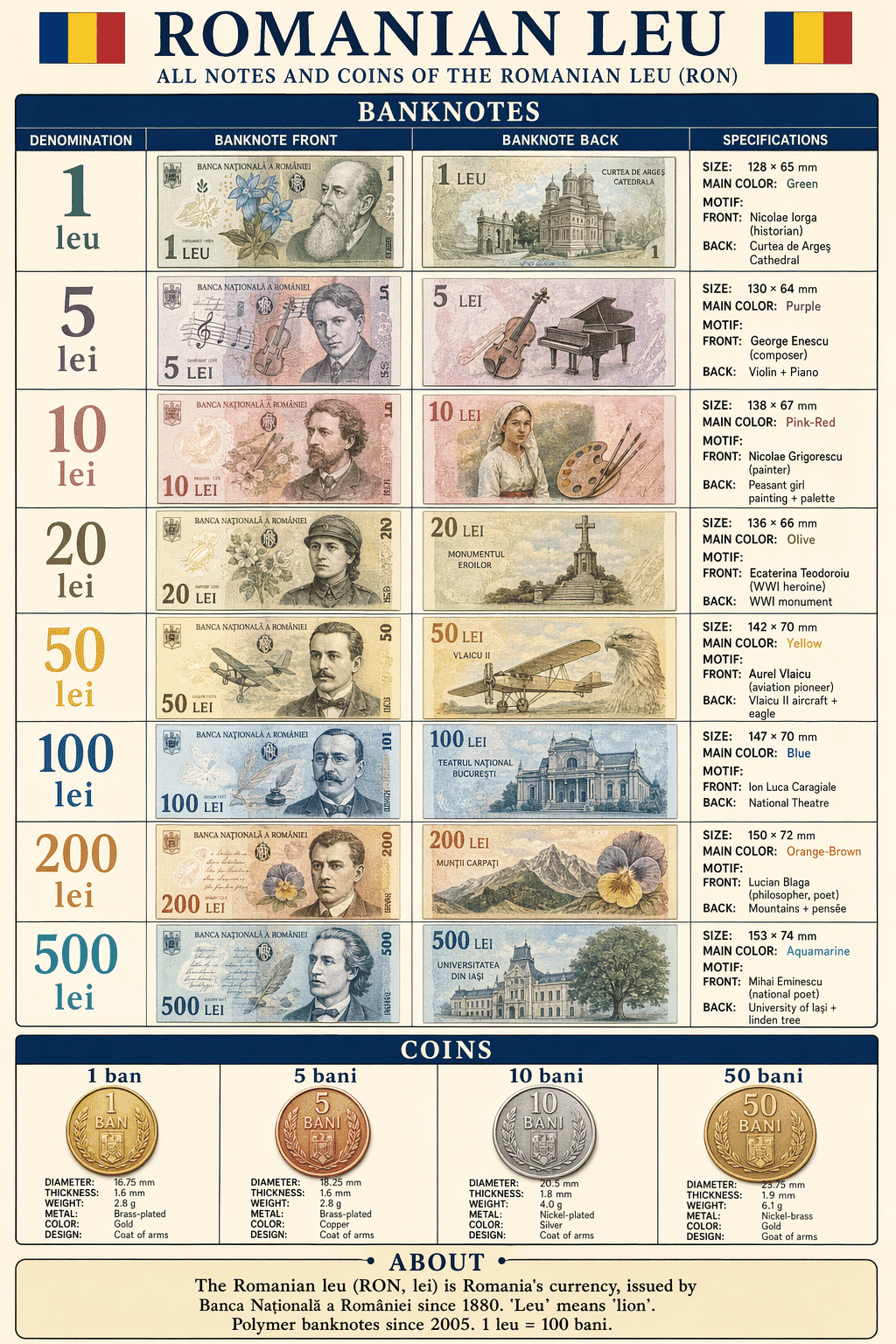
Romania’s current banknote series is unusual: polymer notes, making it the first EU country to issue all banknotes on polymer (since 2005). Each denomination honours a 19th or 20th-century Romanian cultural figure — writers, composers, scientists, and painters dominate.
| Denomination | Figure / Motif | Context | Colour |
|---|---|---|---|
| 1 leu | Nicolae Iorga | Historian, prolific author, 1871–1940 | Green |
| 5 lei | George Enescu | Composer, violinist; ‘Romanian Rhapsody’ | Purple |
| 10 lei | Nicolae Grigorescu | Romantic and realist painter, 1838–1907 | Pink-red |
| 20 lei | Ecaterina Teodoroiu | Romanian WWI heroine, 1894–1917 | Olive |
| 50 lei | Aurel Vlaicu | Aviation pioneer, built Romania’s first aircraft | Yellow |
| 100 lei | Ion Luca Caragiale | Playwright, satirist, 1852–1912 | Blue |
| 200 lei | Lucian Blaga | Philosopher and poet, 1895–1961 | Orange-brown |
| 500 lei | Mihai Eminescu | National poet of Romania, 1850–1889 | Aquamarine |
Coins come in four denominations, all in bani (the leu subunit). Romania is unusual in not having a 1-leu coin — the lowest banknote is 1 leu.
| Denomination | Composition & Design | Notes |
|---|---|---|
| 1 ban | Brass-plated steel; smallest denomination | Since 2005 |
| 5 bani | Brass-plated steel | Since 2005 |
| 10 bani | Nickel-plated steel | Since 2005 |
| 50 bani | Nickel-brass; most common coin | Since 2005 |
History of The Leu
The leu’s history runs back to 1867 Romanian independence, through two world wars, communism (1947–1989), and three separate redenominations to clear accumulated inflation. Governor Mugur Isărescu — in office since 1990 — has overseen more of Romania’s monetary history than any other living person.
| Year | Event |
|---|---|
| 1867 | First modern leu introduced by the young Romanian Kingdom, pegged to the Latin Monetary Union silver standard. |
| 1880 | Banca Națională a României founded on 11 April. |
| 1947 | First post-war redenomination; old leu replaced at 20,000:1 under the new communist regime. |
| 1952 | Second redenomination at 20:1 during Stalinist monetary reform. |
| 1989–1990 | Romanian Revolution; Governor Mugur Isărescu appointed 4 September 1990. |
| 1990s | High inflation erodes the leu; peaks around 256% in 1993. |
| 2005 | ‘New leu’ (RON) introduced 1 July at 10,000 old lei = 1 new leu. |
| 2007 | Romania joins the EU on 1 January. |
| 2022–2023 | Post-pandemic inflation peaks at 16.8% in November 2022. |
| 2024–2026 | BNR holds policy rate relatively stable in 6–7% range; inflation still above target but on a downward path. |
The Romanian Economy and the Leu
Romania is the EU’s twelfth-largest economy and one of its fastest-growing in real-GDP terms over the past decade. The 2025 export mix centres on motor vehicles (Dacia, BMW/Ford plants), electronics, machinery, clothing, and agricultural products. Germany absorbs roughly 21% of exports; the EU as a whole takes around 73%.
BNR targets CPI inflation at 2.5% with a ±1 percentage point tolerance band. After CPI peaked at 16.8% in November 2022, disinflation has been slower than in most peers — February 2026 inflation was still 9.31%, though falling. The policy rate is 6.50%, held through the April 7 2026 meeting. BNR expects inflation to fall sharply in Q3 2026 and to return to the 2.5% target by the first half of 2027.
Using Lei in Romania
Card acceptance is now extensive across Romania’s larger cities. Bucharest, Cluj-Napoca, Timișoara, Iași, and Brașov accept Visa, Mastercard, and contactless payments nearly everywhere. In villages and smaller towns, cash is still common. Tipping (10%) is usually done in cash.
Typical prices in lei (2026): espresso in a Bucharest café 10–16 lei; a substantial meal 50–90 lei in a restaurant; a local mici lunch 25–40 lei; a single Bucharest metro ride 3 lei; a mid-range Bucharest hotel room 280–550 lei. ATMs at Banca Transilvania, BCR, BRD-Groupe Société Générale, and Raiffeisen Bank are widely available and reliable for foreign cards.
The Leu in Regional Context
Romania is part of the EU’s south-eastern cluster, neighbouring Bulgaria (now in the Eurozone), Hungary, and non-EU Moldova and Serbia. The leu is one of the most lightly traded non-euro EU currencies — FX turnover is a fraction of the Polish złoty’s.
| Country | Code | Regime | Inflation | Policy rate |
|---|---|---|---|---|
| 🇷🇴 Romania | RON | Managed float | 3.9% (2026f) | 6.50% |
| 🇧🇬 Bulgaria | EUR (since 1 Jan 2026) | Eurosystem | ~2.3% | 2.00% |
| 🇭🇺 Hungary | HUF | Free float | 2.1% | 6.25% |
| 🇲🇩 Moldova | MDL | Managed float | ~5% | 5.00% |
| 🇷🇸 Serbia | RSD | Managed float | ~3–4% | 5.75% |
| 🇺🇦 Ukraine | UAH | Managed float | 7.5% (2026f) | 15.00% |
Frequently Asked Questions
What is the currency of Romania?
Romania’s currency is the leu (plural lei, symbol lei, ISO 4217 code RON). It has been Romania’s currency since 1867. Subdivided into 100 bani. The current ‘new leu’ (RON) replaced the old leu (ROL) on 1 July 2005 at a ratio of 1 RON = 10,000 ROL to remove accumulated 1990s inflation.
Is Romania in the Eurozone?
No. Romania is an EU member (since 1 January 2007) and is legally required to eventually adopt the euro, but successive governments have declined to set a target date. Romania is not in ERM II and no active preparation for adoption is under way as of 2026.
Who manages Romanian monetary policy?
Banca Națională a României (BNR), founded 11 April 1880, Bucharest. Governor Mugur Isărescu has led BNR since 4 September 1990, making him Europe’s longest-serving central-bank governor. BNR targets CPI inflation at 2.5% (±1 percentage point).
What is the current BNR policy rate?
The BNR policy rate is 6.50%, held at the April 7 2026 meeting. The deposit facility rate is 5.50% and the lending facility rate is 7.50%.
How many lei is one US dollar worth?
At the latest daily close, 1 USD ≈ 4.33 RON. The leu has been essentially flat against the US dollar for 12 months — BNR manages the exchange rate closely via FX interventions.
Why is the Romanian leu polymer rather than paper?
Since 2005, all Romanian banknotes are printed on polymer rather than cotton-paper. Romania was the first EU country to issue all denominations on polymer. Advantages: longer lifespan (2–4x paper notes), better hygiene, and harder to counterfeit. The choice was partly influenced by experience with the Australian and New Zealand polymer notes that pioneered the technology.
Who are on Romanian banknotes?
Eight Romanian cultural figures: historian Nicolae Iorga (1 leu), composer George Enescu (5 lei), painter Nicolae Grigorescu (10 lei), WWI heroine Ecaterina Teodoroiu (20 lei), aviation pioneer Aurel Vlaicu (50 lei), playwright Ion Luca Caragiale (100 lei), philosopher-poet Lucian Blaga (200 lei), and national poet Mihai Eminescu (500 lei).
Data current to April 2026 — BNR and INS (Romanian National Institute of Statistics) releases.

