Key Takeaways
- 331 million users. About 331 million people, 6.2% of the world's adults aged 15 to 64, used a drug in 2024, up from 5.2% a decade earlier.
- Cannabis leads by far. Cannabis is the most widely used drug with roughly 256 million past-year users. National survey rates run highest in Canada (32%), the United States (26%) and Jamaica (19%).
- A record cocaine boom. Global cocaine production has more than quadrupled in ten years to about 4,100 tonnes in 2024, as Colombia, Peru and Bolivia grow record amounts of coca.
- The opium map redrawn. After the Taliban's 2022 ban gutted Afghan output, Myanmar became the world's top opium producer, lifting production from 423 tonnes in 2021 to about 1,010 tonnes in 2025.
Every June, the United Nations publishes the most complete snapshot of the world’s drug markets. The UNODC World Drug Report 2026, released on 26 June to mark the International Day Against Drug Abuse, describes a market that is growing and shifting faster than at almost any point on record: more users than ever, a runaway cocaine boom, and the geography of opium being redrawn from Afghanistan to Southeast Asia.
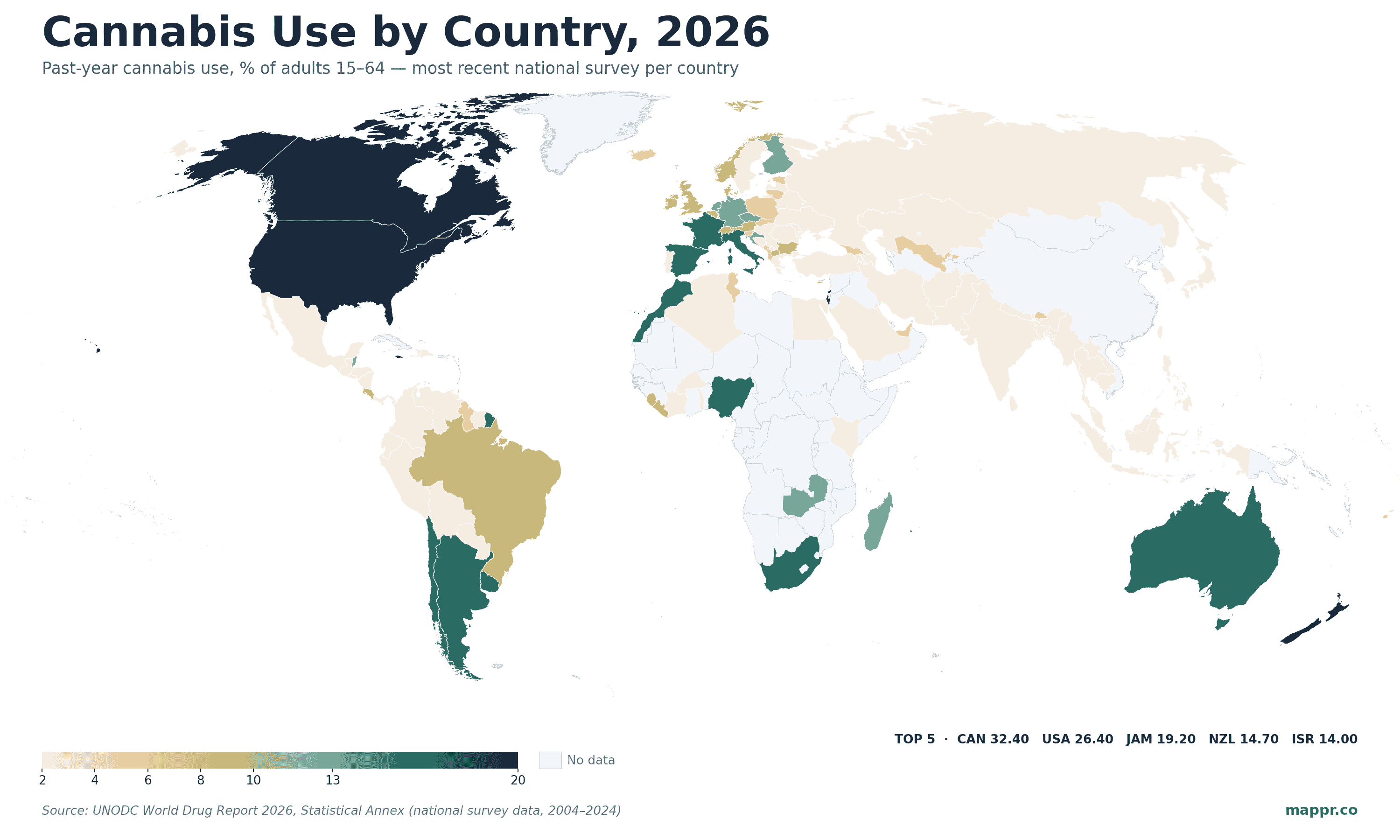
Around 331 million people, or 6.2% of the world’s adults aged 15 to 64, used a drug in 2024, up from 5.2% a decade earlier. The map below shows where drug use is most common, using past-year cannabis prevalence (the world’s most widely used illicit drug) as the clearest proxy, drawn from each country’s most recent national survey.
How many people use drugs?
The 331 million figure is the headline, but the mix matters. Cannabis dominates with about 256 million past-year users worldwide. It is followed by opioids (roughly 63 million), amphetamines and other stimulants (32 million), cocaine (25 million) and ecstasy-type drugs (21 million). The number of cannabis users has grown by roughly 40% over the decade, driven by both population growth and a rising prevalence rate that climbed from 3.8% to 4.8% of the adult population.
Use is also diversifying. UNODC identified 755 new psychoactive substances on the market in 2024, including 118 reported for the first time, a reminder that the menu of drugs is expanding well beyond the traditional plant-based set.
Where cannabis use is highest
On the map, the darkest countries sit in North America. Canada reports the world’s highest past-year cannabis use at about 32% of adults, followed by the United States at 26% and Jamaica at 19%. New Zealand, Israel, Spain and Uruguay round out the top tier between 12% and 15%. It is no coincidence that several of these countries have legalised or decriminalised recreational cannabis: Canada and Uruguay run fully legal national markets, and most U.S. states now permit some form of legal use, which tends to lift both consumption and the willingness of survey respondents to report it.
Most of Western Europe clusters in the middle of the range, with France, Italy and Spain near the top of the continent and the Nordics generally lower. Reported use is lowest across much of Asia and the Middle East, where both genuine prevalence and survey coverage are limited: Japan (0.2%), South Korea, Iran and Saudi Arabia all sit near the bottom.
The record cocaine boom
If one market defines this year’s report, it is cocaine. Global production has more than quadrupled in a decade, from roughly 900 tonnes in 2014 to about 4,100 tonnes in 2024. The supply is overwhelmingly Andean: Colombia alone holds close to two-thirds of the world’s coca, with a record 261,000 hectares under cultivation in 2024, ahead of Peru (about 89,800 hectares) and Bolivia (34,000 hectares). With around 25 million users and demand spreading well beyond the traditional North American and European markets into Africa and Asia, the cocaine trade is now one of the fastest-growing parts of the global drug economy.
The opium map, redrawn
The biggest geographic story is opium. For decades Afghanistan was the source of the overwhelming majority of the world’s opium and heroin. The Taliban’s 2022 cultivation ban changed that almost overnight: Afghan production collapsed from 6,800 tonnes in 2021 to under 300 tonnes by 2025. Into that gap stepped Myanmar, where production has climbed steadily to roughly 1,010 tonnes, making it the world’s largest opium producer for the first time in a generation. Laos and Mexico make up much of the rest.
OPIUM PRODUCTION
The opium map, redrawn
Potential opium production, in tonnes. The Taliban’s 2022 cultivation ban collapsed Afghan output and handed Myanmar the top spot.
| Country | 2021 | 2025 | Change |
|---|---|---|---|
| Afghanistan | 6,800 t | 296 t | ▼ 96% |
| Myanmar | 423 t | 1,010 t | ▲ 139% |
| World total | 7,845 t | 2,110 t | ▼ 73% |
The shift has consequences far beyond Asia. A tighter heroin supply can push users toward synthetic opioids, and it reshapes the trafficking routes that feed Europe and the wider region.
Synthetic drugs and shifting markets
Synthetic drugs are the other engine of change. Methamphetamine production and trafficking have spread into new markets across the Near and Middle East, Africa and parts of Europe, far from the drug’s traditional strongholds in East and Southeast Asia and North America. At the same time, the captagon trade that long centred on Syria was disrupted after the fall of the Assad government in late 2024, pushing prices up sharply in some markets and, UNODC warns, potentially nudging users toward methamphetamine instead.
A note on the data
Drug-use figures are harder to pin down than most health statistics. Countries survey their populations at different times and with different methods, so the map mixes data from as far back as 2004 with results from 2024. A high reported rate can reflect genuinely heavy use, more open reporting in places where a drug is legal, or simply a more recent and thorough survey. The numbers are best read as a guide to broad patterns rather than a precise league table, and gaps on the map mark countries with no recent national survey rather than zero use.
Taken together, the World Drug Report 2026 describes a market that is not only bigger but more fragmented and faster-moving than ever, with production booming, geography shifting and the line between plant-based and synthetic drugs increasingly blurred.