Key Takeaways
- A patchwork, not a floor. 20 states still use the federal $7.25 minimum wage, while 17 states plus Washington, D.C. now sit at $15 an hour or more, a gap of more than $11.
- A July 1 raise wave. Alaska ($13 to $14), Oregon (up to $16.80 in the Portland metro) and Washington, D.C. ($17.95 to $18.40) all lift their statewide floors on July 1, 2026, alongside 20-plus cities and counties.
- D.C. pays the most. At $18.40 an hour from July 1, Washington, D.C. has the highest minimum wage in the country, followed by Washington state ($17.13) and Connecticut ($16.94).
- California's $25 outlier. California's general minimum is $16.90, but its health-care-sector floor reaches $25 an hour for large hospital systems from July 1, the highest industry minimum in the U.S.
There is no single American minimum wage. The federal floor has been frozen at $7.25 an hour since 2009, so for most workers the real number depends entirely on which state, and sometimes which city, they clock in. On July 1, 2026, that map shifts again: Alaska, Oregon and Washington, D.C. raise their statewide rates, and more than 20 local jurisdictions follow. Here is the statutory minimum wage in every state as it stands from July 1, mapped and ranked.
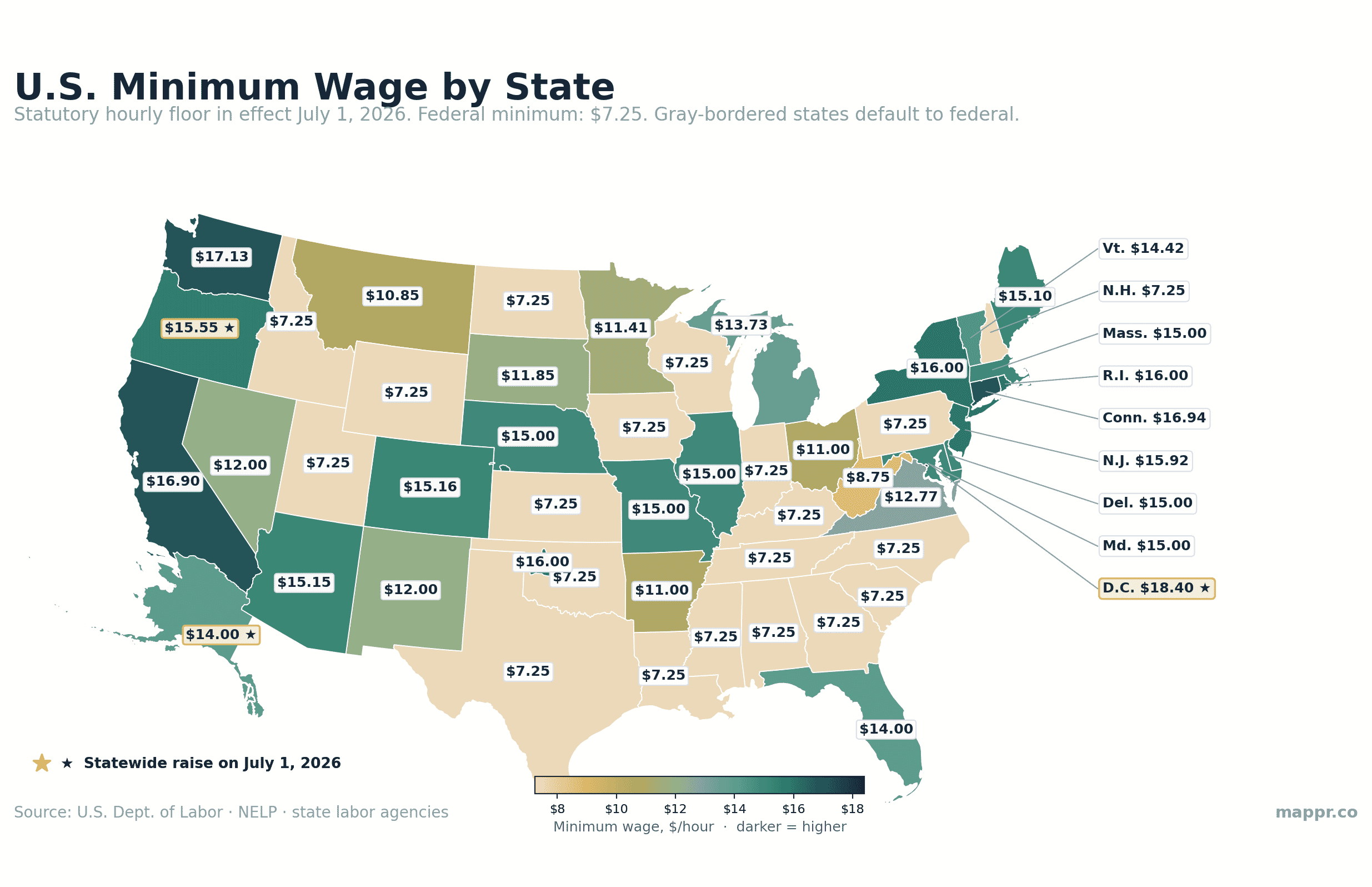
U.S. minimum wage by state, mapped
Darker states pay more. The 20 gray-bordered states have no minimum above the federal $7.25 floor (a handful have no state minimum-wage law at all and default to it). States marked with a gold star raise their statewide rate on July 1, 2026.
The July 1, 2026 raise wave
Three statewide floors move on July 1, along with a long list of cities and counties:
- Alaska: $13.00 to $14.00, the second step of a voter-approved schedule that reaches $15.00 in July 2027.
- Oregon: rates are inflation-indexed each July. The standard rate rises to $15.55, the Portland metro rate to $16.80, and non-urban counties to $14.55.
- Washington, D.C.: $17.95 to $18.40, keeping the District the highest in the nation.
More than 20 local jurisdictions also raise their floors the same day. San Francisco climbs from $19.18 to $19.61, among the highest city minimums anywhere. Separately, California’s industry-specific health-care minimum reaches $25.00 an hour for the largest hospital systems on July 1, the steepest sector floor in the country, even though the state’s general minimum stays at $16.90.
Every state, ranked
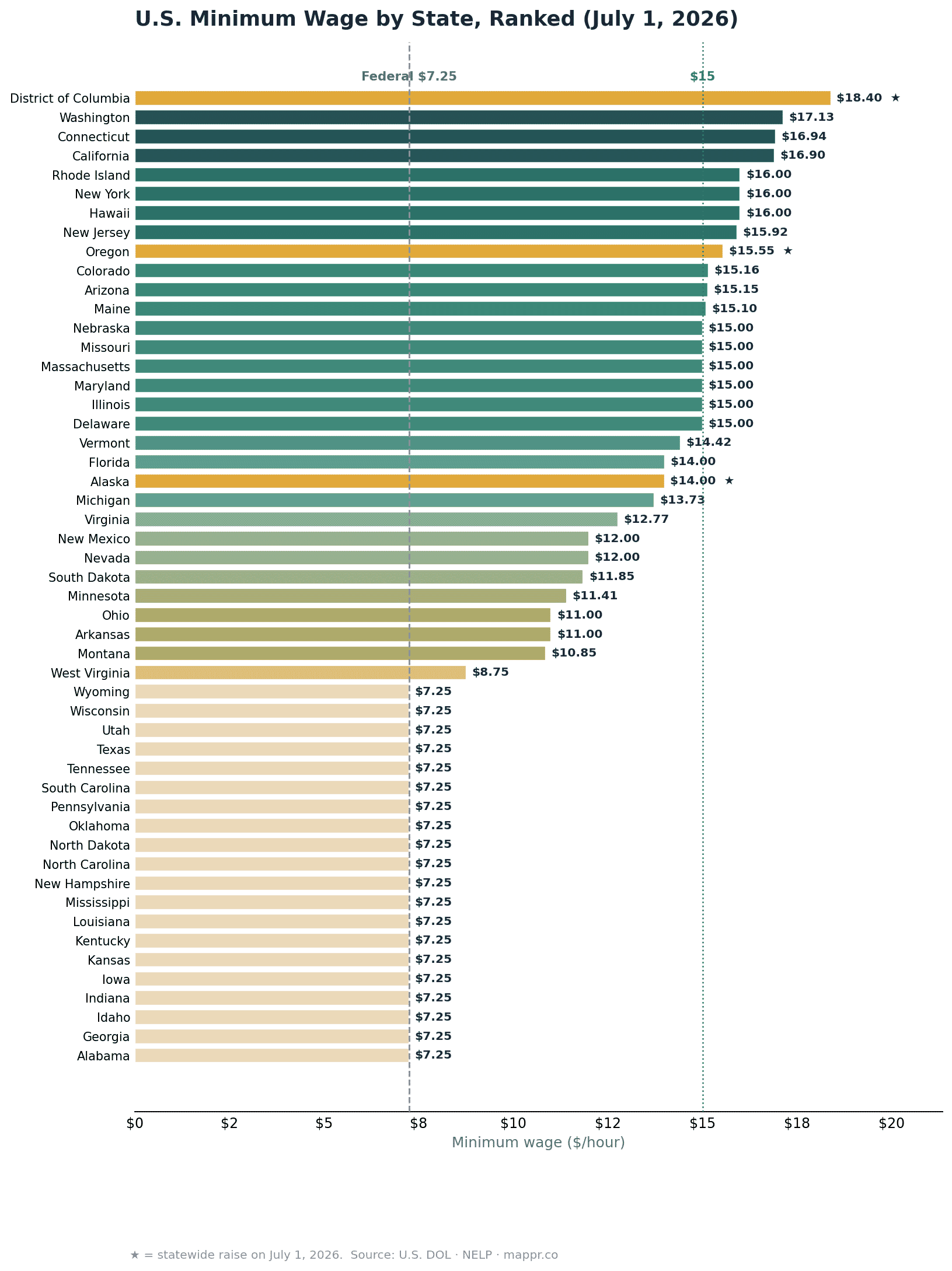
From Washington, D.C. at $18.40 down to the 20 states pinned at the federal $7.25, the spread is more than 2.5 to 1 for the same hour of work. The dashed lines mark the federal floor and the $15 threshold.
The states still at $7.25
Twenty states have a minimum wage no higher than the federal $7.25 an hour: Alabama, Georgia, Idaho, Indiana, Iowa, Kansas, Kentucky, Louisiana, Mississippi, New Hampshire, North Carolina, North Dakota, Oklahoma, Pennsylvania, South Carolina, Tennessee, Texas, Utah, Wisconsin, Wyoming. Five of them (Alabama, Louisiana, Mississippi, South Carolina and Tennessee) have no state minimum-wage law at all, so the federal rate applies by default. Georgia and Wyoming keep a $5.15 state rate on the books, but federally covered employers must still pay $7.25.
The $15-and-up club
At the other end, 17 states plus Washington, D.C. now guarantee at least $15 an hour: District of Columbia ($18.40), Washington ($17.13), Connecticut ($16.94), California ($16.90), Hawaii ($16.00), New York ($16.00), Rhode Island ($16.00), New Jersey ($15.92), Oregon ($15.55), Colorado ($15.16), Arizona ($15.15), Maine ($15.10), Delaware ($15.00), Illinois ($15.00), Maryland ($15.00), Massachusetts ($15.00), Missouri ($15.00), Nebraska ($15.00). Most of these rates are tied to inflation and tick up automatically every January or July, so the bottom of this list keeps rising.
Full table: minimum wage by state
Every state and D.C., with the statutory minimum in effect from July 1, 2026, how far it sits above the federal floor, and whether it rises on July 1. Sortable and searchable.
| Rank | State | Minimum wage ($/hr) | vs. federal $7.25 | July 1, 2026 raise |
|---|---|---|---|---|
| 1 | District of Columbia | $18.40 | +$11.15 | Yes ★ |
| 2 | Washington | $17.13 | +$9.88 | — |
| 3 | Connecticut | $16.94 | +$9.69 | — |
| 4 | California | $16.90 | +$9.65 | — |
| 5 | Hawaii | $16.00 | +$8.75 | — |
| 6 | New York | $16.00 | +$8.75 | — |
| 7 | Rhode Island | $16.00 | +$8.75 | — |
| 8 | New Jersey | $15.92 | +$8.67 | — |
| 9 | Oregon | $15.55 | +$8.30 | Yes ★ |
| 10 | Colorado | $15.16 | +$7.91 | — |
| 11 | Arizona | $15.15 | +$7.90 | — |
| 12 | Maine | $15.10 | +$7.85 | — |
| 13 | Delaware | $15.00 | +$7.75 | — |
| 14 | Illinois | $15.00 | +$7.75 | — |
| 15 | Maryland | $15.00 | +$7.75 | — |
| 16 | Massachusetts | $15.00 | +$7.75 | — |
| 17 | Missouri | $15.00 | +$7.75 | — |
| 18 | Nebraska | $15.00 | +$7.75 | — |
| 19 | Vermont | $14.42 | +$7.17 | — |
| 20 | Alaska | $14.00 | +$6.75 | Yes ★ |
| 21 | Florida | $14.00 | +$6.75 | — |
| 22 | Michigan | $13.73 | +$6.48 | — |
| 23 | Virginia | $12.77 | +$5.52 | — |
| 24 | Nevada | $12.00 | +$4.75 | — |
| 25 | New Mexico | $12.00 | +$4.75 | — |
| 26 | South Dakota | $11.85 | +$4.60 | — |
| 27 | Minnesota | $11.41 | +$4.16 | — |
| 28 | Arkansas | $11.00 | +$3.75 | — |
| 29 | Ohio | $11.00 | +$3.75 | — |
| 30 | Montana | $10.85 | +$3.60 | — |
| 31 | West Virginia | $8.75 | +$1.50 | — |
| 32 | Alabama | $7.25 | At federal floor | — |
| 33 | Georgia | $7.25 | At federal floor | — |
| 34 | Idaho | $7.25 | At federal floor | — |
| 35 | Indiana | $7.25 | At federal floor | — |
| 36 | Iowa | $7.25 | At federal floor | — |
| 37 | Kansas | $7.25 | At federal floor | — |
| 38 | Kentucky | $7.25 | At federal floor | — |
| 39 | Louisiana | $7.25 | At federal floor | — |
| 40 | Mississippi | $7.25 | At federal floor | — |
| 41 | New Hampshire | $7.25 | At federal floor | — |
| 42 | North Carolina | $7.25 | At federal floor | — |
| 43 | North Dakota | $7.25 | At federal floor | — |
| 44 | Oklahoma | $7.25 | At federal floor | — |
| 45 | Pennsylvania | $7.25 | At federal floor | — |
| 46 | South Carolina | $7.25 | At federal floor | — |
| 47 | Tennessee | $7.25 | At federal floor | — |
| 48 | Texas | $7.25 | At federal floor | — |
| 49 | Utah | $7.25 | At federal floor | — |
| 50 | Wisconsin | $7.25 | At federal floor | — |
| 51 | Wyoming | $7.25 | At federal floor | — |
About the data
Rates are the statutory minimum hourly wage in effect on July 1, 2026, from the U.S. Department of Labor’s state minimum-wage tables and the National Employment Law Project’s 2026 tracker. Where a state sets regional rates (Oregon, New York), the map shows the standard statewide floor; the higher metro rates are noted in the text. Many cities and counties set their own, higher minimums that are not reflected in the state map. Florida’s minimum rises again to $15.00 on September 30, 2026. Tipped-wage minimums differ and are not shown here.