Key Takeaways
- July 4 is just the start. The United States celebrates independence from Great Britain on 4 July 1776 — but more than 150 countries mark an independence day of their own.
- Britain looms largest. 61 countries celebrate independence from the United Kingdom — more than from any other power — followed by France (30), the Soviet Union/Russia (24) and Spain (22).
- 1960 was the Year of Africa. 18 countries became independent in 1960 alone, part of a wave that saw 58 nations gain independence between 1956 and 1970.
- August is peak season. August (29 countries), July (27) and September (25) host the most national independence days.
- Some have none. Old, never-colonised states — the UK, France, Japan, China, much of Western Europe — have no single independence day at all.
Every 4 July, the United States lights up the sky to mark its independence from Great Britain in 1776. But the US is far from alone: more than 150 countries around the world celebrate an independence day of their own — a date marking the moment they broke away from an empire, a union or a colonial ruler.
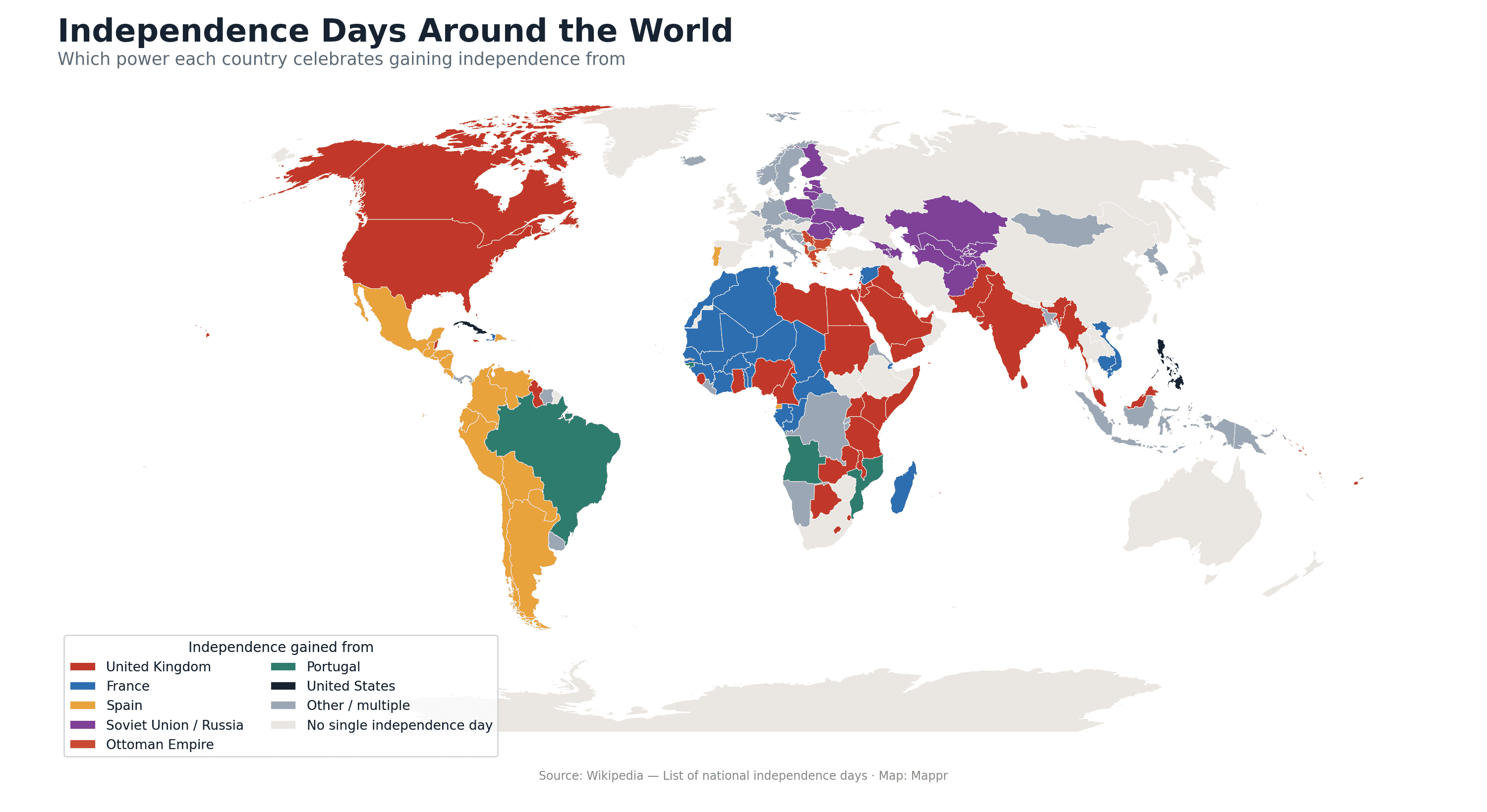
We mapped them all. The map below colours each country by the power it gained independence from — and the result is a vivid portrait of five centuries of empire, colonisation and the great 20th-century wave of decolonisation.
The British Empire’s long shadow
No power appears more often than the United Kingdom: 61 countries celebrate independence from Britain, from the United States and India to Nigeria, Egypt, Jamaica and Australia’s Pacific neighbours. It’s the cartographic echo of an empire on which, famously, the sun never set. The United States was the first to break away (1776); the bulk of the rest followed in the 20th century as the empire wound down after the Second World War.
France, the Soviet Union, Spain and the rest
France is next with 30 countries — a band stretching across West and Central Africa plus former Indochina. The Soviet Union and Russia account for 24: the post-1991 republics from the Baltic states to Central Asia, which all mark their break from Moscow. Spain follows with 22, almost entirely in Latin America, where a chain of revolutions in the early 1800s ended three centuries of Spanish rule.
Smaller but distinct clusters round out the map: the Ottoman Empire (9, across the Balkans and Middle East), Portugal (8, including Brazil, Angola and Mozambique) and the United States itself (5, led by the Philippines). Dozens more trace their independence to break-ups of federations such as Yugoslavia and Czechoslovakia, or to other colonial powers like the Netherlands and Belgium.
1960: the Year of Africa
If the map has an epicentre, it’s Africa in the mid-20th century. 1960 alone — the “Year of Africa” — saw 18 countries become independent, most of them French colonies. Zoom out a little and the scale is staggering: 58 nations gained independence between 1956 and 1970, redrawing the political map of the world in barely 15 years. It was the fastest dismantling of empires in human history.
When are independence days?
Independence days cluster in the second half of the year. August is the single most common month (29 countries), just ahead of July (27) and September (25) — a pattern driven largely by the timing of mid-20th-century decolonisation. The US’s 4 July sits within that July peak, sharing the date (give or take) with several others, including a clutch of former colonies that timed their handovers to the calendar.
The countries with no independence day
Not every country has one. The world’s oldest continuous states — the United Kingdom, France, Japan, China, Sweden, Denmark and much of Western Europe — were never colonised in the modern sense and have no single independence day. Instead they tend to celebrate national days tied to a monarch, a constitution or a unification. On our map, these appear in grey: places whose national story simply doesn’t start with a break from someone else.
So when the fireworks go up over America this 4 July, remember it’s the opening act of a global calendar. From the Year of Africa to the fall of the Soviet Union, almost every nation has its own date — and its own story of how it came to rule itself.