
Key Takeaways
- 2026 is the biggest wave yet. More European cities and countries are introducing or raising overnight tourist taxes in 2026 than in any year before, as destinations push back against overtourism.
- Amsterdam charges the most. At 12.5% of the room price, Amsterdam has Europe's steepest tourist tax, working out to roughly €18 per person per night.
- Brand new for 2026. Norway introduced its first-ever national overnight levy (up to 3%), and Edinburgh launches a 5% room tax on 24 July 2026, the first in the UK.
- Rising fast. Vienna is moving from 3.2% toward 5% (and 8% in 2027), Barcelona's rate has roughly doubled to about €15, and Greece added a climate-resilience fee of up to €15 a night.
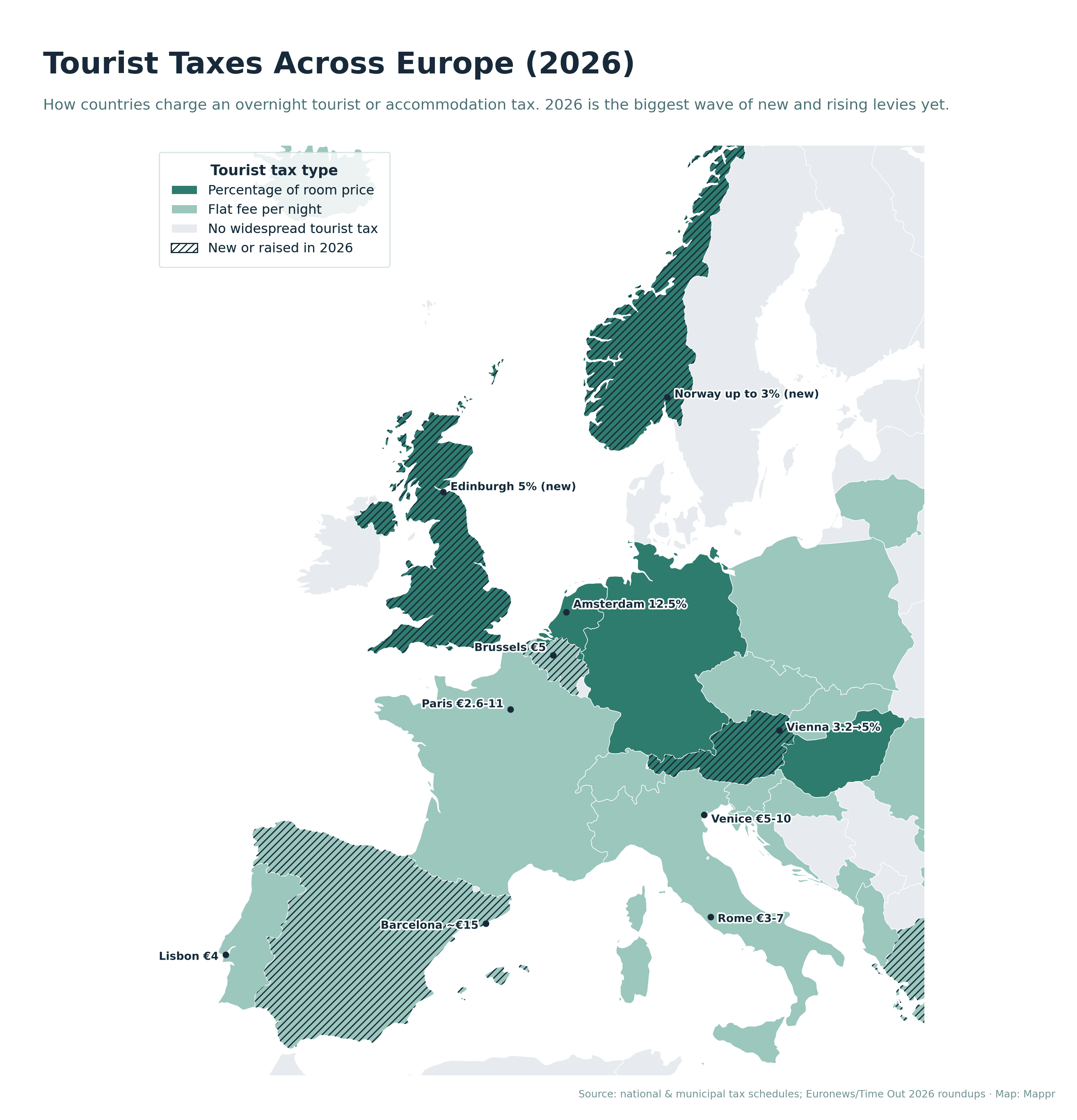
- Flat fee or percentage. Most countries charge a flat fee per night (often by hotel star), while the Netherlands, Germany, Austria, Norway and Scotland take a percentage of the room price.
If you are travelling in Europe in 2026, expect to pay a little extra at checkout. A growing number of countries and cities now charge an overnight tourist tax (sometimes called a city tax, accommodation tax or visitor levy) on top of your hotel bill, and 2026 is the biggest wave of new and rising taxes yet. From Norway introducing its first-ever national levy to Edinburgh launching a 5% room tax, the map is changing fast. Here is what every major country and city now charges per night.
Flat fees vs percentages: how the taxes work
Tourist taxes come in two main forms. Most countries charge a flat fee per person per night, often scaled by hotel star rating, city zone or season. Italy, France, Spain, Portugal, Greece and Belgium all work this way. A smaller group charges a percentage of the room price, which can add up quickly on a pricey booking. The Netherlands (12.5%), Germany and Berlin (5%), Austria, Norway and Scotland all use the percentage model. Either way, the charge is usually collected by your hotel and added to the final bill, and many places cap it after a set number of nights or exempt children.
What cities charge in 2026
Here are the headline tourist tax rates for Europe’s major destinations in 2026. The table is sortable and searchable.
| Place | 2026 rate | Tax type | 2026 change |
|---|---|---|---|
| Amsterdam (Netherlands) | 12.5% of room price (about €18/night) | Percentage | Highest in Europe |
| Athens & Greece (national) | €1.50 to €15/night by season & category | Flat fee | New climate fee, 2026 |
| Barcelona (Spain) | Up to about €15/night | Flat fee | Raised in 2026 |
| Venice (Italy) | €5 to €10/day for day visitors | Day-tripper fee | Expanded in 2026 |
| Paris (France) | €2.60 to €11.38/night by class | Flat fee | — |
| Milan (Italy) | €4 to €10/night by hotel star | Flat fee | — |
| Rome (Italy) | €3 to €7/night by hotel star | Flat fee | — |
| Vienna (Austria) | 3.2% of the bill (rising to 5%) | Percentage | Rising in 2026 |
| Edinburgh (UK) | 5% of the room rate | Percentage | New from 24 July 2026 |
| Berlin (Germany) | 5% of the room rate | Percentage | — |
| Brussels (Belgium) | €5 per room/night | Flat fee | Raised in 2026 |
| Lisbon (Portugal) | €4/night | Flat fee | Raised in 2026 |
| Norway (national) | Up to 3% in tourism-stressed areas | Percentage | New in 2026 |
| Bucharest (Romania) | About €2/night (10 lei) | Flat fee | New |
New and rising in 2026
Several changes make 2026 a landmark year:
- Norway introduced its first-ever national framework, letting municipalities in tourism-stressed areas add up to 3% on overnight stays.
- Edinburgh launches a 5% “Transient Visitor Levy” on 24 July 2026, the first tourist tax in the UK, capped at seven nights.
- Vienna is phasing its levy up from 3.2% toward 5% in mid-2026, and 8% in 2027.
- Greece added a climate-resilience fee of €1.50 to €10 (up to €15 in 5-star hotels in peak season).
- Brussels raised its rate to €5 per room per night from January 2026.
- Barcelona roughly doubled its city surcharge, taking the combined nightly charge to about €15.
Why tourist taxes are rising
The surge is closely tied to overtourism. On 15 June 2026, coordinated anti-tourism protests swept more than 40 cities across southern Europe, from Barcelona and Venice to Lisbon and Palermo, with residents complaining that mass tourism is driving up rents and hollowing out neighbourhoods. Cities argue the taxes help fund the public services, cleaning and infrastructure that visitors use, and increasingly that they pay for climate resilience and crowd control. With record visitor numbers, expect more destinations to follow.
Where there is no tourist tax
A handful of European countries still have no widespread overnight tourist tax, including Ireland, Denmark, Sweden, Finland, Luxembourg and the Baltic states. But the direction of travel is clear: with Scotland and Norway joining in 2026 and Wales preparing its own levy, the list of tax-free destinations keeps shrinking.
The bottom line
Tourist taxes are now a normal part of travelling in Europe, and in 2026 they are higher and more widespread than ever. The amounts are still modest next to the cost of a flight or hotel, usually a few euros a night, but on a percentage basis in cities like Amsterdam they add a real premium. It pays to check the local rate before you book, because the price you see is rarely the price you pay.
Data and references (national & municipal tax schedules, current as of June 2026):