Key Takeaways
- Over 1.6 million cases in the Americas. Through epidemiological week 34 of 2026, PAHO had recorded 1,626,962 suspected dengue cases in the Americas, with 3,218 severe cases and 521 deaths. PAHO is still running a Grade-3 multi-country outbreak response, its highest emergency level.
- Brazil dominates. Brazil accounts for 1,262,783 cases, about four-fifths of the regional total. It is one of five countries (with Venezuela, Mexico, Panama and Colombia) reporting all four dengue serotypes at once.
- Down 57% from 2025. As large as it is, the 2026 outbreak is 57% smaller than the same period in 2025 and 64% below the five-year average, and weekly counts have fallen steeply since February.
- Sri Lanka is Asia's hotspot. Sri Lanka (82,007 by late July), Indonesia (58,357), Malaysia (over 50,000) and Vietnam (41,684) lead a long list of Asian and Pacific countries reporting dengue in 2026.
- 90+ countries worldwide. ECDC counted dengue in more than 90 countries and territories between January and July 2026, with over 1.5 million cases and more than 500 deaths reported globally.
- Florida's local cluster grows. Florida has logged 190 locally acquired dengue cases in 2026, 170 of them in Hillsborough County around Tampa. On 19 September the state confirmed its first dengue death of 2026, an 80-year-old Hillsborough woman.
Latest update · 25 September 2026
First death confirmed: on 19 September the Florida Department of Health confirmed that dengue killed a Hillsborough County woman. It is the state’s first dengue death of 2026.
Florida: locally acquired dengue has climbed to 190 cases for 2026, after 38 new cases in the week of 13 to 19 September. Hillsborough County now accounts for 170 of them.
Mosquitoes: Florida’s 17th dengue-positive mosquito pool of 2026 was collected in Pasco County, the first found outside Hillsborough.
Americas: PAHO’s week-34 report (18 September) puts the region at 1,626,962 suspected cases, 3,218 severe cases and 521 deaths, now down 57% on 2025.
Dengue remains a region-wide emergency in the Americas. The Pan American Health Organization (PAHO) is running a Grade-3 multi-country outbreak response, its highest level, after the region logged 1,626,962 suspected dengue cases, 3,218 severe cases and 521 deaths through epidemiological week 34 of 2026.
The curve has turned, though. Week 34 added 24,381 new suspected cases, a fraction of the February peak, and the year to date runs 57% below 2025. Spread by the Aedes aegypti mosquito, dengue is now a year-round, multi-continent threat.
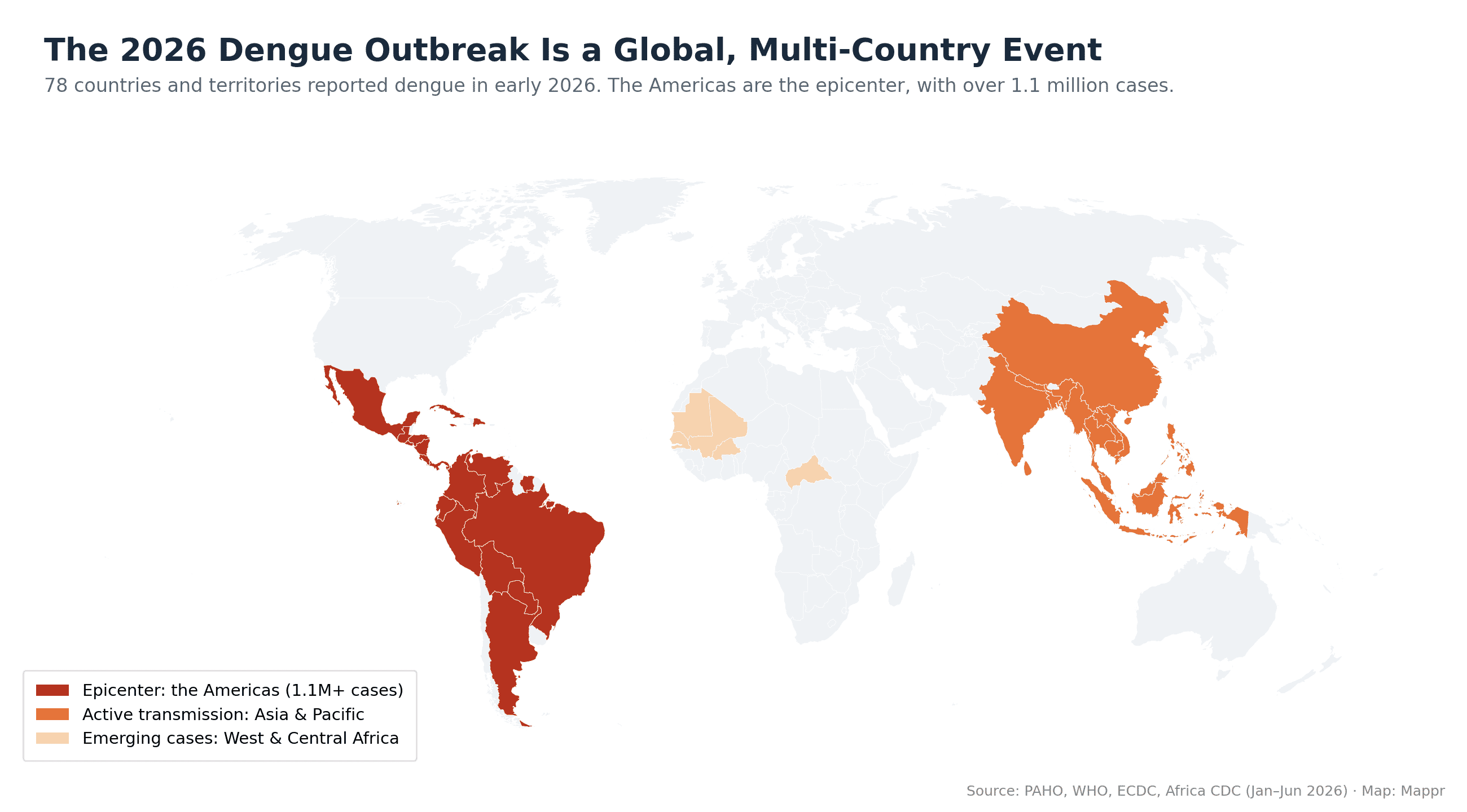
It is not just the Americas. The European CDC counted dengue in more than 90 countries and territories worldwide between January and July 2026, with over 1.5 million cases and more than 500 deaths reported globally. The map below shows the global picture, with the Americas as the clear epicenter.
What is dengue, and how dangerous is it?
Dengue is a viral infection spread to people through the bite of an infected Aedes mosquito, mainly Aedes aegypti. It does not spread directly from person to person. There are four closely related types of the virus (DENV-1 to DENV-4), and recovering from one gives only short-term protection against the others, which is why people can catch dengue more than once.
Most infections are mild or cause no symptoms at all. When symptoms do appear, usually 4 to 10 days after a bite, they typically include:
- High fever (often 40°C / 104°F)
- Severe headache and pain behind the eyes
- Intense muscle, bone and joint pain, which earns dengue its nickname “breakbone fever”
- Nausea, vomiting, swollen glands and a skin rash
Most people recover within one to two weeks. The danger comes from severe dengue, which develops in a small share of cases (roughly 1 in 20 symptomatic patients). Warning signs such as severe belly pain, persistent vomiting, bleeding gums and rapid breathing can signal plasma leakage, internal bleeding and organ failure. Severe dengue is a medical emergency that can kill within hours if untreated, and the risk is higher on a second infection with a different serotype.
There is no specific antiviral cure; treatment is supportive, mainly fluids and careful monitoring, which is why early care matters so much. With prompt hospital treatment the case fatality rate is well under 1%, but it climbs sharply where health systems are overwhelmed. Two dengue vaccines now exist, and the best protection remains avoiding mosquito bites and clearing the standing water where the mosquitoes breed. The World Health Organization estimates that about half the world’s population now lives at risk of dengue, with up to 400 million infections a year.
The Americas are the epicenter
Through epidemiological week 34 of 2026, PAHO recorded 1,626,962 suspected cases across 45 reporting countries and territories, of which 496,051 (30.5%) were laboratory-confirmed. Severe dengue accounted for 3,218 of those cases, and 521 people have died, a case fatality rate of 0.032%.
Brazil alone accounts for 1,262,783 cases, about four-fifths of the regional total. It is now one of five countries, with Venezuela, Mexico, Panama and Colombia, where all four dengue serotypes circulate simultaneously, which raises the risk of severe disease.
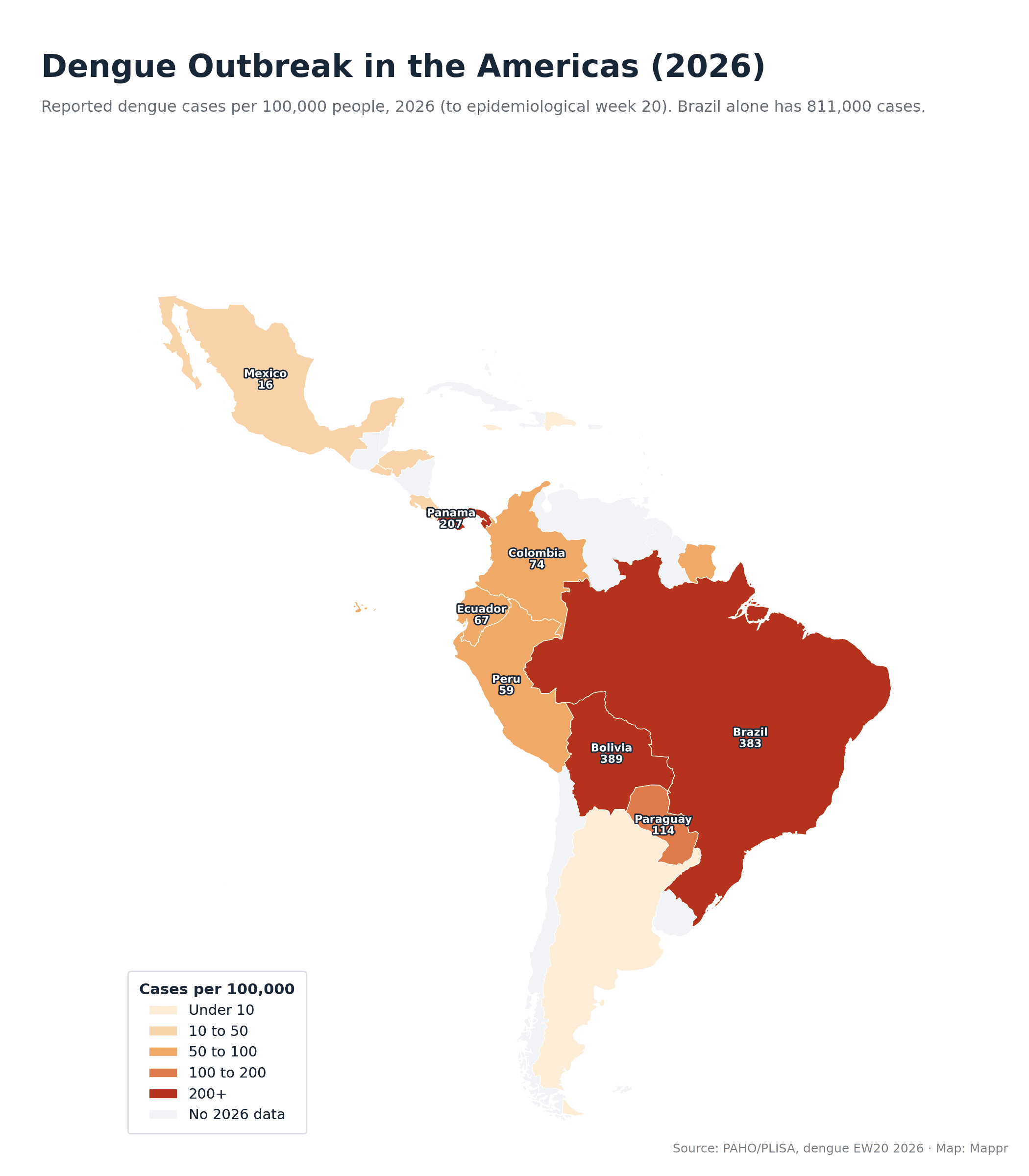
Adjusted for population, the picture shifts. The map below is a snapshot to epidemiological week 20, when Bolivia (389 per 100,000) edged out Brazil (383) for the most intense outbreak among the larger nations, with Panama and Paraguay also running high.
Cases have kept climbing since, and unevenly: Mexico (46,200) and Peru (49,691) have both more than doubled their cumulative counts, Colombia (74,970) is up about four-fifths and Brazil about half. Region-wide incidence now stands at 156 cases per 100,000 people.
Beyond the Americas: Asia and the Pacific
Dengue is endemic across much of tropical Asia and the Pacific, where transmission runs year-round. By late July 2026, Sri Lanka had become the region’s hotspot with 82,007 cases, roughly 2.5 times its 2025 pace, and weekly counts still above 6,000.
Indonesia reported 58,357 cases in the first half of the year, and Malaysia passed 50,000 by early August. Vietnam logged 41,684 cases from January to June, and Cambodia reached 28,074 by mid-July, well ahead of the 17,760 it had recorded a year earlier.
In South Asia, India reported 22,938 cases to the end of June and Bangladesh 15,310 to 31 July, with Bangladeshi cases rising every month since April but still below 2025 levels.
Trends diverge among the smaller reporting countries. Timor-Leste, one of the sharpest risers early in the year, has declined month on month since April. New Caledonia (2,202 cases to 19 July) has also eased since mid-April.
Singapore stayed low at 1,656 cases to 25 July, and China reported 255 cases in June, though that is 13% above June 2025. Laos counted 2,647 cases to 18 July, down about 27% year on year.
Africa: an expanding frontier
Dengue is harder to track in Africa, where surveillance is thinner and the disease is often confused with malaria, so reported numbers almost certainly understate the true burden.
Africa CDC counted 3,650 cases across six countries up to 19 July 2026. Mali leads with 1,861 cases, followed by Kenya (1,583), Nigeria (95), Senegal (72), Mauritania (38) and the Central African Republic (1).
Kenya’s cluster is the notable change: it was not among the reporting countries earlier in the year, and it puts East Africa alongside the Sahel on the continent’s dengue map. Public-health agencies warn that the Aedes mosquito’s range is still expanding across both.
Dengue cases by country worldwide
The table below brings together the affected countries across all regions, ranked by reported 2026 cases. Sort or filter by region to compare.
Americas figures are cumulative to epidemiological week 34 (PAHO, 18 September 2026). Countries that did not report that week are shown at their last published 2026 total, which in some cases is several months old.
Asia, Pacific and Africa figures come from the ECDC worldwide overview published in August 2026, covering 1 January to 31 July (WHO, ECDC and Africa CDC data). Figures are not directly comparable across regions.
| Country | Region | Reported cases (2026) |
|---|---|---|
| Brazil | Americas | 811,075 |
| Bolivia | Americas | 48,240 |
| Colombia | Americas | 39,395 |
| Vietnam | Asia & Pacific | 27,365 |
| Mexico | Americas | 20,636 |
| Peru | Americas | 20,107 |
| Sri Lanka | Asia & Pacific | 13,760 |
| Ecuador | Americas | 12,078 |
| Malaysia | Asia & Pacific | 11,340 |
| Panama | Americas | 9,331 |
| Paraguay | Americas | 7,876 |
| Indonesia | Asia & Pacific | 6,872 |
| India | Asia & Pacific | 6,563 |
| Cambodia | Asia & Pacific | 4,338 |
| Timor-Leste | Asia & Pacific | 3,386 |
| Honduras | Americas | 3,194 |
| Thailand | Asia & Pacific | 3,191 |
| El Salvador | Americas | 1,923 |
| Bangladesh | Asia & Pacific | 1,870 |
| Martinique | Americas | 1,294 |
| Costa Rica | Americas | 907 |
| Laos | Asia & Pacific | 703 |
| Maldives | Asia & Pacific | 646 |
| Mali | Africa | 589 |
| Suriname | Americas | 416 |
| Dominican Republic | Americas | 413 |
| Guadeloupe | Americas | 349 |
| Singapore | Asia & Pacific | 322 |
| China | Asia & Pacific | 187 |
| Jamaica | Americas | 103 |
| United States (Florida)* | Americas | 73 |
| Grenada | Americas | 60 |
| Argentina | Americas | 51 |
| Barbados | Americas | 38 |
| Senegal | Africa | 35 |
| Mauritania | Africa | 33 |
| Central African Republic | Africa | 1 |
Big, but far below 2025’s record
For all its scale, the 2026 outbreak in the Americas is 57% smaller than the same period in 2025 and 64% below the five-year average, PAHO reported on 18 September. Regional incidence stands at 156 cases per 100,000 people.
That is because 2024 and 2025 were extraordinary: the Americas shattered all previous records, driven by an intense El Niño, high temperatures and the spread of the mosquito into new areas. The 2026 numbers are a partial retreat from that peak, not a sign that dengue is going away.
Why dengue keeps surging
The long-term trend is upward. A warming climate is extending the range and active season of the Aedes aegypti and Aedes albopictus mosquitoes that carry the virus, pushing dengue into higher altitudes and new countries. Rapid, unplanned urbanization creates ideal breeding sites in standing water, and increased global travel moves the virus and its four serotypes between regions. Because catching one serotype offers little protection against the others, large populations remain vulnerable year after year.
The United States: Florida’s unusual summer
Dengue is no longer just an import in the mainland United States. Florida has recorded 190 locally acquired cases in 2026, meaning infections picked up from mosquitoes inside the state, not abroad. That is up from 152 a week earlier: the state’s surveillance report for 13 to 19 September, published on 24 September, added 38 local cases.
The outbreak is unusually concentrated. Hillsborough County (the Tampa area) accounts for 170 of the 190 cases, an unprecedented cluster far from the state’s traditional Miami-area transmission. Miami-Dade (7), Pinellas (7), Orange (3), Pasco (2) and Palm Beach (1) make up the rest.
Almost all of it is a single serotype: 169 of the 171 cases serotyped so far are DENV-2, the other two being DENV-3 in Miami-Dade. Onsets cluster in August (139 cases), with 21 in July and 30 in September.
Florida has now logged 17 dengue-positive mosquito pools in 2026. The newest, reported in the week of 13 to 19 September, came from Pasco County: the first found outside Hillsborough, where the other 16 were collected.
Duval, Hillsborough, Miami-Dade, Orange and Pinellas counties are under a mosquito-borne illness alert. Alachua, Brevard, Leon, Palm Beach, Pasco and Walton counties are under the lower-level advisory.
The counts are small next to Latin America’s, but the trend is exactly what the climate models predict: the Aedes aegypti mosquito’s range is creeping north, and with it, local transmission.
*In the table below, the United States row counts locally acquired cases only. Florida has separately reported 212 travel-associated dengue cases in 2026. Thanks to the sharp-eyed reader who pointed out the gap.
Florida’s first dengue death of 2026
On 19 September the Florida Department of Health confirmed that the Hillsborough County resident it had been investigating did die of dengue. It is the state’s first dengue death of 2026, and reportedly the Tampa Bay area’s first in close to a century.
The woman was Gay Small, who died at Tampa General Hospital on 4 September, her 80th birthday. Her death certificate lists dengue infection alongside septic shock and multi-organ failure.
Her family says she was bitten near her home on Bayshore Boulevard in South Tampa, and believes an earlier infection abroad left her vulnerable to severe disease on reinfection. The health department, citing privacy rules, has released no further detail.
The bottom line
The 2026 dengue outbreak is a genuinely global event, with the Americas, led by Brazil, at its center and active transmission stretching from Sri Lanka to Mali to the suburbs of Tampa.
Regionally the curve is falling: cases are down 57% on 2025’s catastrophic record. But more than 1.6 million infections have been logged in the Americas by week 34, and Florida’s cluster is still growing and has now killed someone.
Data and references (latest available as of 25 September 2026):