
Key Takeaways
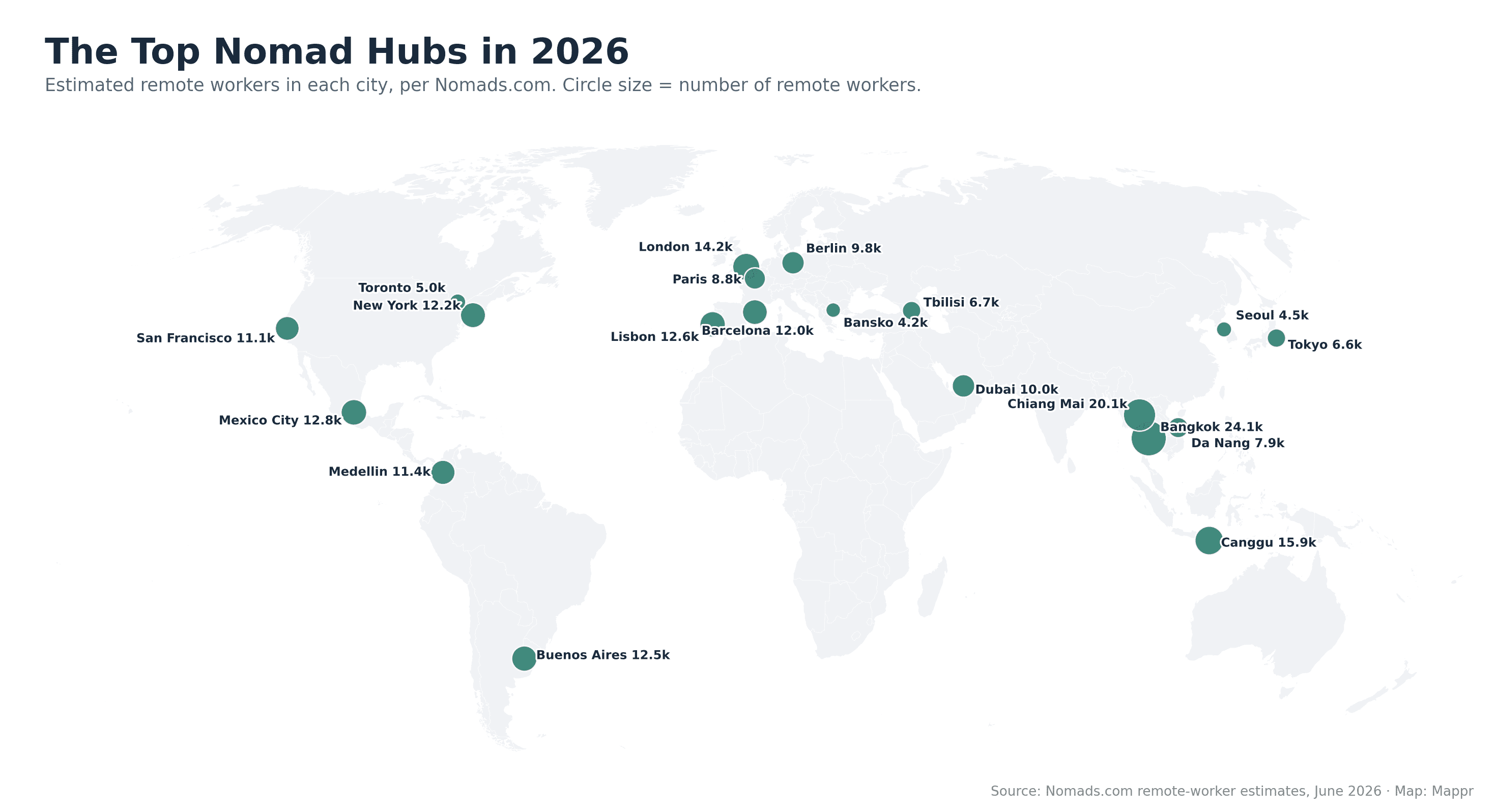
- Bangkok leads, Thailand dominates. Bangkok has the most remote workers of any hub (about 24,100), and fellow Thai city Chiang Mai is second with around 20,100, per Nomads.com.
- Bali's Canggu is third. Canggu in Bali (about 15,900) keeps Southeast Asia firmly on top, taking three of the top three spots.
- London is Europe's biggest. London (around 14,200) leads Europe, ahead of Lisbon, Barcelona, Berlin and Paris.
- Latin America is booming. Mexico City, Buenos Aires and Medellin all rank in the top 10, reflecting the surge of remote workers heading to Latin America.
Where are the world’s digital nomads actually based right now? Nomads.com (the community formerly known as Nomad List) estimates how many remote workers are living in each city, which makes it one of the best gauges of nomad hotspots. We pulled those estimates for 20 of the most popular cities in June 2026 and mapped them. The result is a clear picture of where the remote-work crowd is clustering this year.
The 20 top nomad hubs in 2026
Here are the 20 cities ranked by their estimated remote-worker population on Nomads.com. The table is sortable and searchable.
| Rank | City | Country | Remote workers |
|---|---|---|---|
| 1 | Bangkok | Thailand | 24,103 |
| 2 | Chiang Mai | Thailand | 20,130 |
| 3 | Canggu (Bali) | Indonesia | 15,880 |
| 4 | London | United Kingdom | 14,250 |
| 5 | Mexico City | Mexico | 12,829 |
| 6 | Lisbon | Portugal | 12,632 |
| 7 | Buenos Aires | Argentina | 12,486 |
| 8 | New York City | United States | 12,200 |
| 9 | Barcelona | Spain | 11,973 |
| 10 | Medellin | Colombia | 11,400 |
| 11 | San Francisco | United States | 11,088 |
| 12 | Dubai | UAE | 9,955 |
| 13 | Berlin | Germany | 9,850 |
| 14 | Paris | France | 8,786 |
| 15 | Da Nang | Vietnam | 7,929 |
| 16 | Tbilisi | Georgia | 6,660 |
| 17 | Tokyo | Japan | 6,600 |
| 18 | Toronto | Canada | 5,035 |
| 19 | Seoul | South Korea | 4,530 |
| 20 | Bansko | Bulgaria | 4,200 |
Southeast Asia is the nomad capital
Southeast Asia takes all three top spots. Bangkok leads the world with around 24,100 remote workers, thanks to cheap living, superb street food, fast internet, a huge coworking scene and an airport that connects the whole region. Chiang Mai, the original budget hub that helped start the movement, is second with about 20,100, and Bali’s Canggu (around 15,900) is third, still the archetypal nomad village of cafes and surf. Vietnam’s Da Nang rounds out the region further down the list.
Europe’s nomad magnets
London is Europe’s biggest hub (around 14,200), despite its high costs, followed by Lisbon and Barcelona, each with roughly 12,000, then Berlin and Paris. Further east and on a smaller scale, Tbilisi in Georgia is a favourite for its year-long visa-free stay, and the Bulgarian mountain town of Bansko has reinvented itself as a winter nomad hub built around an annual festival.
Latin America’s surge, plus the Gulf and East Asia
Latin America is the year’s big story, with Mexico City (about 12,800), Buenos Aires (12,500) and Medellin (11,400) all in the top 10, plus San Francisco, New York and Toronto keeping North America well represented. Dubai anchors the Gulf with its remote-work visa and tax-free income, while Tokyo and Seoul draw nomads willing to trade lower costs for world-class cities.
How we ranked them
The figures are Nomads.com’s estimate of how many remote workers are based in each city, as shown on its city pages in June 2026. These are modelled estimates rather than an official census, and they shift with the seasons, so they are best read as a guide to which cities have the largest remote-work communities right now, not a precise headcount.
The bottom line
In 2026, the digital nomad map still tilts toward Southeast Asia, led by Bangkok, Chiang Mai and Bali, with London topping Europe and Latin America surging up the table. Cheap living, fast internet, warm weather and welcoming visa rules remain the winning formula, and the hubs that offer all four keep pulling in the remote-work crowd.
Data and references (Nomads.com remote-worker estimates, June 2026):