Key Takeaways
- 39 countries restricted. Presidential Proclamation 10998 took effect on January 1, 2026. It fully bars visa issuance for nationals of 19 countries and partially restricts 20 more.
- A separate, wider net. A distinct order effective January 21, 2026 paused immigrant-visa processing for nationals of 75 countries pending a review of “public charge” welfare risk. Twenty-three of the ban countries overlap.
- The courts pushed back. On June 5, 2026 a federal judge in Rhode Island vacated four USCIS benefit-freeze policies nationwide. Crucially, that ruling did not lift the entry ban or the State Department's consular visa pause.
- A clear geography. Full bans cluster across Africa and the Middle East, while the immigrant-visa freeze reaches deep into Latin America, the Caribbean, Eastern Europe and South Asia.
For years the map of global visa rules has been drawn from the traveller’s point of view: which passports open the most borders, where you can get a digital nomad visa, what a tourist visa costs. In 2026 the United States has redrawn a different map, one defined not by where you want to go but by the passport you already hold.
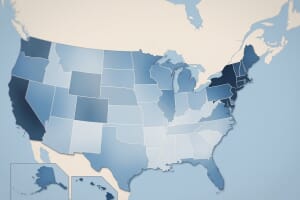
Three overlapping measures now determine whether a foreign national can get a U.S. visa at all, based purely on nationality. A full entry ban covers 19 countries. A partial ban covers 20 more. And a separate immigrant-visa freeze, justified on welfare-cost grounds, sweeps in 75 countries. The map below shows how those layers stack up across the world.
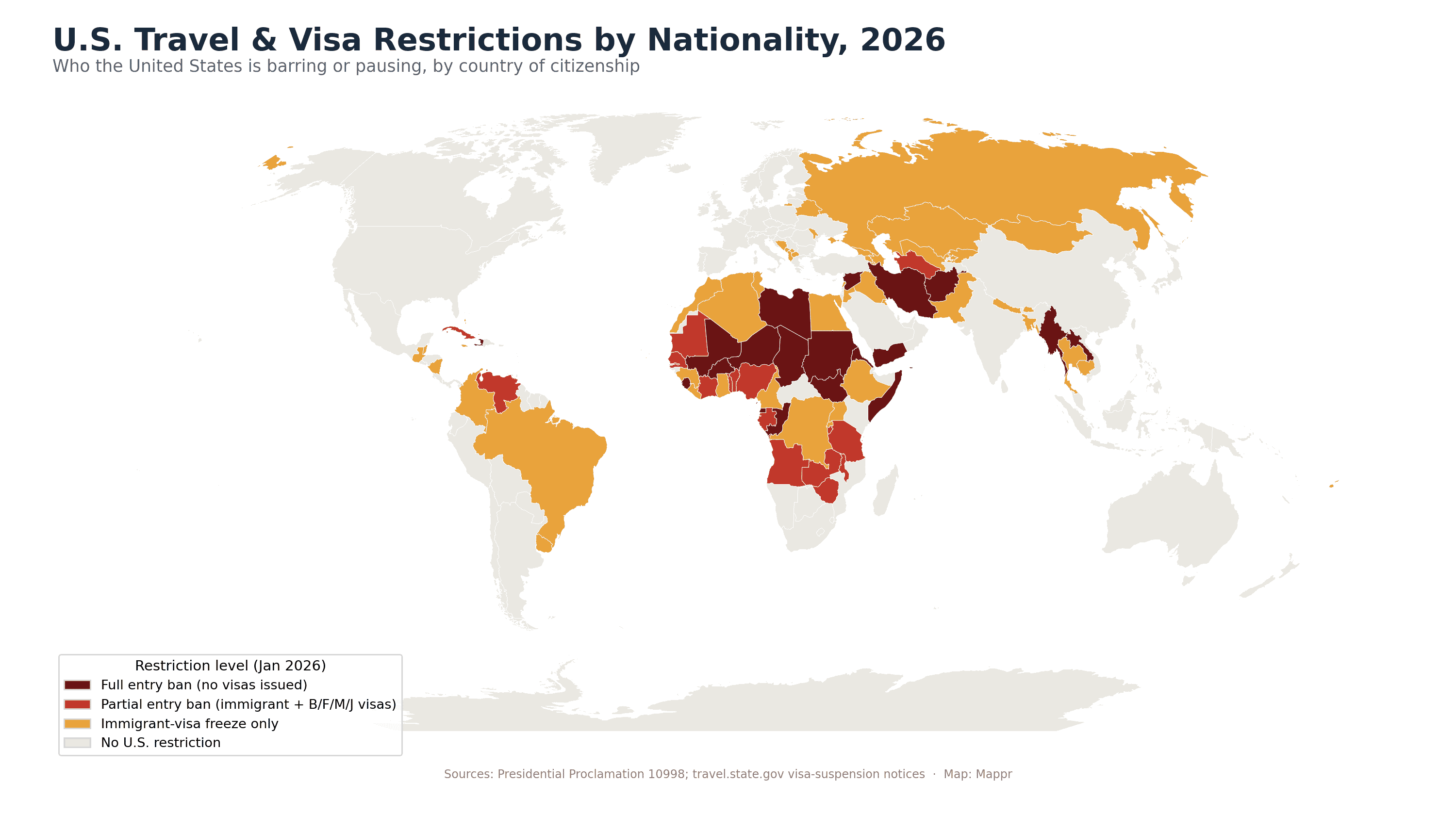
How the U.S. is restricting entry by nationality in 2026
The restrictions are not a single policy but three separate actions that landed within weeks of each other in early 2026. They differ in legal basis, in which visas they touch, and in how many countries they reach, which is why so many people have been confused about who, exactly, is affected.
🚫 Full visa suspension: 19 countries
For nationals of 19 countries, the State Department has suspended issuance of every immigrant and nonimmigrant visa category. In practice that means no tourist, student, work or family visas at all. The list is heavily concentrated in conflict-affected and sanctioned states, including Afghanistan, Iran, Somalia, Syria, Yemen, Libya, Sudan and Haiti. Travellers using documents issued by the Palestinian Authority face the same full suspension.
⚠️ Partial suspension: 20 countries
A second tier partially suspends visas for 20 countries. For most of them the block covers all immigrant visas plus the most common nonimmigrant categories: visitor visas (B-1/B-2) and student and exchange visas (F, M and J). Other categories, such as certain temporary work visas, can still be processed. This tier includes Nigeria, Venezuela, Cuba, Senegal and Zimbabwe. Turkmenistan is a special case: only its immigrant visas are suspended, with the visitor and student categories left open.
The 39 countries under the entry ban, by restriction level
The 19 fully suspended countries appear first, followed by the 20 under partial suspension. The final column shows exactly which visa categories are blocked.
| Country | Restriction | Visa categories blocked |
|---|---|---|
| 🇦🇫 Afghanistan | Full ban | All immigrant & nonimmigrant visas |
| 🇲🇲 Myanmar (Burma) | Full ban | All immigrant & nonimmigrant visas |
| 🇧🇫 Burkina Faso | Full ban | All immigrant & nonimmigrant visas |
| 🇹🇩 Chad | Full ban | All immigrant & nonimmigrant visas |
| 🇨🇬 Republic of the Congo | Full ban | All immigrant & nonimmigrant visas |
| 🇬🇶 Equatorial Guinea | Full ban | All immigrant & nonimmigrant visas |
| 🇪🇷 Eritrea | Full ban | All immigrant & nonimmigrant visas |
| 🇭🇹 Haiti | Full ban | All immigrant & nonimmigrant visas |
| 🇮🇷 Iran | Full ban | All immigrant & nonimmigrant visas |
| 🇱🇦 Laos | Full ban | All immigrant & nonimmigrant visas |
| 🇱🇾 Libya | Full ban | All immigrant & nonimmigrant visas |
| 🇲🇱 Mali | Full ban | All immigrant & nonimmigrant visas |
| 🇳🇪 Niger | Full ban | All immigrant & nonimmigrant visas |
| 🇸🇱 Sierra Leone | Full ban | All immigrant & nonimmigrant visas |
| 🇸🇴 Somalia | Full ban | All immigrant & nonimmigrant visas |
| 🇸🇸 South Sudan | Full ban | All immigrant & nonimmigrant visas |
| 🇸🇩 Sudan | Full ban | All immigrant & nonimmigrant visas |
| 🇸🇾 Syria | Full ban | All immigrant & nonimmigrant visas |
| 🇾🇪 Yemen | Full ban | All immigrant & nonimmigrant visas |
| 🇦🇴 Angola | Partial ban | Immigrant + visitor (B), student (F/M), exchange (J) |
| 🇦🇬 Antigua and Barbuda | Partial ban | Immigrant + visitor (B), student (F/M), exchange (J) |
| 🇧🇯 Benin | Partial ban | Immigrant + visitor (B), student (F/M), exchange (J) |
| 🇧🇮 Burundi | Partial ban | Immigrant + visitor (B), student (F/M), exchange (J) |
| 🇨🇮 Côte d’Ivoire | Partial ban | Immigrant + visitor (B), student (F/M), exchange (J) |
| 🇨🇺 Cuba | Partial ban | Immigrant + visitor (B), student (F/M), exchange (J) |
| 🇩🇲 Dominica | Partial ban | Immigrant + visitor (B), student (F/M), exchange (J) |
| 🇬🇦 Gabon | Partial ban | Immigrant + visitor (B), student (F/M), exchange (J) |
| 🇬🇲 The Gambia | Partial ban | Immigrant + visitor (B), student (F/M), exchange (J) |
| 🇲🇼 Malawi | Partial ban | Immigrant + visitor (B), student (F/M), exchange (J) |
| 🇲🇷 Mauritania | Partial ban | Immigrant + visitor (B), student (F/M), exchange (J) |
| 🇳🇬 Nigeria | Partial ban | Immigrant + visitor (B), student (F/M), exchange (J) |
| 🇸🇳 Senegal | Partial ban | Immigrant + visitor (B), student (F/M), exchange (J) |
| 🇹🇿 Tanzania | Partial ban | Immigrant + visitor (B), student (F/M), exchange (J) |
| 🇹🇬 Togo | Partial ban | Immigrant + visitor (B), student (F/M), exchange (J) |
| 🇹🇴 Tonga | Partial ban | Immigrant + visitor (B), student (F/M), exchange (J) |
| 🇹🇲 Turkmenistan | Partial ban | Immigrant visas only |
| 🇻🇪 Venezuela | Partial ban | Immigrant + visitor (B), student (F/M), exchange (J) |
| 🇿🇲 Zambia | Partial ban | Immigrant + visitor (B), student (F/M), exchange (J) |
| 🇿🇼 Zimbabwe | Partial ban | Immigrant + visitor (B), student (F/M), exchange (J) |
The separate 75-country immigrant-visa freeze
On top of the entry ban, the State Department announced an indefinite pause on immigrant-visa processing for nationals of 75 countries, effective January 21, 2026. The stated reason is a full review of screening and vetting to check whether immigrants from what officials call high-risk countries might rely on public benefits or become a “public charge.” Twenty-three of the entry-ban countries are also on this list, so the two measures reinforce each other for those nationalities.
The freeze is narrower in one sense and broader in another. It touches only immigrant visas, the family-, employment- and diversity-based green cards processed at consulates abroad. Nonimmigrant categories such as H-1B, L-1, F-1 student and B-1/B-2 visitor visas are not affected by the freeze itself. But it reaches far beyond the ban list, pulling in large countries like Brazil, Colombia, Egypt, Pakistan, Russia and Thailand that face no other U.S. entry restriction. On the map above, those countries appear in amber.
What the June 5 court ruling did, and did not, change
The policies have been litigated almost from the day they took effect. On June 5, 2026, Chief Judge John J. McConnell Jr. of the U.S. District Court for the District of Rhode Island issued a 135-page decision in Dorcas International Institute of Rhode Island v. USCIS. He struck down four internal USCIS policies that had quietly frozen the processing of immigration benefits for people from the 39 ban countries, and, for asylum applications, for applicants worldwide.
The court found all four policies unlawful under the Administrative Procedure Act, calling them arbitrary and capricious and backed by a pretextual justification. The relief is nationwide, covering everyone affected rather than just the plaintiffs. It is a significant check on the administration’s approach.
But it is important to be precise about what the ruling reaches. It vacated domestic benefit holds handled inside the country by USCIS. It did not touch Proclamation 10998’s entry ban, and it did not lift the State Department’s separate pause on visas issued at consulates abroad. In other words, a green-card application already pending inside the United States can move again, but the door to a new visa from one of the banned or frozen countries remains largely shut.
Who is not affected
The restrictions are narrower than the headlines sometimes suggest. Proclamation 10998 applies only to people who were outside the United States and did not already hold a valid visa when it took effect. Anyone holding a visa issued before January 1, 2026 keeps it; no existing visas were revoked. Lawful permanent residents (green-card holders) are not covered, and dual nationals can generally travel on a passport from an unrestricted country. Most of the world, shown in grey on the map, including Canada, almost all of Europe, India, China, Japan and Australia, faces no new U.S. nationality-based restriction at all.
What to watch next
Three things will decide how this map looks by the end of 2026. The first is litigation: the June 5 ruling is likely to be appealed, and other challenges to the entry ban and the consular freeze are moving through the courts. The second is the “public charge” review behind the 75-country freeze, which has no announced end date and could be lifted country by country, or expanded. The third is the ban list itself, which the proclamation allows the administration to revise. For now, though, the pattern is clear: for a large share of the world’s population, the single most important factor in getting a U.S. visa in 2026 is the passport on the cover.
Data and references: