Key Takeaways
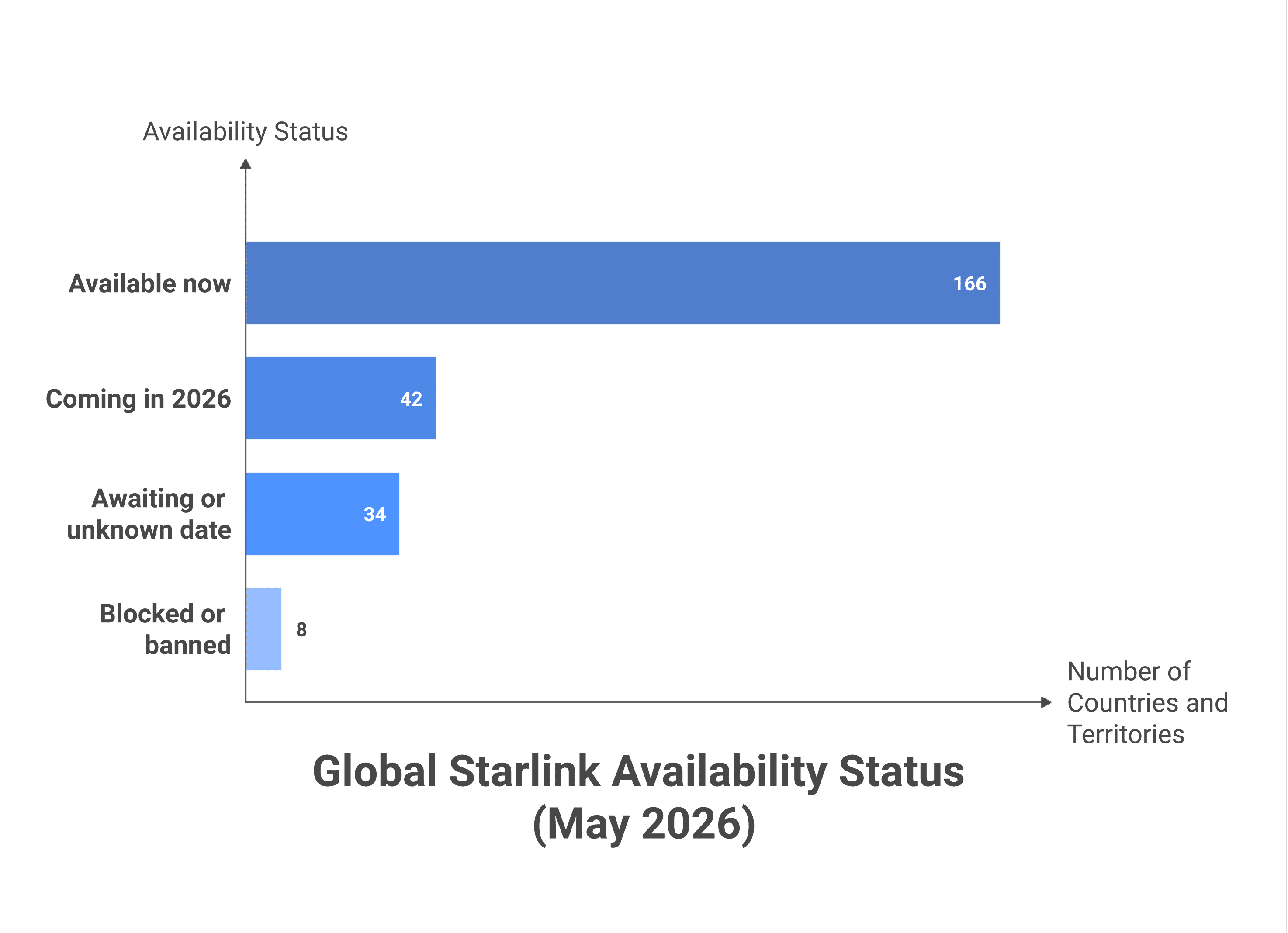
- Live in 166 countries and territories. Starlink's official availability map lists 163 nations with active consumer service plus three more (Cyprus, Georgia, Ukraine) served via sub-national rendering — 166 markets in total as of 10 May 2026.
- 42 more announce 2026 launches. From Angola and Montenegro to Uzbekistan and the Turks & Caicos, 42 countries on Starlink's official roadmap are slated to go live this year.
- Eight countries have explicitly banned it. Afghanistan, Belarus, China, Hong Kong, Macao, North Korea, Russia and Syria are all hard-blacklisted in Starlink's own data. Russia tightened its rules with Decree №488 on 29 April 2026, banning import of foreign satellite terminals on national-security grounds.
- 34 are stuck in regulatory limbo. South Africa, Egypt, Iraq, Lebanon, Morocco, Algeria, Tunisia, Greenland, Taiwan and roughly two dozen others sit in Starlink's "service date is unknown" or "pending regulatory approval" buckets — neither launched nor explicitly blocked.
- 2025 was Starlink's biggest year. 26 countries went live in 2025 — including Sri Lanka, Senegal (Feb 2026), and a wave of Sahel and Caribbean nations. India received final regulatory approval in Q1 2026, Vietnam was licensed in Feb 2026, and Direct-to-Cell went commercial via partner carriers in 22 countries.
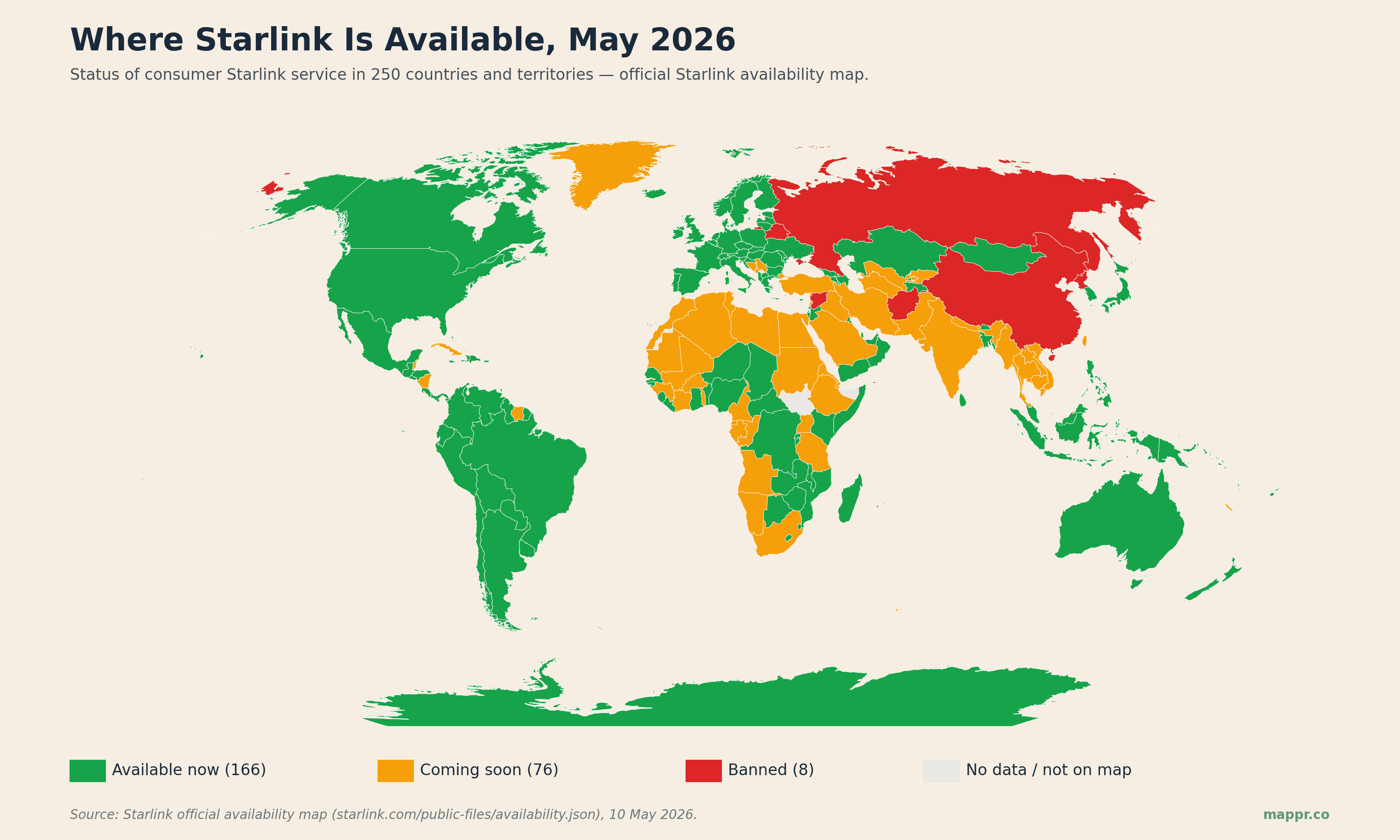
Legend: green = Available now (166); orange = Coming soon — including announced 2026 launches and regulatory limbo (76); red = Blocked or banned (8). Light grey territories are not on Starlink’s map. Source: Starlink’s own availability.json, pulled 10 May 2026.
SpaceX’s Starlink is now the largest commercial satellite-internet network in history. As of 10 May 2026, its official availability data file lists 166 countries and territories with active consumer service, another 42 with publicly announced 2026 launches, 34 stuck in regulatory limbo, and 8 hard-banned. The map above is shaded directly from Starlink’s own data — the same JSON its website uses to paint the live map at starlink.com/map.
The pattern is striking: Starlink covers more of the world’s land area than any consumer ISP in history, but the gaps are concentrated in a handful of authoritarian states and in countries where domestic telecoms regulators have made the case that orbital broadband disrupts national licensing frameworks. The result is a near-binary geography — most of the world is teal; an arc from Belarus through Russia and China is solid navy; and a scattered band of almost-but-not-quite markets sits between them.
The 166: Where Starlink Is Available Today
The “Available Now” bucket spans almost every region of the world. The Americas are essentially complete — every country in North, Central and South America has active consumer service except Cuba (sanctioned) and Nicaragua (regulatory limbo). Venezuela appears as Available on the official map but in practice serves only as a roaming destination; SpaceX briefly offered free service there during the political crisis in January 2026.
Europe is uniformly teal except Belarus and Russia, plus a handful of Western Balkan states still in the coming-soon column (Bosnia and Herzegovina, Serbia, Montenegro). Even Ukraine is Available — Starlink renders it through sub-national admin1 polygons specifically to geofence Crimea and the Russian-occupied parts of Donbas, then enforces a registered-terminals whitelist (added February 2026) to block Russian use.
Sub-Saharan Africa looks the most transformed. As recently as early 2024 only a handful of African markets were live; by May 2026, 27 are. Senegal joined in February 2026 as the 26th African market; Burundi, the Central African Republic, Sierra Leone, São Tomé and Príncipe, and Cabo Verde all went commercial in late 2024 or 2025. Nigeria — the first African market, live since February 2023 — remains the largest single deployment. The countries still missing are mostly the Sahel ban-belt (Mali, Burkina Faso, Niger, Cameroon, Gabon all sitting in Coming Soon 2026) and a cluster of Horn-of-Africa nations (Ethiopia, Eritrea, Sudan, Djibouti) where regulatory approval has stalled.
The Middle East is the most surprising regional story. Yemen — yes, war-torn, partitioned-into-three Yemen — became the first Arab market in September 2024 after the internationally-recognised government signed a five-year deal with SpaceX; the Houthi-controlled north officially opposes it but kits move freely. Jordan, Israel, Bahrain, Kuwait, Qatar, Oman and the UAE are all listed as Available now, though local Arabic-language reporting suggests UAE coverage is in practice maritime/aviation-focused rather than full residential. Saudi Arabia sits in Pending Regulatory Approval; Lebanon, Iraq, Egypt, Morocco, Algeria and Tunisia are all in the Awaiting / Unknown bucket.
Asia-Pacific is split. Australia, New Zealand, Japan, South Korea, Indonesia, Malaysia, the Philippines, Mongolia, Kazakhstan and most of the Pacific micro-states are live. India received final regulatory approval in Q1 2026 with a five-year licence valid through July 2030 (rollout via Reliance Jio and Bharti Airtel partnerships); Vietnam was licensed in February 2026 for up to 600,000 user terminals; Sri Lanka launched in July 2025; Bangladesh, Bhutan and the Maldives are all already live.
The 42 Coming in 2026
Starlink’s data file marks 42 countries with explicit “Starting in 2026” expected dates. The geography is mostly Caribbean micro-states (Aruba, Bermuda, Anguilla, BVI, Curaçao, Grenada, St Kitts & Nevis, St Lucia, Turks and Caicos), French overseas territories (French Polynesia, Wallis and Futuna), the Sahel-and-West-Africa late-rollout cluster (Burkina Faso, Cameroon, Côte d’Ivoire, Equatorial Guinea, Gabon, Gambia, Guinea, Mali, Mauritania, Republic of Congo, Togo, Tunisia), the Western Balkans (Bosnia and Herzegovina, Serbia, Montenegro), Central Asia (Kyrgyzstan, Turkmenistan, Uzbekistan), and a few Pacific island states (Palau, Tokelau).
Several of these have already moved faster than the map suggests. Côte d’Ivoire and Burkina Faso both have signed licences and pre-deployment hardware on the ground; Tanzania has an Airtel Africa Direct-to-Cell agreement that effectively makes it a partial-launch market. Vietnam is “Pending regulatory approval” in the data file but already has a formal commercial licence from February 2026 — the map data is lagging. Expect several of the 42 to flip to Available before the end of 2026.
The Eight Bans (and Iran’s Functional Ninth)
The eight countries explicitly blacklisted by Starlink in its own data file are the world’s most digitally restrictive states: Afghanistan, Belarus, China, Hong Kong, Macao, North Korea, Russia and Syria. Three of these (Hong Kong, Macao, Syria) inherit their ban from the parent regime or US sanctions; the other five are active enforcement zones.
China bans Starlink under its broader prohibition of unlicensed foreign satellite communications. The first official enforcement action — for using a terminal aboard a vessel within the 12-nautical-mile territorial limit — was issued in early 2026, and Beijing requires terminals to be deactivated within Chinese territorial waters. The ban extends to Hong Kong and Macao because both fall under PRC sovereign telecommunications regulation.
Russia tightened its long-standing prohibition with Government Decree №488 on 29 April 2026, formally banning the import of foreign satellite-internet terminals on national-security grounds. The decree explicitly names Starlink. Belarus has never granted a licence and the regime has openly said use is not permitted; Belarus is reportedly developing its own satellite-broadband service (“Бюро 1440”) instead.
Iran sits in a strange middle ground. Starlink’s data marks it as “coming soon” with an empty expected date — reflecting SpaceX’s stated humanitarian intent to provide service under US sanctions exemptions during periods of internet shutdown. In reality, the Iranian government has criminalised possession (sentences of up to 10 years, with reports of execution penalties) and deployed nationwide GPS jamming during the January 2026 internet blackout that cut Starlink throughput by up to 80%. Treat Iran as effectively blocked despite its formal status.
The South Africa Story
South Africa is the single largest economy still missing from Starlink’s coverage map. Service has been blocked since launch by ICASA’s electronic-communications licensing requirement that all licensees meet a 30% historically-disadvantaged-ownership rule under the country’s Broad-Based Black Economic Empowerment (B-BBEE) framework. SpaceX, a privately held US firm, cannot meet that threshold without restructuring.
In December 2025 the Minister of Communications issued a policy directive opening a new path: an Equity Equivalent Investment Programme (EEIP) substituting a R2.5 billion ($145.6M) local-development pledge for the ownership requirement. ICASA opened a public consultation on the new framework in early 2026; if it lands without legal challenge, South Africa could go live by late 2026 or early 2027. For now, Starlink’s data file marks ZAF as Coming Soon — service date is unknown at this time.
What Changed in 2025–2026
The last 18 months have been Starlink’s largest expansion period. According to Rest of World’s tracker, 26 countries went live in 2025 alone — the biggest annual count to date. The headline launches:
- Sri Lanka — 2 July 2025. Final TRCSL approval after a March 2025 hold; nationwide service from launch.
- Yemen — September 2024 (commercialised 2025). First Middle East market; five-year licence with the internationally-recognised government.
- Senegal — 4 February 2026. 26th African market; pricing 22-30k FCFA/month.
- Vietnam — licensed February 2026. Up to 600,000 user terminals authorised; four ground stations approved (Phú Thọ, Đà Nẵng, HCMC); commercial service expected mid-2026.
- India — Q1 2026 final approval. Five-year commercial licence valid through 7 July 2030; rollout via Reliance Jio and Bharti Airtel distribution.
- Pakistan — late 2025. No-objection certificate granted; full commercial launch awaiting spectrum and security clearances.
- Tajikistan — February 2026. Service launched via Kazakhstan-routed gateway; full territory by end-2026.
- Direct-to-Cell — commercial in July 2025. T-Mobile’s T-Satellite went commercial in the United States; partner-carrier coverage now spans 22 countries (Optus, Telstra, Rogers, One NZ, KDDI, SALT, Entel, Kyivstar, VMO2, Airtel Africa) reaching ~400 million people. SMS first; voice and data following late 2025 onwards.
Data and references underpinning this map.
For how terrestrial mobile coverage compares, see our map of LTE coverage by country.