Key Takeaways
- Four levels, 217 countries and territories rated. The US State Department sorts the world into four tiers: Level 1 Exercise Normal Precautions (84 places), Level 2 Exercise Increased Caution (83), Level 3 Reconsider Travel (26) and Level 4 Do Not Travel (24). Together they cover 217 destinations.
- 23 countries are at Level 4: Do Not Travel. The no-go list spans active war zones and collapsed states: Ukraine, Russia, Belarus, Afghanistan, Iran, Iraq, Syria, Yemen, Lebanon, Libya, North Korea, Haiti, Burma and a belt of the Sahel and Horn of Africa.
- The entire Gulf is now Level 3. After the February 2026 US and Iran hostilities, Bahrain, Kuwait, Oman, Qatar, Saudi Arabia, the UAE and Jordan all sit at Reconsider Travel. That puts Dubai and Doha, two of the world's busiest aviation hubs, under a formal US warning.
- Venezuela is Level 3, not Level 4. Widely shared press lists put Venezuela on the Do Not Travel tier, but the official State Department feed has it at Level 3, Reconsider Travel. The map follows the government's live data, not the reposts.
- The list moves constantly. Cyprus was raised to Level 3 on March 3, 2026; Jamaica and Grenada were lowered to Level 2 in early 2026; Niger's Level 4 was renewed on July 9, 2026. Every change is driven by the live advisory feed.
Every American passport holder planning a trip abroad is quietly ranked against a US government scale most travelers never see in full. The US Department of State assigns every country in the world one of four travel advisory levels, from a routine Level 1 to a stark Level 4 Do Not Travel. At the peak of the northern summer travel season, and after an unusually turbulent year of revisions, we mapped all four levels for every country on Earth.
The data comes straight from the State Department’s official advisory feed, pulled live for this map. It is the same source that powers the individual country pages at travel.state.gov, and it covers 217 countries and territories. Here is how the world looks in July 2026.
The global travel advisory map
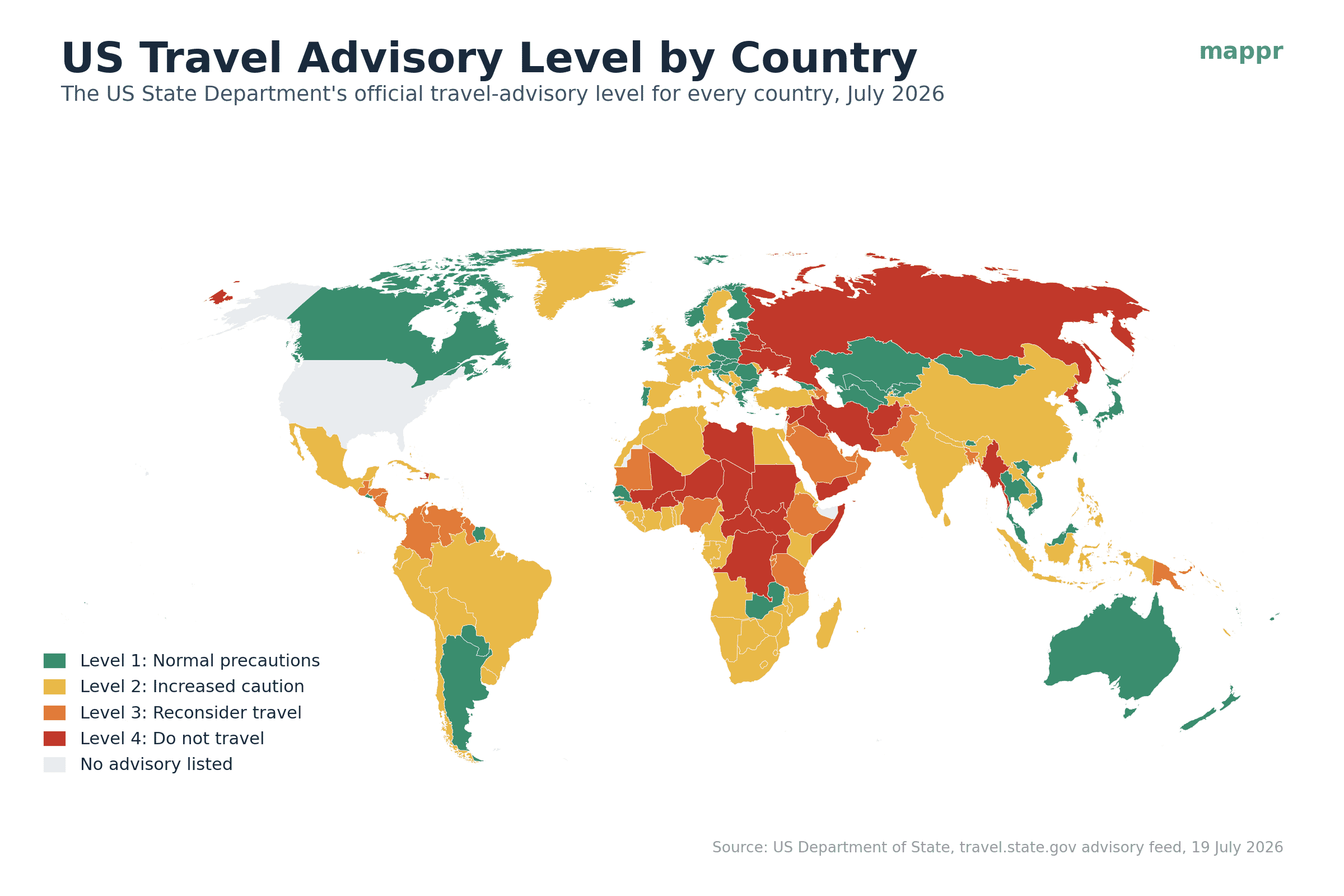
The pattern tracks conflict and state fragility more than distance or development. A dense band of red runs from Ukraine and Russia through the Middle East and across the Sahel and Horn of Africa. Amber and orange cover much of Latin America, South Asia and parts of Africa, where crime or unrest earn a Level 2 or Level 3. Green, the reassuring Level 1, covers Canada, most of Western Europe, Japan, Australia, New Zealand and a scattering of others. The United States itself is blank: the State Department advises on foreign destinations, not its own soil.
What the four levels actually mean
The scale is deliberately simple, but each step carries real weight for insurance, employers and airlines:
Level 1, Exercise Normal Precautions (83 countries). The baseline. Some risk exists everywhere, but nothing that sets the country apart. Most of Europe, Canada and much of East Asia sit here.
Level 2, Exercise Increased Caution (82 countries). Be more aware than usual. This is the single largest tier and includes many popular destinations, from France and the UK to Mexico, Brazil and India, usually flagged for crime or occasional unrest.
Level 3, Reconsider Travel (27 countries). A serious warning. The government is telling you to think hard about whether the trip is worth it. This is where the Gulf states now sit.
Level 4, Do Not Travel (23 countries). The highest tier. The State Department will have very limited ability to help US citizens here, and in many cases urges those already present to leave.
The 23 Do Not Travel countries
The Level 4 list reads like a map of the world’s active crises. It breaks into a few clusters. War and its neighbours: Ukraine, Russia and Belarus. The Middle East: Iran, Iraq, Syria, Lebanon, Yemen, Libya and Afghanistan. The Sahel and Horn of Africa: Mali, Niger, Burkina Faso, Chad, the Central African Republic, the Democratic Republic of the Congo, Sudan, South Sudan, Somalia and Uganda. And three that stand alone: Haiti, gripped by gang violence, Burma (Myanmar) after its civil war, and North Korea, where US passports are not even valid for travel without a special validation.
The Gulf turns orange
The biggest shift of 2026 is the Gulf. Following the February 2026 hostilities between the United States and Iran, the State Department moved the entire region to Level 3, Reconsider Travel: Bahrain, Kuwait, Oman, Qatar, Saudi Arabia, the United Arab Emirates and Jordan. The practical consequence is striking. Dubai and Doha, two of the busiest connecting hubs in global aviation, now sit under a formal US government warning, which affects everything from corporate travel policies to trip-insurance coverage for millions of transit passengers who never intend to leave the airport.
Getting Venezuela right
One country is worth a fact-check. Many widely shared lists of Level 4 countries include Venezuela. The official State Department feed does not: it currently rates Venezuela at Level 3, Reconsider Travel. The distinction matters, and it is exactly the kind of detail that gets garbled as lists are copied around the web. This map follows the government’s live data rather than the reposts, so Venezuela appears in orange, not red.
Every Level 3 and Level 4 country
The table below lists all 217 countries and territories the State Department currently rates at Level 3 or Level 4. It is sortable and searchable, so you can check a specific destination.
| Country | Level | Advisory |
|---|---|---|
| Afghanistan | Level 4 | Do Not Travel |
| Belarus | Level 4 | Do Not Travel |
| Burkina Faso | Level 4 | Do Not Travel |
| Burma (Myanmar) | Level 4 | Do Not Travel |
| Central African Republic | Level 4 | Do Not Travel |
| Chad | Level 4 | Do Not Travel |
| DR Congo | Level 4 | Do Not Travel |
| Gaza | Level 4 | Do Not Travel |
| Haiti | Level 4 | Do Not Travel |
| Iran | Level 4 | Do Not Travel |
| Iraq | Level 4 | Do Not Travel |
| Lebanon | Level 4 | Do Not Travel |
| Libya | Level 4 | Do Not Travel |
| Mali | Level 4 | Do Not Travel |
| Niger | Level 4 | Do Not Travel |
| North Korea | Level 4 | Do Not Travel |
| Russia | Level 4 | Do Not Travel |
| Somalia | Level 4 | Do Not Travel |
| South Sudan | Level 4 | Do Not Travel |
| Sudan | Level 4 | Do Not Travel |
| Syria | Level 4 | Do Not Travel |
| Uganda | Level 4 | Do Not Travel |
| Ukraine | Level 4 | Do Not Travel |
| Yemen | Level 4 | Do Not Travel |
| Azerbaijan | Level 3 | Reconsider Travel |
| Bahrain | Level 3 | Reconsider Travel |
| Burundi | Level 3 | Reconsider Travel |
| Colombia | Level 3 | Reconsider Travel |
| Ethiopia | Level 3 | Reconsider Travel |
| Guatemala | Level 3 | Reconsider Travel |
| Guinea-Bissau | Level 3 | Reconsider Travel |
| Guyana | Level 3 | Reconsider Travel |
| Honduras | Level 3 | Reconsider Travel |
| Israel | Level 3 | Reconsider Travel |
| Jordan | Level 3 | Reconsider Travel |
| Kuwait | Level 3 | Reconsider Travel |
| Macau (China SAR) | Level 3 | Reconsider Travel |
| Mauritania | Level 3 | Reconsider Travel |
| Nicaragua | Level 3 | Reconsider Travel |
| Nigeria | Level 3 | Reconsider Travel |
| Oman | Level 3 | Reconsider Travel |
| Pakistan | Level 3 | Reconsider Travel |
| Papua New Guinea | Level 3 | Reconsider Travel |
| Qatar | Level 3 | Reconsider Travel |
| Rwanda | Level 3 | Reconsider Travel |
| Saudi Arabia | Level 3 | Reconsider Travel |
| Trinidad and Tobago | Level 3 | Reconsider Travel |
| United Arab Emirates | Level 3 | Reconsider Travel |
| Venezuela | Level 3 | Reconsider Travel |
| West Bank | Level 3 | Reconsider Travel |
The risk-indicator tags behind each rating
A single number never tells the whole story, so each country page also carries one or more risk-indicator letters that explain why a country earns its level. The main tags are C for crime, T for terrorism, U for civil unrest, K for kidnapping or hostage-taking, D for wrongful detention, H for health, N for natural disaster and E for a time-limited event. Two countries at the same level can have very different profiles: a Level 3 for a Caribbean island is usually a crime story, while a Level 3 for a Gulf state in 2026 is about the risk of a wider regional conflict.
A moving target
Travel advisories are not fixed. They shift with elections, natural disasters, outbreaks and, as 2026 has shown, sudden geopolitical flare-ups. In the last few months alone, Cyprus was raised to Level 3 on March 3, 2026 as regional tensions spread across the eastern Mediterranean; Jamaica and Grenada were lowered to Level 2 as their security situations improved; and Niger’s Level 4 was renewed on July 9, 2026. Because this map is built from the live feed, it is a snapshot of a system in constant motion. When a level changes, so does the map.
Travel advisory levels are the official US Department of State ratings, pulled live from the advisory feed on July 19, 2026:
Image Sources