Key Takeaways
- 31 countries run reactors, and the 32nd arrives this week. Nuclear plants operate in 31 countries and supply about a tenth of the world's electricity. Bangladesh's Rooppur plant is days from its first grid connection, making it the newest member of the club and the third nuclear nation in South Asia.
- Five countries hold most of the capacity. The US (94 reactors, 97 GW), China (64 reactors) and France (57 reactors) alone account for well over half of global capacity; add Russia and South Korea and five countries control roughly 70%.
- France is the outlier, China is the builder. France gets about two-thirds of its electricity from nuclear, the highest share on Earth. China has around 28 reactors under construction, targeting 150 GW by 2035, the fastest build-out anywhere.
- The phase-out era is reversing. Belgium scrapped its exit law and extended its reactors; the US is restarting Three Mile Island (for Microsoft) and Palisades. Germany, Italy, Lithuania, Kazakhstan and Taiwan remain the five countries that left.
Sometime in the next days, engineers at Rooppur on the Padma river will synchronise Bangladesh’s first nuclear reactor with the national grid, and a new country will appear on this map. It is the single rarest event in energy cartography: the club of nations that generate nuclear electricity has admitted only a handful of members in the past three decades. We mapped who runs the world’s reactors, who is joining, and who has left.
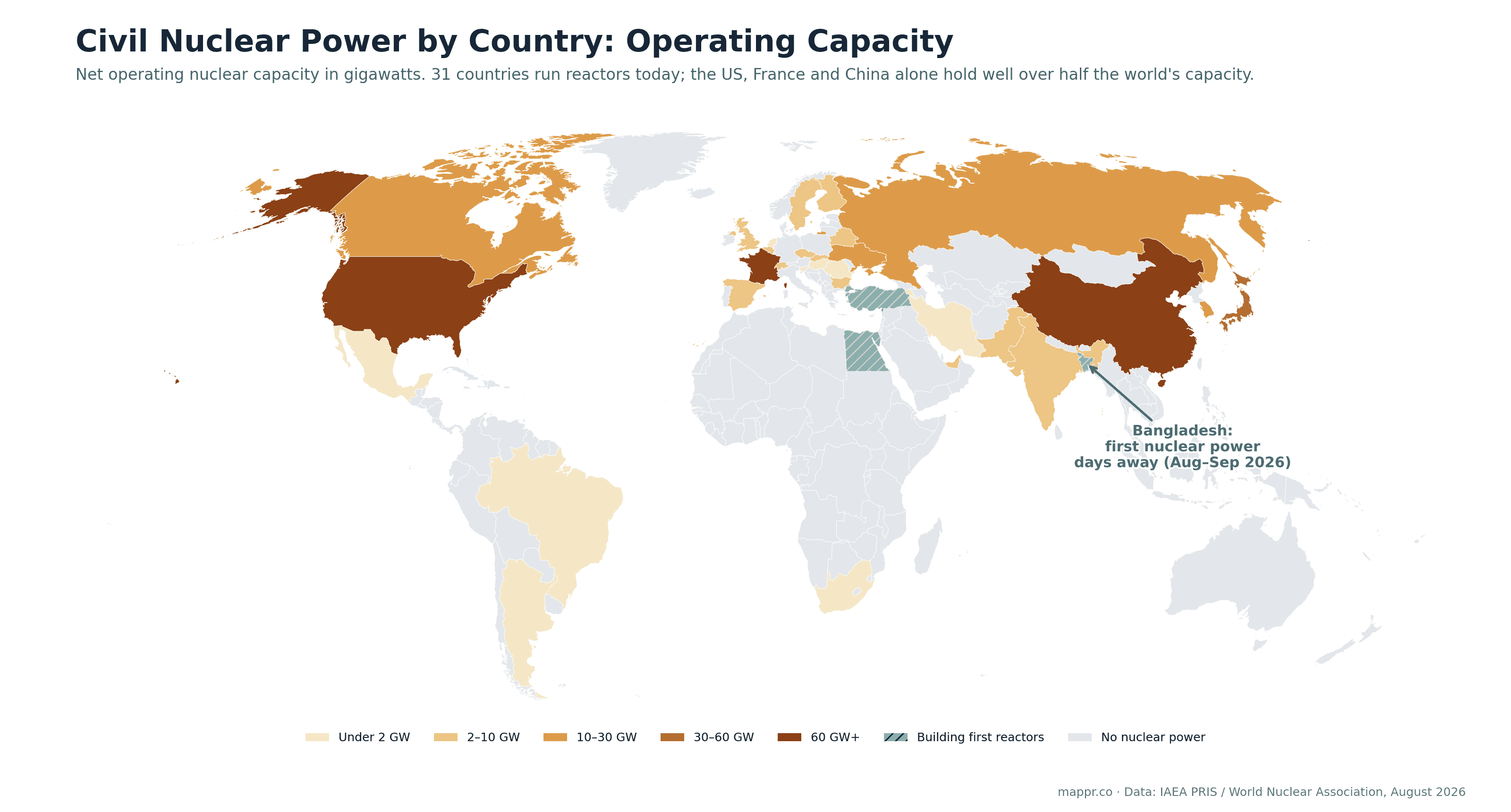
The map’s first message is concentration. Thirty-one countries operate roughly 420 reactors with about 400 GW of capacity between them, but five countries hold about 70% of it. The United States leads with 94 reactors and 97 GW, nearly a fifth of American electricity. China (64 reactors) and France (57) are next at around 63 GW each, though they got there in opposite ways: France built its fleet in a 1970s-80s sprint and stopped; China is mid-sprint now.
The top 15 nuclear nations
| # | Country | Reactors | Net capacity | Share of electricity |
|---|---|---|---|---|
| 1 | 🇺🇸 United States | 94 | 97.0 GW | 18% |
| 2 | 🇨🇳 China | 64 | 64.0 GW | 5% |
| 3 | 🇫🇷 France | 57 | 63.0 GW | 67% |
| 4 | 🇯🇵 Japan | 15 | 31.7 GW | 10% |
| 5 | 🇷🇺 Russia | 37 | 27.7 GW | 18% |
| 6 | 🇰🇷 South Korea | 26 | 25.6 GW | 32% |
| 7 | 🇨🇦 Canada | 19 | 13.7 GW | 13% |
| 8 | 🇺🇦 Ukraine | 15 | 13.1 GW | 55% |
| 9 | 🇪🇸 Spain | 7 | 7.1 GW | 20% |
| 10 | 🇸🇪 Sweden | 6 | 7.0 GW | 29% |
| 11 | 🇮🇳 India | 20 | 6.9 GW | 3% |
| 12 | 🇬🇧 United Kingdom | 9 | 5.9 GW | 12% |
| 13 | 🇦🇪 UAE | 4 | 5.3 GW | 22% |
| 14 | 🇫🇮 Finland | 5 | 4.4 GW | 39% |
| 15 | 🇨🇿 Czechia | 6 | 4.0 GW | 40% |
The share column tells its own story. France gets about two-thirds of its electricity from nuclear power, the highest share in the world, followed by Slovakia (61%), Belgium (57%) and Ukraine (55%), whose reactors have kept the lights on through four years of war. At the other end, China’s giant fleet still supplies less than 5% of its colossal demand, which is exactly why Beijing is building around 28 more reactors, targeting 150 GW by 2035, the fastest nuclear expansion on Earth.
Joining, leaving, and coming back
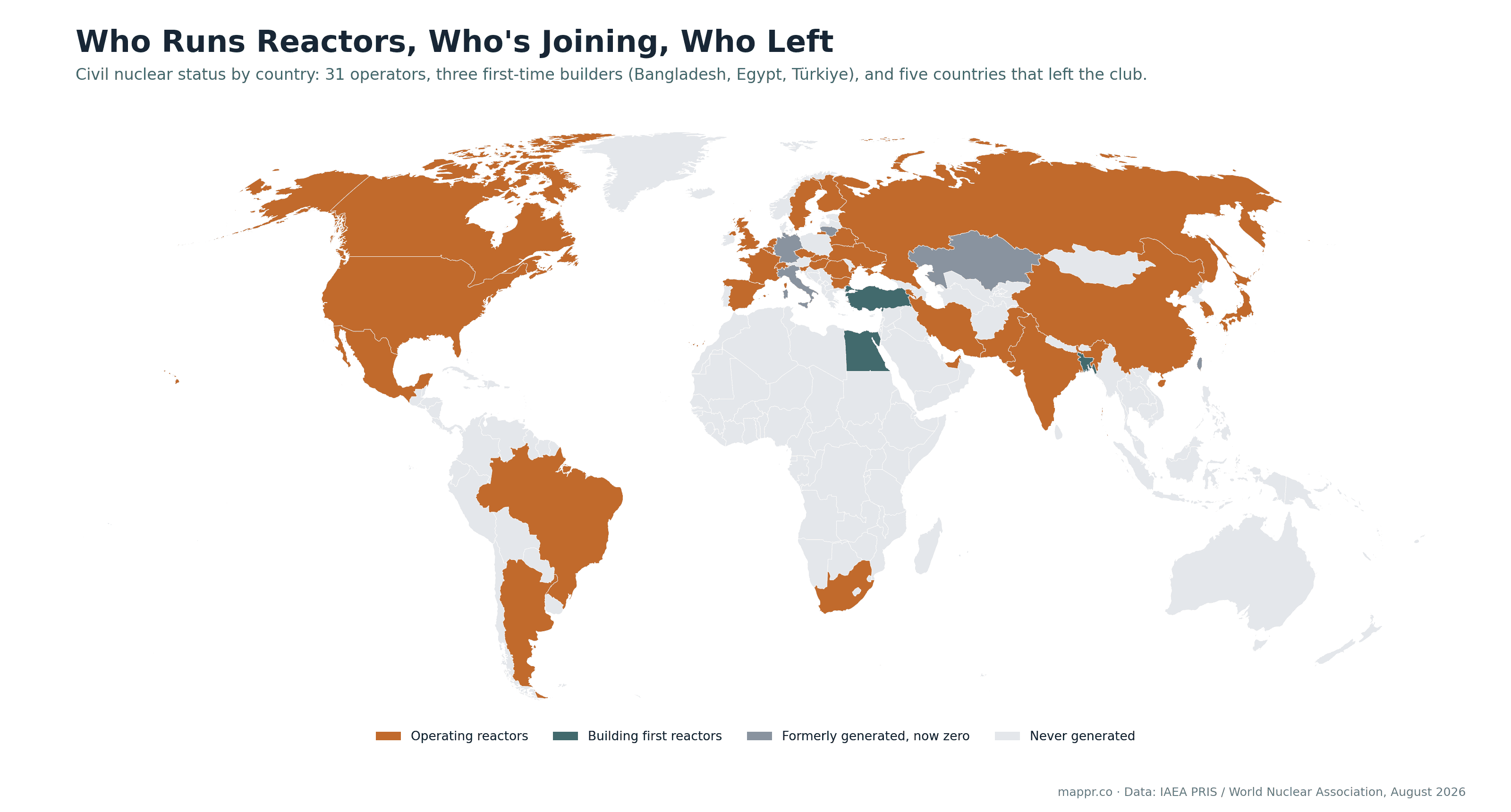
The second map shows the club’s churn. Three countries are building their first reactors: Bangladesh (Rooppur, two Russian-built VVER units, first ~300 MW grid connection expected between late August and September), Egypt (El Dabaa) and Türkiye (Akkuyu, already loading fuel). Bangladesh becomes the 33rd country ever to have generated nuclear electricity, and the third in South Asia after India and Pakistan.
Five countries have left: Italy (after Chernobyl), Lithuania and Kazakhstan (Soviet-era closures), Taiwan (phase-out completed 2025) and Germany, whose 2023 exit remains the largest deliberate dismantling of a nuclear fleet in history. But the tide has visibly turned. Belgium formally scrapped its phase-out law (in force since May 2025) and extended its newest reactors to 2035. And in the United States, AI data-centre demand is doing what no climate policy managed: Three Mile Island Unit 1 is being restarted as the Crane Clean Energy Center under a 20-year power deal with Microsoft, alongside the Palisades plant in Michigan, the first true restarts of shut-down reactors in American history.
A map that rarely changes, changing
Status maps like this one usually move at a glacial pace: whole decades passed with no new entrants. Now Bangladesh joins within days, Egypt and Türkiye follow within a few years, and a dozen more countries, from Poland to Kazakhstan (a re-entry candidate by 2035), from Uzbekistan to Ghana, have signed serious construction or planning agreements. Combined with our map of nuclear tests by country, published for this week’s International Day against Nuclear Tests, and the separate map of countries with nuclear weapons, it completes the trilogy: the bomb, the test, and the power plant are three very different maps. This one is the only one still growing. For the wider energy picture, see electricity from renewables by country.
Sources: