Key Takeaways
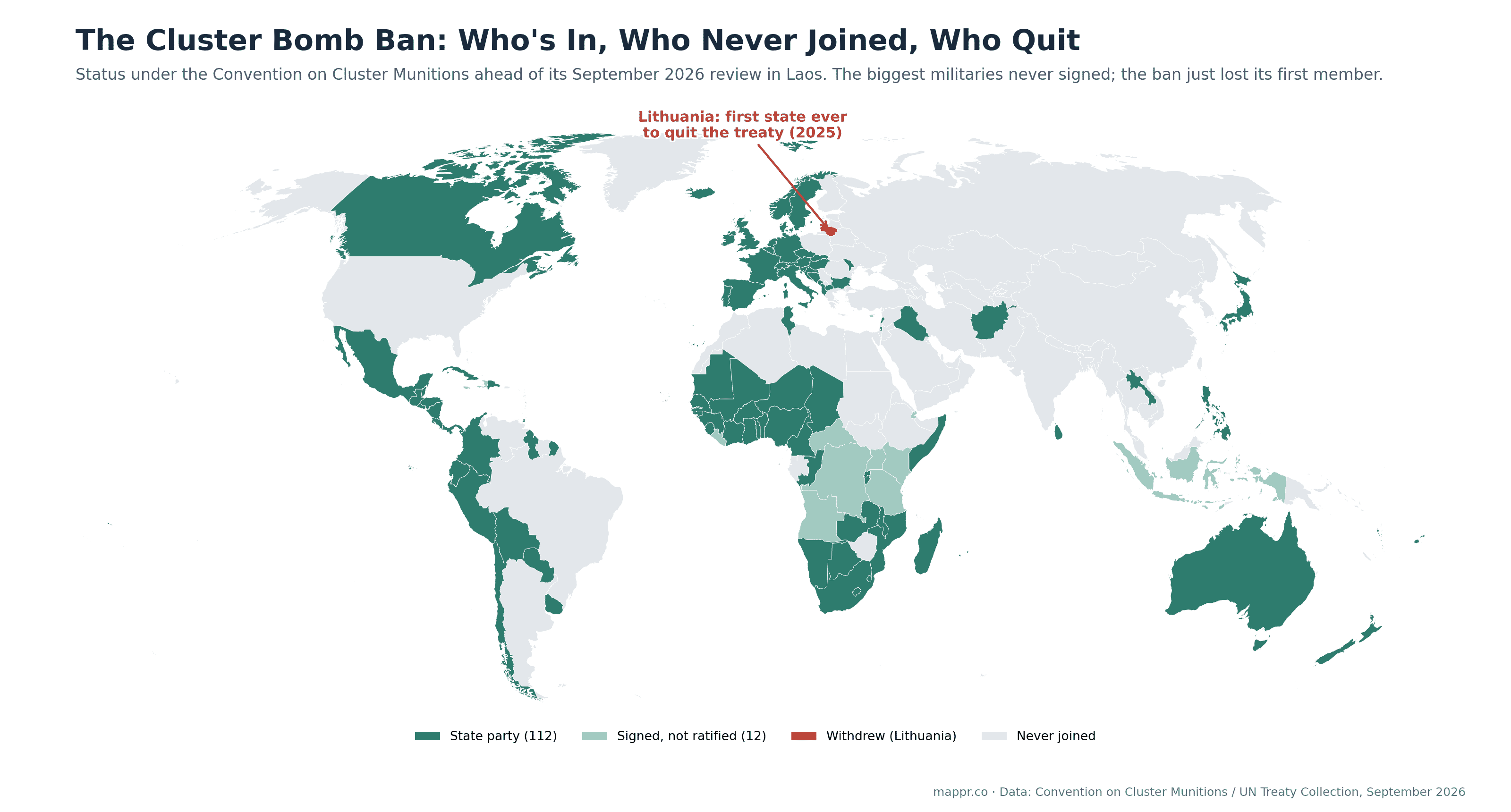
- 112 countries ban cluster bombs; the ones that matter most don't. The Convention on Cluster Munitions binds 112 states, but the US, Russia, China, India, Pakistan, Israel, both Koreas and Ukraine never joined, and several NATO members stayed out from day one.
- The ban has lost its first member. Lithuania's withdrawal took effect on 6 March 2025, the first time any state has left the treaty. The ICRC called it unprecedented: no country had ever denounced a global humanitarian ban before.
- Casualties are rising, and all of them are civilians. The Cluster Munition Monitor recorded 314 people killed or injured in 2024, up 43% on 2023, every one a civilian. Ukraine was the worst-affected country for the third year running, with 208 casualties.
- The venue is the story. The treaty's five-yearly review convenes in Laos on 14-18 September 2026, the most cluster-bombed country in history: some 270 million submunitions were dropped on it in the US 'Secret War', and up to 80 million never exploded.
On 14 September 2026, diplomats from more than a hundred countries gather in Vientiane for the third five-yearly review of the Convention on Cluster Munitions, the 2008 treaty that bans a weapon designed to scatter dozens or hundreds of smaller bombs over an area the size of several football fields. The setting is pointed: Laos, the host, is the most cluster-bombed country in human history. And the treaty being reviewed is under more strain than at any point in its existence.
The map’s grey holes are the story
At first glance the ban looks like a success: 112 states parties, from almost all of Latin America and Western Europe to most of Africa, plus 12 signatories that have yet to ratify. But look at the grey. Every major producer and stockpiler of cluster munitions sits outside the treaty: the United States, Russia, China, India, Pakistan, Israel, both Koreas, and Ukraine, where the weapon is currently doing its work on both sides of the front line. The gap between the ban’s breadth and its bite has never been wider.
| Country | Treaty status | Cluster munitions role |
|---|---|---|
| 🇺🇸 United States | Never joined | Producer and past major user; transferred stocks to Ukraine 2023–24 |
| 🇷🇺 Russia | Never joined | Producer; extensive use in Ukraine since 2022 |
| 🇺🇦 Ukraine | Never joined | Has used against Russian forces; world’s most affected country |
| 🇨🇳 China | Never joined | Producer and stockpiler |
| 🇮🇳 India · 🇵🇰 Pakistan | Never joined | Producers and stockpilers |
| 🇮🇱 Israel | Never joined | Producer; last large-scale use in Lebanon 2006 |
| 🇰🇵 🇰🇷 The Koreas | Never joined | Both produce and stockpile along the DMZ |
| 🇵🇱 Poland · 🇫🇮 Finland · 🇬🇷 Greece · 🇹🇷 Türkiye | Never joined | NATO members that stayed outside from the start |
| 🇱🇹 Lithuania | Withdrew (6 March 2025) | First state ever to leave; cited Russia’s war in Ukraine |
Lithuania’s unprecedented exit
For sixteen years, the treaty only ever grew. That ended on 6 March 2025, when Lithuania’s withdrawal took effect, the first denunciation of the convention by any state. Vilnius argued that facing Russia, a neighbour that uses cluster munitions freely in Ukraine, it could not afford to keep a category of weapon off the table that its adversary employs without restraint. The ICRC called the move unprecedented, warning that no state had ever walked away from a global humanitarian treaty before. The worry in Vientiane is contagion: the same security logic has already driven five NATO states (the Baltics, Poland and Finland) out of the Ottawa landmine ban, and treaty advocates fear the cluster convention is next in line.
Where the weapon still kills
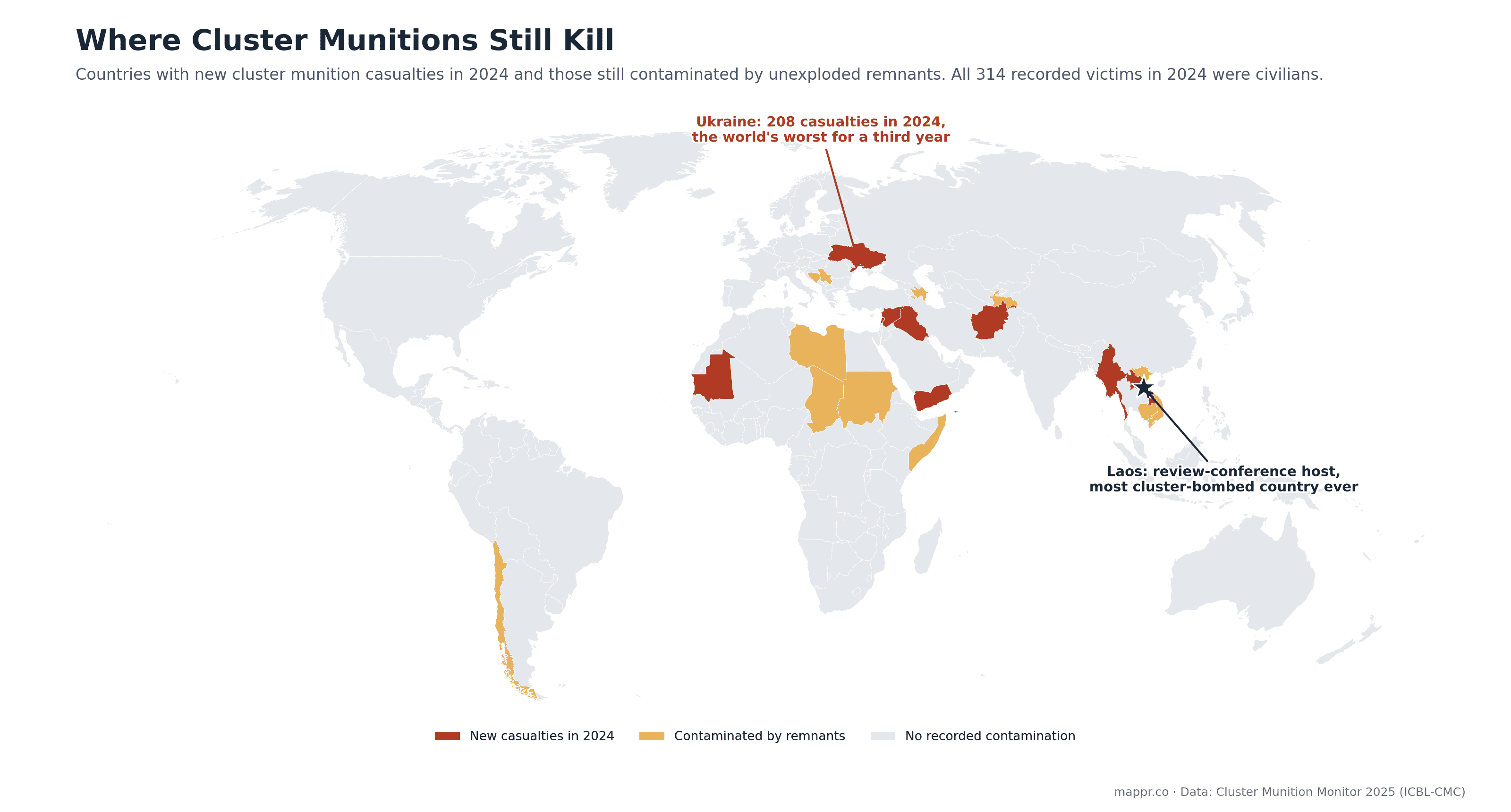
The Cluster Munition Monitor recorded 314 people killed or injured in 2024, all of them civilians, a 43% jump on the year before. Ukraine accounted for 208, the world’s worst toll for the third consecutive year, as both Russian and Ukrainian forces continue to use the weapon. New casualties were also recorded in Syria, Yemen, Myanmar, Afghanistan, Iraq, Lebanon, Mauritania and Laos, and nearly half the victims of unexploded remnants were children, drawn to submunitions that can look like balls or batteries. A further belt of countries, from Cambodia and Vietnam to Bosnia and Chile, remains contaminated by remnants of wars that ended decades ago.
Laos: the host that carries the argument
No place makes the treaty’s case like its venue. Between 1964 and 1973, US aircraft dropped an estimated 270 million cluster submunitions on Laos during the ‘Secret War’, more bombs per capita than any nation has ever absorbed, and up to 80 million failed to explode. Half a century later, Laotian farmers still die in fields their grandparents fled, tens of thousands have been killed or maimed since the war ended, and clearance at the current pace is a project measured in centuries, not years. That is the argument Vientiane’s hosts will put to the delegates: a cluster bomb dropped today is a civilian casualty on someone’s map in 2076. Whether the treaty leaves Laos strengthened, or follows the landmine ban into slow unravelling, is the question the week will answer. For the wider disarmament picture, see our maps of nuclear tests by country and military spending by country.
Sources: