Key Takeaways
- Italy just settled it — in the negative. In May 2026 Italy's Supreme Court ruled that hotels and restaurants have no legal duty to serve free tap water, throwing out a tourist's €2,700 compensation claim.
- France, Spain and Portugal require it. All three legally oblige venues to give customers free drinking water. France's free carafe d'eau is practically a national institution.
- In Britain it's tied to alcohol. Any UK venue licensed to sell alcohol must provide free tap water on request — a mandatory condition of its licence.
- Australia and New Zealand mandate it too. Licensed premises Down Under must keep free drinking water available to patrons while they are trading.
- America has no national rule. Free water is customary but never guaranteed — and California's drought rules even bar restaurants from serving it unless you ask first.
A tourist walks into a hotel restaurant in the Italian Dolomites, orders a meal, and asks for a glass of tap water. The hotel refuses. She sues for €2,700 — and loses. In May 2026, Italy‘s highest court confirmed what many travelers learn the hard way: under Italian law, no restaurant or hotel is obliged to serve free tap water. It is a service each venue can price, refuse, or pour out of goodwill.
That ruling reopened an oddly contentious question across the dining world: is a glass of water a basic courtesy or a billable extra? The answer turns out to depend entirely on which country you’re sitting in. In some, free drinking water is written into law; in others, asking for it marks you as a cheapskate. Here’s the map of where the tap runs free — and where it doesn’t.
Where Free Tap Water Is the Law
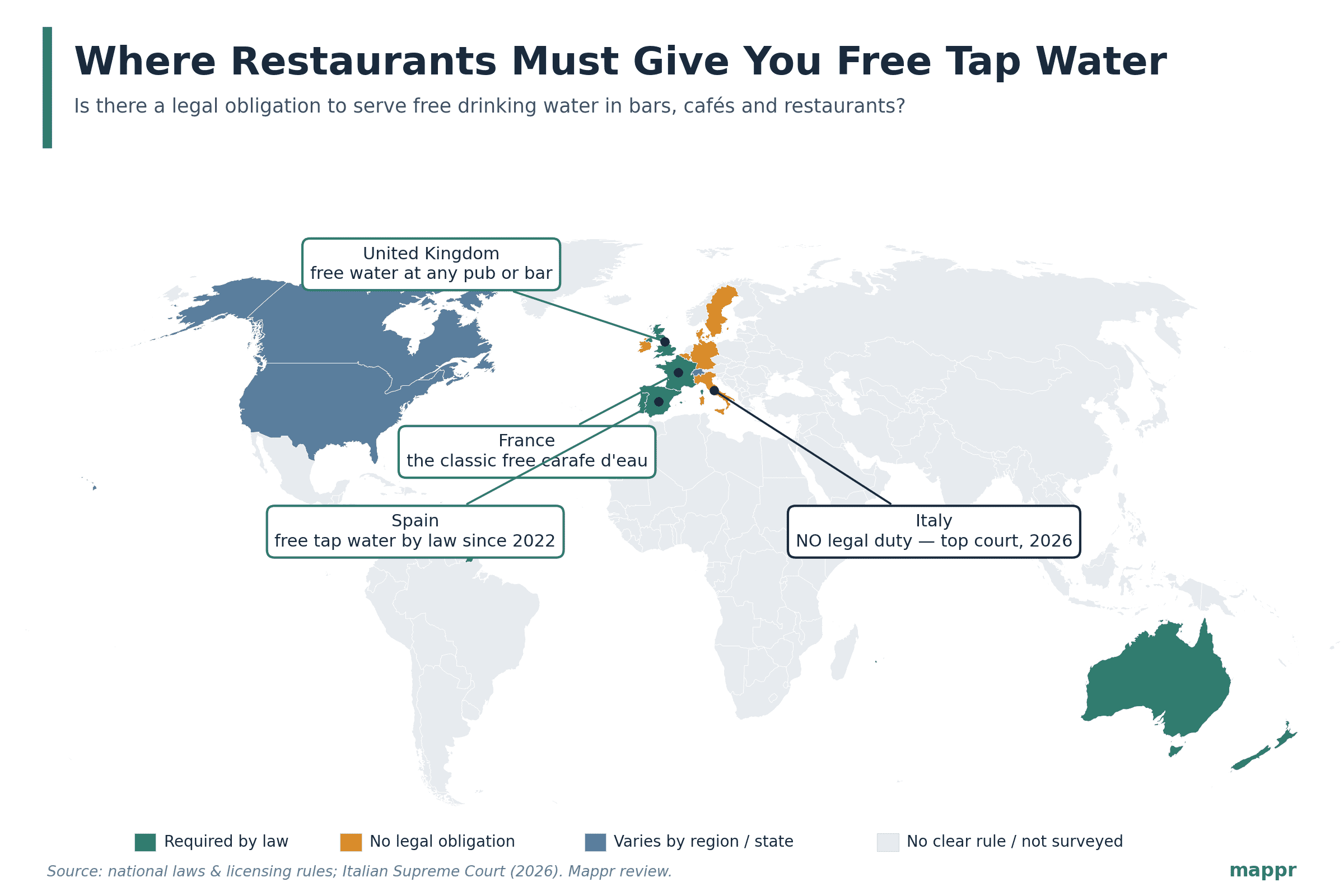
A handful of countries have put the glass of water on a statutory footing. In France, restaurants and drinking establishments must indicate — on the menu or a notice — that customers can request free drinking water, and must provide it on demand. The traditional carafe d’eau served with a meal is the everyday expression of that rule.
Spain went further in 2022, when a national waste law made it compulsory for bars and restaurants to offer customers free tap water — a measure explicitly aimed at cutting single-use plastic bottles. Neighboring Portugal did much the same through its 2021 packaging law, which requires hospitality venues to keep a container of tap water and reusable cups available, free, for anyone using the establishment.
The United Kingdom ties the obligation to alcohol: any premises licensed to sell drink — pubs, bars, many cafés and restaurants — must provide free potable water on request as a mandatory condition of the licence. The same logic runs through Australia and New Zealand, where most states and territories require licensed venues to keep free drinking water available to patrons while they are serving.
Where There’s No Legal Obligation
Italy is now the highest-profile member of the no-obligation club, but it is far from alone. In Germany, there is no general legal mandate; ordering plain tap water is uncommon enough that it can still draw a quizzical look from the waiter. Sweden and Denmark take a similar line — venues are free to charge for tap water, even if many serve it as a courtesy.
Belgium offers a cautionary tale for thirsty diners: regional politicians have repeatedly promised a free-water rule, but it was never actually implemented, leaving the practice discretionary. Ireland, too, has no legal requirement, and its hospitality industry has pushed back against adopting a French-style mandate. In all of these places, a free glass of water is a matter of hospitality, not law.
Where It Depends: the US, Canada and Switzerland
Some countries can’t be colored in with a single brush. The United States has no national rule at all. Free ice water is a deeply ingrained restaurant custom, yet it rests on goodwill rather than statute — and during droughts the logic can even flip: California’s water-conservation rules have at times barred restaurants from serving water unless a customer specifically asks, on pain of fines.
Canada is similarly patchwork: some provinces are said to require free water where alcohol is served, while Québec imposes no such obligation. Switzerland splits along cantonal lines — Ticino requires a free glass of water with a main meal, but in much of the rest of the country you can expect tap water to land on the bill.
Why a Glass of Water Became a Legal Question
The divide is partly cultural and partly environmental. In much of central and northern Europe, bottled water is a normal part of the bill and charging for tap water raises no eyebrows. In Spain and Portugal, by contrast, lawmakers reframed free water as an environmental measure — the cheapest way to nudge diners off single-use plastic bottles. Italy’s court, meanwhile, treated it squarely as a commercial service the state shouldn’t force venues to give away.
For travelers, the practical takeaway is simple: the price of a glass of water can change the moment you cross a border. When in doubt, ask — and don’t assume the answer in Lisbon or London will hold in Milan or Munich. (Note that this map reflects nationwide rules and widely reported practice; obligations can vary by region, venue type and licence, and several countries have no clearly documented rule either way.)
Laws on free drinking water vary by country, region and licence type; this map reflects national rules and widely reported practice, with gaps where no clear obligation is documented.
Image Sources
- charlesdeluvio – via SampleShots / Unsplash
- Konrad Hofmann – via SampleShots / Unsplash