Key Takeaways
- Street View covers most of the world, but the gaps are the story. About 120 countries and territories have public street-level imagery. China has none (landmarks only), most of Central Asia and half of Africa are blank, and a handful of countries allow only fragments.
- Germany is the rich world's great exception, by choice. After a 2010 privacy revolt that blurred nearly 250,000 homes, Google froze German Street View for 13 years. The 2023 relaunch covers big cities, and the pre-blurred legacy imagery was simply deleted.
- A fresh German ruling just tightened the screws again. On September 24, 2026, the Frankfurt Regional Court ordered Google to stop publishing one homeowner's 3D aerial imagery on Earth and Maps without consent. Narrow, under appeal, but a signal.
- Three forces draw this map: privacy, sovereignty, economics. European privacy law trims what the cars may keep; China's surveying laws keep them out entirely; and where there's no ad market, the cars simply never came.
A court decision in Frankfurt put Google’s cameras back in the news this week: on September 24 (reported Monday), the Frankfurt Regional Court ruled that Google must stop publishing one homeowner’s 3D aerial imagery on Google Earth and Maps without consent, holding that worldwide publication of views into areas shielded from the street violates German personality rights. The ruling is narrow and under appeal. But it is also very German, and the perfect excuse to map a question we’ve never mapped: where can Google’s street-level cameras actually go?
The Map: Coverage and Its Limits
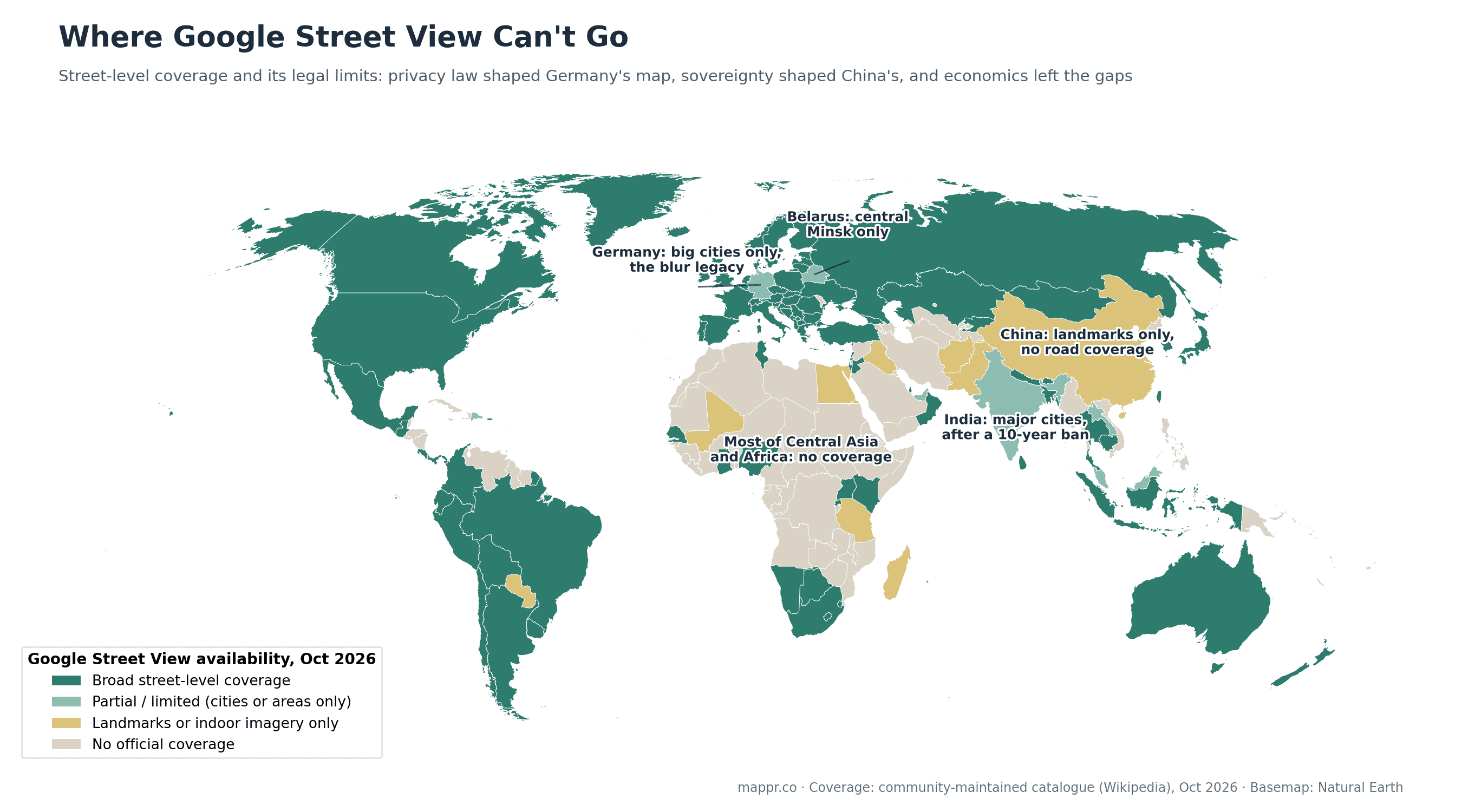
The Americas, Europe, Japan, Southeast Asia and Oceania are solidly covered; about 120 countries and territories have public street-level imagery. The interesting colors are the other three: the partial club (Germany’s big-cities-only coverage, India’s metros, Belarus’s central Minsk), the landmarks-only tier (China, Egypt’s pyramids, Mongolia, a scattering of African states where Google photographed monuments but never streets), and the blanks: most of Central Asia, roughly half of Africa, and closed states like North Korea and Turkmenistan.
The German Exception
No wealthy country has fought the camera cars like Germany. When Street View launched there in 2010, a privacy backlash unprecedented anywhere forced Google to offer pre-launch opt-outs: nearly 250,000 households demanded their homes blurred, politicians threatened legislation, and Google responded by simply freezing German Street View for 13 years: twenty cities, aging 2008-era imagery, famous blur-ghost facades. Only in July 2023 did the cars return, with fresh imagery of the largest cities (and the old blur requests wiped along with the old photos; objectors had to opt out anew). The new Frankfurt 3D ruling extends the same instinct upward, from the street to the oblique aerial view: German law keeps treating the home’s image as part of the person.
Sovereignty and the China-Shaped Hole
China is the largest economy with zero street coverage, and it is not about privacy: foreign companies cannot legally conduct the geographic surveying that camera cars amount to, so Google’s imagery stops at museum interiors and a few tourist sites, while domestic rivals (Baidu Total View, Tencent) photograph Chinese streets freely. India ran a decade-long version of the same story: security objections halted Google’s cars in Bangalore in 2011, and only a 2022 rules change (local partners must own the data) let Street View return to its major cities. South Korea long restricted exportable mapping data on similar grounds.
And Where It Simply Never Came
The beige expanse across Africa and Central Asia is neither law nor rebellion: it is a business decision. Camera cars follow ad markets and tourism revenue. The result is a familiar digital-divide map: the same countries missing from Street View tend to sit low on connectivity maps, and their absence has consequences, from missing training data (one reason AI models mangle African geography) to the quiet editorial power of whose streets are browsable and whose are not.
The notable cases
Street View's famous fights and gaps
The countries where coverage was shaped by law, security or protest rather than logistics.
| Country | Status | The story |
|---|---|---|
| 🇩🇪 Germany | Partial | 2010 blur revolt (≈250k homes) froze coverage for 13 years; 2023 big-city relaunch; 2026 Frankfurt 3D-imagery ruling |
| 🇨🇳 China | Landmarks only | Foreign surveying banned; domestic Baidu/Tencent cover streets instead |
| 🇮🇳 India | Major cities | Security halt 2011; returned 2022 under local-data-ownership rules |
| 🇦🇹 Austria | Full (late) | 2010 data-protection ban after Wi-Fi sniffing scandal; relaunched 2017-18 |
| 🇧🇾 Belarus | Central Minsk only | A few streets of the capital, nothing since |
| 🇰🇷 South Korea | Full | Allowed, but map-data export limits long constrained Google's base maps |
| 🇪🇬 Egypt | Landmarks only | The pyramids got the trekker; the streets never did |
| 🇰🇵 North Korea | None | No cars, no trekkers, no prospect |
Data and reporting for this article come from the following sources: