Key Takeaways
- 24/7 water is a minority privilege. In much of the rich world the tap simply always runs. For well over a billion people, piped water arrives only a few hours a day, on certain days, or whenever the utility can manage it.
- A stark global divide. Continuous supply is the norm across North America, Europe, the Gulf, Japan, Korea and Australia. Across most of South Asia, Sub-Saharan Africa, the Middle East and much of Latin America, intermittent supply is normal.
- Where the tank lives on the roof. Intermittent supply forces households to store water — India's overhead tanks, Mexico's rooftop tinacos, Jordan's weekly fills. The storage tank is a workaround for a pipe that isn't always pressurised.
- This is about continuity, not cleanliness. Water can be perfectly safe to drink and still reach the tap only on Tuesdays and Fridays. The map measures when water flows, not whether it is potable.
- Intermittency is costly and risky. When pipes lose pressure, contaminants can be drawn in; households pay for tanks, pumps and bottled water; and the constant start-stop wears out the network itself.
Turn on a tap in London, Tokyo or Toronto and water comes out — always. It is so reliable that most people there never think about it. But for a huge share of humanity, that is not how water works. The pipe is there, the water is often perfectly safe, yet it only flows for a few hours a day, on certain days, or whenever the utility can manage the pressure. The gap between those two worlds — continuous, 24/7 supply versus intermittent supply — is one of the clearest dividing lines in global development, and you can read it from a single everyday object: the household water tank.
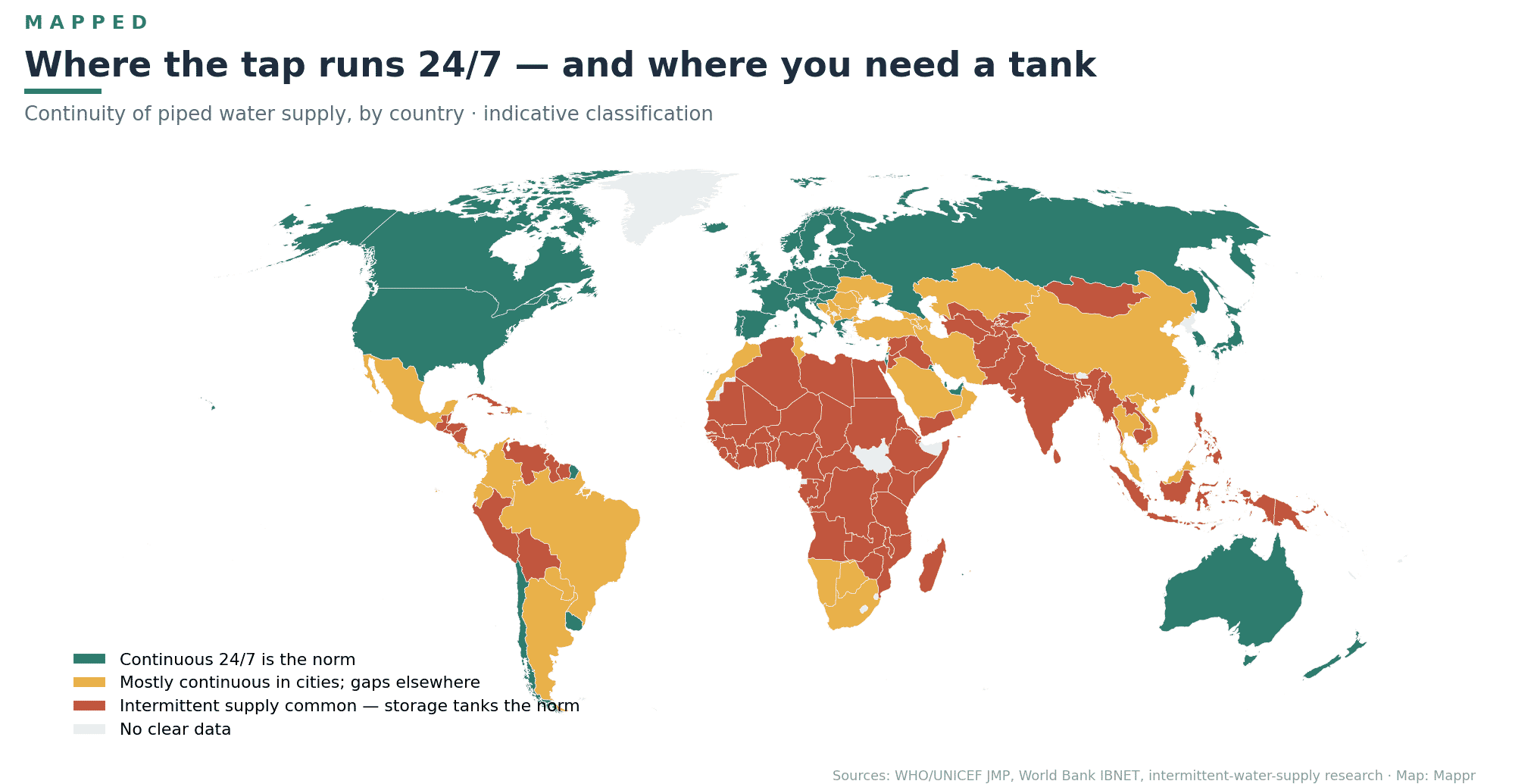
This map shows where piped water runs around the clock and where it does not — and, by extension, where you need a storage tank on the roof to get through an ordinary day. It is about continuity of supply, not drinking-water quality: a network can deliver clean water and still only switch it on twice a week.
What “continuous” water supply actually means
Engineers split piped water into two regimes. Continuous supply means the network stays pressurised around the clock: open a tap at 3am and water flows. Intermittent supply means the utility opens and closes the system on a schedule — a few hours each morning, a couple of days a week, or, in the worst cases, unpredictably. The WHO and UNICEF track this as whether water is “available when needed”; it is one of the conditions a supply must meet to count as safely managed, alongside being on-premises and free from contamination. There is no single global dataset that maps 24/7 service country by country, so the map above is an indicative synthesis of that availability data, World Bank utility benchmarking (IBNET) hours-of-supply figures, and the academic literature on intermittent water supply.
Where the tap runs 24/7
Continuous supply is overwhelmingly a feature of high-income systems with the money, engineering and regulation to keep the whole network pressurised: the United States and Canada, virtually all of Western and Northern Europe, Japan, South Korea, Taiwan, Singapore, Australia and New Zealand. The wealthy Gulf states — the United Arab Emirates, Qatar, Kuwait — run continuous supply too, even though they sit in one of the driest regions on Earth, because they can afford to desalinate at scale. In these countries a rooftop water tank is a curiosity, not a necessity.
Where you need a tank
Across most of the developing world, intermittent supply is simply normal — and households adapt by storing water whenever it flows. The shapes this takes are a kind of accidental cultural geography:
- India — among the most intermittent of all big economies. Most cities supply water for only a few hours a day, so nearly every building has an overhead tank filled by a pump from a ground-level sump.
- Mexico — the rooftop tinaco and an underground cisterna are standard household kit; supply varies street by street and can stop for days.
- Jordan — one of the most water-scarce countries on the planet, where many homes receive piped water only about once or twice a week and rooftop tanks are essential, not optional.
- Brazil — the rooftop caixa d’água is near-universal, even in cities where supply is fairly reliable.
- Sub-Saharan Africa — from Lagos to Nairobi to Kathmandu, public supply is often minimal or sporadic, pushing households onto tanks, boreholes and water vendors.
Why so much of the world is intermittent
Intermittency is rarely a simple matter of not having enough water. It usually comes from a tangle of causes: genuine water scarcity in dry regions; decades of under-investment in pipes and treatment; enormous non-revenue water losses (leakage and theft that can swallow a third or more of what is produced); cities growing far faster than their networks; and utilities too cash-strapped to run pumps continuously. Worse, intermittency becomes self-reinforcing — once a system is run intermittently, pressure surges and air pockets crack pipes and pull in dirt, which raises losses and makes continuous service even harder to reach.
Why it matters
Intermittent supply is not just an inconvenience. Every time a pipe depressurises, contaminated groundwater can be sucked in through cracks and joints, so even treated water can arrive dirty — one reason intermittency is linked to waterborne disease. It is also expensive and unequal: households that can afford tanks, pumps, filters and bottled water cope, while the poorest queue at standpipes or buy from tankers at many times the utility price. Moving a city from intermittent to continuous supply is one of the highest-impact upgrades in public health — and, as this map shows, it is a line most of the world has yet to cross.
This is an indicative classification: no single global dataset maps 24/7 piped supply country by country, so the map synthesises water-availability data, utility hours-of-supply benchmarking and the academic literature on intermittent supply. Figures may be revised as better data emerges.
Data & research:
- WHO / UNICEF Joint Monitoring Programme (JMP) – “Available when needed” — the availability condition for safely managed drinking water.
- World Bank — IBNET water utility benchmarking – Hours-of-supply and continuity-of-service indicators for water utilities.
- Intermittent Water Supply research literature – Reviews of the causes, prevalence and health effects of intermittent piped supply.
Image Sources:
- Map by Mappr – A Mappr original built from the sources above and Natural Earth boundaries.