Key Takeaways
- True trick-or-treating is a four-country tradition. Only the US, Canada, Ireland and the UK have nationwide door-to-door Halloween. Everywhere else, October 31 is a party, a retail season, or a city thing.
- It started in Ireland, 2,000 years before the candy. Halloween descends from the Gaelic fire festival Samhain, carried to North America by Irish emigrants in the 1800s and re-exported to the world as pop culture.
- The surprise heavyweight is Colombia. Latin America's biggest October 31: children's costume parties are a near-universal urban tradition, bigger than in much of Europe.
- A few places still say no, and one famously flipped. Iran restricts it, Malaysia's religious authorities discourage it, Russia's institutions frown on it. Saudi Arabia went the other way: from banned to state-sponsored spooky season.
Nine days to October 31. Costumes are sold on every continent, but who actually celebrates Halloween? The honest answer is a gradient, from countries where skipping trick-or-treat would disappoint an entire street, to countries where the whole thing happens inside a shopping mall, to a few where the authorities would rather it didn’t happen at all.
The Map: a Holiday in Five Tiers
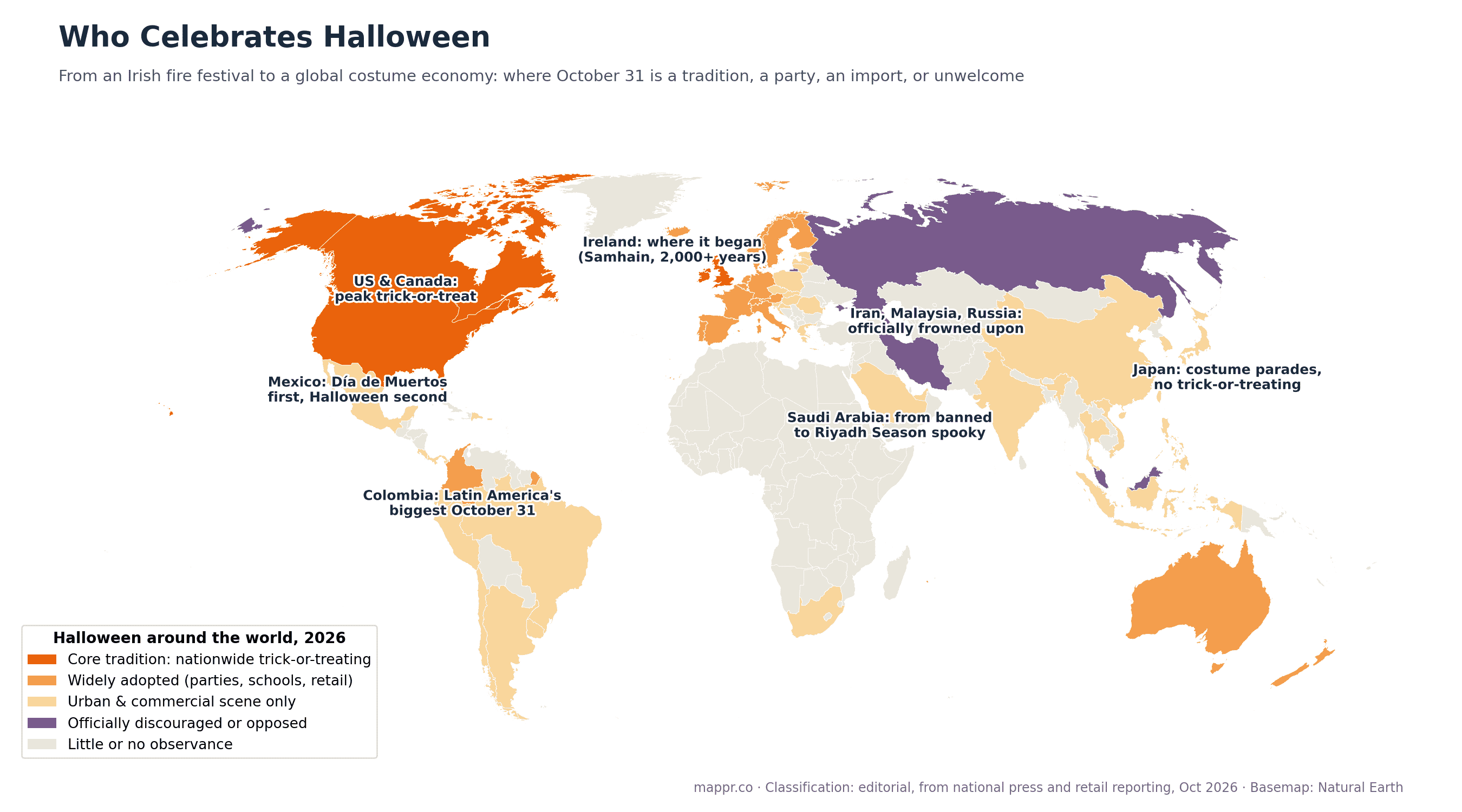
The deep-orange core is small: the United States, Canada, Ireland and the United Kingdom, the only places where residential trick-or-treating is a true nationwide institution. Around it, a broad adopted belt: Australia and New Zealand (street by street), most of Western and Northern Europe (parties, school events and serious retail, with less door-knocking), and Colombia, Latin America’s genuine October 31 stronghold. The pale tier is the urban-commercial scene: Japan’s costume parades, Seoul’s nightlife, mall Halloween from Manila to Mexico City to São Paulo, a party for adults and retailers more than a children’s ritual.
From Samhain to Suburbia
Halloween’s pedigree is older than almost any national holiday on this map: the Gaelic festival of Samhain marked summer’s end over two millennia ago, when the boundary to the otherworld thinned and bonfires and disguises kept the spirits confused. Christianity overlaid All Hallows’ Eve on the same night; Irish and Scottish emigrants carried the customs to North America in the 19th century, where they fused with candy capitalism into the holiday the world now imports back. Ireland still celebrates hardest at home: Púca Festival and Derry’s Halloween festival (Europe’s largest) claim the origin story explicitly.
Where It’s Frowned Upon, and the Country That Flipped
The purple tier needs precision, because “banned” is usually an overstatement. Iran restricts public and school celebrations as Western cultural imports. Malaysia’s National Fatwa Council has ruled against Muslim participation, institutional discouragement rather than street-level prohibition. Russia’s Orthodox Church and many school authorities condemn it as occult, with local bans but no national law. The most interesting case moved the other way: Saudi Arabia, where Halloween was long effectively prohibited, now hosts costume and horror events inside the state-run Riyadh Season, imported spookiness, on the government’s terms.
The Other Festivals of the Dead
Much of the world doesn’t need Halloween: it already has an older appointment with its dead, and in most of these countries the local festival outranks October 31 completely.
The alternatives
Festivals of the dead around the world
Where another tradition, not Halloween, is the real event.
| Country | Festival | When | What happens |
|---|---|---|---|
| 🇲🇽 Mexico | Día de Muertos | Nov 1–2 | Ofrendas, marigolds, cemetery vigils; UNESCO-listed and emphatically not 'Mexican Halloween' |
| 🇬🇹 Guatemala | Día de Todos los Santos | Nov 1 | Giant kites flown over cemeteries in Sumpango and Santiago Sacatepéquez |
| 🇵🇭 Philippines | Undas | Nov 1–2 | Families camp at graves; more central than the mall Halloween beside it |
| 🇭🇹 Haiti | Fèt Gede | early Nov | Vodou festival of the ancestors in purple and black |
| 🇵🇱 Poland | All Saints / Zaduszki | Nov 1–2 | Candlelit cemeteries nationwide; Halloween stays a contested import |
| 🇯🇵 Japan | Obon | Jul/Aug | Ancestral homecoming festival; Halloween is a separate costume-party economy |
| 🇨🇳 China | Ghost Festival | 7th lunar month | Offerings for wandering spirits; Qingming in spring tends the graves |
| 🇰🇭 Cambodia | Pchum Ben | Sep/Oct | Fifteen days of offerings to seven generations of ancestors |
Seen from this table, Halloween’s global spread looks less like a conquest and more like a convergence: nearly every culture already set aside days for the dead. The Irish version just happens to come with better marketing, and candy.
Data and reporting for this article come from the following sources: