Key Takeaways
- Both of the Middle East's maritime chokepoints are under attack at once. Twelve commercial vessels were attacked near the Strait of Hormuz between October 5 and 11, with three sinking, while Houthi forces strike shipping near the Bab al-Mandab. UKMTO rates the Hormuz threat SEVERE.
- Riyadh's main airport was hit; Saudi authorities count 17 dead in the week's attacks. Houthi missile and drone attacks on Riyadh October 7-11 killed 17 and injured over 330 by official count; King Khalid International closed October 10 and has only partly reopened.
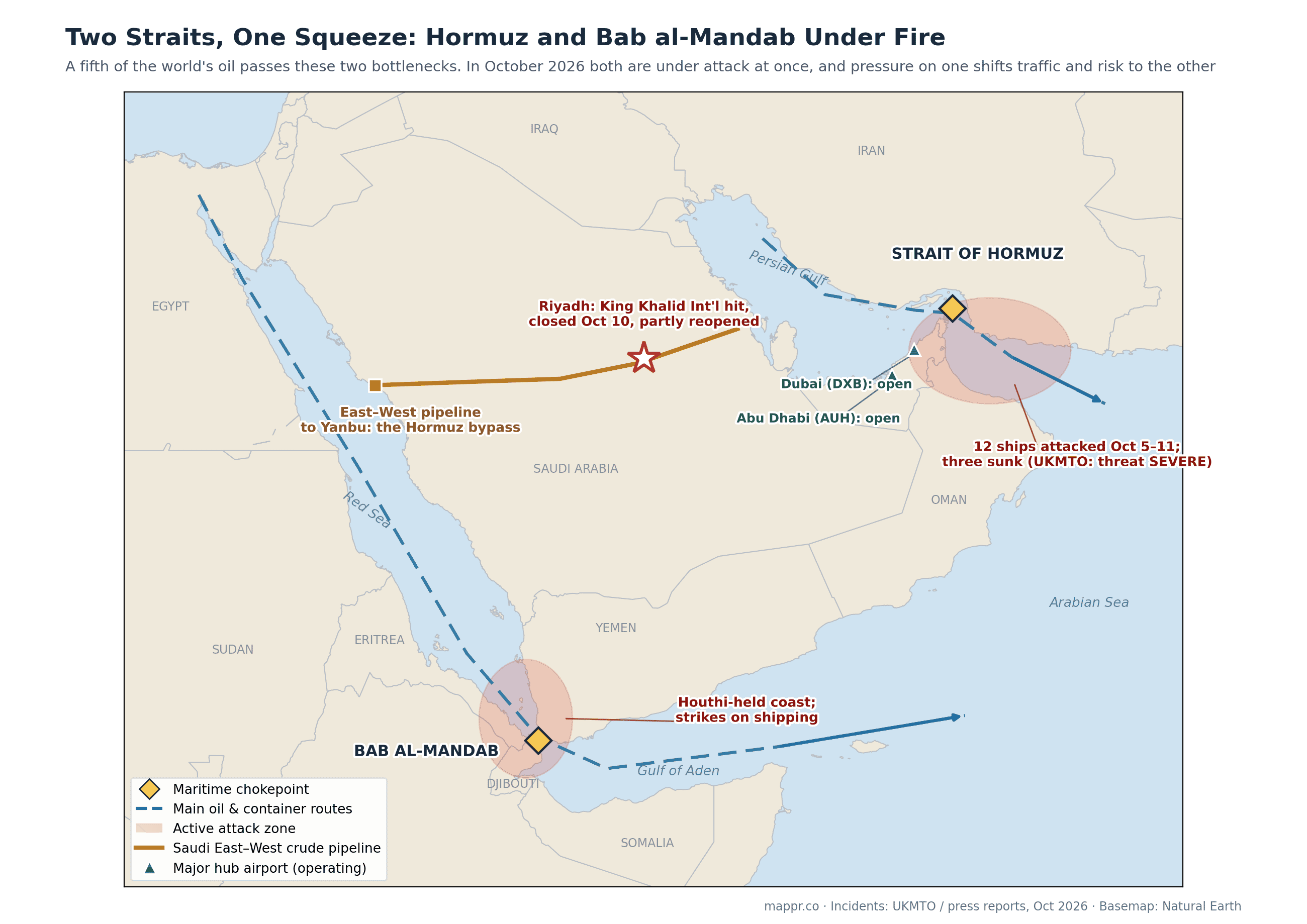
- The squeeze logic: pressure on one strait loads the other. Saudi crude can bypass Hormuz through the East-West pipeline to Yanbu on the Red Sea, but Yanbu's exit runs through Bab al-Mandab, which is also under fire. The two chokepoints are one system.
- Dubai and Abu Dhabi airports are open, with caveats. No attacks have hit UAE territory; DXB and AUH are operating per US embassy alerts. But the US advises Reconsider Travel (Level 3) for the UAE, some regional routes are cancelled, and airlines are routing around Iranian airspace.
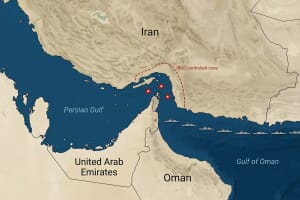
A fifth of the world’s oil and a major share of Asia-Europe container traffic pass through two narrow gates: the Strait of Hormuz (about 34 km wide at its narrowest) and the Bab al-Mandab (about 30 km). In October 2026, for the first time in the modern era, both are under sustained attack simultaneously: Iranian forces and their proxies against shipping around Hormuz, and Iran-backed Houthi forces from Yemen’s Red Sea coast, with missiles reaching as far as Riyadh’s main airport.
The Map: Two Straits, One System
Hormuz: Twelve Ships in Seven Days
Between October 5 and 11, UKMTO logged twelve attacks on commercial vessels in and around the strait, six of them on October 11 alone, and now rates the threat SEVERE. At least three ships have gone down: the GFS Pride (Iran claimed a mine; Singapore said a projectile, and US Central Command rejected the mine account), the Cape Dao, and a Singapore-flagged container ship struck off Ras Markbut, Oman on October 13, which sank the next day with all 21 crew rescued. Attribution for individual incidents remains contested; the pattern does not.
Riyadh: the War Reaches the Capital’s Airport
Houthi missile and drone attacks reached Riyadh repeatedly between October 7 and 11. Saudi figures put the toll at 17 dead and more than 330 injured across the week. King Khalid International (RUH) closed on October 10 and has reopened only partially; what exactly struck the airport grounds is disputed (the Houthis claim a ballistic-missile hit, Saudi reporting describes interception debris), but the operational result is not. More than a dozen daily connections from the Gulf hubs to Riyadh, Jeddah and Dammam have been cancelled or disrupted since.
Bab al-Mandab and the Pipeline Trap
At the other gate, Houthi forces hold stretches of Yemen’s Red Sea coast and continue striking shipping in the approaches. That matters doubly because the classic answer to a closed Hormuz, Saudi Arabia’s East-West pipeline (nominal capacity around 5 million barrels a day) to Yanbu, exits into the Red Sea, whose southern door is the Bab al-Mandab. The bypass for one chokepoint runs through the other. War-risk insurers already treat the Gulf, the Gulf of Oman and the southern Red Sea as elevated-risk waters, and every escalation at either strait reprices the whole system, a dynamic we covered when the Hormuz crisis began.
Are Dubai and Abu Dhabi Safe to Fly Through?
The question every connecting passenger is asking this week. The factual picture, as of October 22:
✅ No attacks on UAE territory. Nothing has struck Dubai, Abu Dhabi or any UAE infrastructure in this escalation; the shipping incidents nearby occurred off Oman and in the strait itself.
✈️ Both hubs are operating. US embassy security alerts (October 18) explicitly list Dubai (DXB) and Abu Dhabi (AUH) as operational. Emirates and Etihad are flying their long-haul networks; cancellations are concentrated on short regional routes (Bahrain, Kuwait, and Saudi cities including Riyadh).
⚠️ The advisories are cautious, not closed. The US State Department has the UAE at Level 3, Reconsider Travel (alert October 18, warning of possible short-notice airspace closures), while the UK’s FCDO (updated October 21) does not advise against travel but flags unpredictable conditions.
🧭 Routings are longer. Airlines are avoiding Iranian airspace where necessary, adding time to Europe-Asia connections.
Practical translation: transiting DXB or AUH remains viable and is not being treated as unsafe by regulators, but build in buffer time, keep airline notifications on, avoid short connections onto Saudi or Gulf-regional sectors, and recheck advisories the day you fly. Conditions in this region have changed on hours’ notice all month.
We will update this page as the situation at either strait changes materially.
Data and reporting for this article come from the following sources: