Key Takeaways
- Australia went first, and hard. In December 2025 Australia became the first country to enforce a nationwide, no-loopholes ban blocking under-16s from major platforms including Instagram, TikTok, YouTube, Facebook, X and Snapchat. Fines for non-compliant platforms were doubled in 2026 to A$99 million per breach.
- France is the first EU country to pass a ban. On 21 July 2026 France's parliament passed an under-15 social-media ban, effective from the September 2026 school year and enforced by Arcom. Four countries already enforce bans (Australia, Indonesia, Brazil and Malaysia); the UK, Greece and the UAE have also passed laws that take effect by 2027.
- The debate has shifted from whether to how. Denmark plans to lean on its national digital-ID system. The UAE will require photo ID at account creation. Australia is testing facial-age-estimation. All approaches raise the same question: how do you verify age at scale without turning the whole internet into an ID checkpoint?
- The United States is a patchwork, not a policy. There is no federal ban. Around a dozen states have passed their own age-verification or parental-consent laws, but many have been blocked or narrowed by courts on First Amendment grounds. That leaves the US off this map, even though the pressure is real.
- The health case is the driver. The WHO, national health agencies and reviews of adolescent mental health data have converged on heavy social-media use as a plausible driver of the rise in youth anxiety and depression since 2012. That evidence, plus the Jonathan Haidt-led public debate, is the political fuel behind almost every one of these laws.
Something has broken loose. In late 2025 Australia became the first country to enforce a nationwide social media ban for under-16s. Since then, the trickle of copycat legislation has become a flood, and on 21 July 2026 it reached a milestone: France became the first European Union country to pass such a law, setting the cut-off at 15. By late July 2026, four countries have bans in force, four more (France among them) have passed laws that take effect between September 2026 and 2027, and at least five others are actively drafting their own. This is what the front of that wave looks like, mapped.
The Map: Who Has Banned What
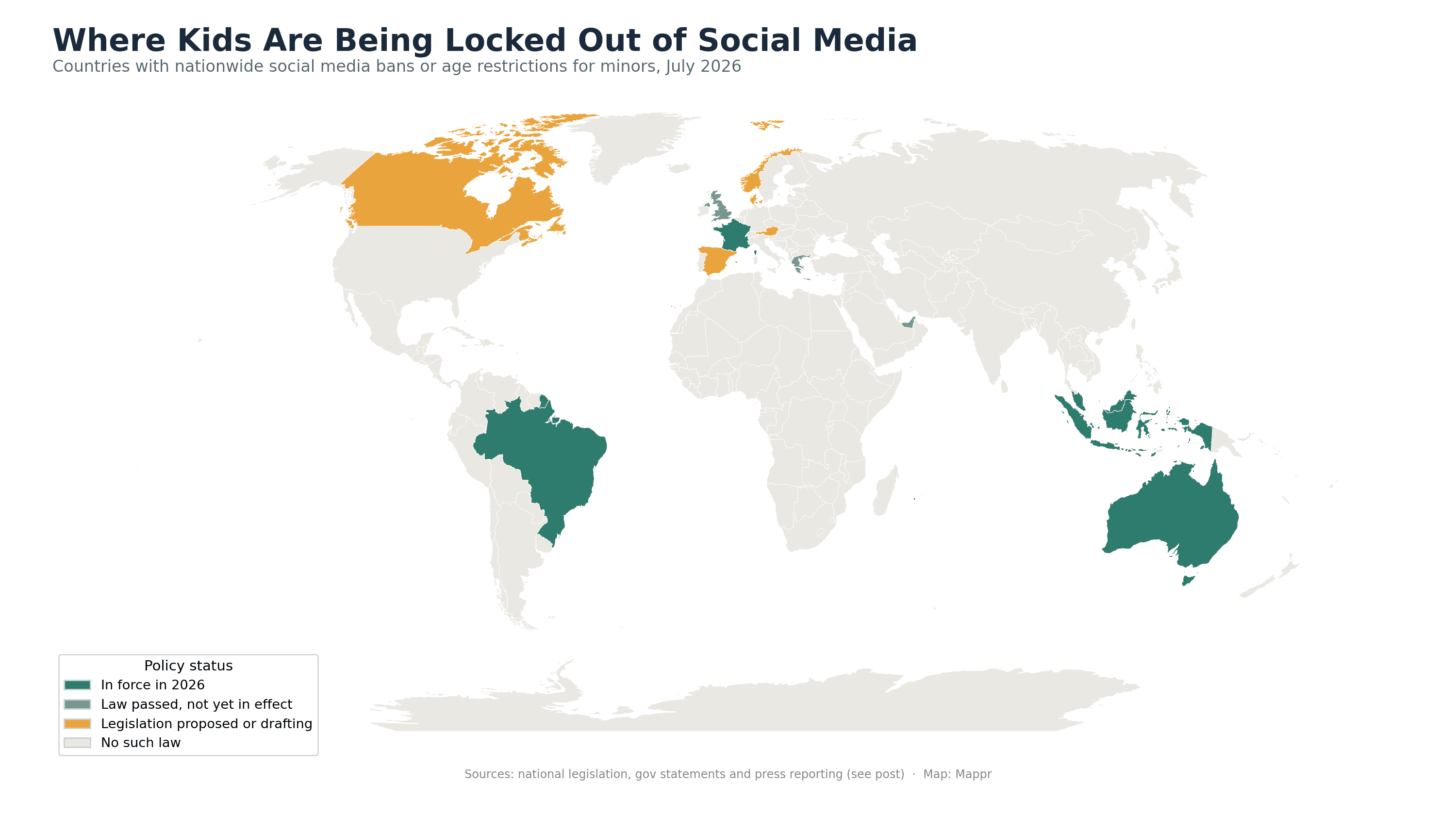
The pattern is unusual: this is one of the very few contemporary policy waves where Australia moved first, Europe followed and the United States sits out entirely. The gap in North America is not lack of interest but the First Amendment: state-level laws in Utah, Ohio, California and elsewhere have repeatedly been blocked or narrowed by courts. Elsewhere, the picture divides cleanly into three tiers: laws already in force, laws passed but not yet effective, and legislation still being drafted.
Every Country’s Position, at a Glance
| Country | Age cut-off | Status (July 2026) | Key detail |
|---|---|---|---|
| Australia | Under 16 | In force since Dec 2025 | First nationwide ban. Fines doubled to A$99 million in 2026. Facial-age-estimation trials. |
| France | Under 15 | Passed 21 Jul 2026; in force Sep 2026 | First EU country to pass a ban. Enforced by Arcom; also bans social-media ads aimed at under-15s. Age-verification method still to be set. |
| Indonesia | Under 16 | In force (2026) | Enforcement on “high-risk” platforms including TikTok, Instagram, Facebook and Roblox. |
| Brazil | Under 16 | In force since Mar 2026 (ECA Digital) | Requires linking accounts to a guardian; bans infinite-scroll for minors. Enforced by ANPD. |
| Malaysia | Under 16 | In force since Jun 2026 | Announced by the Communications Minister; platforms must age-verify. |
| United Kingdom | Under 16 | Law passed; live by spring 2027 | Built on Online Safety Act. Age verification via mobile OS mandatory. |
| Greece | Under 15 | Law passed; live 1 Jan 2027 | To be enforced via a state-issued app. |
| United Arab Emirates | Under 15 | Law passed; live mid-2027 | First Arab country to legislate. 15-16 year-olds face restricted, parent-controlled use. |
| Canada | Under 16 | Digital safety bill proposed | Framed under a broader Online Harms package. |
| Denmark | Under 15 | Political agreement reached | Will use the national MitID digital-ID system to verify age. |
| Austria | Under 14 | Drafting legislation | Lowest cut-off age currently being drafted anywhere. |
| Norway | Under 16 | Legislation proposed | Gov aiming for a hard ban rather than parental-consent workaround. |
| Spain | Under 16 | Legislation proposed | Would raise national digital-consent age from 14 to 16. |
The Playbook
Australia: the template
Australia’s law, in force since December 2025 and toughened again in 2026, bars under-16s from creating accounts on Instagram, TikTok, YouTube, Facebook, X, Snapchat and similar platforms. Enforcement sits on the platforms rather than the parents: an under-age account discovered by regulators triggers a fine of up to A$99 million per breach, doubled from the original A$49.5 million after complaints that penalties were too easy to write off. Facial-age-estimation trials, run by the eSafety Commissioner, are the leading technical mechanism, controversial, and closely watched by every other government drafting the same law.
France and Greece: the European model
France’s parliament passed its national ban on 21 July 2026, with both the Assemblée Nationale and the Sénat voting it through and President Macron set to sign it into law. That makes France the first EU member state to legislate a social-media age limit, setting the cut-off at 15 from the start of the September 2026 school year. The law is broad and does not name specific platforms; it will be enforced by Arcom, the French audiovisual and digital regulator, which still has to define how ages are verified. The text goes further than most, banning advertising that promotes social media to under-15s and requiring platform ads to carry the warning “Dangerous products for children under 15.” Greece has legislated the same age with a similar structure, effective January 2027, and plans to use a state-issued verification app. Both fit within the EU’s Digital Services Act framework, which already requires large platforms to keep minors off addictive features and adtech; national laws are the next layer up.
The UK: mobile OS as the gatekeeper
Britain’s ban, passed in 2026 and due to take effect by spring 2027, is different in one important respect: age verification will run through the mobile operating system rather than each individual app. Apple and Google would be required to enforce a device-level age check that then flows to platforms downstream, a design that shifts most of the compliance burden onto two companies.
Brazil and Indonesia: the emerging-market versions
Brazil’s ECA Digital, in force since March 2026, does not simply block accounts. It requires minors under 16 to link accounts to a guardian and specifically bans features like infinite scroll and autoplay for younger users, treating the platform design itself as the problem. Indonesia has taken a more platform-by-platform approach, deactivating minor accounts on a designated list of “high-risk” services including TikTok, Instagram, Facebook and Roblox.
Denmark and the UAE: the ID-first approach
Denmark’s proposal will lean on MitID, the national digital-ID everyone already uses to file taxes and log into their bank, an approach with the technical infrastructure but the obvious privacy concerns. The UAE will use its national ID system at account creation, and its 15-16 year-olds will face a parent-controlled account rather than a full block.
Why Now
The health case is the political driver. Over the past three years, national health agencies (the WHO, the US Surgeon General’s advisory of 2023, the UK’s DHSC and others) have converged on the finding that heavy adolescent social-media use is a plausible driver of the sharp rise in youth anxiety, depression and self-harm since 2012. The academic evidence is contested at the margins, but the political consensus has hardened: waiting for perfect proof looks less attractive when the trend line keeps going the wrong way.
Whether these laws will actually work is the next question. Age verification is technically hard at internet scale, VPN workarounds are trivial for a determined 14-year-old, and platforms have shown themselves willing to design around every restriction they have ever faced. But even skeptics concede that the political calculus has flipped: for the first time, the burden of proof has moved from parents to platforms, and from national governments to the countries that have not yet legislated. Expect this map to look very different in a year.
Sources: