Key Takeaways
- Norway tops the world at 91.73. Five of the top six countries are Nordic. The Social Progress Imperative ranks 171 countries on 57 social and environmental outcome indicators — Norway leads, with Denmark, Finland, Sweden and Iceland all in the top six alongside Switzerland.
- Global stagnation since 2021. After a decade of steady gains, the world's average SPI score has been flat or falling since 2021 — driven by deteriorating Rights & Voice, Safety, Environmental Quality and Health. Nearly a third of the 171 countries declined in the last year alone.
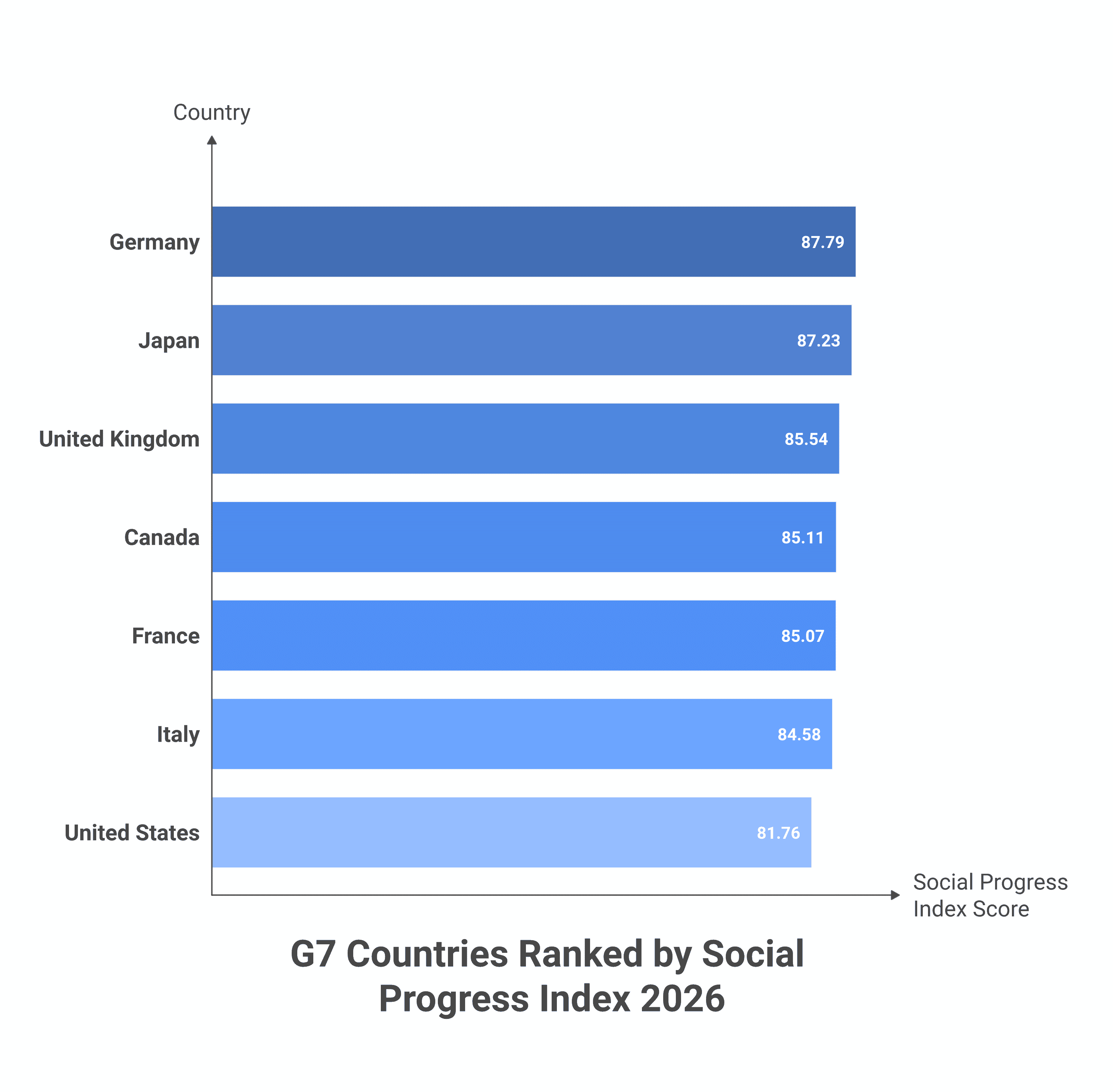
- The United States falls to 32nd. The US is one of only eight countries to record a NET DECLINE on the Social Progress Index since 2011 (-2.41 points). It now ranks behind Poland and Lithuania, and is the lowest-ranked G7 country by a wide margin.
- China stalls, India slows. China's social progress has stagnated since 2021 (+0.6 points over four years), with declines on Safety, Basic Education, Health and Freedom & Choice. India has added just 1.53 points in the same period, with gains in education and health offset by losses on Rights and Environmental Quality.
- The EU has overtaken the US. The European Union surpassed the United States on Social Progress in 2019 and is now three points ahead. Germany (87.79, rank 11) leads the G7. Newer EU members Slovenia (16th) and Estonia (17th) have entered the top tier.
The world has stopped getting better. That’s the headline of the 2026 Global Social Progress Index, published in January 2026 by the Washington-based Social Progress Imperative. After a decade of slow but steady gains, the world’s average score has been flat since 2021 — and nearly a third of the 171 countries ranked declined on social progress in the last year alone.
The Social Progress Index is a 100-point composite built from 57 outcome indicators across three dimensions — Basic Needs (nutrition, water, housing, safety), Foundations of Wellbeing (basic education, information, health, environmental quality) and Opportunity (rights, freedom, inclusion, advanced education). It explicitly excludes economic indicators like GDP, asking instead the more direct question: how well are countries converting their resources into outcomes people actually live? In 2026, the answer for much of the world is: not as well as a decade ago.
Norway, Then a Nordic Bloc
Norway tops the ranking for another year at 91.73 points. Five of the top six countries — Norway, Denmark, Finland, Sweden and Iceland — are Nordic, joined in that elite group by Switzerland. The top tier of the Index runs to about twenty countries: Western Europe almost in full, Japan (14th) and Singapore (15th) as the only Asian entrants, and Ireland (8th) as the highest-ranked English-speaking country, ahead of Australia (13th) and the United Kingdom (18th).
Slovenia (16th) and Estonia (17th) are perhaps the most striking entries — both newer EU members that have moved into the top tier on social progress despite GDP per capita well below the long-established Western European cluster. Both stand as evidence for the report’s central argument: economic growth helps, but it doesn’t determine outcomes. Some countries convert wealth into well-being far more efficiently than others.
The Global Stagnation
From 2011 to 2020, the world’s population-weighted Social Progress Index score climbed steadily — from 58.86 to 63.33. Since then, the line is essentially flat. The 2025 figure of 63.75 represents just 0.42 points of gain in five years, against a long-run average of close to 0.5 points per year.
The slowdown isn’t uniform across the components. Information and Communications, Housing, Advanced Education and Water and Sanitation are still rising — though more slowly than before. But Safety, Environmental Quality and Health all score lower now than they did in 2021. And the biggest single drag is Rights and Voice, which has fallen 6 points since 2011 and a further 1.9 points since 2021. Press freedom has slid across nearly every region. Academic freedom is down. Acceptance of gays and lesbians has declined for the first time across all regions tracked.
The Social Progress Imperative’s CEO Michael Green pins much of this on the global drift toward populist and authoritarian politics. The Index identifies Nicaragua, El Salvador, Hungary, Turkey, India and Russia as among the countries showing the sharpest declines in Rights and Voice — all governed for at least part of the period by leaders who have visibly narrowed civic space. Brazil is offered as a counter-example: it recovered into the second tier after the end of the Bolsonaro government, and is now the leading BRICS country on the Index. Poland, post-Law and Justice, has overtaken the United States for the first time.
The United States Falls to 32nd
The starkest country-level finding in the 2026 report is the United States. American GDP per capita is the 7th highest in the world. American social progress is 32nd, behind Poland and Lithuania. Since 2011, the US has fallen 12 places in the global ranking and is one of only eight countries — alongside Venezuela, Syria, Afghanistan, Lebanon, the Central African Republic, South Sudan and Canada — to record a net decline on the Index across the 15-year measurement period.
The US score has fallen on 9 of the 12 components since 2011. The biggest single drop is on Rights and Voice (-9.57 points), with substantial declines also on Inclusive Society and Health. The European Union overtook the United States on Social Progress in 2019 and is now three points ahead. The UK and Canada, the report notes, are also among the world’s 10 least-improved countries — though they remain well above the US in absolute terms.
Who’s Catching Up — and Who Isn’t
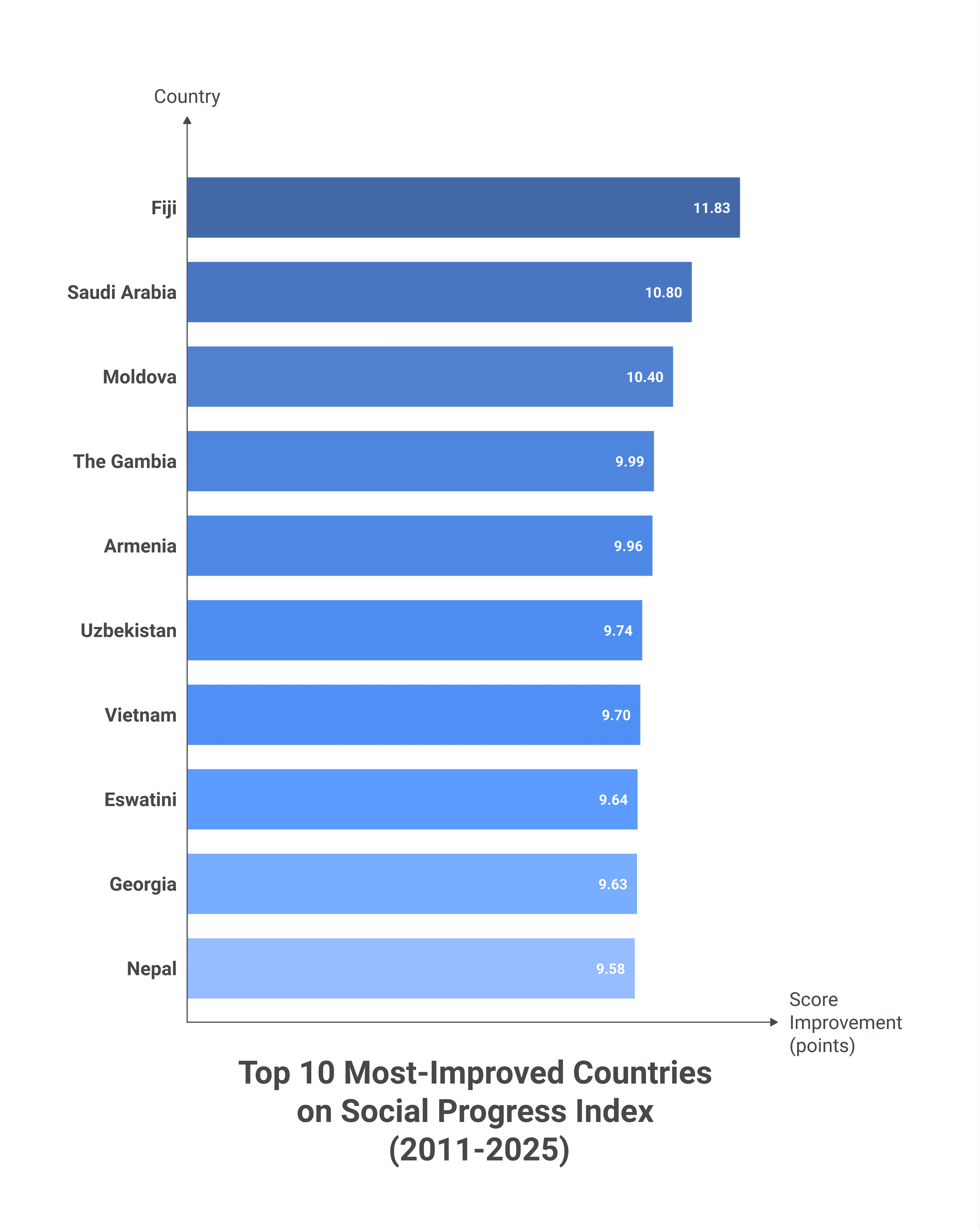
The 15-year view reveals which countries have made the biggest gains in social progress regardless of where they started. Fiji tops the list with a +11.83-point gain since 2011, driven mostly by improvements in Information and Communications, Advanced Education and Inclusive Society. Saudi Arabia (+10.80) and Moldova (+10.40) come next. The full top 10 of most-improved countries is geographically diverse — three Central Asian states (Uzbekistan, Armenia, Georgia), Southeast Asia’s Vietnam, two African countries (Gambia, Eswatini), and Nepal in South Asia.
The bottom of the change ranking is dominated by countries in state collapse or sanctions: Venezuela has lost 4.72 points since 2011, Syria 4.25 points, Afghanistan 3.21 points. The United States (-2.41), Canada (-0.75), the Central African Republic, South Sudan and Lebanon also appear among the world’s 10 least-improved. The presence of two G7 economies in a list otherwise made up of conflict states is one of the report’s most pointed findings.
Regional Patterns
Latin America places its strongest country — Chile (36th) — just outside the top tier. Uruguay (37th), Costa Rica (39th), Argentina (42nd), Brazil (51st) and Panama (55th) round out the regional leaders. Chile and Costa Rica have long been the region’s quiet outperformers; Brazil’s recent jump into Tier 2 is the report’s most notable upward mover.
Africa is led by Mauritius (56th), the only Sub-Saharan country in the top half of the global ranking. South Africa sits at 91st, Nigeria at 137th and Ethiopia at 151st — the latter two reflecting both demographic pressure and recent setbacks on Rights and Safety. Central Asia and the Caucasus is the fastest-improving region since 2011 (Armenia, Georgia, Uzbekistan, Moldova all in the most-improved top 10), though it still has the lowest scores of any region on Rights and Voice.
Asia is the most internally divergent region. Japan and Singapore sit in the top tier; South Korea, Taiwan and Malaysia round out the top half. India (still rising slowly), China (stalled), Indonesia, Bangladesh and Vietnam are mid-table movers. Russia has fallen to 77th, behind both China (73rd) and Ukraine (65th), a striking inversion of the pre-invasion ranking.
Beyond GDP — and Why It Matters
The Social Progress Index makes the same argument every year: GDP is necessary but not sufficient. Two countries with identical per-capita output can produce dramatically different outcomes on health, safety, rights and the environment depending on policy choices. Latvia, with GDP per capita roughly half that of the United States, achieves similar social-progress outcomes. Denmark and the US sit at almost identical income levels, but Denmark scores almost 10 points higher on social progress.
For most of the post-Cold War era, the Index showed a tight coupling between income and social progress at the country level. Since 2021, that relationship has weakened. Economic growth has resumed in most of the world; social progress hasn’t followed. The 2026 report frames this as a turning point. Whether it’s a temporary plateau or the start of a sustained reversal is the question the next several years will answer.
Data and references underpinning this analysis.